
I get this question probably three times a week. Someone messages me, or a friend, or shows up to a free trial and says: “I don’t know how to pick a teacher. They all look the same on the website.”
Honestly? They’re not the same. Not even close.
A teacher who’s amazing for a 6-year-old learning the alphabet through songs is probably the wrong person to teach you formal Arabic for a diplomatic job. A teacher who can drill Tajweed rules for two hours straight might bore a beginner who just wants to order food in Cairo without embarrassing themselves. This isn’t about “good” or “bad” teachers. It’s about fit. And fit depends almost entirely on what you’re actually trying to do with the language.
So let’s go through this properly. No fluff, no “just trust your gut” nonsense. Real criteria you can actually use.
Why This Decision Matters More Than People Think
Here’s the thing people get wrong: they treat teacher selection like picking a Netflix show. Random click, hope for the best, cancel if it’s bad. But Arabic isn’t a two-hour commitment. It’s months, sometimes years, of weekly sessions. The wrong match doesn’t just waste time — it kills motivation. I’ve seen students quit Arabic entirely, convinced they’re “not good at languages,” when really they just had a teacher who taught grammar like a lecture and never let them speak.
And I’ve seen the opposite too. Someone who tried three different apps, felt stuck, then had one good session with the right teacher and suddenly things clicked. Same brain. Same person. Different teacher, different result.
If you’re serious about learning — whether that’s Modern Standard Arabic, Egyptian dialect, Quran, or Arabic for your job — the teacher matters more than the curriculum, more than the app, more than the textbook.
“Do I need a native speaker or just someone who’s fluent?”
This one comes up constantly, and I’ll be straight with you: native speaker status alone doesn’t make someone a good teacher.
Being born speaking a language and being able to teach it are two different skills. I know plenty of native Arabic speakers who couldn’t explain why a verb changes form if their life depended on it — they just know it “sounds right.” That’s fine for a conversation partner. It’s not enough for someone guiding you from zero to fluency.
What you actually want is a native speaker who’s also trained in teaching methodology — someone who understands grammar structure well enough to explain the why, not just correct the what. That combination is what you should be screening for, not just the passport.
Match the Teacher to Your Actual Goal

This is the part most people skip, and it’s the biggest mistake I see. They pick “a teacher,” not “a teacher for X.” Let’s break it down by goal.
If your goal is Modern Standard Arabic (MSA)
You need someone who teaches grammar in a structured, layered way — not someone who just chats with you and hopes vocabulary sticks. MSA has real rules: case endings, verb conjugation patterns, sentence structure that doesn’t map onto English at all. A good MSA teacher builds this in order, checks your understanding before moving on, and doesn’t rush you into reading news articles before you can handle a simple sentence. If reading, writing, or formal media Arabic is your target, this structured approach isn’t optional — it’s the whole game. You can see how a full Modern Standard Arabic course is usually structured before you commit to anyone.
If your goal is speaking Egyptian Arabic day to day
Different priority entirely. Grammar accuracy matters less here than fluency and confidence. You want a teacher who forces you to talk — a lot — from the first lesson, corrects you gently without interrupting your flow every ten seconds, and actually knows street Arabic, not just the textbook dialect. If your teacher can’t slip into casual, fast, real-life Egyptian speech, ask yourself how you’ll ever sound natural.
If your goal is Quran and Tajweed
This is its own category completely. You need Ijazah certification, not just “comfortable reading Arabic.” Tajweed has precise pronunciation rules, and a teacher without proper certification can — without meaning to — pass down small mistakes that are hard to unlearn later. If memorization (Hifz) is part of your goal, ask directly about their Hifz teaching experience, not just recitation skill. This deserves real scrutiny before you start; there’s a full breakdown in our Quran courses guide if you want to go deeper on what to look for.
If your goal is professional or diplomatic Arabic
You need a teacher who’s actually worked with business, media, or formal government-register Arabic — not someone teaching you the same content they’d give a tourist. Ask if they’ve taught professionals before. Ask for examples: business vocabulary, formal email writing, media analysis. If they can’t give you a concrete answer, that’s a signal.
If you’re finding a teacher for your child
Completely different skill set again. Patience, games, songs, short attention-span management — none of that shows up on a teaching résumé unless you ask about it directly. A teacher who’s excellent with adults can genuinely struggle with an 8-year-old, and vice versa. Ask specifically whether they specialize in kids, and how they keep young learners engaged for a full session.
“How do I actually test if a teacher is good before committing?”
This is the second most common question I get, usually from people who got burned once already. Here’s what actually works.
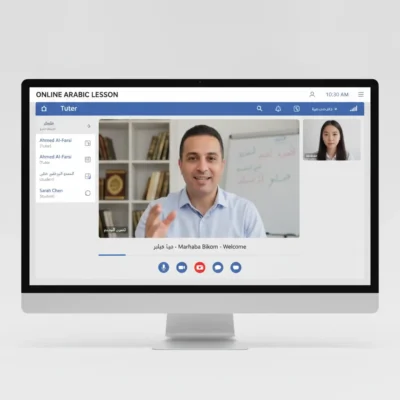
Take the free trial seriously. Don’t treat it as a formality. Use it to test three things: Can they explain a concept two different ways if the first explanation doesn’t land? Do they correct your mistakes without making you feel stupid? Do they actually listen to what you say you want, or do they just launch into their standard curriculum?
Ask about their teaching background, not just their degree. A university degree tells you they studied Arabic. It doesn’t tell you they can teach it. Ask how many years they’ve taught online specifically — teaching over Zoom is a different skill than teaching in a classroom.
Pay attention to how they handle silence and mistakes. If you freeze up or say something wrong, watch their reaction. Good teachers create space for you to think and try again. Bad ones jump in too fast or, worse, make you feel embarrassed for missing something.
Ask what a typical lesson plan looks like for someone with your exact goal. Vague answers (“we’ll just see how it goes”) are a red flag. A teacher who’s taught your specific goal before should be able to describe a rough roadmap on the spot.
If you’re not sure what level you’re even starting from, don’t guess — take a proper Arabic placement test first. It saves everyone time and stops you from getting matched with a teacher who’s pitched at the wrong level entirely.
Red Flags I’d Personally Walk Away From

I’ll be honest about this because nobody else will tell you straight.
- A teacher who talks more about themselves than they ask about you in the trial lesson.
- No clear answer when you ask about their specialization — everyone claims to teach “everything.”
- Pressure to commit to a long package before you’ve even had a real trial.
- A teaching style that’s 90% lecture, 10% you actually speaking.
- Zero materials or structure — just “conversation” with no plan behind it.
None of these are dealbreakers on their own necessarily, but two or three together? Move on.
Personality Fit Is Real, and It’s Not Superficial
I’ll say something that sounds obvious but people ignore it anyway: you have to actually enjoy the sessions, or you won’t show up consistently. Consistency is what builds fluency — not one brilliant lesson followed by three skipped ones. If a teacher’s energy drains you, or their pace feels wrong (too slow and you’re bored, too fast and you’re lost), that’s not you being difficult. That’s a mismatch, and it’s completely fine to ask for a different teacher.
This is also why sticking to a routine matters as much as the teacher you pick — the two work together. If you want a sense of what a sustainable weekly rhythm looks like once you’ve found the right fit, this beginner Arabic study routine breaks down what realistic consistency actually looks like for busy adults.
Male or Female Teacher — Does It Matter?
For some students, yes, and that’s a completely legitimate preference — not something to feel awkward about. Some people are more comfortable with a same-gender teacher for cultural or personal reasons, especially for younger students or for Quran study. Any academy worth using should let you specify this upfront without making it a whole conversation.
Does Price Tell You Anything About Quality?
Not really, and I say that as someone who works in this industry. A higher price doesn’t guarantee a better teacher, and a cheaper rate doesn’t mean lower quality — it often just reflects overhead, platform fees, or where the academy is based. What actually correlates with quality is the vetting process behind the teacher: background checks, credential verification, ongoing student ratings. Ask how an academy screens its teachers before you look at the number on the invoice. If you want to compare what different course structures actually include for the price, our Arabic course pricing page breaks it down by goal rather than just by hour.
Should You Try Multiple Teachers Before Settling?
If the platform lets you, yes — within reason. One trial lesson isn’t always enough to know for sure. But don’t turn this into an endless audition process either. Two, maybe three trials with teachers who specialize in your specific goal is plenty. After that, you’re not evaluating teachers anymore, you’re just delaying starting.
A Quick Checklist Before You Commit
- Does this teacher specialize in your specific goal (MSA, Egyptian, Quran, kids, professional)?
- Are they certified, not just a native speaker?
- Did the trial lesson feel structured, not just casual chat?
- Did they listen to your goal, or push their own agenda?
- Do you know your actual level, or are you guessing?
- Does their teaching pace match your energy and schedule?
- Is there a clear plan for what the next few months look like?
If you can answer yes to most of these, you’ve probably found the right fit. If you’re still unsure on more than one or two, that’s worth addressing before you sign up for a long package.
Final Thought
Picking an Arabic teacher isn’t a small decision you make once and forget about. It shapes whether you actually reach your goal or quietly give up in month two, blaming yourself instead of the mismatch. Take the trial lesson seriously. Ask direct questions. Match the teacher to what you actually want — not just “learn Arabic” in a vague sense, but your real, specific goal.
At Alphabet Arabic Academy, every teacher is matched to your goal after a proper level assessment, not assigned at random. If you want to see how that works and what it actually costs based on your goal, go ahead and تعرّف على المدرسين.