A private Arabic tutor is the fastest, most direct path to Arabic fluency — and the single most important decision you’ll make in your Arabic learning. The right tutor gives you personalized feedback, corrects your mistakes in real time, and builds lessons around your exact goals. The wrong one wastes months you’ll never get back. This guide shows you exactly how to find, evaluate, and get maximum value from the right private Arabic tutor for your level and goals.
Who Is This For?
Let’s be honest about who actually benefits from private tutoring — and who doesn’t.
This is for you if:
- You’re a complete beginner with no Arabic background and need a clear starting point
- You’ve tried apps and group classes but feel stuck, frustrated, or not progressing
- You want to learn Quranic Arabic, business Arabic, or Egyptian colloquial specifically
- You’re an English speaker who needs someone who can explain Arabic concepts in plain English
- You want results in months, not years
- You’re a parent looking for private instruction for your child with qualified, child-trained teachers
This is NOT for you if:
- You’re looking for a “magic shortcut” that requires zero consistent effort outside of class
- You only want to learn casual phrases for a two-week trip (an app is honestly fine for that)
- You’re not willing to spend at least 15–20 minutes practicing daily between sessions
Clear? Good. Let’s get into it.
Why a Private Arabic Tutor Changes Everything
Here’s the thing most language learners discover too late.
The difference between struggling through Arabic for two years and achieving real fluency in 8–12 months usually comes down to one factor: whether you had someone focused entirely on you.
Group classes teach everyone the same thing at the same pace. Apps give you pre-recorded content with zero feedback. Self-study has no one to tell you when you’re wrong.
Private tutoring solves all three problems at once.
The Four Core Advantages
Personalized attention. Your tutor focuses on your weak points. Struggling with pronunciation? You’ll work on it every session until it’s automatic. Grammar clicks but conversation doesn’t? Every lesson shifts toward speaking. This kind of targeted work is impossible in a group setting.
Flexible pacing. Fast learners don’t sit through repetition they don’t need. Slower learners get patience and extra practice without feeling rushed or embarrassed. Your pace becomes the actual pace of the class.
Immediate correction. Every mistake gets caught and fixed in real time. This prevents bad habits from cementing into your Arabic. And trust me — bad habits cemented in Arabic take twice as long to undo as they did to form.
Goal-aligned curriculum. Whether you need Quranic Arabic for prayer comprehension, business Arabic for Gulf meetings, or Egyptian dialect for everyday conversation — every lesson connects directly to that specific goal. Not a generic syllabus. Yours.
Native Arabic Tutors: Why “Native” Actually Matters
Not all Arabic teachers are created equal. And “native speaker” matters more in Arabic than it does in almost any other language.
Here’s why.
Arabic has sounds that simply don’t exist in English, French, German, or most European languages. The ح versus ه. The ع versus أ. The غ versus خ. These aren’t minor accent variations — mispronouncing them changes meanings entirely.
A non-native teacher who learned Arabic academically often makes the same substitution errors that their students make. They’ve learned to approximate the sounds. A native teacher is the standard — they produce every letter from its correct articulation point automatically, without thinking.
Beyond pronunciation, native tutors bring something textbooks can’t:
Natural rhythm and intonation. How a sentence flows. Where stress falls. How questions sound different from statements. These patterns are absorbed from a native teacher in a way that no recording or grammar explanation fully captures.
Cultural intelligence. When to use which register. What a phrase means in context versus literally. Why the same word can be warm or rude depending on tone. Language is inseparable from culture, and native teachers carry that culture in every lesson.
Real-world language. The shortcut expressions. The colloquialisms. The way people actually speak in Cairo, not the way a textbook says they should speak. This is what makes your Arabic sound natural rather than robotically correct.
Why Egyptian Arabic Specifically?
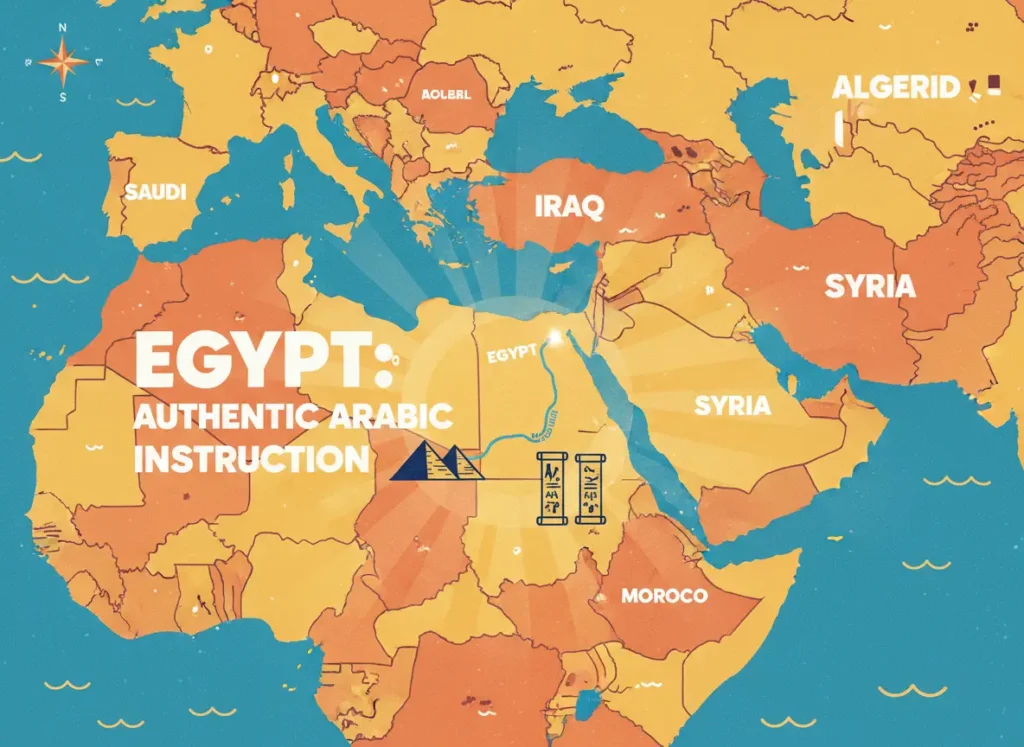
Egyptian Arabic is the most widely understood dialect across the Arab world — largely because of Egypt’s dominant role in Arab cinema, television, and music. Someone who speaks Egyptian Arabic can be understood from Morocco to the Gulf. Someone who speaks Gulf Arabic, Levantine Arabic, or North African Arabic will be less universally understood.
Egyptian Arabic also has relatively clear pronunciation compared to some other dialects, making it a strong choice for learners building both spoken fluency and formal Arabic foundations simultaneously.
At Alphabet Arabic Academy, every tutor is a native Arabic speaker from Egypt — many of them Al-Azhar University graduates, combining deep traditional scholarship with modern teaching methods.
Online vs. In-Person: The Honest Answer

I’ll be straight with you: for most people in 2026, online is the better option. Not “acceptable if you can’t do in-person.” Actually better.
Here’s why.
Access to the best teachers globally. If you live in rural Canada, suburban Australia, or anywhere that isn’t a major Arab city, finding a qualified, experienced, native-speaking private Arabic tutor locally is genuinely difficult. Online removes that constraint entirely. A student in London can learn from a certified Al-Azhar graduate in Cairo. A convert in rural America can work with a Tajweed specialist. Geography stops being a limitation.
No commute. That 1–2 hours round-trip per session adds up quickly. Online gives that time back.
Cost. Quality online tutoring typically costs 30–50% less than equivalent in-person lessons. At Alphabet Arabic Academy, private tutoring starts from $40 per session. Compare that to in-person private instruction in most Western cities.
Flexibility that makes consistency possible. You pick the time. Early morning after Fajr, late evening after the kids sleep, weekends — whatever actually fits your life. Consistency is everything in language learning, and flexibility is what makes consistency sustainable.
Session recording. With a tutor’s permission, you can record lessons. Replay a difficult grammar explanation. Practice a pronunciation point you heard the teacher demonstrate. This review layer dramatically accelerates retention.
When in-person makes sense. Some learners have specific tactile learning needs, significant technology discomfort, or genuinely want to build a local community through their Arabic study. For those learners, in-person is the right call. But it’s a minority.
Private Arabic Lessons for English Speakers: What Makes Them Different
This section is specifically for native English speakers starting Arabic from scratch. Because your starting point is actually somewhat specific — and a good tutor will account for it.
What English Speakers Struggle With (and Solutions)
The alphabet is genuinely new. English speakers have no prior exposure to Arabic script. No partial recognition from cognates. No related alphabet to fall back on. Everything is new. But — and this is important — the Arabic alphabet has only 28 letters, and with 15–20 minutes of daily focused practice, most English-speaking beginners can recognize all of them within 4–6 weeks. It feels overwhelming at the start. It genuinely isn’t.
Right-to-left reading direction. This feels disorienting for about a week. Then it becomes automatic. Your brain adapts faster than you expect.
Sounds that don’t exist in English. The ع, the ح, the غ, the خ — these require physical training, not just intellectual understanding. A native tutor demonstrates the correct mouth and throat position. You imitate and get corrected in real time. Apps can’t do this. Books can’t do this. Only a live human teacher can.
Grammar that works differently. Arabic verb roots, gender agreement, dual forms, broken plurals — these don’t map onto English grammar at all. But they’re logical. Arabic grammar follows clear rules with very few arbitrary exceptions. A good tutor explains these patterns in plain English until they click, then gradually shifts to using Arabic directly.
Choosing the right dialect and register. Should you learn Modern Standard Arabic (MSA), Egyptian colloquial, or both simultaneously? A private tutor who understands your specific goals helps you make this decision correctly from the start — rather than spending six months on MSA only to discover you needed spoken Egyptian Arabic for the job you’re aiming for.
The honest answer for most English-speaking beginners: start with MSA fundamentals (because they underpin everything), then add Egyptian colloquial once you have a solid reading and grammar foundation.
How to Find and Evaluate a Private Arabic Tutor
Choosing the right tutor is probably the most important decision in your entire Arabic learning journey. Here’s how to evaluate your options without getting burned.
The Key Factors
Native speaker. Non-negotiable for pronunciation development. A native Egyptian speaker brings authentic pronunciation, cultural context, and natural language patterns that no non-native teacher can fully replicate.
Teaching experience, not just Arabic knowledge. Speaking Arabic and teaching Arabic are completely different skills. Look for tutors with at least 2–3 years of experience specifically teaching non-native speakers. Ask directly: have you taught students at my level before? What are the most common challenges they face?
Qualifications. Arabic language degrees, teaching certifications, Al-Azhar or Islamic university credentials — these aren’t just resume decorations. They indicate structured linguistic knowledge and teaching methodology.
Specialization match. A brilliant Quranic Arabic specialist might not be the best fit if you need conversational Egyptian dialect for business. A dialect specialist might not have the classical Arabic grounding needed for Quranic study. Make sure the tutor’s specialization matches your goal.
Teaching style fit. Some tutors are highly structured and grammar-focused. Others are conversation-first and intuitive. Neither is universally better — but one is probably better for you. A trial lesson reveals this quickly.
Trial class availability. Any reputable tutor or academy offers a trial lesson. If they don’t — that’s information.
Questions to Ask Before Booking
Before committing to a package or subscription, get answers to these:
- What are your formal qualifications in Arabic teaching?
- Have you taught students at my specific level before? What challenges did they face?
- Do you assign homework? How do you track progress between sessions?
- How do you handle corrections — immediately during speaking, or at the end?
- What platform do you use and what are the technical requirements?
- Can I reschedule if something comes up?
- Is there a trial lesson before committing?
A good tutor answers these questions confidently and specifically. Vague answers or resistance to any of them is a warning sign.
Not sure what level you’re starting at? Take the free Arabic placement test — it takes a few minutes and gives you a clear picture of your starting point before you choose a tutor.
Arabic Tuition Online: 3 Proven Methods That Actually Work
Online Arabic tuition works — when it’s done right. Here are the three methods that consistently produce results.
Method 1: Structured Progression with Live Feedback
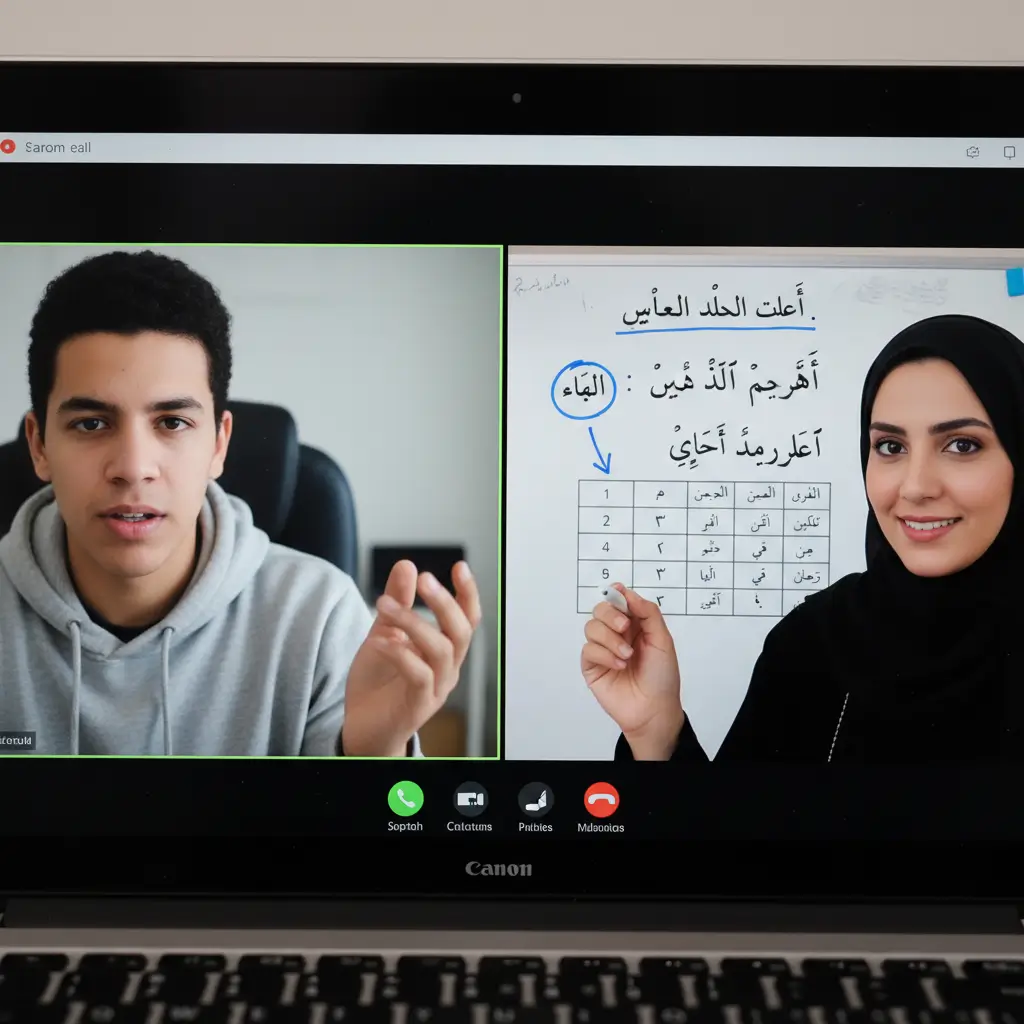
This is the core of effective online tutoring. Not pre-recorded videos. Not apps. Live sessions with a qualified teacher who hears your recitation, sees your writing, and corrects you in real time.
The structure matters enormously. Sessions that meander produce slow progress. Sessions built around a clear weekly objective — this week, master the definite article and its pronunciation rules — produce measurable forward movement.
What this looks like in practice: each session has a warm-up review of the previous lesson (5–10 minutes), new content introduction (15–20 minutes), active practice through speaking or writing drills (20–25 minutes), and assignment for the coming week (5 minutes). That’s a 60-minute session that actually moves you forward every single time.
Method 2: Conversation Practice from Day One
The biggest mistake beginners make is treating Arabic as a reading and grammar subject for the first six months, then trying to start speaking. It doesn’t work that way. Speaking from the very first lesson — even just “how are you,” “my name is,” “I want to learn Arabic” — builds the neural pathways that make fluency possible.
Good online tutors create space for spoken practice in every session. They speak more Arabic as your level increases, gradually shifting the ratio from explanation-heavy to conversation-heavy over the course of months. By month three, you should be speaking real Arabic in every session, not just answering grammar exercises.
Method 3: Spaced Repetition Between Sessions
What you do between classes determines 60–70% of your progress. Not what happens during class.
Specifically: vocabulary reviewed within 24 hours of first exposure has dramatically higher retention than vocabulary reviewed a week later. Pronunciation practiced daily for 15 minutes cements faster than practice in long weekly blocks.
The minimum effective dose is 15–20 minutes of daily practice between sessions. That’s not much. Most people spend longer than that scrolling their phone. But those 15–20 minutes — flashcard review, reading aloud, listening to Arabic audio, writing new vocabulary — compound dramatically over weeks and months.
What Stress-Free Arabic Teaching Actually Looks Like
Let’s be honest: a lot of language learning environments are unnecessarily stressful. Teachers who correct harshly. Group classes where mistakes feel humiliating. Curriculums that push you through content before you’re ready.
That’s not how adults learn languages effectively.
Research consistently shows that low-anxiety learning environments produce better outcomes — more retention, more willingness to practice, faster progress. When you’re not afraid of making mistakes, you make more attempts. More attempts mean more feedback. More feedback means faster improvement.
Here’s what stress-free online Arabic teaching looks like in practice:
Positive correction. Mistakes get corrected — always. But the correction is informative and encouraging, not critical. “Almost — the ع comes from the back of the throat, try again” is very different from “that’s wrong.”
Flexible pacing. If you didn’t quite master this week’s grammar point, next week we practice it more before moving on. The curriculum serves you. You don’t serve the curriculum.
No comparison. You’re not being measured against other students. Your progress is measured against your own previous self. That’s the only comparison that matters.
Optional review weeks. Good programs build in review sessions so that nothing is left behind. You’re not racing a timeline — you’re building a foundation.
This approach works for adults, for beginners, for people who’ve tried and quit before. Because it removes the most common reason people give up: feeling like they’re failing.
What a Private Arabic Lesson Actually Looks Like

A lot of people book their first private lesson without knowing what to expect. Here’s a typical 60-minute session structure at Alphabet Arabic Academy.
Warm-up and review (5–10 minutes). The teacher opens by reviewing what you covered last time. Quick questions, a few phrases, checking that the previous lesson’s vocabulary or grammar point has settled. This also gives you time to raise any questions you thought of between sessions.
New content introduction (15–20 minutes). One focused new topic — a grammar rule, a set of vocabulary, a pronunciation point. The teacher introduces it clearly, explains it in English if needed, then shows examples in Arabic. You ask questions here.
Active practice (20–25 minutes). This is the most valuable part. Speaking drills, writing practice, conversational exercises, pronunciation repetition. You’re producing Arabic — not passively receiving it. The teacher corrects in real time.
Homework and wrap-up (5–10 minutes). The teacher assigns specific practice for the coming week — vocabulary flashcards, a short paragraph to write, a recording to make of yourself reciting something. Good homework reinforces exactly what was covered in the session.
Homework Is Non-Negotiable
Students who complete their homework progress 2–3x faster than those who only show up to sessions. This isn’t a guess — it’s consistent across every level and learning style.
Homework isn’t busywork. It’s where retention actually happens. The session plants the seed; daily practice between sessions makes it grow.
Recommended Session Frequency
Beginners: 2–3 sessions per week. More early exposure accelerates habit formation and prevents forgetting between lessons.
Intermediate learners: 2 sessions per week, with consistent daily self-study.
Advanced learners: 1–2 sessions per week for refinement and accountability.
Minimum session length: 60 minutes. Anything less rarely produces meaningful progress in a single sitting.
Common Mistakes When Choosing a Private Arabic Tutor
People make the same mistakes over and over. Here’s how to avoid them.
Choosing based on price alone. A $5/hour tutor is not a deal if they have no Arabic teaching qualifications, can’t hear the difference between your ص and your س, and teach with no structure. The correction is the entire point. Cheap but uncorrected = practicing mistakes for months.
Not taking a trial class. Almost every reputable academy or tutor offers a trial. Take it. Don’t commit based on a profile photo and a bio. Chemistry matters enormously in private tutoring — and you won’t know if there’s chemistry until you’re in a session.
Switching tutors too quickly. This is the opposite mistake. Give a tutor at least 4–6 sessions before deciding they’re not a fit. It takes time for a teacher to understand your learning style, and it takes time for you to get comfortable enough with someone to make accurate progress. First lesson jitters are normal.
Setting vague goals. “I want to learn Arabic” tells your tutor nothing useful. “I want to read Quranic Arabic with basic comprehension within 12 months” gives them everything they need to build a curriculum. Specific goals produce specific results.
Treating sessions as passive experiences. Your tutor’s job is to create the environment. Your job is to actively engage in it. Ask questions. Speak first even when you’re uncertain. Push yourself to produce Arabic rather than just receiving it.
Skipping homework. See the section above. Skipping homework between sessions means you’re only learning during class. That’s half the equation at best.
Ignoring culture. Language without culture is incomplete. The best Arabic tutors integrate cultural context — Egyptian expressions, social norms, the why behind certain phrases — because it makes vocabulary stick and makes your Arabic sound like a human being, not a grammar textbook.
Pricing: What to Expect and How to Budget
Private Arabic tutoring isn’t free. But it’s more accessible than most people assume — and it’s significantly cheaper than years of slow progress through alternatives.
Average Market Rates
| Tier | Hourly Rate | What You Get |
|---|---|---|
| Budget | $10–$20/hr | Less experienced tutors, often non-native, minimal structure |
| Mid-Range | $25–$45/hr | Experienced native speakers with teaching certifications — the sweet spot |
| Premium | $50–$100+/hr | University professors and expert-level specialists |
At Alphabet Arabic Academy, Quran and Arabic tutoring starts from $40/session, with flexible plans for adults, teens, kids, and Quran learners.
Is It Worth It?
Compare the alternatives.
Group classes at a language center: $200–$500/month, 2–4 years to conversational fluency, no personalized attention.
Apps: $10–$30/month, zero human feedback, limited speaking practice, notoriously high dropout rates.
Private tutoring: higher per-session cost, but most students reach conversational fluency in 6–12 months. That’s 2–3 years faster than group classes or self-study.
Time is money. Faster results mean lower total investment, not higher.
Budgeting Strategies
Start with individual trial sessions before committing to a package. Find your fit first.
Once you’ve found a great tutor, commit to a package — most academies offer discounts for 10–20 session blocks.
Combine paid sessions with free supplementary resources. YouTube channels, Arabic podcasts, vocabulary apps like Anki — these reinforce class time at zero additional cost.
Set a realistic monthly budget. Even 2 sessions per week at $40/session is $320/month — comparable to a gym membership, a streaming service collection, or a few restaurant dinners. It’s a question of priority.
Real Results: What Private Tutoring Achieves

Let me tell you about Sarah.She’s a marketing manager from Manchester. She needed Arabic for work — her company was opening an office in Dubai. She had a budget, but she didn’t want to overspend.So she did what many learners do. She went cheap first.She found a freelance tutor on a marketplace for $12/hour. Great price, she thought. Three months later, she’d learned some vocabulary. But her pronunciation was still poor. She had no structured curriculum. She was stuck at the same level, spinning her wheels.She’d saved money on paper. But she’d wasted three months of time — and her work deadline was approaching.Then she found us.We placed her at A2 (not beginner — she’d learned more than she realised). Two sessions a week. Structured curriculum. Real-time pronunciation correction. WhatsApp support between lessons.Six months later? She had her first client meeting in Arabic. Her company paid for her next 6 months as a professional development expense.Here’s what Sarah learned — and what I want you to take away.Cheaper isn’t cheaper if it doesn’t work. The $12/hour tutor who doesn’t move you forward is more expensive than the $25/session structured programme that actually delivers results.Calculate value, not just price.
Here’s what consistent private tutoring actually produces, based on real student patterns.
Month 1–2: Arabic alphabet mastered. Basic reading ability. Common words recognized. Foundation in pronunciation with specific corrections.
Month 3–4: Reading Arabic text slowly but correctly. Simple conversation possible. Grammar fundamentals in place. 200–300 vocabulary words active.
Month 5–6: Reading fluency developing. Holding short conversations on familiar topics. Tajweed basics if studying Quranic Arabic. 500+ vocabulary words.
Month 8–12: Conversational fluency for most everyday topics. Independent reading of short texts. 800–1,200 vocabulary words. Real comprehension of Quranic surahs if that was the goal.
These aren’t exceptional results. They’re what happens when someone shows up to sessions consistently and does the daily practice between them.
Maximizing Your Private Lessons: What High-Progress Students Do
Paying for private lessons is step one. Getting maximum value from them is the other half.
Before each lesson: Review your previous session notes for 10–15 minutes. Prepare at least two specific questions. Set a clear goal for what you want to get out of this session.
During each lesson: Speak as much as possible. Ask for clarification immediately when confused — don’t wait until the end. Record the session if your tutor permits it. Take notes specifically on corrections, not just new content.
Between lessons — daily habits that work:
Review vocabulary from recent sessions (10 minutes). Read aloud from material covered (10 minutes). Listen to Arabic audio at your level (15 minutes — during commute, exercise, or cooking). Record yourself speaking one minute of Arabic and listen back.
That’s 35 minutes total. Most people can find 35 minutes.
Track your progress. Keep a simple learning journal: what you covered, what you struggled with, questions for next session, and milestones you’ve hit. On the days when Arabic feels slow, looking back at how far you’ve come is more motivating than any external encouragement.
Why Alphabet Arabic Academy for Private Tutoring
Here’s what makes us different.
Every tutor is a native Egyptian Arabic speaker. Authentic pronunciation. Deep cultural knowledge. The real language, not a textbook approximation.
Al-Azhar trained instructors. Many of our tutors are graduates of Al-Azhar University — one of the world’s oldest and most prestigious institutions for Arabic and Islamic scholarship. They combine traditional linguistic depth with modern, practical teaching methods.
Specialists for every goal. Quranic Arabic with Tajweed. Business Arabic for professionals. Egyptian colloquial for conversation. MSA for formal literacy. Arabic for children with age-appropriate methods. You’re matched with a tutor whose specialization matches your actual goal — not assigned whoever’s available.
Female teachers available. For learners who prefer a female instructor — many students learning Quran or Islamic studies do — we have certified female tutors available on request.
Flexible online delivery. All lessons via Zoom or your preferred platform. Schedule morning, evening, or weekend sessions based on your life. Sessions available 7 days a week across all major time zones.
Pricing from $40/session. Quality private instruction without the premium pricing of in-person tutoring in Western cities.
5,000+ students from 80 countries. 4.9/5 on Trustpilot. Those numbers come from real students who started as complete beginners and are now reading, speaking, and — in many cases — understanding the Quran directly.
You can see all our tutors, courses, and programs here.
Frequently Asked Questions
Q1: How long does it take to reach conversational fluency with a private tutor?
Most students reach conversational fluency in 6–12 months with consistent practice — 2–3 sessions per week plus 15–20 minutes of daily self-study. That’s 2–3x faster than group classes or self-study alone. Advanced fluency typically takes 18–24 months.
Q2: Do I need to know any Arabic before starting with a private tutor?
None at all. Quality tutors work effectively with complete beginners, starting from the alphabet and basic sounds. The beginner phase is actually where private tutoring adds the most value, because pronunciation mistakes corrected early don’t become habits.
Q3: What’s the difference between a private tutor and a group Arabic class?
Group classes teach everyone at the same pace with shared attention. A private tutor focuses entirely on you — your weak points, your goals, your pace. The result: 2–3x faster progress on average, and a curriculum that actually matches what you need.
Q4: Should I learn Modern Standard Arabic or a dialect?
Start with MSA for reading, grammar, and formal comprehension — it’s the foundation that makes everything else easier. Add Egyptian Arabic for conversation once you have a solid base. Discuss your specific goals with your tutor in the trial session; they’ll guide you to the right sequence.
Q5: How do I know if my tutor is actually effective?
After 4–6 weeks of consistent sessions and daily practice, you should see measurable improvement: reading speed increasing, new vocabulary retaining, pronunciation correcting. If you’re not seeing forward movement after 6 weeks of genuine effort, reassess the tutor fit.
Q6: Are online private Arabic lessons as effective as in-person?
For most students, yes — and often more effective, because the best native-speaking tutors are now accessible globally regardless of where you live. The key is live, interactive sessions with real-time feedback — not pre-recorded videos.
Q7: Is it too late to learn Arabic as an adult?
No. Adults learn Arabic every day at Alphabet Arabic Academy — in their 30s, 40s, 50s, and beyond. The internal motivation adults bring is actually a significant advantage over children. The main challenge is patience with the early slow phase. That phase passes.
Conclusion: Your Next Steps
A private Arabic tutor isn’t a luxury. It’s the most efficient path to actual Arabic fluency for serious learners.
The investment is real. So are the results.
Six to twelve months of consistent private instruction plus daily practice produces what two to four years of group classes and apps usually don’t: the ability to actually speak, read, and understand Arabic in real contexts. Whether that means following your prayer with comprehension, conducting meetings in Arabic, or simply holding a conversation with your heritage language — that ability is worth the effort.
Here’s exactly how to start:
Define your specific goal. “I want to understand Quranic Arabic in salah within 12 months” is a goal. “I want to learn Arabic” is a wish.
Take the placement test. Know your starting point before choosing a course or tutor. Take the free Arabic level test here — it takes five minutes.
Book a trial lesson. Experience the teaching method before committing. Meet a potential tutor, check the chemistry, see how personalized instruction actually feels.
Commit to 90 days. Three months of consistent sessions plus daily practice is when results become undeniable. Don’t evaluate before then.
Practice daily. Even 15 minutes. The tutor plants seeds. Daily practice makes them grow.
👉 See all courses and start your free trial — native Egyptian teachers, Al-Azhar certified, courses from $40.
Alphabet Arabic Academy — 5,000+ students from 80 countries, Al-Azhar certified teachers, 4.9/5 on Trustpilot. Based in Cairo, Egypt.