Last updated: April 2026
Diagnosing Gaps: When Good Teaching Isn’t Enough
Yasmin’s parents enrolled her in a quality Arabic class with excellent teachers. The curriculum was solid. The teacher was qualified. Other children in the class were progressing nicely.
But Yasmin, age 9, was falling behind.
While classmates read simple sentences, Yasmin still confused letters. While others held basic conversations, Yasmin froze when asked to speak. She was trying hard—coming to every class, practicing at home. But something wasn’t clicking.
Her teacher, managing 8 students, couldn’t dedicate the intensive individual attention Yasmin needed to overcome her specific struggles. The class moved forward. Yasmin felt increasingly frustrated and defeated.
“I’m just bad at Arabic,” she told her mother, tears streaming. “I can’t do it.”
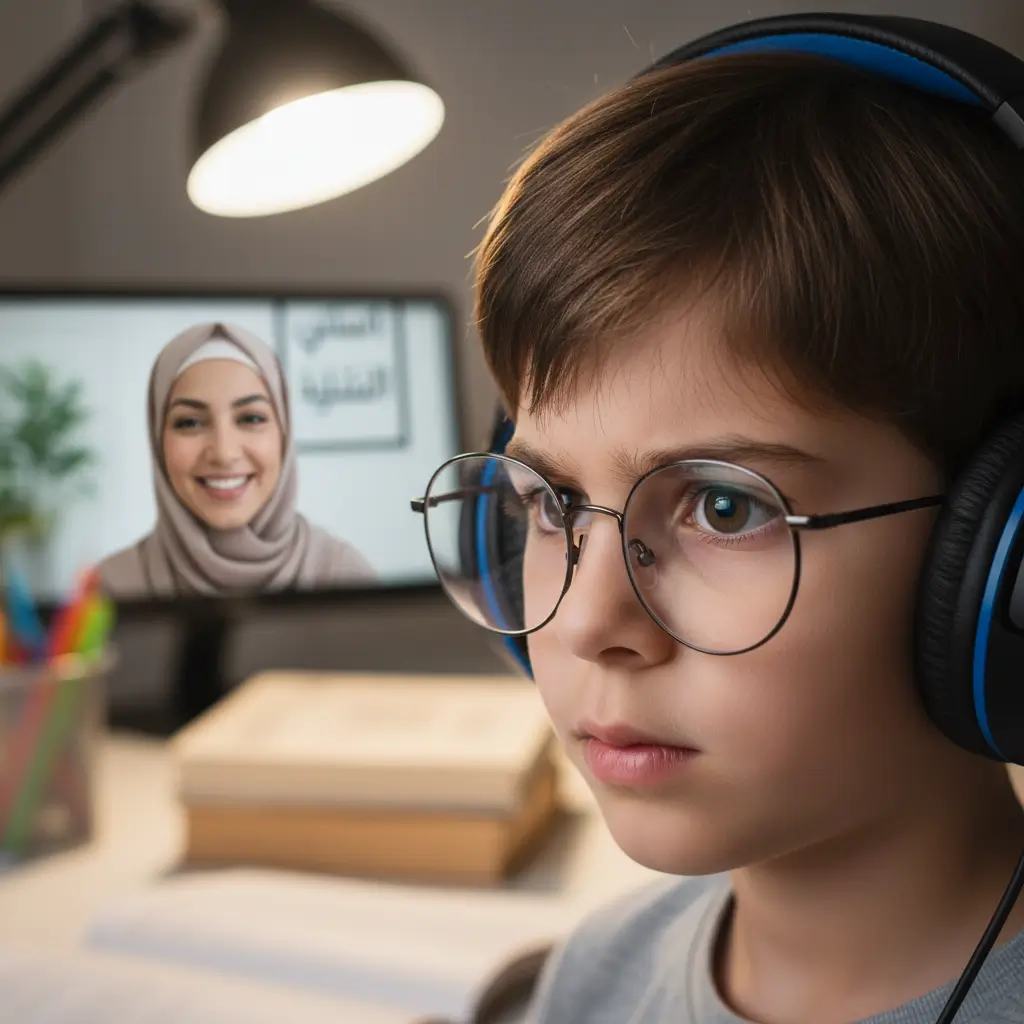
That’s when Yasmin’s parents made a critical decision: they hired an Arabic tutor for kids online—not to replace her regular classes, but to provide intensive, personalized support targeting her specific challenges.
Within three weeks of working one-on-one with Tutor Layla, something shifted. Layla identified that Yasmin had visual processing differences affecting letter recognition. She adapted teaching methods specifically for Yasmin’s learning style. She provided the repetition and reinforcement Yasmin needed without pressure or judgment.
Six months later, Yasmin caught up to her class. Her confidence transformed from “I can’t” to “Watch me.” The tutor didn’t teach a complete curriculum from scratch—she solved specific problems preventing Yasmin from succeeding in her regular program.
This is the precise purpose of an Arabic tutor for kids: intensive, targeted intervention when standard instruction isn’t sufficient. Not for every child. Not for teaching from zero. But for children facing specific struggles requiring specialized, personalized support.
This comprehensive guide helps parents recognize when their child needs tutoring support, what qualified tutors provide, how to find the right match, and realistic expectations for intensive intervention.
What Makes a Tutor Different from a Teacher
Parents often confuse teachers and tutors. Both teach Arabic. But their roles and approaches differ fundamentally.
Teacher: Systematic Curriculum Delivery
What Teachers Do:
- Follow structured curriculum from beginner to advanced
- Teach groups of students simultaneously (even small groups)
- Progress according to predetermined syllabus
- Cover complete language skills systematically
- Assess all students with standardized measures
Best For:
- Children learning Arabic from scratch
- Students progressing normally
- Building comprehensive Arabic proficiency
- Long-term language acquisition
Tutor: Targeted Problem‑Solving Intervention
What Tutors Do:
- Identify specific learning obstacles or gaps
- Provide intensive one‑on‑one remedial support
- Focus exclusively on areas where student struggles
- Adapt methods to individual learning differences
- Accelerate weak students OR challenge advanced students
Best For:
- Children falling behind despite good teaching
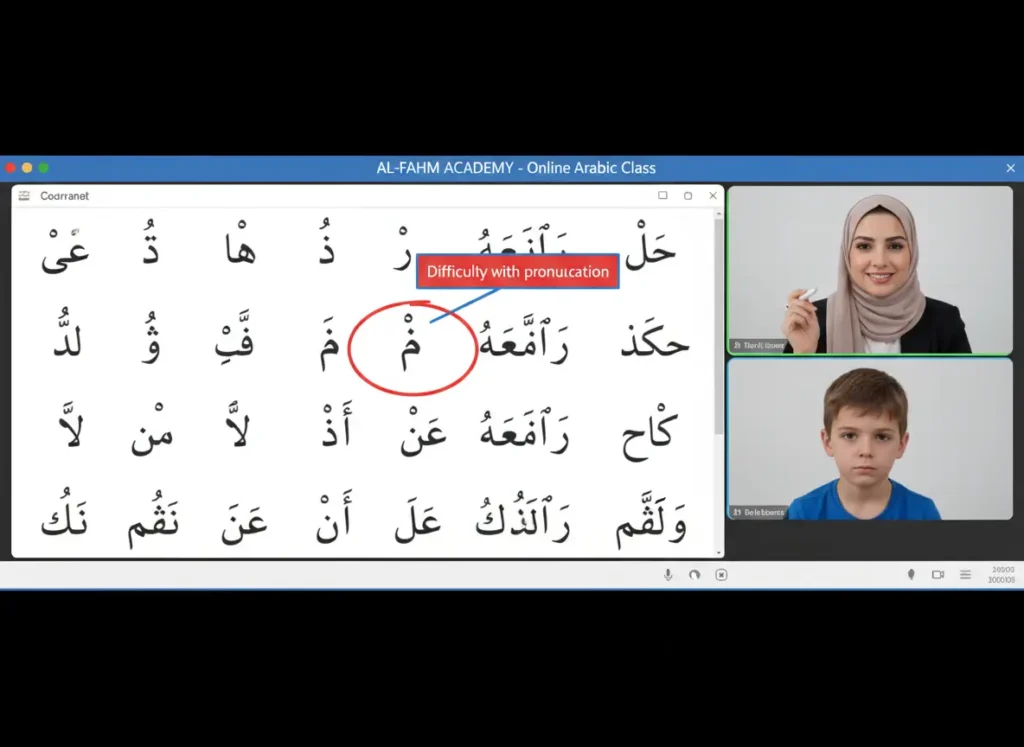
- Students with specific pronunciation, reading, or comprehension difficulties
- Learners needing acceleration before tests or travel
- Kids with learning differences requiring individualized approaches
- Students catching up after extended absence
The Fundamental Difference
- Teacher = Comprehensive instruction for typical learners
- Tutor = Intensive intervention for specific problems
Think of it this way: A teacher is like a pediatrician providing routine care for healthy children. A tutor is like a specialist addressing specific medical issues requiring targeted treatment.
Your child might need both—regular classes with a teacher for systematic learning and periodic tutoring for targeted support with specific challenges.
When Does Your Child Need an Arabic Tutor?
Not every child needs tutoring. But specific signs indicate intensive individual support would help.
Sign 1: Falling Behind Despite Effort
The Situation: Your child attends regular Arabic classes, practices at home, and genuinely tries—but consistently performs below classmates.
What’s Happening: Something specific is preventing progress that the regular teacher cannot address due to time constraints with multiple students.
What Tutor Provides: Diagnostic assessment identifying exact obstacle (pronunciation difficulty, grammar confusion, memory challenge, learning style mismatch). Then intensive targeted work fixing that specific problem.
Sign 2: Specific Skill Weakness
The Situation: Your child does well in some areas but struggles dramatically with one particular aspect:
- Cannot pronounce certain Arabic sounds correctly (ع، ح، خ، غ، ق، ص، ض، ط، ظ)
- Reads very slowly despite months of instruction
- Understands spoken Arabic but cannot produce sentences
- Memorizes well but cannot apply grammar
- Strong speaking but very weak writing
What Tutor Provides: Concentrated work on the specific weak skill using specialized techniques until it reaches the level of other skills.
Sign 3: Lost Confidence and Motivation
The Situation: Your child once enjoyed Arabic but now resists, says “I’m bad at it,” shows anxiety or frustration.
What Tutor Provides: Individualized success experiences rebuilding confidence. Pace adjusted to enable consistent achievement. Positive reinforcement restoring motivation.
Sign 4: Preparing for a Specific Event or Test
The Situation: Your child needs accelerated Arabic progress for a specific reason: visiting Arab relatives soon, entering an Arabic school program, taking a placement test, or moving to an Arab country.
What Tutor Provides: Targeted preparation for the specific objective. Intensive practice. Test‑taking strategies. Rapid skill‑building in priority areas.
Sign 5: Extended Absence Creating Gaps
The Situation: Your child missed significant Arabic instruction due to illness, family travel, relocation, or schedule conflicts.
What Tutor Provides: Intensive catch‑up work filling specific gaps quickly so the child can rejoin class successfully.
Sign 6: Learning Differences Requiring Adaptation
The Situation: Your child has diagnosed or suspected learning differences: ADHD, dyslexia, auditory or visual processing disorders, autism spectrum.
What Tutor Provides: Specialized techniques adapted to the learning difference. Multi‑sensory approaches. Extended processing time. Structured supports.
Sign 7: Advanced Student Needing Acceleration
The Situation: Your child excels in regular class and is bored or unchallenged.
What Tutor Provides: Enrichment beyond the regular curriculum. Acceleration to higher levels. Challenge appropriate to advanced ability.
Types of Problems Arabic Tutors Solve
Specialized tutors address challenges regular classes cannot fully remediate.
| Problem | Tutor’s Solution | Typical Timeline |
|---|---|---|
| Pronunciation difficulties (ع، ح، خ، غ، ق، ص، ض، ط، ظ) | Diagnostic assessment → intensive drilling with immediate feedback → recording and playback → systematic practice | 6‑12 weeks |
| Reading fluency barriers (painfully slow reading) | Texts at exact instructional level → repeated reading → systematic expansion → measurable tracking | 8‑16 weeks (double speed) |
| Grammar confusion (gender, conjugations, case endings) | Break rules into small components → numerous examples → guided practice with immediate correction | 4‑8 weeks per concept |
| Speaking anxiety (understands but freezes) | Private environment → building confidence through guaranteed success → starting with single words | 6‑10 weeks |
| Memory and retention challenges | Spaced repetition → mnemonic devices → multi‑sensory learning → overlearning | Ongoing toolkit |
| Test preparation (school placement or program admission) | Diagnostic practice test → intensive work on tested skills → test‑taking strategies | 6‑8 weeks |
Online Arabic Classes for Kids: A Complete Overview
Before deciding on a tutor, many parents first look for online Arabic classes for kids as a primary or supplementary solution. Here’s what you need to know.
Types of Online Arabic Classes for Kids
- Group live classes (4‑8 students per teacher) – More affordable, social interaction, but less individual attention.
- One‑on‑one live classes – Maximum personalization, faster progress, higher cost.
- Self‑paced video courses – Flexible but no live feedback or speaking practice.
- Hybrid programs – Group classes plus occasional one‑on‑one tutoring.
What Makes a Quality Online Class for Kids?
- Short sessions (30 minutes for ages 5‑8, 45‑60 minutes for ages 9‑12)
- Interactive tools (digital whiteboards, games, rewards, screen sharing)
- Teachers trained in child pedagogy – not just native speakers
- Structured curriculum (Noorani Qaida → Tajweed → Quran reading or conversational Arabic)
- Progress reports for parents
- Flexible scheduling across time zones
Recommended Platforms for Online Arabic Classes for Kids
| Platform | Type | Age Range | Price Range | Live Teacher |
|---|---|---|---|---|
| Alphabet Arabic Academy | Live 1‑on‑1 & group | 4‑18 | From $40/month | ✅ Yes |
| Rattil Quran | Live 1‑on‑1 | 5‑16 | $30‑60/month | ✅ Yes |
| Bayyinah Kids | Self‑paced + live | 6‑12 | $25/month | ❌ No (video) |
| Preply (filter children) | Tutor marketplace | Any | $15‑40/session | ✅ Yes |
| Italki (filter children) | Tutor marketplace | Any | $15‑50/session | ✅ Yes |
For most parents, starting with a structured live academy (like Alphabet Arabic Academy) provides the best balance of quality, safety, and progression.
Best Arabic Tutor for Kids Online: How to Choose
When regular classes aren’t enough, finding the best Arabic tutor for kids online becomes essential. Here’s a step‑by‑step selection process.
Step 1: Identify the Specific Problem
Before searching, clarify:
- Exactly what is your child struggling with? (e.g., “cannot pronounce ع” not just “bad at Arabic”)
- What is the goal? (fix pronunciation / catch up to class / pass test / build confidence)
- What is the timeline? (ongoing support / 8‑week intensive / until a specific milestone)
Step 2: Find Tutors with Relevant Specialization
Different problems need different expertise:
| Problem | Look For |
|---|---|
| Pronunciation | Tutor with phonetics training or Tajweed background |
| Reading fluency | Tutor experienced in literacy development |
| Learning differences | Tutor with special education or dyslexia training |
| Test preparation | Tutor familiar with the specific test format |
| Advanced acceleration | Tutor comfortable with advanced materials |
Step 3: Verify Qualifications
Essential credentials:
- Native or near‑native Arabic (for pronunciation models)
- Teaching credentials or extensive tutoring experience with children
- Specific training relevant to your child’s needs
- Documented success with similar challenges
Warning signs:
- Vague about qualifications
- No experience with your specific problem type
- Cannot provide references or examples
Step 4: Assess Compatibility with a Trial Session
During the trial, observe:
- Does the tutor accurately diagnose your child’s specific issue?
- Does the tutor explain their approach clearly?
- Does your child seem comfortable and engaged?
- Does the tutor set realistic expectations?
After the trial, evaluate:
- Do you understand the proposed intervention plan?
- Is the timeline reasonable?
- Do you trust this tutor’s expertise?
- Does your child want to continue?
Step 5: Establish Clear Communication
Before starting, agree on:
- Specific measurable goals
- Session frequency and duration
- Pricing and payment terms
- How progress will be measured and reported
- Cancellation and rescheduling policies
Top Qualities of the Best Arabic Tutors for Kids
- Patience – Children need repetition without frustration
- Creativity – Using games, stories, and rewards to maintain engagement
- Flexibility – Adapting to the child’s mood and energy level
- Clear feedback – Positive correction that builds confidence
- Parent partnership – Regular updates and home practice guidance
At Alphabet Arabic Academy, all tutors are native speakers, trained in child pedagogy, and experienced with common learning struggles. We match your child with a tutor who specializes in their specific need.
Learn Arabic for Kids Near Me: Combining Local and Online Options
Many parents search for “learn Arabic for kids near me” hoping for in‑person classes. While local options exist, online tutoring has become the preferred choice for most families due to flexibility and access to specialists.
Online vs. Local: Honest Comparison
| Factor | Online (Global) | Local (Near Me) |
|---|---|---|
| Teacher quality | Access to world‑class specialists regardless of location | Limited to your community |
| Scheduling | High flexibility (morning, evening, weekends) | Fixed schedule |
| One‑on‑one attention | Yes (most online academies) | Often group setting |
| Cost | From $40/month | $100‑500 per semester |
| Social interaction | Limited (some platforms offer group classes) | Strong community feel |
| Travel time | None | Commute required |
How to Find Local Arabic Classes (If You Prefer In‑Person)
- Search: “Arabic classes for kids near me” or “mosque Arabic school [your city]”
- Check local Islamic centers, community colleges, and language institutes
- Ask in local Muslim Facebook groups or Nextdoor
- Visit the class in person to observe teacher‑student interaction
The Hybrid Approach: Best of Both Worlds
Many successful families combine:
- Online one‑on‑one tutoring for intensive skill‑building (2‑3 sessions/week)
- Local weekend classes for social learning and community (1 session/week)
This way, your child gets specialized help from a remote expert and enjoys peer interaction locally.
Learn Arabic for Kids Online: A Complete Guide for Parents
If you’re considering learn Arabic for kids online as your primary method, here’s everything you need to know to set your child up for success.
Why Online Learning Works for Kids
- Engaging technology – Animated lessons, interactive games, digital rewards
- Personalized pace – No pressure to keep up with a group
- Safe environment – Learn from home without travel
- Consistency – Same teacher every session builds rapport
- Progress tracking – Clear reports for parents
What a Great Online Arabic Program for Kids Includes
- Placement assessment – Starts at exactly the right level
- Structured curriculum – Noorani Qaida → Tajweed → Quran or conversational Arabic
- Shorter sessions – 30 minutes for young children, 45‑60 for older
- Interactive tools – Digital whiteboard, screen sharing, games, songs
- Homework – Age‑appropriate practice between sessions
- Parent portal – View progress, lesson recordings, teacher feedback
Sample Weekly Schedule for a 7‑Year‑Old
| Day | Activity | Duration |
|---|---|---|
| Monday | Live online class with tutor | 30 min |
| Tuesday | Practice flashcards (app or physical) | 10 min |
| Wednesday | Listen to Arabic nursery rhyme | 5 min |
| Thursday | Live online class with tutor | 30 min |
| Friday | Review worksheet | 10 min |
| Saturday | Watch Arabic cartoon with subtitles | 15 min |
| Sunday | Free review / game | 10 min |
Total weekly time: ~2 hours. Very manageable for busy families.
How to Keep Your Child Motivated Online
- Short sessions – Stop before fatigue sets in
- Rewards system – Stickers, screen time, small treats for completing tasks
- Real‑world connection – Use Arabic during daily activities (greetings, naming objects)
- Celebrate small wins – Finished a page in Noorani Qaida? Pronounced a difficult letter correctly? Celebrate!
- Let them choose – Which cartoon to watch? Which game to play? Choice increases engagement.
Common Pitfalls to Avoid
- Long sessions – Children under 10 rarely focus well for 60 minutes
- Passive watching – If the child isn’t speaking or interacting, it’s not effective
- Inconsistent schedule – Missing weeks kills momentum
- Unrealistic expectations – Fluency takes time; celebrate incremental progress
How Online Arabic Tutoring Works (Step by Step)
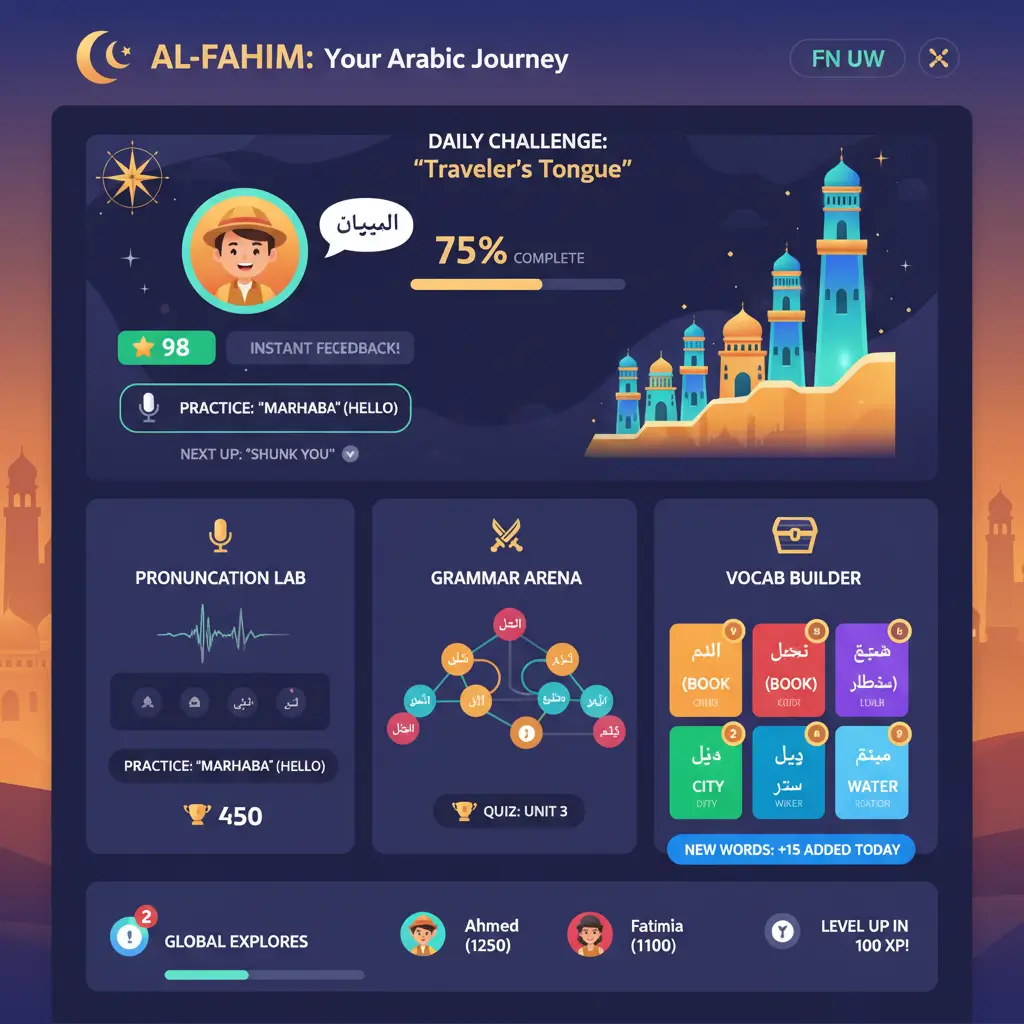
Understanding the tutoring process helps parents set realistic expectations and support their child effectively.
Phase 1: Diagnostic Assessment (Session 1‑2)
What Happens: Tutor assesses your child’s current Arabic skills comprehensively: pronunciation of all Arabic sounds, reading fluency and accuracy, listening comprehension, speaking ability (vocabulary, sentence construction), grammar understanding, and writing skills (if age‑appropriate).
Purpose: Identify precisely where the child struggles. Not “bad at Arabic”—specifically which skills need targeted work.
Parent Involvement: Tutor shares detailed findings: “Your child confuses ح and ه sounds. Reading fluency is below grade level. Grammar understanding is age‑appropriate. Speaking vocabulary is strong.”
Phase 2: Customized Intervention Plan (Session 3)
What Happens: Based on assessment, the tutor creates an individualized plan: specific skills to target, specialized techniques for your child’s learning style, measurable goals and timeline, frequency and duration of sessions needed, and home practice recommendations.
Purpose: Clear roadmap from current state to desired outcome.
Phase 3: Intensive Targeted Work (Ongoing Sessions)
What Happens: Systematic work on identified problems. Each session focuses on a specific objective. The child receives immediate correction and feedback. Techniques are adapted in real time to what works for this child. Regular progress checks against goals.
Typical Session Structure:
- Review of previous work (5‑10 minutes)
- Intensive new skill practice (20‑30 minutes)
- Application and reinforcement (10‑15 minutes)
- Home practice assignment
Frequency:
- Mild difficulties: 1x weekly
- Moderate challenges: 2x weekly
- Severe struggles or urgent timelines: 3‑4x weekly
Duration:
- 30 minutes for young children (ages 5‑7)
- 45 minutes for middle childhood (ages 8‑11)
- 60 minutes for adolescents (ages 12+)
Phase 4: Transition and Maintenance
What Happens: Once the child reaches goals: gradual reduction in tutoring frequency, integration back to regular classes only (if that was the goal), or transition to a maintenance schedule (monthly check‑ins). Strategies for sustaining gains are taught.
Parent Involvement: Understand how to support ongoing progress without the tutor.
Success Stories: When Tutoring Solved the Problem
Ahmed’s Pronunciation Breakthrough
Age 7, Egyptian‑American. Couldn’t pronounce ع، ح، ق after 8 months of regular classes. A tutor provided intensive phonetic instruction 2x weekly. Result (3 months): All sounds corrected, confidence restored, continued regular classes successfully.
Noor’s Dyslexia Adaptation
Age 10, diagnosed with dyslexia. Arabic right‑to‑left reading was overwhelming. A specialized tutor used a multi‑sensory approach, colored overlays, kinesthetic methods, and technology. Result (6 months): Functional reading level achieved, strategies for managing dyslexia with Arabic text, relationship with language transformed.
Kareem’s Test Success
Age 13. Needed to pass a placement test in 8 weeks. An intensive tutor met 4x weekly, focusing on tested skills, practice tests, and time management. Result: Passed the test, entered the desired program, tutoring discontinued (mission accomplished).
Frequently Asked Questions
Q: How is tutoring different from regular Arabic classes?
Regular classes teach a complete curriculum systematically to groups. Tutoring provides intensive one‑on‑one intervention targeting specific problems. Children often need both—regular classes for comprehensive learning and tutoring for targeted support with specific challenges.
Q: How long will my child need tutoring?
Depends on the problem. Specific pronunciation issues: 2‑3 months. Reading fluency: 3‑6 months. Catching up after extended absence: 4‑8 weeks. Learning differences: ongoing periodic support. Test preparation: 6‑8 weeks. Quality tutors set clear goals and timelines upfront.
Q: Can tutoring replace regular Arabic classes?
Generally no. Tutoring solves specific problems but doesn’t provide a comprehensive curriculum. Exception: very short‑term intensive tutoring for a specific goal (pass a test, prepare for travel). For long‑term Arabic proficiency, children need systematic instruction (regular classes) plus targeted intervention (tutoring) when specific problems arise.
Q: How much should quality Arabic tutoring cost?
Fair rates (2026): $30‑50 per session for qualified specialized tutors. Higher ($50‑70) for tutors with advanced specializations (dyslexia, high‑stakes test prep). Lower ($20‑30) may indicate less specialized tutors. Very cheap (<$20) often signals unqualified. Intensive specialized intervention merits fair compensation.
Q: My child’s regular teacher says tutoring isn’t necessary. Should I still consider it?
Teachers sometimes underestimate how much a child is struggling (managing multiple students, may not see the full picture). Trust your parental instincts. If your child shows signs of struggle, frustration, or falling behind despite effort, a consultation with a specialized tutor for a diagnostic assessment can’t hurt. A second opinion from an expert specifically focused on struggling learners provides valuable information.
Q: Can online tutoring really work for intensive intervention?
Yes. Research shows no significant difference in outcomes between in‑person and online one‑on‑one tutoring when technology is adequate and the tutor is skilled. Online advantages: access to specialized tutors regardless of location, often lower cost, and scheduling flexibility. The key is a qualified tutor with online teaching skills and stable technology.
Q: What age should my child start online Arabic classes?
Children as young as 4 can begin with 20‑minute sessions focused on the alphabet through games and songs. Ages 5‑7 typically manage 30 minutes. Ages 8+ can handle 45‑60 minutes. The most important factor is not age but the child’s attention span and interest.
Q: How do I know if my child is ready for online learning?
Your child is ready if they can: sit still for 20‑30 minutes, follow simple instructions, interact with a screen (point, repeat after the teacher), and tolerate not being the center of attention (for group classes). For one‑on‑one tutoring, the attention requirement is lower because the teacher engages them constantly.
Why Choose Alphabet Arabic Academy for Specialized Tutoring
At Alphabet Arabic Academy, we understand that some children need more than excellent teaching—they need intensive, specialized intervention.
Our Specialized Tutoring Approach
✅ Diagnostic‑Driven Intervention – We start with a thorough assessment identifying precise obstacles. Never generic “help with Arabic”—always a specific targeted intervention plan.
✅ Tutors with Relevant Specializations – Pronunciation specialists, reading interventionists, dyslexia‑trained tutors, test prep experts. We match your child’s specific problem with the appropriate specialist.
✅ Intensive One‑on‑One Attention – 100% focus on your child every session. Immediate feedback. Real‑time adaptation. Progress at your child’s exact pace.
✅ Measurable Goals and Transparent Progress – Clear objectives. Regular progress measurements. Transparent reporting. You always know where your child stands.
✅ Evidence‑Based Techniques – Research‑backed intervention methods. Not guesswork—systematic approaches proven effective for specific types of struggles.
✅ Collaboration with Regular Teachers – With your permission, we communicate with your child’s regular Arabic teacher to ensure coordinated support.
✅ Parent Partnership – Regular communication. Home practice guidance. Strategies you can use to support your child between sessions.
✅ Affordable Pricing – Starting from $40/month for specialized one‑on‑one tutoring. Family discounts available.
✅ Free Trial Lesson – No financial commitment to assess fit.
Your Next Steps: Get Your Child the Targeted Help They Need
Every child who overcomes learning obstacles had someone who recognized the struggle and provided specialized support. That someone could be you, making the decision today.
How to Begin
Step 1: Acknowledge the specific problem. Move beyond “struggling with Arabic” to “cannot pronounce ع correctly” or “reading is painfully slow” or “has dyslexia affecting Arabic learning.”
Step 2: Determine if tutoring is appropriate. Is this a specific problem requiring intensive individual intervention? Or does your child just need more practice with regular instruction?
Step 3: Define clear goals. What does success look like? “Pronounce all Arabic sounds correctly” / “Read at grade level” / “Pass placement test” / “Catch up to class.”
Step 4: Find a qualified specialized tutor. Match the problem to the tutor’s specialization. Verify credentials. Take a trial session.
Step 5: Commit to the process. Intensive intervention requires consistency. Attend all sessions. Complete home practice. Trust the process.
Step 6: Monitor progress. Regular check‑ins. Measurable improvements. Adjust the plan when needed.
Conclusion: Targeted Intervention Changes Trajectories
Remember Yasmin from our introduction? She wasn’t “bad at Arabic.” She had specific visual processing differences affecting letter recognition. Her regular teacher was excellent but couldn’t provide the intensive specialized intervention Yasmin needed.
Three weeks with the right tutor changed everything. Not because the tutor taught a complete curriculum—but because she solved the specific problem preventing success.
This is what specialized Arabic tutoring does: identifies obstacles invisible in group settings, provides intensive targeted intervention, and gets children unstuck so they can succeed.
Not every child needs tutoring. But for children facing specific struggles despite good teaching and genuine effort—specialized tutoring intervention can be transformative.
The signs are clear:
- Falling behind despite trying
- Specific skill weaknesses
- Lost confidence
- Preparing for a time‑sensitive goal
- Learning differences requiring adaptation
- Extended absence creating gaps
- Advanced students needing a challenge
The solution is clear: Find a qualified tutor with relevant specialization. Set measurable goals. Commit to intensive targeted work. Monitor progress. Celebrate success.
At Alphabet Arabic Academy, our specialized tutors have helped hundreds of struggling children overcome specific obstacles and thrive. We’ve seen pronunciation barriers disappear, reading fluency soar, confidence rebuild, and children who said “I can’t” transform to “Watch me.”
👉 Schedule a diagnostic consultation with Alphabet Arabic Academy’s specialized tutors → and get your child the targeted help they need.
For a comprehensive Arabic learning foundation, explore our Arabic for Kids complete program.
Your child’s struggle is specific. The solution should be too.
Specialized tutoring: intensive intervention when your child needs more than excellent teaching.
بسم الله – In the name of Allah.