
So you’ve been learning Arabic for a while. Or maybe you’re just starting. Either way, someone told you “you’re at B1” or “we need ACTFL Intermediate Mid” — and now you’re staring at letters and words that mean absolutely nothing to you.
You’re not alone. This confuses a lot of people.
Here’s what those terms actually mean, how they map to Arabic, and how to figure out where you actually sit right now.
First, Why Do These Frameworks Even Exist?
Because “I know some Arabic” means nothing.
Seriously. It could mean you memorized 50 words from Duolingo. It could mean you’ve been studying for two years and can read a newspaper. “Some Arabic” is useless for a teacher, an employer, or a university trying to figure out what you can actually do.
That’s why we have frameworks. They give everyone a shared language. A B2 in Arabic means roughly the same thing to a teacher in Egypt as it does to a professor in Germany.
Two main frameworks are used globally:
CEFR — Common European Framework of Reference. Used mostly in Europe, international schools, and language programs worldwide.
ACTFL — American Council on the Teaching of Foreign Languages. Used mostly in the US, American universities, and government/military language programs.
They’re not identical. But they map pretty closely to each other.
CEFR Levels for Arabic: What They Actually Mean
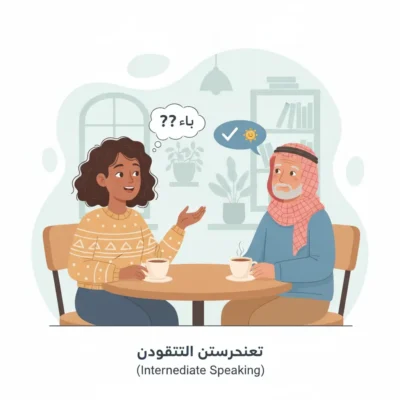
CEFR has 6 levels, split into 3 bands:
A (Beginner)
- A1 — You know the alphabet. You can say your name, greet someone, ask “where is the bathroom.” That’s it.
- A2 — You can handle very basic conversations. Introduce yourself, talk about your family, order food. Still relying heavily on memorized phrases.
B (Independent)
- B1 — You can manage everyday situations. Travel, simple work conversations, understand slow speech. You make mistakes, but you communicate.
- B2 — This is where things get interesting. You can follow the news, have real discussions, write coherent emails. Most fluency goals for everyday learners land around here.
C (Proficient)
- C1 — You express yourself with ease. Complex topics, nuanced writing, understanding regional dialects to some degree. This is near-native territory.
- C2 — Fully proficient. Native-level comprehension and expression. Very few non-native speakers reach this, and honestly, for Arabic, you’d need to define which Arabic — MSA or a specific dialect.
ACTFL Levels: The American Version
ACTFL breaks things down a bit differently. It uses these main levels:
Novice (Low, Mid, High) Intermediate (Low, Mid, High) Advanced (Low, Mid, High) Superior Distinguished
Here’s the quick version of what each means in practice:
| ACTFL Level | What You Can Do |
|---|---|
| Novice Low | A few words and memorized phrases |
| Novice Mid | Basic greetings, numbers, colors |
| Novice High | Short sentences on familiar topics |
| Intermediate Low | Simple questions and answers in familiar contexts |
| Intermediate Mid | Handling routine social and survival situations |
| Intermediate High | Narrating, describing, asking follow-up questions |
| Advanced Low | Paragraphs, not just sentences. Handling complications |
| Advanced Mid | Extended descriptions, most everyday tasks with ease |
| Advanced High | Near C1 territory |
| Superior | Complex academic/professional discussions |
| Distinguished | Full professional and academic proficiency |
CEFR vs ACTFL: How Do They Match Up?
Here’s the rough equivalency table. I say “rough” because the two frameworks weren’t designed to perfectly mirror each other — so there’s always a little debate around the edges.
| CEFR | ACTFL |
|---|---|
| A1 | Novice Low / Mid |
| A2 | Novice High / Intermediate Low |
| B1 | Intermediate Mid / High |
| B2 | Advanced Low / Mid |
| C1 | Advanced High / Superior |
| C2 | Distinguished |
So if someone tells you you’re “Intermediate Mid” in ACTFL, you’re roughly B1 in CEFR. If a program says they take students from B1 to B2, that’s roughly ACTFL Intermediate Mid to Advanced Low.
Okay But Why Does This Matter for Arabic Specifically?
Here’s the thing — Arabic is weird. In a good way. But weird.
Most languages have one standard form. Arabic has at least two distinct registers that learners deal with: Modern Standard Arabic (MSA), which is the formal written language used in books, news, and official contexts, and colloquial dialects like Egyptian, Levantine, Gulf Arabic, and so on — which is what people actually speak in everyday life.
This creates a real problem with level frameworks.
You could be B2 in MSA — reading Al Jazeera, writing formal emails — but barely B1 in spoken Egyptian Arabic. Or the reverse: you grew up watching Egyptian soap operas and you speak like a local, but you can’t read a formal document.
So when you say “I’m B2 in Arabic” — which Arabic? Written MSA? Spoken dialect? Quranic Arabic?
This is why placement is so important. A good Arabic program doesn’t just ask “what’s your level” — it figures out which skill areas are strong and which ones need work.
How Long Does It Take to Reach Each Level?
I’ll be straight with you — Arabic is officially rated one of the hardest languages for English speakers by the US Foreign Service Institute. They estimate about 2200 classroom hours to reach professional proficiency (roughly C1/Advanced High).
That sounds terrifying. But here’s some context:
- A1 to A2: around 150–200 hours of structured study
- A2 to B1: another 200–300 hours
- B1 to B2: another 300–400 hours
These are estimates. Some people move faster with intensive immersion or a great teacher. Some move slower if they study inconsistently.
If you’re doing 15–20 minutes a day on your own (which, by the way, is a realistic starting point — check out our daily Arabic study routine for beginners), it’ll take time. If you’re in structured weekly classes, you’ll move faster.
The point isn’t to sprint. The point is to know where you are so you’re studying the right things at the right time.
Common Questions About Arabic Levels
“Does my level in MSA transfer to Egyptian Arabic?”
Partially. The grammar overlaps. Your vocabulary carries over somewhat. But spoken dialects have their own pronunciation, vocabulary, and rhythm. A B1 in MSA doesn’t automatically make you B1 in Egyptian Arabic conversation.
“Can I skip A1/A2 if I already know the alphabet?”
Knowing the letters isn’t the same as being able to read. You might know the alphabet but still be at A1 in reading comprehension. Don’t skip foundational work — it catches up with you later.
“Do employers care about ACTFL or CEFR?”
Depends on where you’re applying. US government jobs, international organizations, and American universities tend to use ACTFL. European programs and most international schools use CEFR. Knowing your level in both (since they map to each other) is useful.
“Is B2 fluent?”
Honestly, it depends on what you mean by fluent. B2 means you can handle yourself confidently in most everyday situations. You’re not lost in conversations. You can read and write. Most people would call that “fluent.” Full professional or academic proficiency is more like C1.
Where Do Most Arabic Learners Get Stuck?

The two biggest plateaus are:
A2 to B1. This is where memorized phrases stop being enough and you need to actually build sentences on the fly. A lot of learners stall here because they’re still studying from vocabulary lists instead of practicing real communication.
B1 to B2. Your conversational Arabic is okay but your reading and formal writing is weak. Or the reverse. The skills don’t level up at the same speed, and learners get frustrated because they feel like they’re “stuck.”
The solution to both: structured practice that targets your weak area specifically. Not more apps. Not more vocab lists. Targeted work on what’s actually holding you back.
If you’re interested in tackling Arabic from scratch and building through these levels properly, the beginners’ guide to learning Arabic is a good starting point.
How to Figure Out Your Actual Level Right Now
Here’s the honest reality: most people overestimate their level.
We’re comfortable talking about the topics we know. But throw an unexpected question at us — or a formal text to read — and we quickly discover our limits.
The most accurate way to find your level is a real placement test with a native teacher who can actually listen to you speak, correct you in real time, and assess all four skills: reading, writing, listening, speaking.
Apps can give you a rough idea. A written test online can help. But nothing replaces a few minutes of actual conversation with a qualified teacher.
That’s exactly what our Free Arabic Level Test is designed to do. It’s not a quiz. It’s a real assessment that tells you exactly where you stand — across skills, across the CEFR framework — so you can start studying the right material at the right level.
No guessing. No “I think I’m B1?” Just clarity.
What Happens After You Know Your Level?
You start learning efficiently.
Instead of reviewing things you already know or drowning in things that are too hard, you work in the right zone. That’s where real progress happens.
If you want to see what structured level-based Arabic learning looks like — and what it actually costs — you can check out our course and pricing options.
The Bottom Line
CEFR and ACTFL are just tools. They’re not the point. The point is that you know where you are so you can get where you’re going.
A1 doesn’t mean you’ve failed. C1 doesn’t mean you’re done. Every level has a purpose, and every learner moves at their own pace.
But guessing your level? That’s where people waste months studying the wrong things.
Find out where you actually are.
👉 Take the Free Arabic Level Test — it takes less than 30 minutes and gives you a real answer.