Every few weeks a new student sends me the same message. Different words. Same worry.
“Should I learn to read the Quran first, or start with Tajweed? I’ve seen people say both.”
Here’s my short answer. Read first. But don’t wait to touch Tajweed.
That sounds like a cop-out. It isn’t. The internet treats this like a fight between two options, and it’s not. It’s one road with two stages, and they overlap. Once you see how they overlap, the whole question gets a lot less scary.
In this article I’ll answer the questions people actually ask online. Is Tajweed required? When did it even become a thing? Which matters more? And why does it feel so hard when you’re trying to learn it on your own? Then I’ll give you a simple order to follow, so you stop second-guessing.
The Quick Answer (If You’re in a Hurry)
- Can’t read Arabic letters yet? Start with basic reading. Use a step-by-step method like Noor Al-Bayan.
- Can read, but you make mistakes or rush? Start Tajweed now. Begin with letter sounds, then the core rules.
- Read well, want to sound better? Go deeper into Tajweed, then think about memorization or an Ijazah.
- Everyone, no matter the level: Learn from a teacher who can hear you. This one matters more than any app or book.
Want the full reasoning? Keep reading.
First, What Do These Two Things Actually Mean?
People mix these terms up all the time, so let’s fix that.
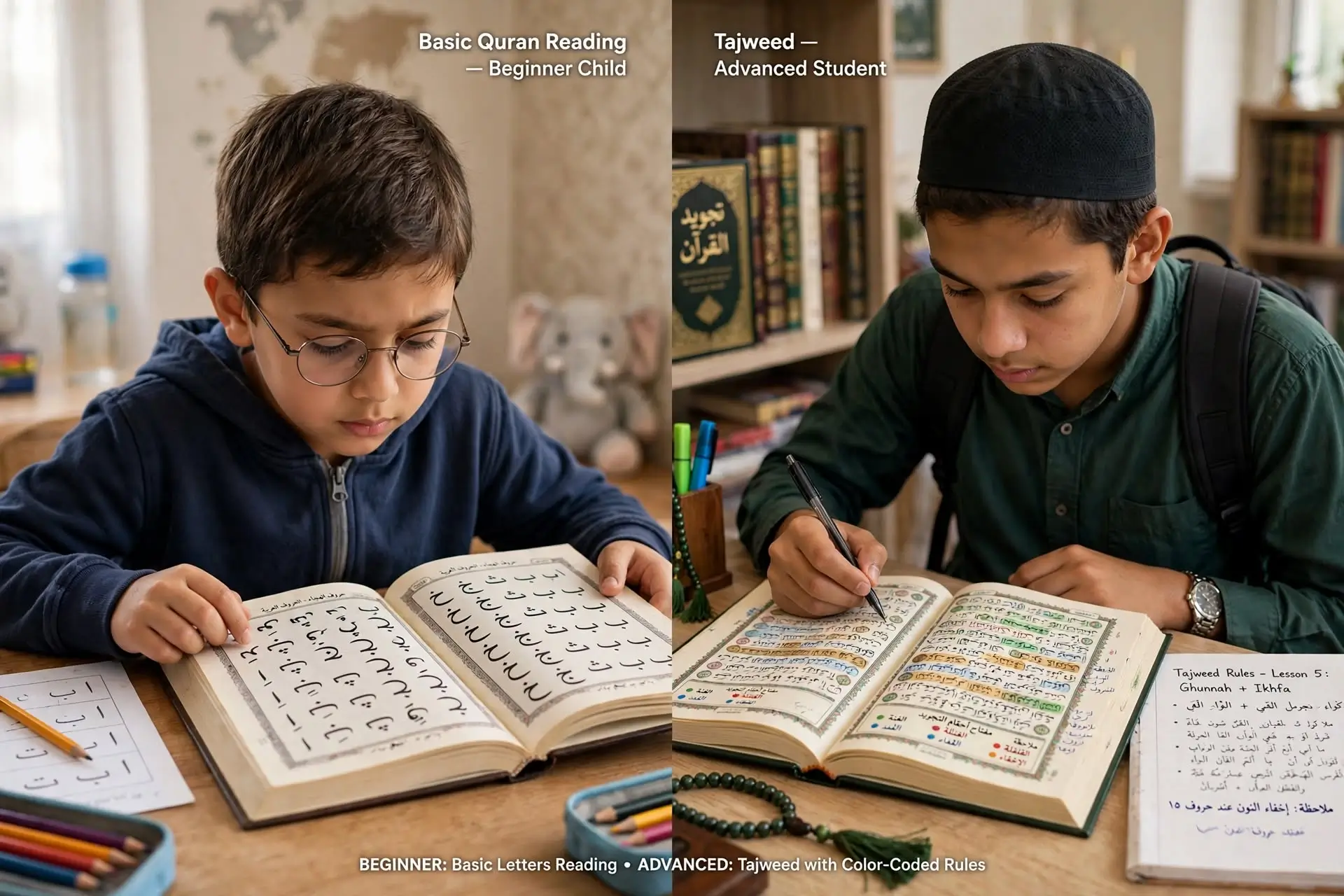
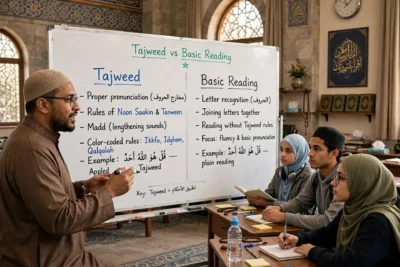
Basic Quran reading means you can look at a line of the Mushaf and read it. You know the letters. You know how they change shape when they join. You know the short vowels, the long vowels, the sukun, the shaddah. You can get through a verse without freezing.
Tajweed means giving every letter its right. Where it comes from in the mouth or throat. What quality it carries. How long to hold a vowel. When to blend two sounds, when to nasalize, where to stop. The word itself comes from a root meaning to make something better. Wikipedia’s overview of Tajwid describes it as a set of rules for pronouncing the letters correctly, with all their qualities.
Here’s a simple way to hold both ideas:
| Basic Quran Reading | Tajweed | |
|---|---|---|
| The question it answers | “Can I read this?” | “Am I reading this correctly?” |
| What you need first | Nothing. Start at zero. | The ability to read Arabic script |
| What you practice | Letters, vowels, joining, fluency | Articulation points, rules, pauses, lengthening |
| Typical timeline | 2–3 months for most beginners with a teacher | Months to years, and it never fully “ends” |
| If you skip it | You can’t read at all | You read, but with errors you don’t hear |
Look at that second row. Tajweed assumes you can already read. That’s why the order matters.
“Is It Required to Recite the Quran With Tajweed?”
This is the most common question I get, and it’s the one I’m most careful with.
I’ll be straight with you: I’m a teacher, not a mufti. I can’t hand you a ruling. And scholars genuinely disagree on how to describe the obligation, so be wary of anyone online who pretends it’s simple.
Here’s what you’ll find if you read the sources yourself:
- Some scholars say that applying the detailed rules of Tajweed is not obligatory. In this view, if you pronounce the letters clearly with the right vowels, that’s sufficient, and the finer rules are about beautifying your recitation. This answer on IslamQA explains that position.
- Other scholars say reciting with Tajweed is required, and that reciting without it is a kind of error called lahn.
- A middle position you’ll often see separates two things. Mistakes that change the meaning or clearly distort the words are a serious problem. Subtle imperfections in the finer rules are treated more lightly.
Everyone in that conversation agrees on one thing, though. Meaning-changing mistakes need to be fixed.
A classic example from Surah Al-Fatiha: the word أَنْعَمْتَ (“You have favored”). Change the final vowel from fatha to damma and you get أَنْعَمْتُ, which means “I have favored.” Same letters. Completely different meaning. That’s the kind of slip Tajweed training catches.
So if you want a ruling for your own situation, ask a scholar or a qualified teacher you trust. What I can tell you as a teacher is this: you’ll never know which of your mistakes are small and which change the meaning unless somebody who knows the rules listens to you. Which brings us back to why Tajweed matters even for beginners.
“When Did Reading the Quran With Tajweed Become a Thing?”
Honestly, I love this question, because the answer has two layers.
Layer one: the recitation itself. The Quran was taught by listening and repeating. The Prophet ﷺ recited, the Companions learned from him, and each generation learned from the one before. The Arabs of that time spoke their language naturally, so many of the sounds we now label as “rules” were simply how they talked.
Layer two: the written science. As Islam spread and many non-Arabs became Muslim, scholars saw the need to write the rules down so recitation stayed accurate. According to the Wikipedia article on Tajwid, Abu Ubaid al-Qasim ibn Salam (774–838 CE) is often credited with putting the science into writing in his book on the readings. Later, from around the 4th century of the Hijra, Tajweed was treated as its own independent field. Ibn al-Jazari (1350–1429 CE) wrote two famous poems on the readings and on Tajweed that students still study today.
So when someone asks “when did Tajweed start?”, the honest answer is: the recitation goes back to the Prophet ﷺ, and the books of rules came later to protect it.
Why does that matter to you? Because it explains something practical. Tajweed was always passed on by ear, from teacher to student. A book can describe the rule. Only a living teacher can tell you, “No, that’s not quite it. Listen again.”
So Why Read First?
Because you can’t polish something that doesn’t exist yet.
Think about learning to drive. You don’t start with advanced racing lines. You learn where the pedals are. Then you learn the road. Then you refine.
Tajweed rules are written in terms of letters, vowels, and signs. If you can’t recognize those yet, a rule like “when a noon sakinah meets a ba, you hide the noon” is just noise. It’s like being handed a grammar book in a language you can’t read.
That’s why we start complete beginners with a step-by-step reading method. If you’re not familiar with it, our guide on what Noor Al-Bayan is and why beginners love it walks through how it builds from single letters to syllables to full words. And if you’re a parent, here’s when children should start Noor Al-Bayan.
But Don’t Treat Tajweed Like a Final Boss
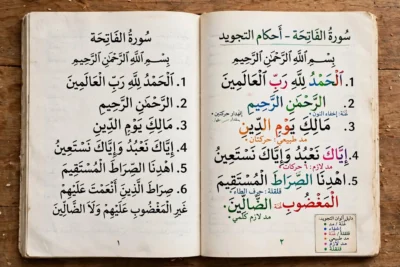
Here’s the thing. Most people hear “read first, Tajweed later” and take it too literally. They spend a year reading with sloppy sounds, then try to fix it all at once.
That’s backwards. Bad habits get set fast, and old habits are harder to undo than new ones are to build.
So even in your first weeks of reading, you should be learning how each letter actually sounds, not just what it looks like. This part is called makharij, the articulation points. It’s technically a Tajweed topic, but it’s really the bridge between the two stages.
Take a few pairs that beginners (especially English speakers) mix up all the time:
- ق and ك. One comes from deep in the throat area, the other from higher up. Mix them and you can turn قَلْب (heart) into كَلْب (dog). Not what you meant!
- ح and ه. Two different “h” sounds. One is deeper and breathier.
- ص and س. A heavy sound and a light one.
- ع and ء. Very different, and many learners treat them as the same.
Learning these from day one costs you maybe five extra minutes per lesson. It saves you months of unlearning later.
So the real sequence looks like this:
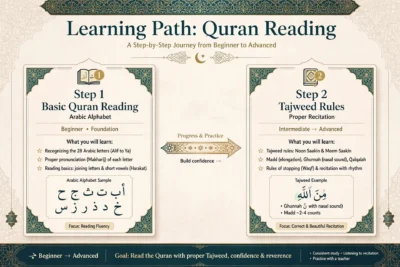
- Stage 1: Read. Letters, joining, vowels, fluency. Include correct letter sounds from the start.
- Stage 2: Core Tajweed. Noon and meem sakinah, madd (lengthening), qalqalah, waqf and ibtida (stopping and starting).
- Stage 3: Refine. Fine points, longer passages, memorization, and, for some students, an Ijazah.
Notice the overlap between 1 and 2. That’s the “it’s not either/or” part.
“Tajweed or Qira’ah: What Should I Focus On?”
Fair warning: this one confuses people, because “qira’ah” gets used in two ways.
When someone says it casually in a forum thread, they usually mean reading, the plain ability to read the text fluently. In that case, my answer is the same as above. Fluent reading comes first, and Tajweed grows on top of it.
But in the scholarly sense, qira’at means the different authentic modes of recitation, like the reading of Hafs or Warsh. That’s a separate topic, and not something beginners need to worry about. Most students around the world learn the reading of Hafs from Asim, and that’s what you’ll hear in most printed Mushafs.
If you’re not sure which one you’re being asked about, assume it means “reading fluency” and ignore the rest for now.
“I’m Struggling to Learn Tajweed. How Did You Learn?”
I hear this one a lot, and it comes with a lot of frustration.
I’ll tell you what almost always goes wrong.
1. Learning rules from videos and books only. You watch a lesson on ikhfa. It makes sense. Then you open the Quran and can’t tell where it applies, or whether you’re doing it right. Nobody is listening to you. Nobody corrects you. You feel like you’re learning, but you’re not getting feedback, and feedback is the whole game.
2. Trying to learn every rule at once. Tajweed has a lot of terminology. If you open a full course and try to memorize every rule in order, you’ll burn out by week three. Learn one or two rules. Apply them to real verses. Then add more.
3. Studying rules without practicing recitation. Knowing the definition of madd doesn’t mean your voice holds it for the right count. The skill lives in your mouth and ears, not your notes.
4. Skipping the basics. Often the real issue isn’t Tajweed at all. It’s that reading isn’t fluent yet, so every rule feels like extra weight on a shaky foundation.
What actually works:
- Read a short passage aloud to a teacher. Get corrected live.
- Fix your biggest errors first. Don’t chase perfection.
- Learn one or two rules at a time and use them in the verses you already recite.
- Record yourself. Listen back. It hurts, and it works.
- Practice a little every day instead of a lot once a week. Our 15-minute daily study routine was written for Arabic in general, but the same logic applies here: short, daily, focused sessions beat marathon weekends.
Which Starting Point Is Yours?
Let’s make this concrete. Find yourself below.
1. “I don’t know the Arabic letters yet.”
Start with basic reading. No Tajweed rules yet beyond correct letter sounds. A good beginner path will have you reading simple words in weeks, not years.
2. “I can read, but slowly, and I know I’m making mistakes.”
This is the sweet spot for starting Tajweed. You have the foundation. Now you need someone to hear your recitation and tell you what to fix first. This is where most of our adult students begin.
3. “I read fluently but never studied the rules.”
Good news. You’ve got the hard part. Most of what you need now is targeted correction plus structured rules, usually starting with noon sakinah, madd, and stopping rules.
4. “I want to understand what I’m reading.”
That’s a different (and wonderful) goal, and it runs alongside the others. Tajweed makes your recitation correct. Arabic study makes it meaningful. If that’s you, take a look at the first 50 Quranic words every beginner should learn and our guide on Quranic Arabic vs Modern Standard Arabic.
Not sure which one fits? Our Quran online classes page lays out the same four starting points, and a free trial lesson will tell you the truth about your level faster than any article can.
A Realistic 90-Day Plan
Everyone is different, so treat this as a map, not a contract. Here’s what it can look like for a beginner who practices 10–15 minutes a day and has a couple of lessons a week.
Days 1–30: Foundation
- Learn the letters, their shapes, and how they sound
- Short and long vowels, sukun, shaddah
- Start reading short words
- Your teacher fixes the pronunciation errors that matter most
Days 31–60: Fluency
- Read short verses without stopping on every word
- Practice joining sounds smoothly
- Meet your first Tajweed rules, usually madd and a simple version of noon sakinah
Days 61–90: Apply
- Recite a few short surahs with 1–2 rules applied correctly
- Record yourself weekly and compare
- Get a written plan for the next three months
For reference, at our academy most complete beginners can read basic Quranic text independently within about 2–3 months, and reading fluently with basic Tajweed usually takes around 6–9 months. That depends on your consistency far more than on talent.
And if you want a gentle next step once you can read a little, try the best way to start understanding short surahs. Reciting words you understand changes how you listen to yourself.
Five Mistakes I See Constantly
Memorizing before reading properly. Hifz built on shaky reading means you memorize your own mistakes. Then you have to un-memorize them. Painful.
Chasing the “perfect” accent immediately. Perfect isn’t the first goal. Clear and correct is. Beauty comes with time.
Trusting only apps. Apps are great for drills and listening. They can’t tell you what your tongue is actually doing.
Learning from a different source every week. One structured path beats ten random videos. Pick a method and stick with it for a few months.
Waiting until you feel “ready.” You won’t. Start imperfectly. Fix as you go.
Common Questions
Do I need to know Arabic to learn Tajweed?
No. You need to be able to read Arabic script, which is a much smaller step than speaking the language. Understanding the meaning is a separate, optional path.
Can adults really learn this from zero?
Yes. Adults often move fast because they’re motivated and can focus. You’re not too late.
Can I learn Tajweed without a teacher?
You can learn the theory alone. You can’t reliably check your pronunciation alone, because you can’t hear your own subtle errors. That’s why the Quran has always been passed on teacher to student.
How long does it take to learn Tajweed?
The core rules take a few months with steady practice. Mastery takes longer, and honestly, even experienced reciters keep refining for life.
Should kids learn reading and Tajweed together?
Reading first, with correct letter sounds from the start. Formal Tajweed rules come once they can read comfortably. Short, playful sessions work best for children.
What if I already memorized surahs the wrong way?
It’s fixable. Tell your teacher up front. They’ll review what you know and correct it gently, starting with the mistakes that matter most.
So, What Comes First?
Read first. Learn the sounds properly while you do. Add Tajweed rules as soon as you can read comfortably, and get a real person to listen to you along the way.
That’s the whole answer. It really is that simple, and it’s okay if it took you a few months of forum threads to hear it.
If you want help picking your starting point, you’ve got two easy options. Our teachers work one-on-one, with sessions of 30 minutes, recorded lessons you can review, and female teachers available for sisters and children. And the pricing page shows plans starting from $35 a month, with a free trial class so you can see how it feels before you commit.
Choose a Starting Point
Pick the one that sounds like you, and we’ll take it from there.
- I can’t read Arabic letters yet → Start with Noor Al-Bayan
- I can read, but I make mistakes → Start Tajweed correction
- I read well and want to go further → Explore Tajweed, Hifz and Ijazah
Not sure at all? Book a free trial class and let a teacher listen to you for 30 minutes. You’ll know exactly where you stand.