You’ve just learned how to say “How are you?” in Egyptian Arabic. Feels great. Then a friend asks: “Wait, are you saying that to a man or a woman?”
Hmm. What?
English never made you care about this. Arabic does. And Egyptian Arabic brings it up in almost every sentence you say.
Here’s the good news. It’s a lot simpler than most grammar charts make it look. I’ve taught Egyptian Arabic to beginners for years, and I can fit about 90% of this topic on a sticky note. So that’s what we’re going to do. No giant tables of 14 endings. No panic.
By the end, you’ll know:
- how “you” changes for men and women
- how to tell if a noun is masculine or feminine
- how adjectives and verbs follow along
- why groups of people are actually easier than one person
Let’s go.
The Quick Version: What’s Actually Going On?
Egyptian Arabic has two genders. Masculine and feminine. That’s it. No “it.” No neutral option. Every noun is one or the other, and the words around it have to match.
In English, gender shows up in “he” and “she.” That’s about all. Arabic goes further. It also changes “you,” plus adjectives, verbs, and even “this” and “that.”
Quick background if you’re new here. Egyptian Arabic, also called Cairene Arabic or Masri, is the spoken dialect of Egypt. It’s understood across most of the Arabic-speaking world thanks to Egyptian movies and music. Good reason to learn it.
Now the part that makes this simple: the changes are tiny. Usually one sound. An -a on the end of a word. An -i on the end of a verb. That’s the whole pattern. Everything else is just practice.
Start With “You”: Inta vs Inti
This is where you’ll feel it first, because “you” is the word you use most when you talk to someone.
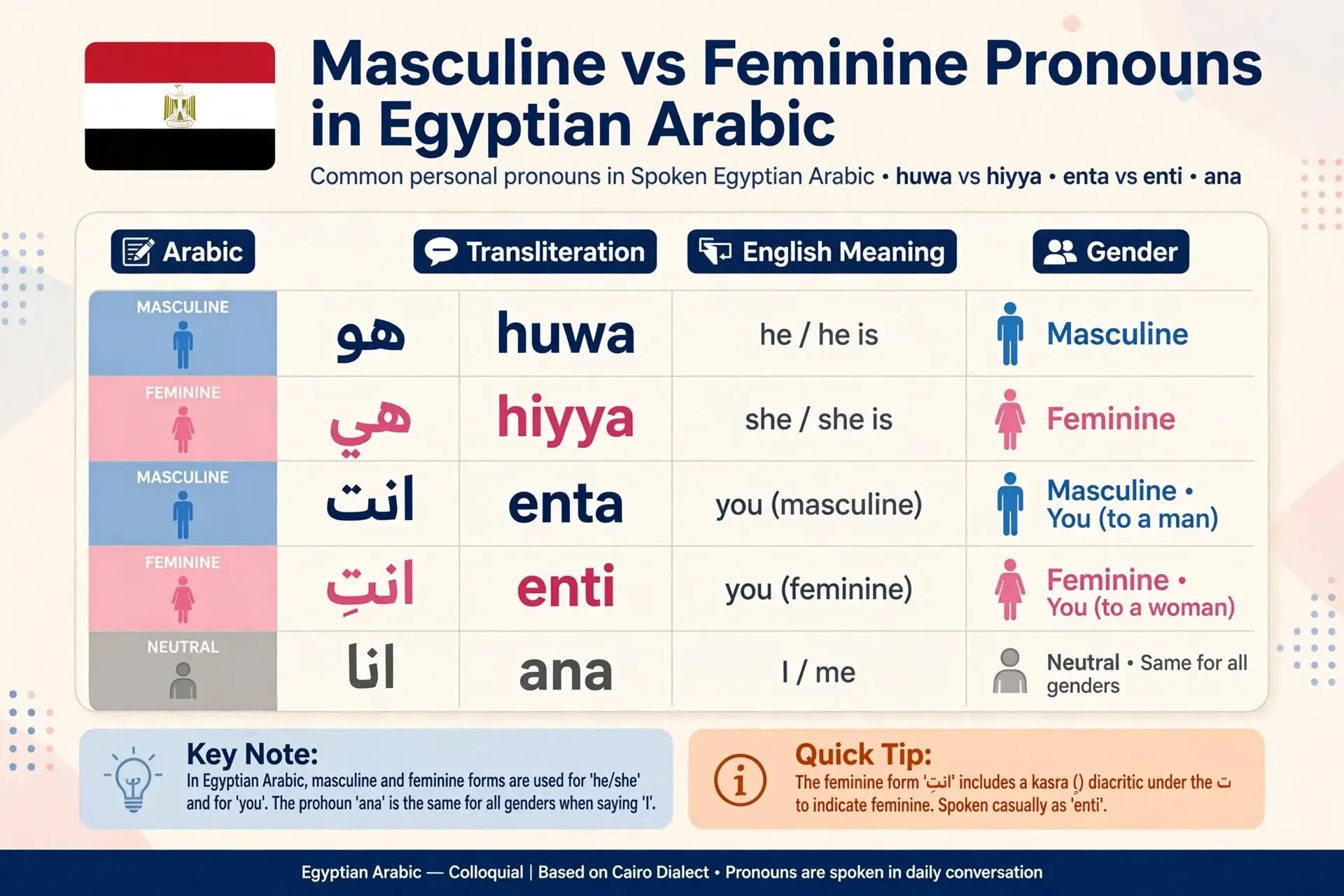
- إنت (inta) = you, talking to a man
- إنتي (inti) = you, talking to a woman
- إنتو (intu) = you, talking to a group
Try it:
- إنت منين؟ (inta mineen?) — Where are you from? (to a man)
- إنتي منين؟ (inti mineen?) — Where are you from? (to a woman)
Greetings work the same way. The famous “How are you?” is إزيك (izzayak) for a man and إزيك (izzayik) for a woman. Look at the Arabic script. Identical. Only the last vowel changes: -ak or -ik.
Welcome follows the pattern too. أهلاً بيك (ahlan beek) to a man. أهلاً بيكي (ahlan beeki) to a woman.
Honestly, if you only fix one thing this week, fix this. Listen for the last sound. -ak for him, -ik for her. It’s the most common gender slip I hear from learners, and it’s also the easiest one to fix. Want to see more male and female pairs in action? Our list of the 50 most common Egyptian Arabic phrases has plenty.
Nouns: The “-a” Rule
For nouns, one rule does most of the work.
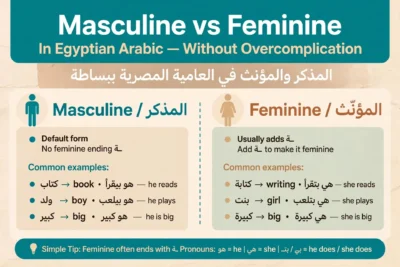
If a noun ends in -a (ـة), it’s usually feminine. If it doesn’t, it’s usually masculine.
- كتاب (kitaab) — book — masculine
- مدرّس (mudarris) — male teacher
- مدرّسة (mudarrisa) — female teacher
- طالب / طالبة (taalib / taaliba) — male student / female student
- صاحب / صاحبة (saahib / saahiba) — male friend / female friend
For people, you just add the -a to make it female. Easy.
Things are a little trickier, because the gender can feel random. A few common ones are feminine even without the -a: إيد (eed) hand, عين (eyn) eye, شمس (shams) sun. And a few male names end in -a, like Hamza. So the rule is a strong hint, not a law.
I’ll be straight with you: you will never memorize these from a list. Don’t try. Learn the word with its partner instead. Don’t learn “bag.” Learn “this bag,” الشنطة دي (esh-shanta di). That tiny word di tells you it’s feminine every single time you say it.
Adjectives: Add -a for a Woman
Adjectives follow the person or thing they describe. For people, add -a to make the feminine.
- تعبان / تعبانة (ta’baan / ta’baana) — tired
- جعان / جعانة (ga’aan / ga’aana) — hungry
- مبسوط / مبسوطة (mabsoot / mabsoota) — happy
- عايز / عايزة (ayiz / ayza) — wanting
Now here’s where almost every beginner trips. Gender follows the person the word describes. Not the person you’re talking to.
- A man says: أنا تعبان (ana ta’baan) — I’m tired.
- A woman says: أنا تعبانة (ana ta’baana) — I’m tired.
Same sentence in English. Different word in Arabic, because the speaker is different.
Now flip it. When you ask someone else how they feel, the word follows them:
- To a man: إنت تعبان؟ (inta ta’baan?)
- To a woman: إنتي تعبانة؟ (inti ta’baana?)
So before you speak, ask yourself one question: “Who is this word describing?” That’s the whole decision.
Things work the same way. Use ده (da) for masculine and دي (di) for feminine:
- الكتاب ده جديد (el-kitaab da gedeed) — This book is new.
- الشنطة دي جديدة (esh-shanta di gedeeda) — This bag is new.
See what happened? Da goes with the book. Di goes with the bag. And the adjective picked up an -a on the bag sentence. Everything matches. That’s all “agreement” means.
Verbs: Small Changes, Big Payoff
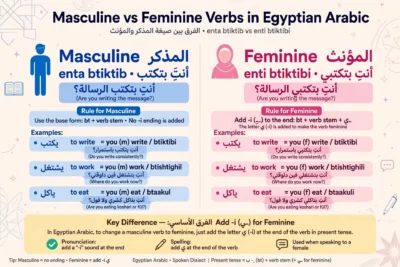
Verbs change too. But the pattern is smaller than you’d think. Let’s use the verb “write.”
Present tense:
- أنا بكتب (ana baktib) — I write (man or woman, same word)
- إنت بتكتب (inta bitiktib) — you write (to a man)
- إنتي بتكتبي (inti bitiktibi) — you write (to a woman)
- هو بيكتب (huwwa biyiktib) — he writes
- هي بتكتب (hiyya bitiktib) — she writes
Two rules fall out of that. When you talk to a woman, add -i to the end. And “he” becomes “she” by swapping biyi- for bit-.
One trap, and I’ll flag it now so it doesn’t surprise you. Look at “you (to a man)” and “she.” Both are bitiktib. Same word. Context tells you which one it is. Everybody gets confused about this for about a week. Then it clicks and you never think about it again.
Past tense follows the same idea. The woman’s form gets an extra sound at the end:
- هو راح (huwwa raah) — he went
- هي راحت (hiyya raahit) — she went
- إنت رحت (inta ruht) — you went (to a man)
- إنتي رحتي (inti ruhti) — you went (to a woman)
Notice the pattern. Women get an extra -i or -it. That’s it. You don’t need to memorize full charts to start. Pick five verbs you use daily and learn both versions.
Groups: The Good News
Here’s something nobody mentions early enough. Plural is easy in Egyptian Arabic.
In formal Arabic (MSA), plural forms still split by gender. Egyptian dropped most of that in everyday speech. One plural form covers everybody.
- إنتو (intu) — you all (men, women, or mixed)
- دول (dool) — these
- تعبانين (ta’baneen) — tired (plural)
- عايزين (ayzeen) — wanting (plural)
- بتكتبوا (bitiktibu) — you all write
Talking to three women? Same words. Mixed group? Same words. No second guessing.
Curious how this compares with the formal version? We break down the bigger picture in MSA vs Egyptian vs Quranic Arabic: Which One Should You Start With?
Questions Learners Keep Asking
These come up in almost every beginner class I teach. So let’s answer them straight.
“Do I really have to change everything when I talk to a woman?”
Not everything. Start with three things: inti, the -ik ending, and the -i on verbs. That covers most of daily conversation. The rest comes naturally as you listen to more Egyptian speech.
“What if I don’t know if the person is a man or a woman?”
Think texting a stranger, a voice note, or an online customer service chat. Use the masculine form. It’s the default form when you don’t know who you’re addressing. Nobody will blink.
“What happens if I get it wrong?”
Nothing bad. I promise. Egyptians are famously patient with learners, and most are thrilled you’re trying at all. Someone might smile. Someone might gently fix you. That’s a free lesson.
Honestly, the people who worry most about gender mistakes are the ones who speak the least. Speak first. Fix later. That’s how every fluent speaker did it.
“Is it the same in Modern Standard Arabic?”
Mostly yes. Same two genders, same basic idea. But MSA has extra forms on top, like separate feminine plurals. Egyptian is lighter. That’s one reason many learners find spoken Egyptian friendlier to start with.
“Does the Arabic script show the difference?”
Sometimes it doesn’t. We saw it already: إزيك is written the same for a man and a woman. Without the short vowels, the script hides the very sound you need. That’s why I always tell beginners to learn by ear first. It’s also why our Egyptian Arabic course starts with listening and speaking, with Latin-letter transliteration so you can say things on day one. The script comes later, if you want it.
The Sticky-Note Cheat Sheet
Copy this onto a sticky note. Seriously.
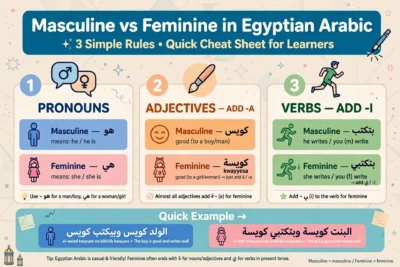
- Talking to a man: inta, -ak. Talking to a woman: inti, -ik.
- Nouns: ends in -a = usually feminine.
- Adjectives: add -a when it describes a woman or a feminine thing.
- Verbs: add -i for “you” to a woman. Swap biyi- for bit- for “she.”
- “This”: da for masculine, di for feminine.
- Groups: intu, -een, -u. Gender disappears.
Six rules. That’s the whole system for beginners.
Quick Practice (No Scrolling Yet)
Try these out loud before you check the answers.
- You’re asking your female teacher if she’s tired.
- A man tells you he’s hungry.
- Your sister went home.
- “This bag is new.”
Answers:
- إنتي تعبانة؟ (inti ta’baana?)
- أنا جعان (ana ga’aan)
- أختي راحت البيت (ukhti raahit el-beit)
- الشنطة دي جديدة (esh-shanta di gedeeda)
Got three out of four? You’re already ahead of most beginners.
How to Practice Without Burning Out
Here’s what works. Learn everything in pairs. Don’t learn ta’baan. Learn ta’baan / ta’baana and say both out loud. Five pairs a day is plenty.
And keep it short. Fifteen focused minutes beats a two-hour weekend cram, every time. Our 15-minute daily study routine shows the exact structure: review, one new thing, then speak it. It’s written around MSA, but the method works just as well for Egyptian.
If you like learning from real phrases, go back to the Egyptian Arabic phrases list and notice every male and female pair as you read. You’ll start spotting the pattern everywhere.
Learn It the Simple Way
Reading about gender gets you halfway. The other half is hearing it, saying it, and getting corrected by someone who has said these words their whole life. That’s hard to do alone.
At Alphabet Arabic Academy, our Colloquial Egyptian Arabic course is built around real conversation with Egyptian teachers. You speak from the first lesson, and your teacher fixes the -ak and -ik slips before they become habits.
Not sure where you are right now? Take the free Arabic level test first. Want to know who you’d be learning with? Meet the teachers. Ready to compare options? The pricing page lays everything out.
Or just book a free trial lesson and hear how it feels.
Gender in Egyptian Arabic isn’t scary. It’s just a few small endings, repeated until your mouth does them on its own.
Learn simply. Start today.