Here’s a scene I see every month. A new student learns مش (mish) in lesson one. They feel great. Then they try to say “I didn’t go,” and out comes mish ru7t.
Everyone in the room understands. But it’s wrong. And that’s the moment they find out that negation in Egyptian Arabic has two tools, not one.
Good news, though. It’s still far easier than negation in Modern Standard Arabic. Once you see the pattern, you’ll stop second-guessing every “not” you say.
(Quick note: I write ع as 3, ح as 7 and the hamza as 2. It’s how Egyptians type on WhatsApp, and it’s easier to read than fancy symbols.)
The Short Answer
If you only have 30 seconds, here it is:
- مش (mish) goes before nouns, adjectives, participles like عايز and فاهم, places, and the future with هـ.
- ما + verb + ش (ma… sh) wraps around verbs in the past, the present with ب, and commands.
- مفيش (mafeesh) and ما عنديش (ma 3andeesh) cover “there isn’t” and “I don’t have.”
That’s the whole system. The rest of this article is just learning to use it without freezing mid-sentence.
Why Egyptian Negation Is Easier Than MSA
In MSA you pick between لا, ما, لم, لن and ليس. Which one depends on the tense and on whether the sentence has a verb at all. Wikipedia’s overview of negation in Arabic lays out how many options there are.
Egyptian Arabic cut that list down hard. You have مش, and you have the ما…ش wrap. That’s it.
If you’re still deciding between the two varieties, read our guide on Egyptian Arabic vs MSA first. If you want the formal side later, our Modern Standard Arabic online guide covers it.
Tool #1: مش (mish) for Everything That Isn’t a Verb
Put مش right before the word you want to negate. No endings. No gender changes. No plural forms. It stays مش for “he,” “she,” “they,” “you all.” Everything.
- هو مش كبير. (howwa mish kibeer) He’s not big.
- أنا مش جعان. (ana mish ga3aan) I’m not hungry.
- هي مش هنا. (heyya mish hena) She’s not here.
- هما مش في البيت. (humma mish fil-beit) They’re not at home.
- دي مش مشكلتي. (dee mish moshkilti) That’s not my problem.
The participle trap
Here’s where beginners get confused. Words like عايز (want), فاهم (understand), عارف (know) and رايح (going) feel like verbs. In English they act like verbs. In Arabic grammar they’re active participles, which makes them closer to adjectives. So they take مش:
- أنا مش عايز قهوة. (ana mish 3ayez ahwa) I don’t want coffee.
- هي مش فاهمة. (heyya mish fahma) She doesn’t understand.
- هو مش رايح الشغل. (howwa mish raye7 esh-shoghl) He’s not going to work.
You’ll use these constantly. Honestly, if you master just this section and the “don’t know” phrase (مش عارف), you can survive most everyday conversations. You’ll also hear them all through our list of the 50 most common Egyptian Arabic phrases.
The future also uses مش
The future marker هـ (ha-) works like a little participle, so it takes مش too:
- مش هروح. (mish haroo7) I won’t go.
- هي مش هتيجي. (heyya mish hatigi) She won’t come.
- مش هنلحق. (mish hanil7a2) We won’t make it in time.
Grammar books sometimes list a ما…ش version of the future. You may hear it now and then. Ignore it. Use مش and you’ll sound natural.
Tool #2: The ما…ش Sandwich for Verbs
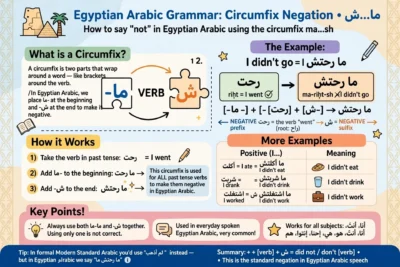
This is the one that trips people up. A real verb gets wrapped: ما goes before it and ـش goes after it. The verb sits in the middle like a sandwich filling.
ما + verb + ش
Let’s build one together. Take the past tense verb شفت (shuft), “I saw.”
- Start with the verb: شفت
- Add ما in front: ما شفت
- Add ـش at the end, with a helper vowel: ما شفتش (ma-shuftish)
Done. “I didn’t see.”
The -sh vs -ish detail
Look at what happened at the end. The verb ended in a consonant (shuft), so a little vowel appeared: shuft-ish. If the verb ends in a vowel, you just add -sh, and the vowel before it usually stretches out.
| Pronoun | Affirmative | Negative |
|---|---|---|
| ana (I) | رحت ru7t | ما رحتش ma-ru7tish |
| inta (you, m.) | رحت ru7t | ما رحتش ma-ru7tish |
| howwa (he) | راح raa7 | ما راحش ma-raa7sh |
| heyya (she) | راحت raa7it | ما راحتش ma-raa7itsh |
| ihna (we) | رحنا ru7na | ما رحناش ma-ru7naash |
| humma (they) | راحوا raa7u | ما راحوش ma-raa7oosh |
Yes, “I went” and “you went” sound identical in the affirmative. That’s normal. Context handles it.
Some past tense verbs are irregular, and the most common one is جه (geh, “he came”):
- هو ما جاش (howwa ma-gaash) He didn’t come.
- هي ما جتش (heyya ma-gatsh) She didn’t come.
- هم ما جوش (humma ma-guush) They didn’t come.
The present tense with ب
For habits and ongoing actions, wrap the verb after the ب:
- أنا ما بحبّش السمك. (ana ma-ba7ebbesh es-samak) I don’t like fish.
- أنا ما باكلش اللحمة. (ana ma-bakolsh el-la7ma) I don’t eat meat.
- هو ما بيشربش قهوة. (howwa ma-byeshrabsh ahwa) He doesn’t drink coffee.
Here’s a bit of good news. With the ب present you can often use مش instead. “Mish ba7ebb es-samak” is also fine, but it sounds a little more like a general statement. Native speakers swap between the two all the time.
Where does -sh go when you add extra pieces?
At the very end. After everything. Object pronouns, “to me,” “for you,” all of it comes before the ش.
- ما شفتوش (ma-shuftuush) I didn’t see him.
- ما قلتلوش (ma-olt-illoosh) I didn’t tell him.
If you remember one thing from this section, remember that ش is always the last sound.
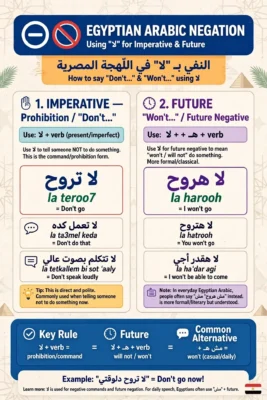
Negative Commands: “Don’t Do That!”
Want to say “don’t”? Use ما…ش with the you form of the verb. Not مش.
- ما تروحش. (ma-tru7sh) Don’t go.
- ما تقلقش. (ma-te2la2sh) Don’t worry.
- ما تنساش. (ma-tensaash) Don’t forget.
- ما تزعلش. (ma-tez3alsh) Don’t be upset.
Talking to a woman? Add a long -ee: ما تقلقيش (ma-te2la2eesh). Talking to a group? Use -oo: ما تقلقوش (ma-te2la2oosh).
“I Don’t Have” and “There Isn’t”
Egyptian Arabic has no verb for “have.” You use عند (3and), “at,” and negate it with ما…ش like a verb:
- ما عنديش وقت. (ma-3andeesh wa2t) I don’t have time.
- ما معييش فلوس. (ma-ma3ayyaash felus) I don’t have money on me.
For “there isn’t,” Egyptians glue things together into one word:
- مفيش مشكلة. (mafeesh moshkela) There’s no problem.
- مفيش حد هنا. (mafeesh 7add hena) There’s nobody here.
And for “wasn’t/weren’t,” use the past of كان:
- ما كنتش هناك. (ma-konteesh henaak) I wasn’t there.
- ما كانش موجود. (ma-kaanesh mawgood) He wasn’t there.
Double Negatives Are Not a Mistake
I’ll be straight with you. If you grew up with English grammar rules, this feels wrong. In Egyptian Arabic you pile up negatives and it’s perfectly correct:
- مفيش حد جه. → محدش جه. (mahaddesh geh) Nobody came.
- ما شفتش حاجة. (ma-shuftish 7aaga) I didn’t see anything.
- ما قلتش لحد. (ma-olt-eesh le7add) I didn’t tell anyone.
- ما بحبش ولا حاجة. (ma-ba7ebbesh wala 7aaga) I don’t like anything.
Don’t try to “fix” it. “I didn’t see nothing” is bad English. In Egyptian Arabic, it’s just how sentences work. You’ll also run into the word ولا (wala), which means “not even” or “neither/nor,” as in ولا مرة (wala marra), “not once.”
One more thing. Sometimes ما shows up on its own with no ـش, especially in set phrases like عمري ما شفته (3omri ma shuftu), “I’ve never seen him.” Don’t stress about it. You’ll pick it up by ear.
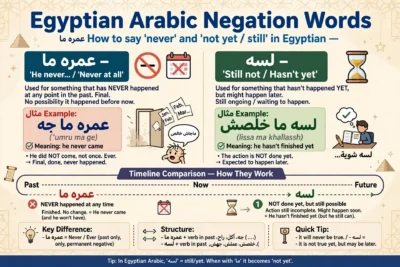
“Not Yet” with لسه
Say you want “I haven’t eaten yet.” Use لسه (lessa, “still/yet”) plus the negated verb:
- لسه ما أكلتش. (lessa ma-akaltish) I haven’t eaten yet.
- لسه ما جاش. (lessa ma-gaash) He hasn’t come yet.
When مش Does Go With the Past
Okay, so I told you not to say mish ru7t. Here are the two situations where مش and a past verb do meet.
1. Rhetorical questions. This is super common:
- مش قلتلك؟ (mish olt-illak?) Didn’t I tell you?
2. Contrast, where مش goes before a pronoun, not the verb:
- مش أنا اللي كسرته. (mish ana illi kasartu) I’m not the one who broke it.
Notice that in both cases مش is doing a different job. It’s negating a person or asking a leading question. It isn’t negating the action.
“Don’t Have To” vs “Must Not”
This is a favorite of mine because the English is so sneaky. Same words, wildly different meanings:
- مش لازم تروح. (mish laazem teru7) You don’t have to go. (Optional.)
- لازم ما تروحش. (laazem ma-teru7sh) You must not go. (Forbidden.)
Mix those up at a family dinner and things get awkward fast.
Six Mistakes I See All the Time
1. Using مش with past verbs.
Wrong: mish ru7t. Right: ma-ru7tish.
2. Forgetting the ـش.
Saying ma ru7t sounds half-finished to an Egyptian ear. Other dialects work differently. For example, Hejazi Arabic doesn’t add the -sh ending to negated verbs, so learners who’ve heard Gulf Arabic often drop it. In Egyptian, keep it.
3. Using ما with nouns and adjectives.
Wrong: ma howwa kibeer. Right: howwa mish kibeer. Outside of verbs, ما almost never works as a negation in Egyptian Arabic.
4. Dragging in MSA negation.
Saying ana la a3raf (“I don’t know”) with an Egyptian accent sounds like a news anchor at a falafel stand. Say معرفش (ma3rafsh) or مش عارف (mish 3aaref). This is the same trap I describe in our full guide to learning Egyptian Arabic, the MSA-Egyptian hybrid.
5. Using مش for commands.
“Don’t go!” is ma-tru7sh. Not mish teru7.
6. Saying لا for “no.”
The everyday Egyptian “no” is لأ (la2). It’s short, with a clipped hamza. The MSA لا sounds stiff in casual speech.
Quick Practice: Negate These
Cover the answers and try them out loud. Seriously, say them. Your mouth needs the practice more than your eyes do.
- أنا جعان.
- هي رايحة الشغل.
- أنا فهمت.
- هو بيحب القهوة.
- هاروح بكرة.
- عندي وقت.
- روح!
- فيه مشكلة.
- هو جه إمبارح.
- شفت حد.
Answers:
- أنا مش جعان. (ana mish ga3aan)
- هي مش رايحة الشغل. (heyya mish ray7a esh-shoghl)
- أنا ما فهمتش. (ana ma-fhemtish)
- هو ما بيحبّش القهوة. (howwa ma-byi7ebbesh el-ahwa)
- مش هاروح بكرة. (mish haroo7 bokra)
- ما عنديش وقت. (ma-3andeesh wa2t)
- ما تروحش! (ma-tru7sh)
- مفيش مشكلة. (mafeesh moshkela)
- هو ما جاش إمبارح. (howwa ma-gaash embare7)
- ما شفتش حد. (ma-shuftish 7add)
If you got eight or more, you’re in good shape. If you got five or fewer, no panic. Come back tomorrow and do them again. That’s how this works.
Questions Learners Keep Asking
I couldn’t pull exact Reddit or Quora threads for this draft, but these questions show up constantly on italki, WordReference and in my own classes.
What’s the difference between مش عارف, معرفش and مبعرفش?
The first two both mean “I don’t know.” The first uses عارف, a participle negated with مش, while the second is the verb negated with ما…ش, but they land on the same meaning. The third, مبعرفش, is the ب-present. It leans toward “I generally don’t know how to” something, like مبعرفش أتكلم روسي, “I can’t speak Russian.”
Can I just use مش for everything to keep it simple?
You can survive for a while. Egyptians will understand you. But you’ll sound like a learner every time you use it with a past verb. The ما…ش wrap isn’t hard once you’ve said it twenty times.
Does ماشي mean “not”?
Not in Egypt. In Egyptian Arabic ماشي means “okay, fine, deal.” But in Moroccan and Algerian Arabic, ماشي works as a negation. That’s a fun one to remember when you travel across the region.
Is it مش or مش؟ Do I pronounce it “mish” or “mush”?
Both. Spelling is always مش. You’ll hear mish more often, and mush from some speakers. Pick one and be consistent.
How do Egyptians type negation in chat?
Usually the same Arabic spelling, just glued together: مشوفتش، معرفش، مفيش. For more on this, see our guide to WhatsApp and chat Egyptian Arabic.
How to Actually Make This Stick
Don’t memorize tables. That’s the worst way to learn this.
Here’s what works. Pick five sentences from this article. Say each one out loud ten times a day. Then swap the verb. Ma-akaltish becomes ma-shribtish. Ma-ru7tish becomes ma-gittish. You’re training your mouth, not your notebook.
If you need a structure to keep this going, our daily Arabic study routine shows how to fit 20 minutes of practice into a normal day. For conversation practice with real phrases, check out the Egyptian Arabic conversation guide. Got more questions? Our Arabic learning FAQ covers the basics, and the blog has the rest.
Not sure where you stand right now? Take the free Arabic placement test. It takes a few minutes and tells you exactly which level to start from.
Ready to Stop Guessing?
Negation is one of those things that’s easy to explain and hard to use without feedback. You need someone to catch the mish ru7t before it becomes a habit.
That’s what our teachers do. Meet the teachers, check the course options and pricing, and start building real spoken Egyptian Arabic from day one.