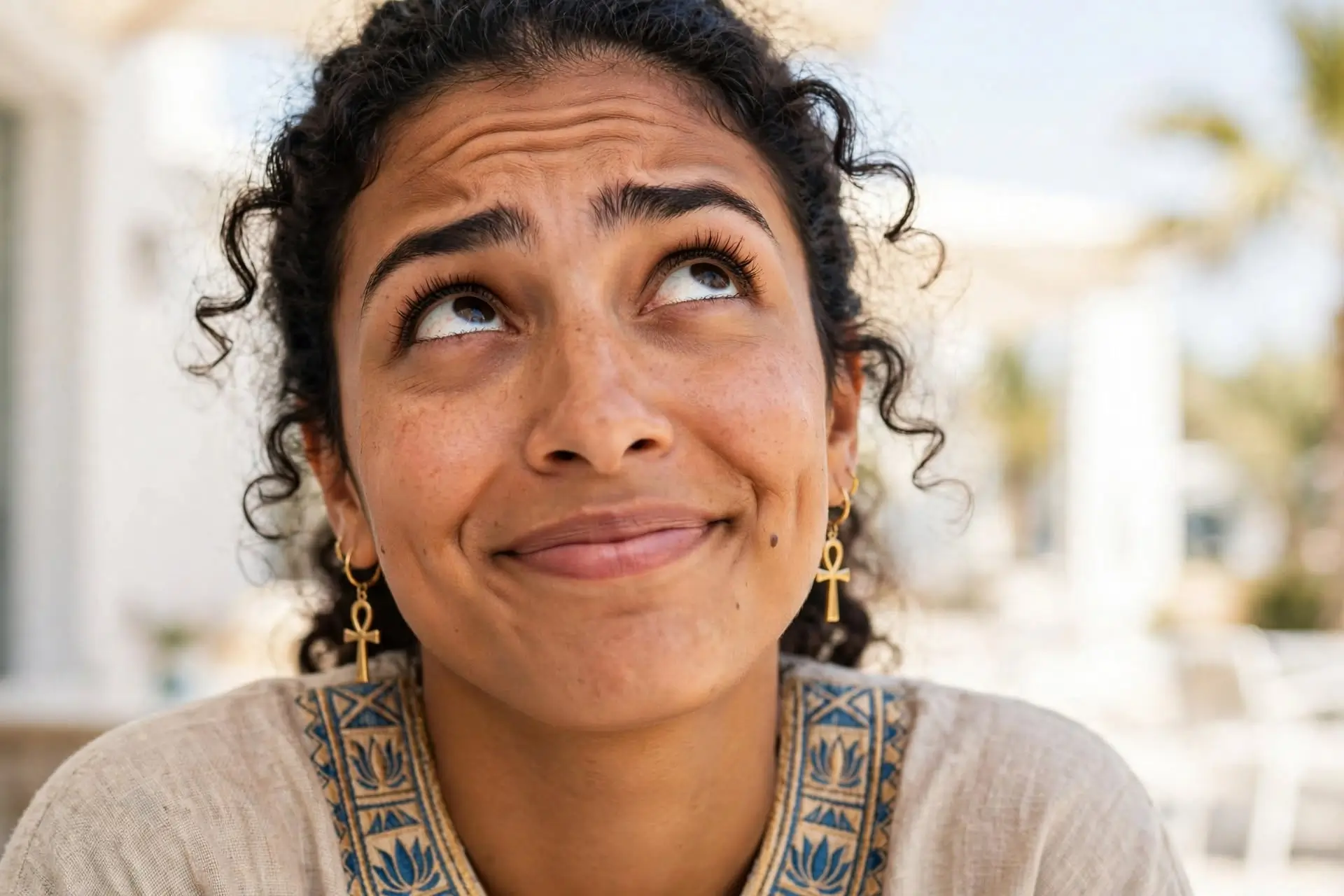
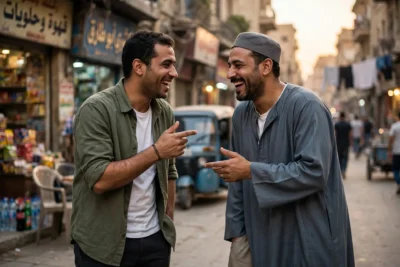
You finally understand the words. You caught every single one. And the whole table still burst out laughing while you sat there smiling politely, waiting for someone to explain.
I’ve watched this happen to students for years. Egyptian Arabic humor is one of the last things learners get, and it’s the thing they want most. Nobody dreams of ordering bread correctly. They dream of getting the joke.
So let’s talk about what’s actually going on, and why your textbook never mentioned any of it.
Why the jokes don’t land (even when you know the words)
Here’s the thing. Vocabulary isn’t your problem. Context is.
Egyptian humor runs on tone, timing, and things nobody says out loud. The literal meaning of a sentence is often the opposite of what the person means. If you translate word by word, you’ll get the words right and the message completely wrong.
Egyptians also have a reputation across the Arab world for being funny. Part of that comes from media. Egyptian Arabic is understood in most Arabic-speaking countries largely thanks to Egyptian cinema and music, which is why a lot of people from Morocco to Iraq grew up hearing Egyptian jokes. You can read more about the dialect’s background on Wikipedia’s Egyptian Arabic page. Comedy is a big part of why it travelled.
Jokes, songs, and movies all live in the dialect. If you only study the formal language, you’ll miss most of that. (More on that in a minute.)
“Damo khafif”: the phrase that explains everything
Start with one phrase. دمه خفيف (damo khafeef). It literally means “his blood is light.”
It means someone is funny, charming, easy to be around. A compliment. A big one.
The opposite is دمه تقيل (damo te’eel), “his blood is heavy.” That person is annoying, or tries too hard, or kills the mood.
Why does this matter? Because in Egypt, being funny isn’t a bonus personality trait. It’s close to a social skill. People judge each other on it. When you learn to say damo khafeef about someone, you’re speaking their value system, not just their language.
Two more you’ll hear all the time:
- ابن نكتة (ibn nokta): literally “son of a joke.” A guy who’s naturally funny.
- بايخ (baayekh): a joke or a person that falls flat. Stale. Lame. Egyptians hate a baayekh joke and they’ll tell you.
Sarcasm: praise that means the opposite
This is where learners get burned first.
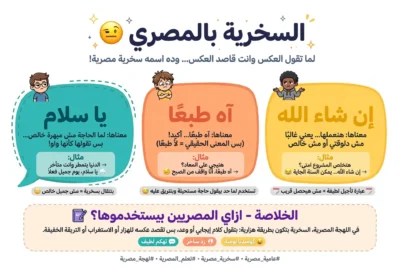
In Egyptian Arabic, a lot of sarcasm works by praising something that’s obviously bad. Spilled tea on the laptop? Someone says “bravo.” They don’t mean bravo.
| Phrase | Literal meaning | What it can mean when sarcastic |
|---|---|---|
| شاطر (shaater) | Smart, hardworking | “Real genius, huh?” |
| برافو عليك (bravo ‘aleek) | Bravo to you | “Well done. Really.” |
| يا سلام (ya salaam) | Wow! | “Oh sure. Of course.” |
| تحفة (tohfa) | A masterpiece | “Beautiful. Just beautiful.” (about a mess) |
| ربنا يهديك (rabbena yehdeek) | May God guide you | “You’re impossible.” |
Notice the problem. Every one of these is also a real, sincere phrase. Ya salaam can be pure delight. Same words, opposite meaning.
So how do you tell? Three clues:
- The situation. Is the thing they’re praising actually good? If not, it’s sarcasm.
- The tone. Flat, drawn-out, slightly too sweet. You’ll hear it.
- The face. Raised eyebrow, half smile. Egyptians rarely hide sarcasm completely.
I’ll be straight with you: you will get this wrong for a while. Everybody does. I still remember misreading a “ya salaam” as praise years ago and thanking someone who was roasting me. The room loved it. Getting it wrong is part of the process, and Egyptians are usually kind about it.
Insults that aren’t insults
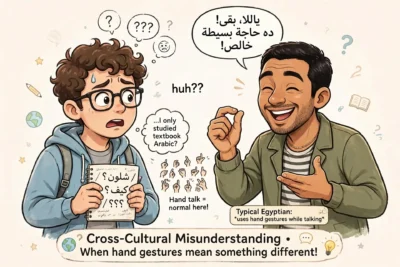
This one confuses people the most. Between friends, family, and neighbors, something that sounds like a curse is often affection.
- يخربيتك (yikhrab beitak): “may your house be ruined.” Said with a laugh, it means “you crazy genius” or “I can’t believe you did that.”
- يا مجنون (ya megnoon): “you lunatic.” Friendly, when smiling.
- يا حمار (ya hemaar): “you donkey.” Teasing between close friends.
- يا نصاب (ya naassaab): “you fraud.” Usually said when someone tells a big story or pulls a fast one.
Here’s the catch, and please listen. Don’t start using these yourself with people you barely know. Same words, different relationship, very different result. Understand them first. Use them last, and only with people who’ve already teased you.
Exaggeration, understatement, and Egyptian time
Egyptians love a dramatic line. Ask how long something will take and the answer might be “five minutes,” which can mean anything from five minutes to the rest of your evening.
The classic example: بكرة في المشمش (bukra fil mishmish). Literally, “tomorrow, in apricot season.” Apricot season is short, so this means “when pigs fly.” It’s a polite, funny way to say never.
Other favorites:
- أنا جاي حالاً (ana gay haalan): “I’m coming right now.” Time will tell.
- يا خبر أسود (ya khabar eswid): “black news!” Oh no, what a disaster (often exaggerated on purpose).
- هموت من الضحك (hamoot min ed-dahk): “I’ll die from laughing.” Very normal thing to say.
Egyptians also use شر البلية ما يضحك, roughly “the worst calamity is what makes you laugh.” It’s a saying, but it’s also a way of life. Traffic, prices, bureaucracy, the neighbor’s cat: everything becomes material. Humor is how a lot of people cope. If you understand that, the jokes make more sense. They aren’t random. They’re a pressure valve.
The joke vocabulary you actually need
You don’t need a hundred words. You need these:
- نكتة (nokta): a joke
- هزار (hazaar): joking around. بهزر (bahazzar) means “I’m kidding.”
- قفشة (‘afsha): a quick witty comeback
- إفيه (efeeh): a punchline or catchphrase, often from a movie or a show
- تريقة (taree’a): mocking or teasing, usually light
- مقلب (ma’lab): a prank
- بتشتغلني؟ (betesh-taghalni?): “are you messing with me?”
That last one is gold. When you don’t know if someone is serious, ask it. Egyptians will laugh and tell you.
Humor in text messages
Egyptians text like they talk, and humor gets even quicker there.
You’ll see long strings of هههههه and 😂 everywhere. A short “هه” from someone can feel dry or sarcastic, though it depends on the person. You’ll also see يا نهار أبيض (“white day!”, a reaction to bad news or surprise, usually playful) and lots of meme references you won’t get until you’ve watched enough Egyptian content.
Which brings me to something practical.
Where to learn this stuff
You won’t find it in a grammar book. You find it in:
- Old and new Egyptian comedy films. Watch with Arabic subtitles first, then try without.
- Stand-up clips and short sketches. Short is good. You can replay a 90-second scene ten times.
- Comment sections on Egyptian pages. This is messy and honest and full of sarcasm. Perfect study material.
- Your teacher. A good one will stop mid-lesson and say, “Wait, they didn’t mean that. Here’s the real meaning.”
If you want more structure around building a routine like this, our daily Arabic study routine breaks it into short, doable pieces. Ten minutes of comedy clips counts as study time. I promise.
“But I studied MSA first.” Now what?
This is one of the most common questions I see from learners, and you’ll find versions of it all over Reddit and Quora:
- “Learning Egyptian dialect after 2 years of MSA?”
- “Should I learn Egyptian Arabic or MSA first?”
- “What’s easier and more practical to start with?”
Honest answer. Your MSA isn’t wasted. Reading, spelling, and a lot of shared vocabulary carry over. But humor is exactly where MSA-only learners feel the gap. Jokes and slang live in the dialect. You can understand a sentence and still miss what it does.
The fix isn’t starting over. It’s adding Egyptian on top: pronunciation shifts (like ج becoming a hard g), new negation with مش (mish), the بـ (bi-) present tense, and the slang that goes with it. I break down the whole MSA-versus-Egyptian decision in Egyptian Arabic vs MSA: which one first?. Read that if you’re stuck choosing.
And if you’re just starting out and wondering how conversation practice works, this guide on speaking Egyptian dialect and everyday conversation will help.
Will other Arabic speakers understand my Egyptian?
Another question I see constantly: “I learn Egyptian Arabic, will speakers of other dialects understand me?”
Mostly, yes. Egyptian is the most widely understood dialect, again because of movies, TV, and music. You won’t get blank stares in Lebanon or the Gulf the way you might with a smaller dialect. Their own dialect will differ, and their jokes will too, but they’ll follow yours.
Five mistakes learners make with Egyptian humor
- Translating jokes word for word. Jokes rarely survive it. Ask what the person meant.
- Taking praise at face value. If it sounds too enthusiastic about something bad, it’s probably sarcasm.
- Copying insults and slang too early. Understand first. Use later.
- Laughing at something you didn’t understand. It usually shows. Asking is better and people like it.
- Waiting until you’re “advanced” to listen to real Egyptian. Start now. You’ll catch 20 percent and that’s fine. It grows.
“My goal is to reach intermediate, but I don’t think I’ll get there”
I’ve seen this exact worry from a learner on Reddit, and I want to answer it directly.
You’ll get there. Not fast, but you’ll get there. Intermediate in Egyptian Arabic isn’t a magic level. It’s the point where you can follow a normal conversation, catch most of the jokes, and answer back without freezing. That happens through repetition, listening, and a bit of stubbornness. Not talent.
The learners who make it aren’t the ones with the biggest vocabulary. They’re the ones who keep showing up, keep listening, and don’t get embarrassed when a joke goes over their head.
Quick answers
What should I know before learning Egyptian Arabic?
That it’s spoken more than written, that humor is a huge part of daily talk, and that tone matters as much as words.
Is Egyptian Arabic humor hard for foreigners?
The vocabulary isn’t. The context is. Sarcasm and cultural references take time. Exposure fixes it.
Can I be funny in Egyptian Arabic as a beginner?
Yes, in small ways. Learn bahazzar, betesh-taghalni, and a couple of exaggerated phrases. Egyptians appreciate the effort more than the accuracy.
Should I learn Egyptian or MSA first?
Depends on your goal. For real conversations and jokes, Egyptian. For reading and formal contexts, MSA. Many people end up learning both.
Ready to get the jokes?
Reading about humor helps. Practicing it with a person who can tell you why something was funny helps more.
If you want to hear real Egyptian in real situations, with a teacher who’ll stop and explain the tone, the slang, and the sarcasm, take a look at our Colloquial Egyptian Arabic course. Not sure where you stand? Take the free Arabic placement test first. You can also meet the teachers or check pricing and plans.
Develop practical Arabic skills. And next time the table laughs, laugh with them for the right reason.