

If you want to learn Arabic for beginners, the first thing you need is the Arabic alphabet — master it, and everything else becomes clear. This complete guide walks you through every step, from zero knowledge to confident conversation, using proven methods used by students in over 80 countries at Alphabet Arabic Academy.
You won’t need to read anything else about how to start learning Arabic for beginners. Here, I’ve gathered everything you might need. Arabic is easy, not difficult as everyone says. It just requires focus and attention, and above all, choosing a good teacher. By the way, we are original teachers from Egypt. There’s nothing better than that! Whatever your age or gender, you can apply with us and begin your enjoyable journey. You’ll find everything you wish for in learning Arabic with us. Let’s read the article, and you’ll find what you’re looking for.
Who Is This Guide For?

This guide is for you if:
- You have never studied Arabic before and don't know where to start
- You tried learning Arabic before but gave up because it felt too hard
- You want a complete roadmap, not scattered tips and random advice
- You are willing to invest consistent time (even 20 minutes daily)
- You want to learn Arabic for any reason: travel, work, Quran, family, or personal growth
This guide is NOT for you if:
- You are looking for a "magic method" that requires zero effort
- You are already at an intermediate or advanced level (you need a different guide)
- You want to become fluent in 30 days (that is not realistic for any language)
Learn Arabic for Beginners: Essential Language Tools
Before you open a textbook or download an app, you need to understand the tools that will carry you through this journey. Learning Arabic is not about finding the most expensive course — it’s about choosing the right foundation and sticking to it consistently. Here is what every beginner truly needs.
Arabic Alphabet Overview
The Arabic alphabet is made up of 28 letters, written from right to left. Each letter can take up to four different shapes depending on its position in a word — at the beginning, in the middle, at the end, or standing alone. This might sound complex, but it is actually a very logical and consistent system once you start practicing.
A smart approach is to group letters by shape similarity. For example, the letters ب، ت، ث share the same base shape and differ only in the number of dots beneath or above them. Learning them together saves time and builds recognition faster. Aim to learn 3–4 letters per day, with daily review of all previous ones. At this pace, you will complete the alphabet in under two weeks.
Write every letter by hand before moving to typing. The physical act of writing builds what language experts call kinesthetic memory — a deeper kind of retention that reading alone cannot give you.
Let me tell you about Ali.
I’ll tell you a true story. A student came to us who literally didn’t speak a word of Arabic. He’d lived in America his whole life, and his name was Ali. He started studying with us from scratch. Ali never had time to learn, and it was a huge challenge for us to teach him, make him memorize, and show him how to write—all in class. Honestly, he struggled to study even one lesson a week, and despite his many excuses, Ali now reads and writes on his own and has a huge vocabulary. He even met two Egyptians at the mall near his house and started speaking Arabic with them. They became friends, and he tells me about it all with such joy. Ali is an ambitious and hardworking young man. You can be like him, don’t hesitate.
Pronunciation Basics
Arabic has sounds that do not exist in English. Letters like ع، ح، خ، غ، ق are produced from the back of the throat and require deliberate practice. The biggest mistake beginners make is postponing pronunciation work until “later.” By then, bad habits are already formed — and unlearning them takes three times longer than learning them correctly from the start.
The best approach is to work with a native-speaking teacher from the very first week. No app can hear you, correct your tongue position, or explain where exactly a sound comes from. A live teacher can. This is the single most important reason why students who take structured lessons with a qualified instructor progress far faster than those who rely only on self-study tools.
One practical technique that works well is the watch-and-repeat method: find short native audio clips (10–30 seconds), listen carefully, then record yourself and compare. Repeat until the sounds match closely.
Useful Language Apps
Apps are excellent supplements — not replacements — for structured learning. For beginners, the most useful apps include:
Duolingo — Good for building daily practice habits and learning basic vocabulary. It is free and easy to use but does not cover pronunciation or grammar in enough depth for serious progress.
Memrise — Particularly strong for vocabulary memorization using spaced repetition, which is the most scientifically supported method for retaining new words.
Anki — A flashcard app used by serious language learners worldwide. You can create your own Arabic decks or download shared ones. Highly effective for vocabulary and grammar patterns.
ArabicPod101 — Offers audio and video lessons with native speakers. Good for developing listening skills alongside your structured course.
Use apps for 10–15 minutes daily — during your commute, before bed, or during a break. Combine this with your main course for a complete learning system.
Learn Arabic for Beginners: Grammar Foundations
Grammar is not the enemy. In Arabic, grammar is actually one of the most logical systems you will encounter in any language. It follows clear rules with very few arbitrary exceptions. The key is to build it step by step rather than trying to absorb everything at once.
Nouns and Gender
Every Arabic noun is either masculine or feminine — and unlike French or Spanish, Arabic gender follows predictable patterns. Most feminine nouns end in the letter ة (called ta marbuta), which sounds like a soft “a” or “at” when followed by another word. For example:
- كتاب (kitab) = book (masculine)
- مدرسة (madrasa) = school (feminine)
Adjectives, verbs, and pronouns must all agree in gender with the noun they describe. This agreement system might feel unfamiliar at first, but it becomes intuitive quickly with practice.
Arabic also has a unique feature that English lacks: the dual form. Instead of just singular and plural, Arabic has a special form for exactly two of something. This is a small extra step compared to English, but it is a regular, rule-based system — not an exception.
Verbs and Tenses
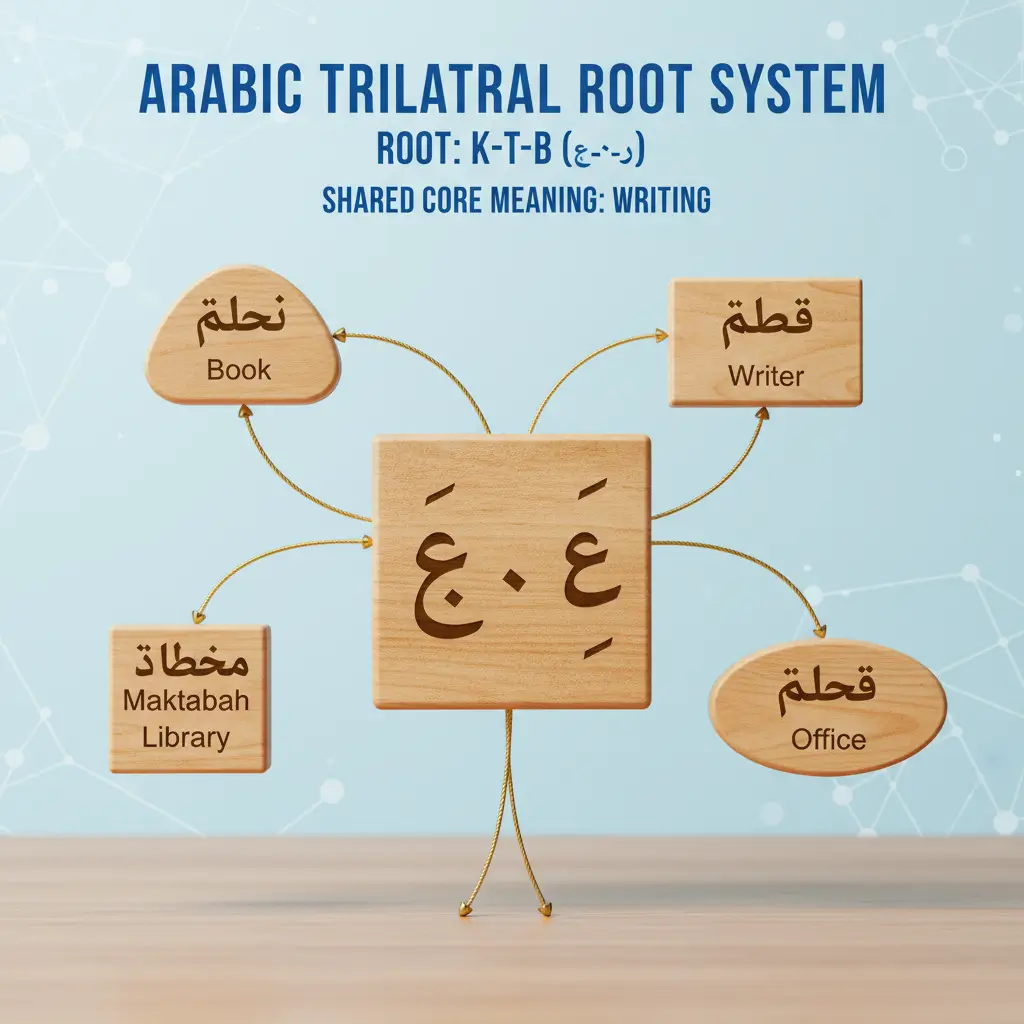
Arabic verbs follow a root system that makes vocabulary learning exponential once you understand it. Almost every Arabic word is built from a three-letter root. Take the root ك-ت-ب (K-T-B), which relates to writing:
- كَتَبَ (kataba) = he wrote
- كِتَاب (kitab) = book
- مَكْتَب (maktab) = office/desk
- كَاتِب (katib) = writer
- مَكْتَبَة (maktaba) = library/bookstore
From one three-letter root, five useful words emerge. Once you learn 200 roots, you can often guess the meaning of thousands of words you have never seen before. This is one of the features that makes Arabic more approachable than its reputation suggests.
For beginners, start with the present tense and build from there. Arabic verbs conjugate to reflect the subject’s person, number, and gender — but the patterns are regular and learnable.
Basic Sentence Structure
Arabic sentences often begin with the verb rather than the subject — a verb-subject-object order (VSO) that differs from English’s subject-verb-object (SVO). For example:
- English: “Ahmed wrote the book.”
- Arabic: كَتَبَ أَحْمَدُ الكِتَابَ (Wrote Ahmed the book.)
However, nominal sentences — sentences without a verb — are extremely common in Arabic and are a great starting point for beginners. The Arabic equivalent of “I am a student” is simply: أَنَا طَالِب (Ana talib) — literally “I student,” with no verb for “am” required.
Start with nominal sentences in your first weeks. They are simple, natural, and widely used in everyday Arabic.
Build Vocabulary for Everyday Conversations
Vocabulary is the material that fills your grammar framework. Without words, grammar is an empty structure. But not all vocabulary is equal — what you learn first matters enormously.
Common Phrases to Know
Your first 50 phrases should be the ones you would use in real situations within the first week of visiting an Arab country. Here are the categories that matter most:
Greetings and social exchanges:
- مرحبا (marhaba) — Hello
- السلام عليكم (al-salamu alaykum) — Peace be upon you (standard Islamic greeting)
- كيف حالك؟ (kayfa halak?) — How are you?
- شكراً (shukran) — Thank you
- من فضلك (min fadlak) — Please
Basic question words:
- مَن (man) — Who
- ماذا (matha) — What
- أين (ayna) — Where
- مَتى (mata) — When
- كيف (kayfa) — How
- لماذا (limatha) — Why
These six question words unlock hundreds of possible sentences as soon as you combine them with basic vocabulary.
Vocabulary for Travel
If one of your goals is travel in Arabic-speaking countries, prioritize the following vocabulary areas early:
Numbers 1–100, days of the week and months, time expressions (morning, evening, tomorrow, next week), food and restaurant vocabulary, directions (right, left, straight, near, far), and emergency phrases (hospital, police, help).
Learning travel vocabulary in context — inside short phrases rather than isolated lists — is far more effective. “أين المستشفى؟” (Where is the hospital?) is more memorable than memorizing مستشفى (hospital) alone.
Words for Daily Activities
Building a vocabulary of daily activities helps you start thinking in Arabic during your regular routine — which is one of the fastest ways to internalize a language. Key verbs for daily life:
أكل (akala) — to eat | شرب (shariba) — to drink | ذهب (thahaba) — to go | جاء (ja’a) — to come | عمل (amila) — to work | نام (nama) — to sleep | قرأ (qara’a) — to read | كتب (kataba) — to write
Aim for 50 new words per week in your first three months, reviewed daily using spaced repetition. By month three, you should have 500–700 words — enough to handle basic everyday conversations.
Practice Listening Skills in Arabic
Listening is the most underrated skill in language learning. Many students spend months reading and writing Arabic but struggle to understand a native speaker because they never trained their ears. Start listening from week one — even before you understand everything.
Recommended Arabic Podcasts
Podcasts give you access to natural Arabic speech at any time, with no screen required. The following are well-suited for beginners:
ArabicPod101 — Offers episodes specifically designed for beginners with slow, clear speech and full transcripts. Start with their “Absolute Beginner” series.
Sout Al-Arabia — A podcast focused on Modern Standard Arabic with structured lessons. Good for learners aiming to read news or formal texts.
Marhaba Arabic — Short episodes built around everyday conversation topics. Useful for Egyptian Arabic learners.
A proven technique for beginners is to listen to the same short episode (2–5 minutes) every day for a week. On day one, you might understand 10%. By day seven, you will often understand 40–60% — not because the content changed, but because your brain has begun recognizing patterns.
YouTube Channels for Learners
YouTube offers some of the richest free Arabic learning content available. Channels worth following:
Learn Arabic with Maha — An Egyptian teacher with clear, patient explanations in English and Arabic. Excellent for pronunciation and grammar basics.
ArabicPod101 on YouTube — Complements the podcast with visual support and structured lessons.
Speak Arabic Today — Conversational Arabic with a focus on Egyptian dialect, useful for learners aiming for everyday communication.
For Quranic Arabic specifically, channels run by certified reciters with Tajweed instruction are invaluable — search for channels with verified Ijazah credentials.
Reading Arabic Made Simple

Reading Arabic becomes simple once you understand one key fact: unlike English, Arabic words are pronounced exactly as they are written. There are no silent letters, no irregular pronunciations, no exceptions. Once you know the sounds, you can read anything aloud — even if you do not yet understand the meaning.
Finding Beginner-Friendly Texts
The best reading material for beginners uses full vowel markings (called harakat). Vowel markings appear as small symbols written above and below the letters, making pronunciation unambiguous. Most Arabic texts aimed at native-speaking children and most Quranic texts are fully voweled.
Start with:
- Arabic children’s books (available on Amazon or in Egyptian bookstores)
- Voweled religious texts such as the opening chapter of the Quran (Al-Fatiha)
- Beginner reading sheets provided by your course or academy
Once you can read voweled text fluently, transitioning to unvoweled text (which most newspapers and books use) becomes a matter of building context knowledge — a natural progression.
Tips for Grasping Basic Sentences
When you encounter a sentence you do not fully understand, apply this sequence:
- Read the whole sentence aloud once for pronunciation practice
- Identify any words you recognize
- Look up unfamiliar words in a dictionary app
- Re-read the sentence with full understanding
- Write the sentence in your notebook once
This process, repeated daily with 5–10 sentences, builds reading fluency faster than any passive approach. The act of writing what you have just read creates a second encoding of the same material — doubling retention.
For beginners following the Learn Arabic for Beginners course at Alphabet Arabic Academy, reading practice is integrated into every stage of the curriculum — so you never reach a level where reading feels like a separate, overwhelming challenge.
Writing Fundamentals in Arabic
Image suggestion: Hand writing Arabic letters on lined paper with correct pen strokes Alt text: Beginner practicing Arabic letter writing by hand on paper
Arabic writing is an art and a skill. Writing by hand is not just about producing text — it is one of the most effective ways to reinforce letter recognition, vocabulary retention, and grammar understanding simultaneously.
How to Form Arabic Letters
Arabic letters are written in a flowing, connected style (unlike printed capital letters in English). Most letters connect to both the letter before and after them within a word. A few letters (و، ز، ر، ذ، د، أ) only connect to the letter before them and never to the letter that follows.
Begin with these fundamental practices:
- Trace over printed letters before writing them independently
- Practice each letter in all four of its forms (isolated, initial, medial, final)
- Focus on consistent size and spacing — letters should feel balanced
- Use grid paper or Arabic practice sheets for your first two weeks
The direction of writing — right to left — takes about one week to feel natural. Most beginners report that by the end of week two, the direction no longer requires conscious thought.
Basic Writing Exercises
Daily writing exercises for the first month:
Week 1–2: Copy individual letters and simple words (two to three letters). Focus on correct form, not speed.
Week 3: Copy short sentences from your course materials. Begin connecting letters fluently.
Week 4: Write sentences from memory using your growing vocabulary. Try describing your daily routine in three to five simple sentences.
From month two onward, keep a daily Arabic journal — even two or three lines. Choose a daily topic: what you ate, what the weather is like, one thing you learned today. Write it in Arabic. Ask your teacher to review it weekly.
Speak Confidently in Arabic
Image suggestion: Two people having an Arabic conversation via video call on laptop Alt text: Arabic language learner speaking confidently in online conversation session
Speaking is where most language learners feel the most fear — and where the most dramatic progress happens. The earlier you start speaking, the faster every other skill develops.
Tips for Conversational Practice
Speaking practice does not require a partner to begin. In your first weeks, read everything you study aloud. Describe what you see around you in Arabic. Count objects. Name the colors of things in your room. These solo practices train your mouth to produce Arabic sounds naturally.
When you are ready for conversation:
- Book live sessions with a native Arabic teacher — this is the most efficient investment you can make in your speaking skills
- Use language exchange platforms like Tandem or HelloTalk to practice with native speakers informally
- Record yourself speaking for one minute daily and listen back. You will notice your own errors far more clearly than when speaking in real time
- Never stop mid-sentence to correct yourself — finish the sentence, then correct. Fluency comes from completing thoughts, not from perfect sentences
At Alphabet Arabic Academy, our beginner students practice speaking from their very first session. Pronunciation correction, guided conversation, and structured dialogue are built into every lesson — not saved for “later.”
Role-Playing Scenarios
Role-playing is one of the most effective and enjoyable speaking practice methods. It builds vocabulary for specific real-world situations and forces you to produce language under mild pressure — exactly the conditions of real conversation.
Beginner role-play scenarios to practice:
- Introducing yourself and asking about another person
- Ordering food at a restaurant
- Asking for directions in a city
- Buying something in a shop
- Visiting a doctor and describing a symptom
- Making a phone reservation
For each scenario, write out the likely vocabulary and phrases beforehand, practice alone, then practice with your teacher or language partner. After the role-play, review what you said, identify gaps, and add new vocabulary to your flashcard deck.
Cultural Insights for Language Learners

Language and culture are inseparable. Understanding Arabic culture does not just make your learning more enjoyable — it helps you use the language more accurately, naturally, and respectfully.
Importance of Arabic Dialects
Arabic is not one language in daily use — it is a family of related varieties. Modern Standard Arabic (MSA) is the formal written language used in newspapers, education, official speeches, and the Quran. But in daily life, people speak regional dialects that vary significantly from country to country.
The major dialect groups beginners should know about:
Egyptian Arabic — Spoken by over 100 million people and understood throughout the Arab world thanks to Egypt’s dominant role in cinema, music, and television for over a century. Egyptian Arabic has several pronunciation features (such as the “g” sound for the letter ج) that make it relatively more accessible for beginners. It is the best choice if you are uncertain which dialect to learn.
Levantine Arabic — Spoken in Syria, Lebanon, Jordan, and Palestine. Grammatically closer to MSA than Egyptian Arabic, making the transition between formal and spoken registers smoother.
Gulf Arabic — Essential for work or personal connections in Saudi Arabia, UAE, Qatar, Kuwait, Bahrain, or Oman. More conservative in vocabulary, with strong influence from classical Arabic.
Maghrebi Arabic — Spoken in Morocco, Algeria, Tunisia, and Libya. Heavily influenced by Berber, French, and Spanish, making it the most distinct from MSA. Not recommended as a starting dialect for most beginners.
For most beginners, the recommended path is to start with MSA foundations for the first 4–6 weeks, then add Egyptian Arabic or your target dialect alongside MSA study. The two forms reinforce each other more than they compete.
Understanding Arabic Traditions
A few cultural points that directly affect how you use the language:
Greetings carry weight. Arabic greetings are not just formalities — they are expressions of respect and warmth. Taking time to greet properly, responding with the full traditional response, and asking after someone’s family are culturally significant acts that native speakers genuinely appreciate from learners.
The concept of hospitality (diyafa) is central to Arab culture. Phrases related to offering and receiving food, expressing gratitude, and being a gracious guest are high-priority vocabulary for any learner planning to interact with Arabic speakers socially.
Religious language is woven into daily speech. Phrases like إن شاء الله (inshallah — if God wills), الحمد لله (alhamdulillah — praise be to God), and بسم الله (bismillah — in the name of God) appear constantly in everyday conversation regardless of the speaker’s personal religiosity. Learning these phrases and their appropriate contexts is essential for natural-sounding Arabic.
Learning Arabic Through Media
Media immersion is one of the most enjoyable ways to supplement your formal studies — and one of the most powerful ways to train your ear for natural speech rhythms, colloquial vocabulary, and cultural context.
Movies and Series to Watch
The following are widely recommended for Arabic learners at the beginner-to-intermediate stage:
Egyptian films from the 1980s–2000s — Clear Egyptian dialect, relatively slow speech, and cultural richness. Many are available on YouTube with subtitles.
Arabic animated series — Designed for children, these use clear pronunciation, simple vocabulary, and voweled text where written. Freej (UAE) and Bakkar (Egypt) are popular starting points.
Al Jazeera Arabic — Excellent for MSA listening practice. The speech is formal, clear, and well-paced. Beginners can watch with Arabic subtitles to connect spoken and written forms.
Arabic Netflix originals — Series like Jinn (Jordan) and Al-Hayba (Lebanon) offer Levantine dialect exposure with the option of Arabic subtitles. Watching with Arabic subtitles (rather than English) forces your brain to connect sounds and written text simultaneously.
Music Recommendations in Arabic
Arabic music is enormously diverse — and listening to it daily is a surprisingly effective vocabulary and pronunciation tool.
Fairuz — The legendary Lebanese singer is often recommended for learners because her pronunciation is exceptionally clear, her Arabic is relatively formal, and her songs are among the most beloved in the Arab world.
Umm Kulthum — Egyptian classical music that draws heavily on MSA and classical Arabic poetry. Slower-paced and rich in vocabulary.
Modern Arabic pop — Artists like Amr Diab, Nancy Ajram, and Elissa use everyday Egyptian and Levantine dialect. More accessible for beginners trying to learn conversational vocabulary.
Listen actively: pause, look up unfamiliar words, replay. Then listen passively during routine activities. Both modes of listening contribute to language development.
Online Resources for Arabic Learners

The internet offers an overwhelming amount of Arabic learning content — which is both a gift and a challenge. The key is knowing which resources are genuinely useful and how to combine them effectively.
For structured, teacher-led learning, explore the beginner programs at Alphabet Arabic Academy, which combine live instruction with native-speaking teachers, organized curriculum, and ongoing feedback. View our transparent pricing here.
Websites with Free Lessons
ArabicOnline.eu — Free, structured lessons covering MSA from beginner to intermediate level. Well-organized and suitable for self-study.
Madinah Arabic — Focused on classical and Quranic Arabic. Based on the famous Madinah Book series used in many Islamic universities. Free and highly respected.
Al-Arabiyya.net — A solid free resource for grammar explanations with examples and exercises.
Al-Jazeera Learning Arabic — Al Jazeera’s free language learning platform with video lessons and interactive exercises for various levels.
For structured, teacher-led learning, explore the beginner programs at Alphabet Arabic Academy, which combine live instruction with native-speaking teachers, organized curriculum, and ongoing feedback.
Community Forums for Support
Learning a language is harder alone. Online communities give you access to encouragement, answers, and accountability.
r/learn_arabic on Reddit — One of the most active Arabic learning communities online. Beginners can ask questions, share resources, and get feedback from advanced learners and native speakers.
r/arabic — Focused more on language itself than on learning resources. Useful for grammar questions and vocabulary discussions.
Lang-8 / HiNative — Platforms where you can post writing samples and have native speakers correct them for free.
Discord Arabic learning servers — Several active servers exist where learners at all levels practice together, share resources, and organize conversation exchanges.
Setting Goals for Your Arabic Journey
Without clear goals, most language learners drift. They study inconsistently, feel uncertain about their progress, and eventually stop. Setting specific, measurable goals transforms Arabic learning from a vague aspiration into a trackable achievement.
Creating a Study Schedule
The most important finding from language learning research is this: consistency beats intensity. Twenty minutes of Arabic practice every day is more effective than a two-hour session once a week — approximately four times more effective, based on how memory consolidation works.
A realistic beginner weekly schedule:
Monday / Wednesday / Friday: 45-minute live lesson or structured self-study session
- 15 minutes: review of previous material (vocabulary, grammar)
- 20 minutes: new material
- 10 minutes: writing practice
Tuesday / Thursday: 20 minutes of focused self-study
- 10 minutes: Anki flashcard review (vocabulary)
- 10 minutes: listening to Arabic audio
Saturday: 30 minutes of active skills practice
- 15 minutes: reading a short text aloud
- 15 minutes: speaking practice (solo or with partner)
Sunday: Light review
- 10 minutes: vocabulary review
- Watch 10–15 minutes of Arabic media
Total weekly investment: approximately 4–5 hours. This is achievable alongside full-time work and family commitments — and it produces consistent, measurable progress.
Tracking Your Progress
Tracking progress serves two functions: it keeps you honest about what you actually know, and it gives you visible evidence of growth to stay motivated.
Practical tracking methods:
Vocabulary count — Keep a running count of words you know with confidence. Set monthly targets (50 new words in month one, 100 in months two and three, 150 from month four onward).
Reading fluency — Time yourself reading a 100-word Arabic passage aloud at the end of each month. Track your speed and accuracy.
Conversation checkpoints — Every three months, record yourself having a three-minute conversation (with your teacher or alone) and compare recordings over time.
Bi-weekly quizzes — Use your course’s assessment tools or create your own using Anki. Testing yourself is one of the most effective learning activities, not just a measurement tool.
Engaging with Native Speakers
There is no substitute for conversation with a real human being who speaks Arabic natively. Native speakers expose you to natural rhythm, colloquial expressions, regional vocabulary, and cultural context that no textbook or app can fully replicate.
Language Exchange Platforms
iTalki — The largest platform for finding native Arabic-speaking tutors and language exchange partners. Community tutors are more affordable than professional teachers; both are available.
Tandem — A language exchange app where you help someone learn your language in exchange for Arabic practice. Completely free and available on mobile.
HelloTalk — Similar to Tandem, with additional features like text correction tools and voice messages.
Preply — Another tutoring platform with a strong selection of Arabic teachers from various Arab countries and dialects.
When using language exchange platforms, come prepared. Have three to five topics ready to discuss. Bring vocabulary questions you genuinely want to answer. Treat each session as a learning opportunity, not just a chat — and your exchange partner will appreciate the seriousness.
Finding Local Conversation Groups
If you live in or near a city with a significant Arab diaspora community — which includes most major cities in Europe, North America, and Australia — local conversation groups may be available.
Meetup.com — Search for Arabic language meetups in your city. Many Arabic-speaking communities organize cultural events and language exchange gatherings.
Local mosques and Islamic centers — Often welcoming to Arabic learners, particularly those learning for Quranic purposes. Many organize free Arabic classes.
University Arabic departments — Even if you are not a student, many universities host Arabic conversation tables that are open to the public.
Tips for Staying Motivated
The most common reason language learners stop is not difficulty — it is inconsistency caused by loss of motivation. Here is how to build and maintain motivation through a long-term language learning journey.
Celebrating Small Wins
The gap between starting and fluency in Arabic is measured in years, not weeks. If you only celebrate reaching fluency, you will have almost no positive reinforcement for a very long time. Instead, celebrate every meaningful milestone:
- Completing the alphabet (first two weeks)
- Reading your first full Arabic sentence
- Understanding a word you hear in a song or video for the first time
- Having your first short exchange with a native speaker
- Writing your first paragraph in Arabic
- Reaching 100, 300, 500 words
Keep a milestone journal. Write down the date of each achievement. On difficult days, reading back through your milestones is a powerful reminder of how far you have come.
Joining a Learning Group
Accountability is one of the strongest motivational forces in language learning. When other people know you are learning Arabic — and are on the same journey — you are significantly more likely to maintain consistent practice.
Options for finding community:
- Group classes at your academy, where you learn alongside students at the same level
- Online study groups on Discord or WhatsApp
- Reddit communities where you post weekly progress updates
- A learning partner you check in with once a week
At Alphabet Arabic Academy, our group class format (maximum six students per class) is specifically designed to provide both accountability and peer support — without the size that makes individual progress invisible.
Learn Arabic for Beginners: Common Mistakes to Avoid
Knowing what not to do is as valuable as knowing what to do. The following mistakes are made repeatedly by beginners — and avoiding them will save you months of wasted effort.
Mispronunciations to Watch Out For
The ع sound — Many beginners either skip this sound entirely or substitute it with a glottal stop (like the sound between “uh-oh”). The ع is a voiced pharyngeal fricative — produced by constricting the throat. It must be learned with a teacher who can hear you and correct your throat positioning.
The ح sound — Not the same as خ or ه. This is a voiceless pharyngeal fricative — a breathy sound from the throat. Confusing ح and خ changes word meanings entirely.
Short vowel omission — In casual learning, many students skip short vowels because they are not usually written in unvoweled texts. But omitting them in speech makes your pronunciation unnatural and sometimes incomprehensible. Always practice with full vowels.
The letter ق — Pronounced from the very back of the throat, like a deep “k.” Many beginners substitute a regular “k” or “g.” This changes word meanings and marks speech as clearly non-native.
Grammatical Errors New Learners Make
Skipping gender agreement — Every adjective must agree in gender with its noun. Saying كتاب جميلة (a beautiful book) instead of كتاب جميل is one of the most common beginner errors. Build gender awareness from your very first vocabulary lesson.
Wrong plural forms — Arabic has “broken plurals” — where the internal structure of a word changes, not just the ending. There is no single rule for all plurals; they must be learned vocabulary by vocabulary. Do not assume that adding ات or ون always works.
Treating MSA and dialect as interchangeable — MSA and spoken dialects share roots but differ in vocabulary, pronunciation, and some grammar. Using formal MSA vocabulary in casual conversation sounds unnatural; using dialect in formal writing is incorrect. Know which register you are working in at any given time.
Rushing past the alphabet — This is the most consequential mistake. Students who spend only one week on the alphabet and then move to grammar find themselves repeatedly returning to fix pronunciation and recognition problems. Spend a full four to eight weeks on the alphabet. This is not slow progress — it is the fastest path to everything else.
Advanced Techniques for Fast Learning
Once you have your foundation in place (alphabet, basic grammar, 300+ vocabulary words), you can accelerate your progress significantly with these techniques.
Immersion Strategies
Total immersion — moving to an Arabic-speaking country — is the fastest learning environment. But for most learners, that is not a realistic option. Partial immersion, however, is available to anyone.
Change your phone language to Arabic. This immediately gives you 50–100 words of daily exposure in a context you already understand (menu names, notifications, settings). The familiarity of the interface makes the Arabic labels readable and memorable.
Label your home in Arabic. Put sticky notes on furniture, appliances, and rooms. Every time you walk past a labeled object, your brain makes a tiny reinforcement of that word. Over 30 days, this adds up to hundreds of reinforcements per word.
Think in Arabic for two minutes daily. Choose a simple scenario — what you are doing right now, what you will eat for dinner — and narrate it internally in Arabic. Use only the vocabulary you know. This forces active retrieval and builds the mental habit of reaching for Arabic words automatically.
Set one meal per week as “Arabic meal” — look up the Arabic names for everything you are eating, the verbs for cooking processes, and practice describing the meal in Arabic during or after eating.
Utilizing Flashcards Effectively
Flashcards are powerful only when used correctly. The most common mistake is reviewing cards too often when you know them well and not often enough when you are struggling with them. Spaced repetition solves this problem algorithmically.
Anki is the gold standard for spaced repetition flashcards. Key rules for effective flashcard use:
One concept per card — Do not put “10 new vocabulary words” on one card. Each word gets its own card, with Arabic on one side and meaning + example sentence on the other.
Include audio — Download or record native pronunciation for each word. Hearing the word as you review it creates an auditory memory alongside the visual one.
Add context — The most effective flashcards include the word in a short sentence, not in isolation. “الكتاب على المكتب” (The book is on the desk) teaches كتاب, مكتب, and على simultaneously.
Review daily — Even five minutes of Anki review per day maintains a vocabulary of hundreds of words. Skipping three or more days causes significant forgetting.
Evaluating Your Progress in Arabic
Image suggestion: Arabic student reviewing progress chart with teacher feedback notes visible Alt text: Evaluating Arabic learning progress with self-assessment and teacher feedback
Knowing where you are is as important as knowing where you are going. Regular, honest self-evaluation keeps your learning on track and helps you identify where to focus next.
Not sure what your current level is? Take our free Arabic level test — it takes 10 minutes and tells you exactly where to start.
Self-Assessment Methods
Every four weeks, test yourself on the following:
Alphabet and reading — Can you read any fully voweled Arabic text aloud without hesitation? Can you read unvoweled common words you have studied?
Vocabulary — Open your flashcard deck and test yourself on the last 100 cards you added. What percentage do you recognize immediately? Aim for 80% or higher before adding large amounts of new vocabulary.
Grammar — Write 10 sentences in Arabic without referring to any notes. Check them against your grammar references. How many errors do you find?
Listening — Listen to a 2-minute Arabic audio clip at your target level. How much do you understand — general topic? Most sentences? Everything?
Speaking — Record yourself speaking for 90 seconds about a topic you prepared. Listen back and count pronunciation errors.
Seeking Feedback
Self-assessment has limits. You cannot hear your own accent with a native ear, and you cannot identify grammatical errors you do not yet know exist. This is why regular feedback from a qualified teacher is irreplaceable.
At Alphabet Arabic Academy, all beginner programs include bi-weekly written feedback reports from your teacher, covering pronunciation, grammar accuracy, vocabulary use, and recommended focus areas for the coming weeks. This structured feedback loop is one of the clearest advantages of a structured course over self-study alone.
Ready to see where you stand? Start your free trial lesson today with a qualified native-speaking teacher — no financial commitment, no obligation.
Learn Arabic for Beginners: Overcoming Challenges
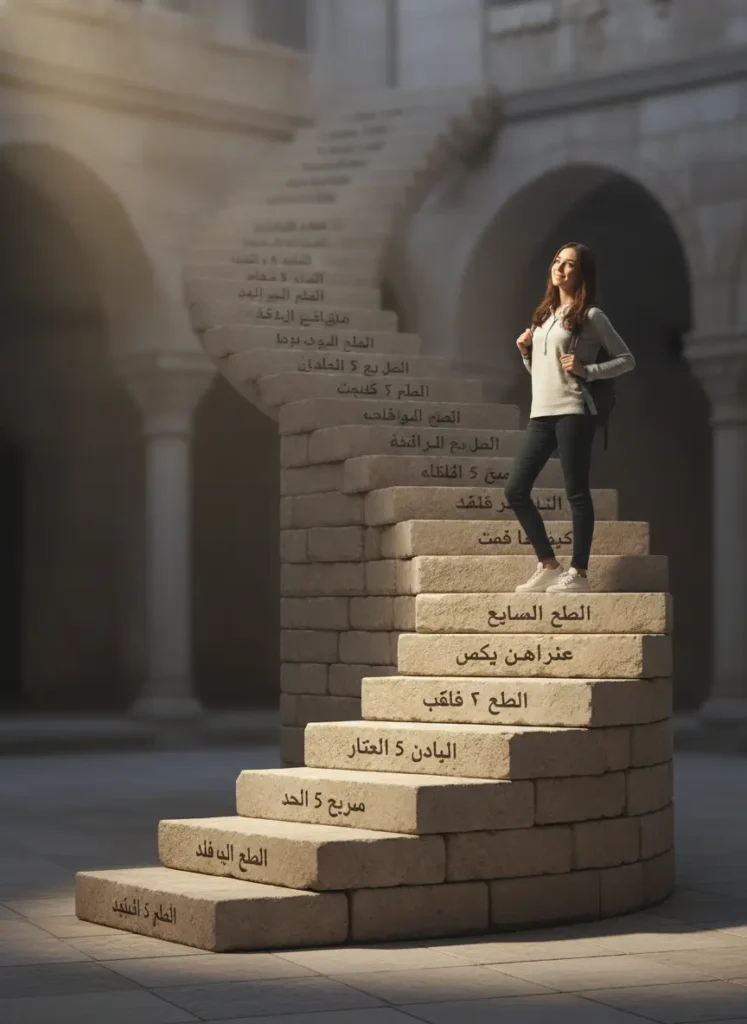
Every Arabic learner hits obstacles. Knowing in advance what they look like — and how to get past them — is part of what separates learners who succeed from those who stop.
Managing Frustration
Frustration in language learning almost always comes from one of three sources:
Comparing your progress to an unrealistic standard. Social media shows language learners who appear to become fluent in three months. The reality: most of these claims involve cherry-picked highlights, languages the learner already partially knew, or definitions of “fluency” that do not hold up. Compare yourself to your past self — no one else.
Studying without feedback. Learning in isolation, with no one to correct you, leads to accumulated errors and growing uncertainty about whether what you are doing is correct. Even monthly feedback from a qualified teacher dramatically reduces frustration.
Fatigue from overstudying. Many beginners start strong — two hours a day for the first two weeks — then crash into inconsistency. A sustainable daily practice of 20–45 minutes is better than intense bursts followed by multi-day breaks.
When frustration peaks: stop the session, take a break, return the next day. Never study when emotionally activated. Make the next session shorter and easier than usual. Rebuild momentum with small wins before returning to challenging material.
Recognizing Language Plateaus
A language plateau is when your progress seems to stop — you feel like you are studying but not improving. Plateaus are normal and are actually signs that your brain is consolidating existing knowledge before integrating new material.
Signs you are on a plateau:
- Vocabulary you knew well starts feeling uncertain
- Grammar rules you understood feel unclear again
- Listening comprehension seems to have stopped improving
What to do on a plateau:
- Switch your primary learning activity. If you have been focused on reading, emphasize listening for two weeks.
- Revisit material you studied two or three months ago. Often, content that was difficult then is now easy — and recognizing this progress breaks through the plateau psychologically.
- Add a new dialect or register. If you have been studying MSA, spend two weeks exploring Egyptian Arabic vocabulary. Novelty reactivates engagement.
- Increase speaking practice. Plateaus often signal that passive knowledge (reading, listening) is ahead of active production (speaking, writing). More speaking usually triggers a breakthrough.
Frequently Asked Questions for Beginners
Q1: How long does it take a beginner to learn Arabic?
With 2–3 sessions per week, most beginners read the alphabet in 4 weeks, hold basic conversations in 3–4 months, and reach intermediate level in 12–18 months. Progress varies by daily practice time, prior language learning experience, and how structured the learning program is. Consistent daily practice of even 20–30 minutes accelerates results significantly.
Q2: Is Arabic harder to learn than other languages?
Arabic has genuine challenges for English speakers: a new script, sounds not found in English, and a root-based grammar system unlike anything in European languages. That said, Arabic is also highly logical and systematic — far more so than English in many ways. With the right teacher and a structured approach, most beginners find it more approachable than expected. Our students at Alphabet Arabic Academy — coming from 80 countries and diverse language backgrounds — consistently report that the first month is the steepest part of the curve.
Q3: Can I learn Arabic for free as a beginner?
Free resources (Duolingo, YouTube, Reddit, free websites) are genuinely useful for building vocabulary, learning the alphabet, and supplementing formal study. However, most beginners who rely only on free resources get stuck within 2–3 months because they have no pronunciation feedback, no structured progression, and no accountability. A structured course with a qualified teacher saves months of trial and error and is the most time-efficient investment you can make.
Q4: Should I learn Modern Standard Arabic or a dialect first?
For most beginners, the recommended path is to start with MSA fundamentals — alphabet, core grammar, pronunciation — for the first 4–6 weeks, then add your target dialect alongside MSA. The two forms reinforce each other, and MSA gives you a grammatical framework that makes dialect learning significantly faster. Our beginner programs at Alphabet Arabic Academy teach both MSA and Egyptian Arabic in a balanced, integrated way.
Conclusion: Your Journey Starts Today
Learning Arabic as a beginner is one of the most rewarding intellectual investments you can make. You are joining a language spoken by over 400 million people, opening access to one of the world’s richest literary and cultural traditions, and — for many learners — deepening a spiritual connection to the Quran and the Islamic heritage.
The path is clear: start with the alphabet, build pronunciation from the first week, learn vocabulary in context, practice all four skills daily, and work with qualified native-speaking teachers who can provide the feedback that separates fast progress from slow drift.
At Alphabet Arabic Academy, we have guided students from 80 countries — beginners with zero Arabic knowledge — to reading, writing, and conversational fluency. Our teachers are graduates of Al-Azhar University in Cairo, our rating is 4.9 out of 5, and our beginner programs start at just $40 per month.
The only step left is yours. Book your free trial lesson today — no financial commitment, no obligation. Meet your teacher, see the curriculum, and experience what structured Arabic learning actually feels like.
بالتوفيق — Wishing you every success.