Last updated: April 2026
There’s a Difference Between Reading the Quran and Understanding It
Best Quranic Arabic Course Most Muslims who grew up reading the Quran can recite it. They learned the letters, practiced Tajweed, memorized surahs. The words flow. The sound is beautiful. And yet something is missing — the meaning slips by, carried in translation rather than felt in the original.
If you’ve ever finished reading a page of the Quran and realized you understood nothing beyond what a footnote told you, you know exactly what that gap feels like. It’s not a failure of faith or effort. It’s a gap in the right kind of education.
Quranic Arabic courses exist to close that gap. Not to replace the spiritual experience of recitation, but to deepen it — so that when you read “inna ma’al usri yusra,” you feel the promise of ease after difficulty in the actual Arabic words, not in a translation someone else made for you.
This guide covers everything you need to know to find the right course, understand what you’ll be learning and in what order, and start making real progress toward the goal that brought you here: reading the Quran and knowing what it says.
Why Quranic Arabic Is Different from Every Other Kind of Arabic
This is the foundational question, and it deserves a direct answer before anything else.
Modern Standard Arabic — the Arabic of newspapers, government speeches, and formal education — is descended from classical Arabic but is not identical to it. Spoken dialects like Egyptian Arabic or Levantine Arabic diverge further still. Quranic Arabic belongs to its own category: classical Arabic in its most precise, most poetic, most linguistically dense form.
The Quran was revealed in the Arabic of seventh-century Arabia, and its linguistic structure has been described by Arabic literary scholars for over fourteen centuries as uniquely inimitable. Every word was chosen with a precision that no translation can fully render. The root-based morphology of Arabic means that a single three-letter root carries families of related meaning, and the Quran deploys these roots with an intentionality that only becomes visible when you understand the language directly.
What this means practically: learning Egyptian Arabic will not teach you to understand the Quran. Learning MSA from a business Arabic course will give you tools but not the specific vocabulary, grammatical structures, and rhetorical patterns of Quranic text. Quranic Arabic requires dedicated study with material drawn from the Quran itself — and teachers who understand the difference.
The good news is that Quranic Arabic, while deep, follows consistent rules. It rewards systematic study. And the vocabulary is more finite than most learners expect: the 300 most frequent words in the Quran account for approximately 70 percent of the text. A learner who masters those 300 words has meaningful comprehension of the majority of what they read, not just isolated passages.
What You Will Actually Learn in a Quranic Arabic Course
A well-structured Quranic Arabic course covers several interconnected areas. Understanding each one before you start helps you evaluate programs and track your own progress.
The Arabic Alphabet and Foundational Reading
No prior Arabic knowledge is required to begin a Quranic Arabic course — and any program worth its name starts from the very beginning for learners who need it.
The Arabic alphabet has 28 letters, all of which appear in the Quran. Learning to recognize each letter in its four positional forms — isolated, initial, medial, and final — is the first step, and it typically takes two to four weeks of daily practice. Learning to read Arabic text aloud, slowly and accurately, requires another few weeks of guided practice.
For Quranic reading specifically, the Noorani Qaida — a traditional foundational text used in Islamic education for generations — is one of the most widely used and effective tools for moving from alphabet recognition to connected reading. Most dedicated Quranic Arabic programs incorporate it or a similar structured reading approach.
Tajweed: The Rules of Correct Recitation
Tajweed (تجويد) is the body of rules governing the correct pronunciation and recitation of the Quran. It covers elongation (madd), the pronunciation of specific letters in specific contexts, the rules for stopping and starting, nasalization, and the precise articulation points of Arabic consonants.
Tajweed is not optional for Quranic recitation — it is the standard to which every Muslim who recites the Quran is called. But it is also learnable, and a qualified teacher who can hear your recitation and correct it in real time is far more effective than any recording or written rule.
The critical point about Tajweed in online courses: voice interaction is essential. A teacher who can hear that your ra’ is too soft, or that your ghunna is missing, or that you’re eliding a madd incorrectly, gives you something no app can provide. This is one of the strongest arguments for live online instruction over self-paced video courses for Quranic study specifically.
Quranic Vocabulary
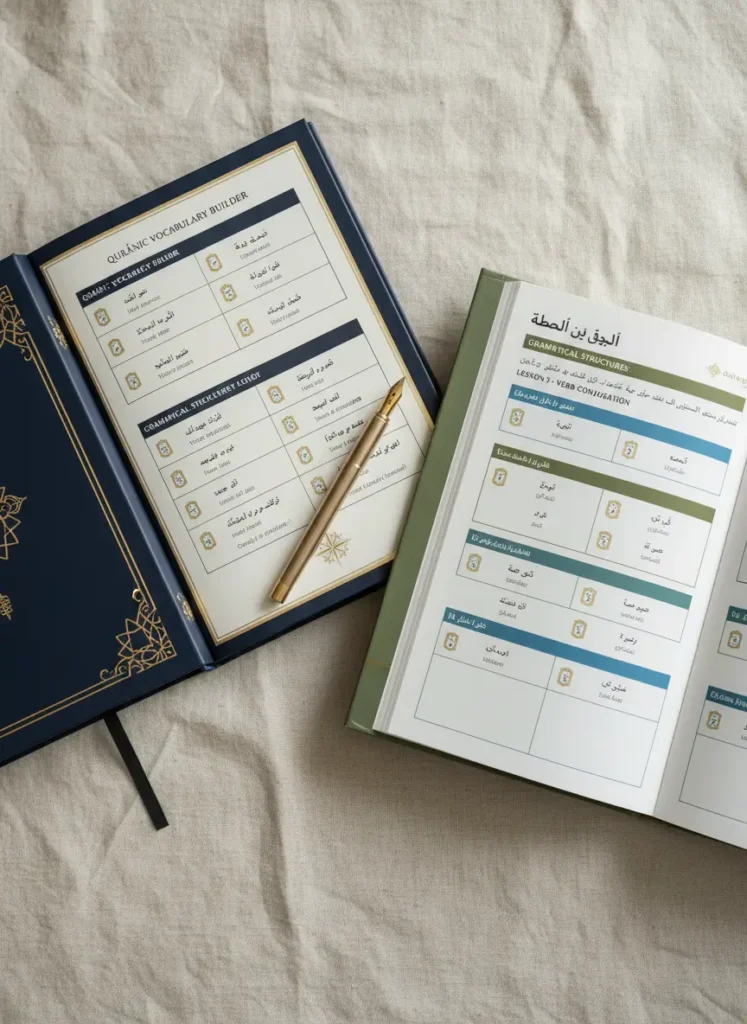
The Quran’s vocabulary is vast but not infinite, and the most frequent words appear repeatedly across the entire text. Learning high-frequency Quranic vocabulary — words like رحمة (mercy), نفس (soul/self), قلب (heart), عمل (deed), يوم (day) — produces immediate comprehension gains because these words appear in nearly every surah.
The most effective vocabulary learning for Quranic purposes organizes words by root and by thematic family, not alphabetically. When you learn that the root ك-ت-ب relates to writing, and you encounter كتاب, كاتب, مكتوب, and مكتبة, you are learning a family of words with one investment of effort rather than four separate words. This root-based approach is one of the things that makes Quranic Arabic more learnable than it initially appears.
Quranic Grammar: Nahw and Sarf
The two classical branches of Arabic grammar — Nahw (syntax) and Sarf (morphology) — are both essential for deep Quranic understanding.
Nahw explains how sentences are constructed in the Quran: why a noun appears in the nominative case, how a conditional sentence is structured, why a verb precedes its subject in certain constructions. For a reader who wants to understand not just what the Quran says but how it says it — and why the specific grammatical choices carry meaning — Nahw is the key.
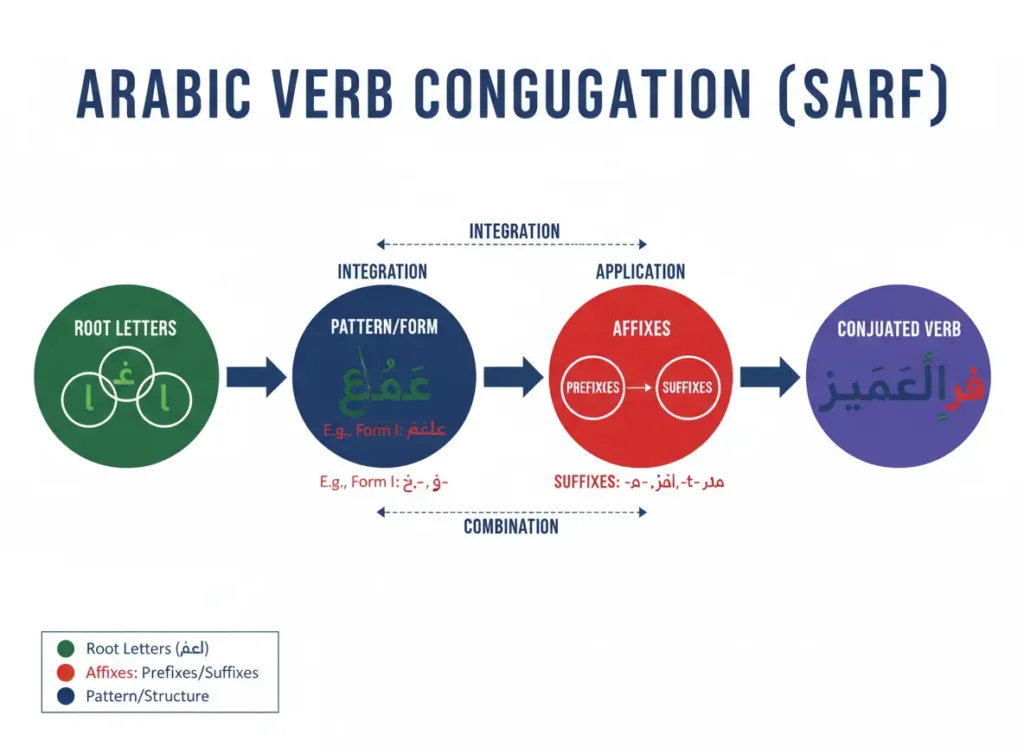
Sarf explains how words are formed and derived from roots. Understanding the morphological patterns of Arabic — that the fa’il pattern produces agent nouns, that the maf’ul pattern produces object nouns, that Form II verbs often indicate causation — transforms vocabulary acquisition from memorization into pattern recognition.
A strong Quranic Arabic course teaches both, but calibrates the depth to the learner’s level. Beginners need functional grammar — enough to follow sentence meaning and identify word roles — not an exhaustive academic treatment. Advanced learners who want to engage with classical tafsir require more depth.
Short Surah Study
One of the most effective and motivating methods in Quranic Arabic education is studying short surahs word by word, applying vocabulary and grammar knowledge to real Quranic text.
Surah Al-Fatiha — seven verses, the most recited passage in the Quran, central to every prayer — is typically the first complete surah studied in depth. Every Muslim who prays has said Al-Fatiha thousands of times. The experience of sitting with it in Arabic and understanding every word — “al-hamdulillahi rabbil ‘alamin” meaning specifically “praise belongs to Allah, Lord of all the worlds,” with the grammatical precision of each case ending carrying meaning — is consistently described by students as one of the most significant moments in their Arabic learning journey.
Surah Al-Ikhlas, Al-Asr, Al-Kawthar, and the shorter Meccan surahs are equally powerful starting points. Their brevity makes them manageable for beginners. Their theological density makes them endlessly rewarding to study with depth.
Who Should Take a Quranic Arabic Course

The honest answer is: almost anyone who prays, recites the Quran, or wants a deeper relationship with Islamic text.
More specifically:
Complete beginners with no Arabic background can start a Quranic Arabic course from scratch. The alphabet, Noorani Qaida, basic vocabulary, and foundational grammar are designed for people with zero prior knowledge. You do not need to already read Arabic.
Muslims who read Arabic but don’t understand it — a very common situation — benefit enormously from Quranic Arabic study. The ability to read without understanding is valuable but incomplete. A focused vocabulary and grammar course built around Quranic text produces dramatic comprehension gains in a relatively short time.
Reverts and new Muslims who came to Islam as adults often find that Quranic Arabic study is one of the most spiritually significant investments they make. Understanding the prayers they are beginning to perform, the surahs they are learning, the phrases they hear in khutbas — this understanding deepens everything.
Parents who want to pass Quranic knowledge to their children often study alongside their children, or slightly ahead of them. Our children’s Quranic Arabic program serves learners from age four, taught by teachers experienced with young learners.
Students of Islamic studies at any level — whether studying independently, in a halaqa, or formally — find that Quranic Arabic is the foundation that makes every other Islamic study more accessible.
Older learners should know that there is no age limit on this pursuit. Students in their fifties, sixties, and beyond have completed our courses and found them fully manageable. The methodology adapts to the pace of the learner, not the other way around.
How to Choose the Right Online Quranic Arabic Course
The online Quranic Arabic course market in 2026 is large, and the quality varies significantly. These criteria cut through the noise.

Native-speaking instructors with Quranic specialization. Teaching Quranic Arabic requires not just native fluency but specific training in classical grammar, Tajweed, and the pedagogical methods that make these subjects accessible to non-native learners. Ask about instructor qualifications before enrolling.
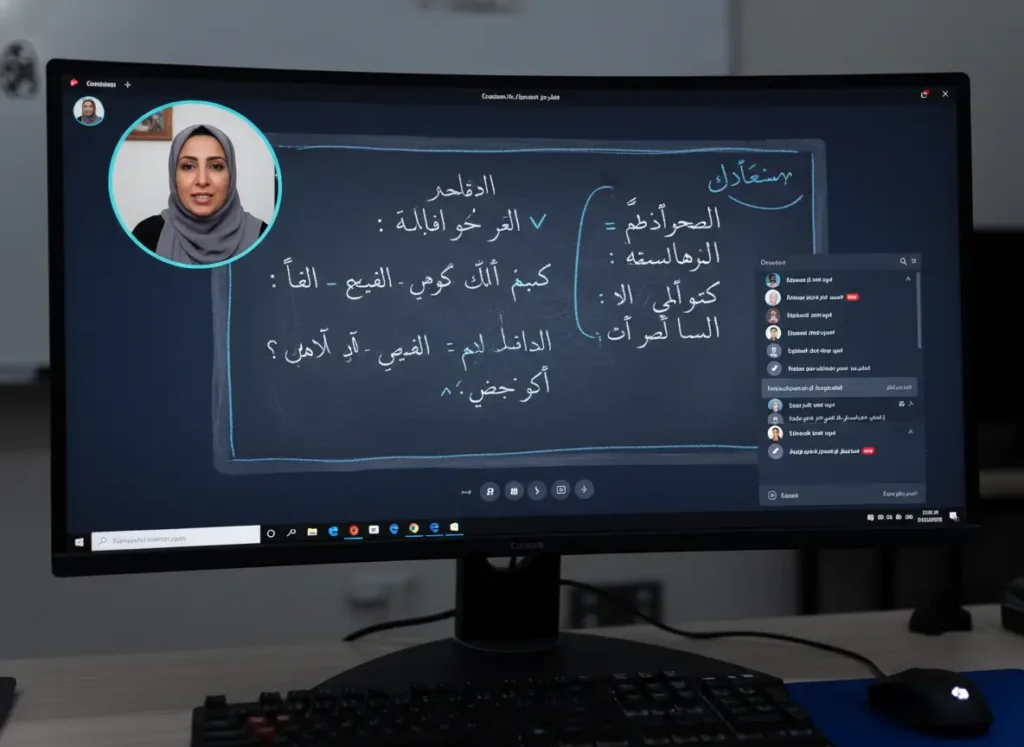
Live instruction, not only recorded video. For Tajweed specifically, and for grammar correction generally, live sessions with a teacher who can hear your recitation and see your confusion are essential. Recorded video courses have their place as supplements but cannot replace real-time interaction.
A curriculum built from the Quran. Some Arabic programs teach MSA grammar and add a Quranic vocabulary supplement at the end. The best Quranic Arabic courses work the other way: they begin with Quranic text and use that text to teach grammar, vocabulary, and linguistic patterns. Look for programs that reference actual Quranic verses throughout the curriculum.
Clear level progression. A good course knows where it starts, where it ends, and what the learner will be able to do at each stage. Vague promises of “fluency” without defined levels and outcomes are a red flag.
Flexibility in scheduling. Students in different timezones, with different work and family commitments, need genuine flexibility — not a fixed timetable that assumes you’re available Tuesday and Thursday at 7pm wherever the academy is based. Morning, evening, and weekend options, with the ability to reschedule when life intervenes, are practical necessities.
Female teachers available. For sisters who prefer to study with a female teacher — which is a preference many learners hold — confirming the availability of female instructors before enrolling is important. Our academy has both male and female qualified teachers.
Transparent pricing with no hidden fees. Quality Quranic Arabic instruction is available at accessible price points. Alphabet Arabic Academy’s Quranic Arabic program starts from $40 per month, with separate pricing structures for children, adults, and teens.
What a Good First Month Looks Like
Many learners who haven’t studied Arabic before worry that they’ll spend months before reaching anything that feels like the Quran. Here is an honest picture of what genuine progress in the first month looks like with consistent study and good instruction.
In the first two weeks, a learner who has no Arabic background can learn to recognize all 28 letters in their isolated forms, begin reading simple connected words, and complete the first several sections of Noorani Qaida. The alphabet stage moves faster than most beginners expect.
By the end of the first month, with two to three sessions per week and daily independent practice of fifteen to twenty minutes, most learners can: read Arabic text aloud slowly but accurately, recognize the basic short vowel marks, and identify common Quranic words they’ve begun memorizing. They are not reading with comprehension yet, but they are reading — and the sound of the Quran in their own voice, accurately pronounced, begins to feel different.
This is the stage that most learners describe as the first meaningful milestone: the moment the Quran stops being a visual mystery and starts being something they can engage with directly.
The Spiritual Dimension of Quranic Arabic Study
This guide has focused on the practical and pedagogical aspects of Quranic Arabic courses because those are the things that determine whether a learner succeeds or struggles. But it would be incomplete without acknowledging why this particular pursuit matters in a way that learning any other language does not.
The Quran was revealed in Arabic. Not as an accident of geography, but — as the text itself states — deliberately: “Indeed, We have sent it down as an Arabic Quran so that you might understand.” The language is inseparable from the message. The rhythm of its verses, the precision of its vocabulary, the structure of its grammar — all of these are part of what makes the Quran what it is.
When a student understands Al-Fatiha in Arabic for the first time — really understands it, not through a translation but through the actual words — something shifts. The prayer that has been recited seventeen times a day becomes a conversation rather than a recitation. The relationship with the text changes. Numerous students have described the experience in similar terms: the Quran starts speaking to them rather than being spoken at them.
This is the deepest reason to take Quranic Arabic seriously. Not for academic achievement, not for certificates, not even for the cognitive benefits of language learning — though all of these are real. For the direct, unmediated relationship with the words of Allah that only the Arabic language makes possible.
Frequently Asked Questions
Do I need to know any Arabic before starting a Quranic Arabic course? No. Complete beginners are welcome and well-served by a properly structured Quranic Arabic program. The curriculum begins with the alphabet and builds from there. The only thing you need is consistency and the willingness to practice between sessions.
Is Quranic Arabic the same as Modern Standard Arabic? They share the same grammatical system at the foundation, but Quranic Arabic is classical and carries significant differences in vocabulary, grammatical usage, and rhetorical patterns. MSA study helps but does not prepare you specifically for Quranic comprehension. A dedicated Quranic Arabic course is built around the text of the Quran itself.
How long before I can understand what I’m reading in the Quran? With consistent study, most learners can understand basic Quranic sentences and recognize high-frequency Quranic vocabulary within three to six months. Understanding the majority of a short surah word by word is achievable within six to twelve months. Full comprehension of the entire Quran is a longer journey — but the milestones along the way are meaningful and motivating.
Can children take Quranic Arabic courses? Yes. Our children’s program serves learners from age four, with age-appropriate materials, games, stories, and teaching methods designed for young learners. Female teachers are available for families who prefer this for their daughters.
Is Tajweed included in Quranic Arabic courses? In well-designed programs, yes. Tajweed and Arabic comprehension are taught as complementary skills — correct recitation and genuine understanding are both goals, not alternatives. Our Quranic Arabic program includes dedicated Tajweed sessions with teachers who can hear and correct your recitation.
What if I’ve tried apps or self-study before and stopped? This is the most common starting point for students who contact us. The limitation was almost never motivation — it was method. Apps produce passive recognition without active production and cannot correct Tajweed. Self-study produces knowledge without accountability. Live instruction with a qualified native teacher addresses both gaps from the first session.
Begin Your Quranic Arabic Journey
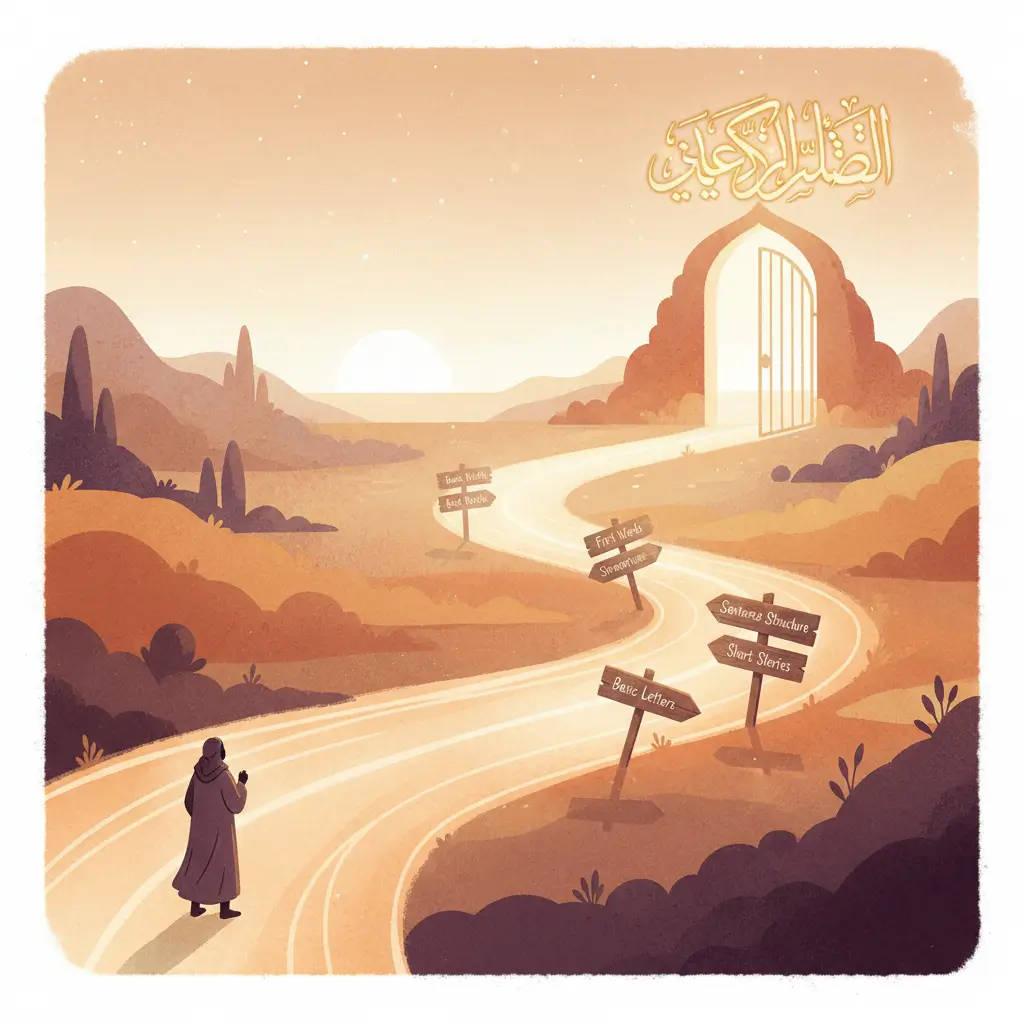
The goal that brought you to this page — understanding the Quran in its original language — is achievable. It is not reserved for scholars or native speakers or people with years of Arabic background. It is available to anyone who finds the right teacher, follows a structured curriculum, and shows up consistently.
Every long journey begins with a specific, concrete first step. The first step here is simple: book a placement session, tell us your current level and your goal, and let us match you with the right teacher and program.
Alphabet Arabic Academy offers Quranic Arabic courses for complete beginners through advanced learners, taught live by native Egyptian Arabic speakers with dedicated Quranic Arabic and Tajweed training. Programs serve children from age four, teenagers, adults, and families. Sessions are thirty to sixty minutes, flexible across timezones, starting from $40 per month.
Visit AlphabetArabicAcademy.com to book your first session, explore pricing for adults, teens, kids, and Quranic study, or speak directly with our team.
The Quran is already there, waiting to be understood. This is how you begin.
Follow us on social media for Quranic Arabic tips, student reflections, and learning resources. AlphabetArabicAcademy.com