

Learning Arabic without grammar and writing is like trying to build a house without a foundation. You might memorize words, repeat phrases, and even hold basic conversations—but sooner or later, everything falls apart. Grammar and writing are what turn scattered knowledge into real language mastery. This guide is your complete, practical roadmap: from your first Arabic letter to confident, fluent expression.
Why Arabic Grammar & Writing Matter More Than Vocabulary
Many learners start Arabic by memorizing words. It feels productive. You learn “book,” “school,” “teacher,” “market.” But then you try to form a sentence—and suddenly everything breaks.
That’s because vocabulary without grammar is powerless.
Grammar gives words their function. Writing gives grammar its structure. And in Arabic, a single word can change meaning completely depending on its position in the sentence, its ending, and whether it’s definite or indefinite.
Here’s the truth: learners who focus on Arabic grammar and writing together progress faster—and retain the language longer. Writing forces you to choose the correct structure, apply grammar rules consciously, and see patterns that speaking alone hides.
Grammar without writing is theory. Writing without grammar is chaos. Together, they create something real.
Why Arabic Grammar for Adults Is Different—and Why It Matters Now

Here’s something most courses get wrong: they teach Arabic grammar as if all learners are 18-year-old university students with unlimited time. If you’re an adult learning Arabic—whether for career, religion, culture, or personal growth—that approach doesn’t work.
Adults don’t need linguistic terminology dumped on them in week one. They need patterns, logic, and application. Arabic grammar for adults should always start with examples, not rules.
The adult brain is actually better at language learning in one key way: you understand why things work. A child memorizes. An adult connects. That’s a strength—if your teacher knows how to use it.
Some real reasons adults start Arabic now:
- Professional opportunities in the Middle East
- Understanding the Quran more deeply
- Reconnecting with cultural heritage
- Academic study or research
- Simply because it’s one of the most expressive languages on earth
The mistake? Waiting until you’re “ready.” You become ready by starting. Adults who begin speaking and writing from week one—even imperfectly—progress significantly faster than those who wait to perfect grammar first.
Consistency beats intensity here. Thirty minutes daily beats three hours once a week, every single time.
The Arabic Alphabet: The Hidden Gateway to Grammar

You can’t talk about Arabic grammar and writing without the alphabet. It’s not a “starter topic” you rush through. It controls how grammar appears on the page.
The Arabic alphabet isn’t just 28 letters. It’s:
- A system of shapes that change with position
- A system of sounds (some of which don’t exist in any European language)
- A system of connection—most letters link to each other in flowing script
Every grammatical rule eventually passes through this system. Word endings, verb patterns, plurals, pronunciation rules—all of it runs through the alphabet.
Learners who rush past the alphabet often struggle later with reading accuracy, writing fluency, and grammar application. Strong writing always rests on strong basics.
Short vowels: the invisible grammar engine. Short vowels (harakat) are often ignored, yet they signal grammatical roles, define verb tense, and clarify subject vs. object. Same letters. Completely different meanings:
- كَتَبَ (he wrote)
- كُتِبَ (it was written)
- كِتاب (book)
Writing without understanding vowels is like coding without syntax. The Arabic alphabet guide for beginners is not a beginner-only resource—it’s a foundational tool for grammar mastery at every level.
Most students recognize and write all 28 letters within 2–4 weeks of focused daily practice. Reading simple words? Another 2–3 weeks. Don’t skip this phase. Build it right the first time.
Arabic Grammar Online: From Your First Letter to Confident Fluency
Learning Arabic grammar online works—but only when it’s structured, progressive, and writing-focused. Random lessons and disconnected rules produce learners who “know” grammar but freeze when asked to write an email.
The most effective online grammar path moves through:
- Sentence awareness — understanding what a sentence is doing
- Sentence construction — applying basic rules in real writing
- Grammar-reinforced writing — using rules automatically in paragraphs
- Style and fluency — making Arabic sound natural, not translated
Modern learners don’t want endless charts or dry explanations. They want clear structure, practical examples, and real writing tasks. That’s when grammar starts feeling usable, not overwhelming.
What actually works online:
- Live instruction with a native teacher who answers “why does this work?” in real time
- Exercises followed immediately by writing application
- Progressive complexity—simple to complex, not the other way around
- Feedback loops that expose gaps and correct them fast
At Alphabet Arabic Academy, our MSA courses cover systematic Nahw and Sarf alongside all four language skills. Our teachers—graduates of Al-Azhar University—make grammar logical, not scary. Take the free Arabic level test to find exactly where you should start.
Sarf and Nahw: The Two Engines Behind Arabic Grammar

Arabic grammar stands on two pillars. Once you understand both, everything else becomes easier.
Sarf: Arabic Morphology — How Words Are Built
Sarf is the engine. From one root, Arabic generates verbs, nouns, adjectives, and active/passive forms.
Take the root ك ت ب (k-t-b):
- كَتَبَ → he wrote
- كِتاب → book
- كاتِب → writer
- مَكْتَب → office
Without Sarf, learners memorize words endlessly. With Sarf, they recognize patterns and predict meanings. Vocabulary growth accelerates because you stop guessing and start understanding.
Nahw: Arabic Syntax — Sentence Structure That Controls Meaning
Nahw decides word order, case endings, and the difference between subject and object. A single vowel change can flip meaning completely.
Look at these two sentences:
- كَتَبَ الطالِبُ الدرسَ → The student wrote the lesson ✓
- كَتَبَ الطالِبَ الدرسُ → Grammatically broken and confusing ✗
Nahw isn’t about being academic. It’s about clarity, professionalism, and accuracy—especially in writing. It’s the difference between Arabic that communicates and Arabic that confuses.
Together, Sarf and Nahw turn Arabic from memorization into logic. That’s the shift every serious learner needs to make.
Arabic Grammar Exercises Online: The Best Method for Practic
Grammar exercises and writing practice serve different purposes. Both are essential. But they’re not the same thing.
Grammar exercises help with:
- Rule identification
- Error spotting
- Pattern recognition
Writing tasks help with:
- Application
- Long-term retention
- Real confidence
The most common mistake? Doing exercises exclusively and calling it “studying grammar.” Exercises alone create recognition. Writing creates production.
Here’s the method that actually works:
- Learn the rule in context—see it in a real sentence first
- Complete a short exercise to spot the pattern
- Write your own sentence immediately using that rule
That loop—learn, practice, apply—is where fluency actually grows. Grammar stops being a mountain and becomes a habit.
What to look for in online exercises:
- Verb conjugation across all pronouns (past, present, future)
- Sentence-building from scrambled words—forces grammar application on the fly
- Dictation exercises that cement spelling and grammar together
- Live grammar workshops where you can ask questions in real time
Some platforms, including ours at Alphabet Arabic Academy, include live grammar sessions with teachers rather than passive drills. That’s where real breakthrough happens—grammar explained in response to a genuine question you had while trying to express something.
Learn Sarf and Nahw Online: Effortlessly, Step by Step
“Effortlessly” doesn’t mean without effort. It means without confusion.
Most learners find Sarf and Nahw intimidating because they’re introduced too early, with too much terminology, and no writing context. That’s the teaching problem, not the grammar problem.
Here’s how to approach both systems without overwhelm:
For Sarf (morphology):
Start with the most common verb forms—Form I and Form II. Learn their patterns through real vocabulary, not abstract tables. Recognize the root in words you already know. Build outward from there.
For Nahw (syntax):
Start with simple nominal sentences (الجملة الاسمية) and verbal sentences (الجملة الفعلية). Understand what role each word plays before worrying about case ending names. Function before terminology—always.
The progression that works:
- Week 1–2: Alphabet mastery and basic word recognition
- Week 3–4: Simple sentence construction with nominal and verbal patterns
- Month 2: Introducing gender, number, and basic iDafa (possession) structures
- Month 3+: Verb patterns, case endings in context, paragraph-level writing
Skipping steps doesn’t save time. It wastes it. Strong writing always comes from a strong foundation built in order.
At our academy, Sarf and Nahw are taught systematically through live one-on-one sessions, not video-only courses. See our Arabic courses for adults and teens to find the right fit for your level.
Madinah Arabic: A Classical Approach and How It Fits

Madinah Arabic is one of the most well-known structured grammar programs in the world. Designed by scholars from Madinah University, it introduces classical Arabic with a strong grammar foundation—particularly useful for those focused on Quranic Arabic and Islamic texts.
What makes it valuable:
- Classical Arabic grammar from the ground up
- Strong focus on root-based vocabulary
- Structured curriculum with clear progression
- Deep Quranic and Islamic vocabulary
Where it can be challenging for modern learners:
- Heavily grammar-first—not always practical for conversational goals
- Pre-recorded lessons without live feedback
- Less adaptation for non-Islamic learning goals
- Can feel rigid for beginners who need encouragement alongside structure
How we use it at Alphabet Arabic Academy: We incorporate Madinah Arabic’s best structural elements into our live curriculum, adding real-time teacher feedback, modern examples, and speaking practice that the original program doesn’t include. The result is classical depth with modern accessibility.
If your goal is Quranic understanding, classical texts, or Islamic studies, Madinah Arabic principles are excellent. If you want full fluency—speaking, writing, grammar, and comprehension—you need a program that goes beyond classical structure alone.
Arabic Grammar Levels: From Absolute Beginner to Confident Writer
Arabic grammar isn’t a wall. It’s a ladder. Miss a step, and everything above feels unstable.
Beginner Level: Building Sentence Awareness
At this stage, grammar isn’t about complexity—it’s about control.
Focus on:
- Simple nominal sentences (هذا كتاب / هذه مدرسة)
- Basic verbal sentences (الطالب يكتب / الطالبة تكتب)
- Gender agreement—masculine vs. feminine
- Singular vs. plural recognition
Writing at this level stays short but intentional. Even two-line paragraphs matter. The goal isn’t perfection. It’s clarity and confidence.
Intermediate Level: Grammar Starts Shaping Meaning
This is where Arabic grammar stops being “rules” and starts being expression.
Learners encounter:
- Verb tenses in real context
- Idafa (الإضافة) structures: كتاب الطالب الجديد
- Prepositions and their grammatical effects
- Short paragraphs, descriptions, structured answers
Mistakes still happen—but now they’re useful mistakes. They reveal gaps that writing alone can expose.
Advanced Level: Writing With Precision and Style
At this stage, learners control case endings consciously, handle complex sentence structures, passive voice, conditional sentences, and formal tone.
Writing evolves into essays, reports, and formal communication. Grammar no longer slows writing down. It supports it.
This is where learners stop translating in their heads and start thinking in Arabic.
Core Arabic Grammar Structures in Real Usage
Understanding rules is one thing. Using them correctly in writing is another. Here’s how grammar appears naturally—not as theory, but as living language:
| Structure | Arabic Example | English Meaning |
|---|---|---|
| Verb–Subject Order | كتبَ الطالبُ الدرسَ | The student wrote the lesson |
| Nominal Sentence | اللغةُ العربيةُ جميلةٌ | Arabic is a beautiful language |
| Preposition + Noun | في الكتابِ | In the book |
| Possessive Structure | كتابُ الطالبِ | The student’s book |
| Adjective Agreement | درسٌ سهلٌ | An easy lesson |
Each of these is grammar in action—not a rule to memorize, but a pattern to internalize through writing.
Common Grammar Mistakes That Break Arabic Writing
Even strong learners fall into the same traps.
1. Translating directly from English.
Arabic doesn’t think like English. Word order, emphasis, and structure differ. Writing Arabic with English logic creates awkward sentences, incorrect emphasis, and grammar errors that feel invisible until a native speaker reads them.
2. Ignoring case endings in writing.
Many learners skip case endings, thinking they’re optional. In formal and academic writing, they’re not. Ignoring them limits your progression—especially in professional or academic contexts where they signal true grammatical control.
3. Memorizing rules without writing practice.
Grammar learned passively fades fast. Grammar applied through writing sticks longer, feels natural, and builds confidence. Writing is where grammar becomes skill, not information.
4. Gender agreement errors.
Arabic requires verb–subject agreement and adjective–noun alignment. Mistakes here instantly signal weak writing, even to a casual reader.
5. Overusing translation logic.
Writing Arabic with English structure breaks sentence rhythm, distorts emphasis, and confuses readers. Natural Arabic writing follows Arabic thinking—not translated structure.
Writing Arabic: From Letters to Meaningful Text
Writing Arabic isn’t about copying shapes. It’s about encoding meaning correctly. And it develops in clear stages.
Stage 1 — Controlled Writing: Dictation-based sentences, structured patterns, grammar-focused lines. Speed doesn’t matter yet. Accuracy does. This is where muscle memory forms.
Stage 2 — Guided Writing: Combining grammar rules, expanding sentences, describing ideas. Short paragraphs, personal responses, simple explanations.
Stage 3 — Independent Writing: Opinions, arguments, formal content. Grammar stops feeling like rules and starts feeling like tools.
Learning to write Arabic sentences correctly accelerates grammar understanding in a way no amount of passive study can. Writing forces decisions. Every sentence requires choosing verb form, matching gender, applying agreement rules.
Modern learners also benefit from Arabic keyboard typing. It removes hesitation, encourages revision, and supports grammatical experimentation in a way handwriting alone doesn’t. Strong writers practice both.
Arabic Grammar for Different Goals
Not all Arabic learners want the same thing. Grammar instruction should match your goal.
For academic learners: Focus on formal sentence patterns, logical connectors (علاوة على ذلك / من ناحية أخرى / بناءً على ما سبق), and precision. Writing must sound controlled and intentional.
For professional learners: Focus on clarity, polite tone, and consistency. Grammar mistakes in business Arabic don’t look small—they look careless. Formal email structure and report writing are non-negotiable.
For religious learners: Focus on classical grammar patterns, Quranic vocabulary, and understanding how case endings function in sacred text. Madinah Arabic principles align well here.
For general conversational learners: Focus on expression, confidence, and flow. Writing should feel usable and natural, not intimidating. Learn Arabic for adults with a method that prioritizes real communication from day one.
Let me tell you about a student named ellie.
He was a senior manager at a metals company. Suddenly, without warning, his company told him he needed to run one of their offices in the Arab world. He had to relocate. He had to lead a team. And he couldn’t write a single correct Arabic sentence.
He tried apps first. Duolingo and others. Several months later? He could say “hello” and “thank you.” But write an email? Read a contract? Present in a meeting? Nothing.
Then he found a structured grammar and writing program.
We started with the basics. Letter forms. Simple sentences. Sarf patterns. Nahw rules — but always connected to writing, never abstract.
Two months later? ellie was writing his own emails. Reading contracts without translation. His team noticed.
He told me recently: “I used to think grammar was a mountain. Now I see it’s just a system.”
That’s what happens when you learn grammar and writing together — not as separate subjects, but as the same skill.
Why Arabic Grammar Feels “Hard”—And Why It Isn’t
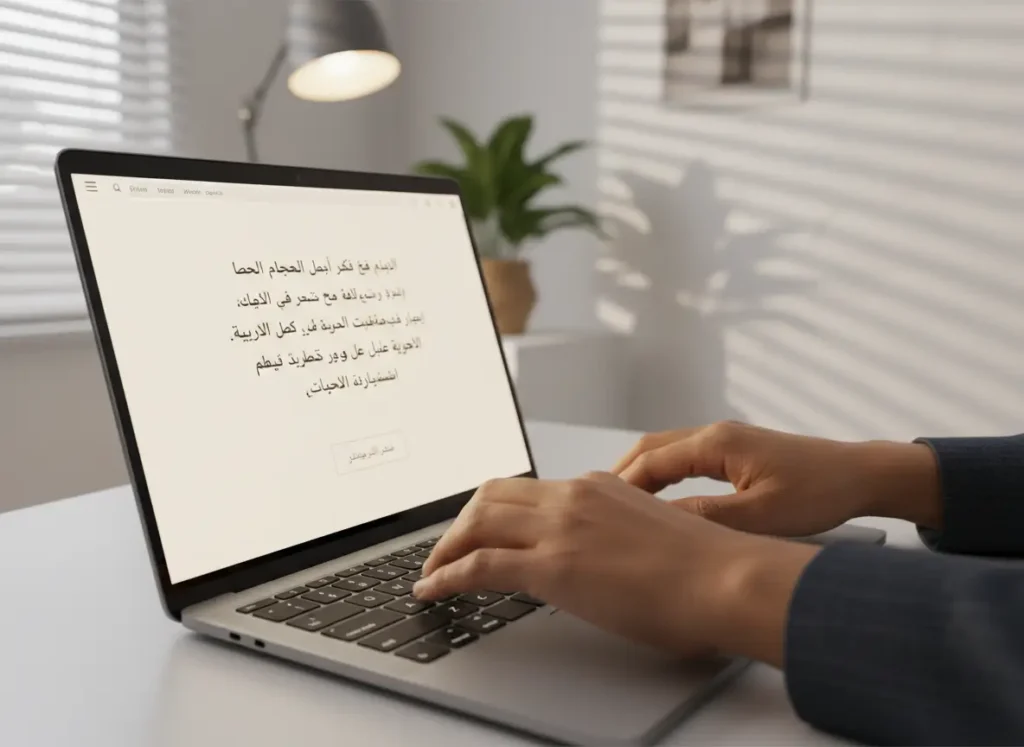
Arabic grammar feels difficult when it’s taught without context, separated from writing, and overloaded with terminology. That’s a teaching problem, not a language problem.
When grammar is progressive, applied, and reinforced through writing—it becomes logical, not scary. Here’s what the research and our experience with students from 80 countries consistently shows:
Arabic grammar is more systematic, not harder, than most European languages. Once patterns are understood, complexity becomes predictable. The root system means learning one word unlocks five. The verb patterns mean conjugation becomes automatic, not memorized individually.
The hidden secret? Frequency. Short, consistent writing beats long, rare sessions every time. Ten minutes of focused Arabic writing daily builds more fluency than two hours once a week. The learners who reach fluency fastest aren’t the ones who study the hardest in one session. They’re the ones who show up daily.
Who Is This Guide For?

This is for you if:
- You’ve tried learning Arabic before but felt lost without structure
- You can say some phrases but can’t form correct sentences yet
- You want to understand the Quran, read Arabic media, or work in Arabic-speaking contexts
- You’re a complete beginner who wants to do this right from the start
- You’re an intermediate learner whose writing feels stilted or translated
This is NOT for you if:
- You’re looking for a quick-fix phrase memorization app
- You’re only interested in one specific dialect with no grammar foundation
- You want results without any writing practice
Frequently Asked Questions About Arabic Grammar & Writing
Is Arabic grammar necessary to write correctly?
Yes—without grammar, writing stays fragile. You may recognize words, but you won’t control meaning, agreement, or sentence flow. Grammar gives writing stability, not complexity.
Should beginners start with grammar or writing?
Both, together. Alphabet first, then basic sentence writing, supported by light grammar. Delaying writing slows progress more than starting imperfectly. You don’t need to be ready to start. You start to become ready.
How long does it take to write Arabic confidently?
Confidence grows in stages: weeks for simple sentences, months for structured paragraphs, and ongoing refinement for professional style. With consistent daily practice and live instruction, most adult learners reach comfortable paragraph writing within 4–6 months.
Is Arabic grammar harder than other languages?
Arabic grammar is more systematic, not harder. Once patterns are understood—especially the root system—complexity becomes predictable. Many learners actually find the logic of Arabic grammar more satisfying than the irregularity of English.
Can I learn Arabic grammar online effectively?
Yes—if learning includes progressive structure, real writing tasks, and practical examples. Grammar learned without writing rarely sticks. Live instruction with a native teacher accelerates everything.
Do I need to master case endings to write Arabic?
Not immediately. Understanding them matters, but clarity and sentence structure come first. Precision with case endings improves with practice, not with front-loading theory.
What’s the fastest way to improve Arabic writing?
Write daily. Even short texts—messages, summaries, short paragraphs—frequency beats intensity. Combine this with exercises and immediate teacher feedback, and progress accelerates significantly.
Is typing Arabic as useful as handwriting?
Both matter. Handwriting builds control and reinforces letter forms. Typing increases fluency, revision speed, and grammatical experimentation. Strong writers practice both.
Why do I understand grammar but struggle to write?
Because recognition is not production. Writing forces active application, exposes gaps, and strengthens memory in ways that reading or listening can’t replicate. If you understand grammar but can’t write it—you need more writing, not more grammar study.
Can grammar and writing improve speaking?
Yes. Strong writing sharpens sentence awareness, improves accuracy, and reduces hesitation. Learners who write regularly speak more clearly because they’ve internalized structure—not just heard it.
Conclusion: Arabic Grammar & Writing as a Lifelong Skill

Arabic grammar isn’t the enemy. It’s the system that makes Arabic powerful, precise, and expressive.
Strong grammar supports meaning. Clear writing builds trust. Together, they turn Arabic from a subject you study into a language you actually use.
The right path is simple—not easy, but clear:
- Master the alphabet as a complete system, not a checklist
- Learn grammar in stages, always connected to writing
- Write early, write often, correct without fear
- Build fluency through consistency, not occasional intensity
You don’t need to be perfect. You need to be consistent. And you don’t need to figure it out alone.
Ready to find out exactly where you are in your Arabic journey? Take the free Arabic placement test and get matched to the right level. Our teachers—graduates of Al-Azhar University, based in Cairo, and trusted by students from 80 countries—are ready to guide you from your first letter to confident, fluent expression.
See our Arabic courses for adults and teens and start building Arabic that lasts.