

Last updated: April 2026
Introduction: Why Learn Modern Standard Arabic Online?
You’ve probably heard that Arabic is one of the most challenging languages for English speakers. But you’ve also heard that it’s one of the most rewarding. And if you’re here, you’re ready to take the leap—not into any dialect, but into Modern Standard Arabic (MSA), also known as Fusha (الفصحى). This is the Arabic of news, literature, formal speeches, education, and the Quran. It’s the version understood by over 400 million Arabic speakers across 22 countries, from Morocco to Oman.
The good news? In 2026, learning Modern Standard Arabic online has never been easier, more flexible, or more affordable. With native teachers, structured courses, and immersive technology, you can go from absolute beginner to confident intermediate speaker without ever leaving your home.
At Alphabet Arabic Academy, we offer live MSA courses taught by native Egyptian teachers, many with Al-Azhar certification. Prices start at just $40/month, with flexible scheduling and a free trial lesson. But before you enroll, let’s explore everything you need to know about learning MSA online—from what it is, to how long it takes, to the best resources and strategies.
Part 1: What Is Modern Standard Arabic (MSA)?
Modern Standard Arabic (MSA) is the standardized, literary form of Arabic used in:
- Newspapers and news broadcasts (Al Jazeera, BBC Arabic)
- Official documents and government communications
- Books, academic papers, and literature
- Formal speeches and religious sermons
- Educational curricula across the Arab world
MSA is derived from Classical Arabic (the language of the Quran and early Islamic texts) but has been simplified and modernized for contemporary use. It is not a spoken dialect—no one grows up speaking MSA as their mother tongue. Instead, it’s learned in school and used for formal communication across all Arab countries.
MSA vs. Classical Arabic vs. Dialects
| Variety | Characteristics | Best For |
|---|---|---|
| Classical Arabic | Quranic and early Islamic texts; rich grammar and vocabulary | Religious studies, historical literature |
| Modern Standard Arabic (MSA) | Simplified version of Classical; used in media, books, formal speech | Reading news, academic study, formal writing |
| Spoken Dialects (Egyptian, Levantine, Gulf, etc.) | Everyday conversational language, varies by region | Travel, daily conversation, connecting with people |
For most learners, starting with MSA is the smartest choice. It gives you a foundation that transfers to any dialect later. And if your goal is to read the Quran or classical texts, MSA is the bridge.
Part 2: Why Learn Modern Standard Arabic Online?
Flexibility That Fits Your Life
Online learning means you choose when and where to study. Early morning before work? Late night after the kids are asleep? Weekends? It’s all possible. No commuting, no rigid classroom schedules.
Access to Native, Qualified Teachers
The best MSA teachers are native Arabic speakers with formal training in teaching Arabic as a foreign language. Online platforms connect you with instructors from Egypt, Jordan, Lebanon, and Palestine—often at a fraction of the cost of local in-person classes.
Structured Yet Personalized Curriculum
Quality online MSA courses offer clear levels (beginner, intermediate, advanced) with measurable outcomes. You’re not left to figure out what comes next. And with one-on-one tutoring, the curriculum adapts to your pace and goals.
Affordable Pricing
Traditional language schools can cost hundreds per month. Online MSA courses start as low as $40/month at Alphabet Arabic Academy, with free trial lessons and no hidden fees.
Recorded Sessions for Review
Most online platforms record your live sessions. This means you can rewatch difficult grammar explanations or pronunciation drills anytime.
Part 3: What You’ll Learn in a Modern Standard Arabic Course
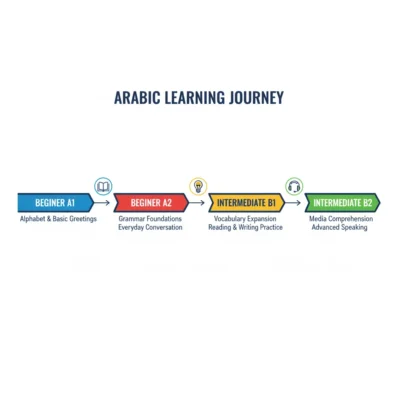
A well-designed MSA course takes you step by step from the alphabet to reading authentic texts. Here’s what a complete beginner to intermediate curriculum looks like:
Level 1: Absolute Beginner (0–3 months)
- Arabic Alphabet: All 28 letters in all their forms (isolated, initial, medial, final). You’ll learn to read and write basic words.
- Pronunciation: Master the unique sounds of Arabic (ع، ح، خ، غ، ق، ص، ض، ط، ظ). Live teacher correction is essential here.
- Basic Vocabulary: 200–300 high-frequency words (greetings, numbers, family, colors, days, months).
- Simple Sentence Structure: Nominal sentences (subject + predicate without a verb). Example: “أنا طالب” (I am a student).
- Introduction to Gender and Definite Article: Masculine/feminine nouns and the “al-” prefix.
Level 2: Elementary (3–6 months)
- Present Tense Verb Conjugation: Learn to conjugate regular verbs for all pronouns (I, you, he, she, we, they).
- Basic Grammar: Verb-subject-object order, negation, question formation.
- Reading Short Texts: Fully voweled children’s stories and simple news headlines.
- Listening Comprehension: Slow, clear audio with transcripts.
- Vocabulary Expansion: 500+ words, including common verbs, prepositions, and adjectives.
Level 3: Lower Intermediate (6–12 months)
- Past Tense and Future Tense: Conjugation and usage.
- More Grammar: The idafa (possessive) construction, relative pronouns, comparative/superlative.
- Reading Unvoweled Texts: Short newspaper articles and short stories with some vowel markings.
- Writing Short Paragraphs: Describe your day, your family, your city.
- Listening: News clips at natural speed with subtitles.
Level 4: Intermediate (12–18 months)
- Verb Forms (Awzan): Introduction to the 10 derived verb forms.
- Complex Sentences: Conditional sentences, subordinate clauses.
- Reading Authentic Materials: Al Jazeera articles, short stories, and beginner-level novels.
- Speaking: Hold a 15-minute conversation on familiar topics (work, hobbies, travel, current events).
- Writing: Short essays and formal emails.
Part 4: How to Learn Modern Standard Arabic Online – A Step-by-Step Roadmap
Step 1: Master the Alphabet and Sounds (2–4 weeks)
Dedicate 15–20 minutes daily to learning the Arabic script. Use apps like Duolingo or write the letters by hand. Most importantly, practice pronunciation with a native speaker. The sounds of ع, ح, and ق are impossible to learn from a book.
Step 2: Build Core Vocabulary with Spaced Repetition
Use Anki or Quizlet to learn the 1,000 most common MSA words. Aim for 10–15 new words per day. Review daily. This alone will get you to about 70% comprehension of simple texts.
Step 3: Take Live Online Classes (2–3 times per week)
Self-study has limits. A live teacher corrects your mistakes, answers your questions, and keeps you accountable. At Alphabet Arabic Academy, you’ll work with native Egyptian teachers who guide you through a structured MSA curriculum.
Step 4: Immerse Yourself Daily
- Change your phone’s language to Arabic.
- Follow Arabic news accounts on social media.
- Listen to Arabic podcasts (e.g., “ArabicPod101”, “BBC Xtra Arabic”).
- Watch Arabic YouTube channels with subtitles.
Step 5: Practice Speaking – Even Imperfectly
Join online language exchange groups (Tandem, HelloTalk) or practice speaking with your tutor. Don’t wait until you feel “ready.” You’ll never feel ready. Start now.
Step 6: Read and Write Every Week
Keep a daily journal in Arabic – just 3–5 sentences. Read short articles on sites like “Al Jazeera Learning Arabic” or “Madinah Arabic”.
Step 7: Take Proficiency Tests (Optional)
If you need certification, prepare for CEFR or ACTFL exams. Many online courses, including ours, offer exam-focused training.
Part 5: Best Platforms to Learn Modern Standard Arabic Online
| Platform | Best For | Price Range | Live Teacher | Notable Feature |
|---|---|---|---|---|
| Alphabet Arabic Academy | Complete curriculum, all levels | From $40/month | ✅ Yes | Native Egyptian teachers, Al-Azhar certified |
| Duolingo | Beginners, daily habit | Free / $6.99 | ❌ No | Gamified alphabet and vocabulary |
| Mango Languages | Structured MSA | $8–20/month | ❌ No | Focuses on practical phrases |
| LinguaLift | Self-paced with feedback | $30/month | ❌ No (has tutors add-on) | Custom learning paths |
| ArabicPod101 | Audio lessons, all levels | Free / $8–25/month | ❌ No | Massive library of podcast lessons |
| Preply / iTalki | One-on-one tutoring | $10–40/session | ✅ Yes | Choose your own tutor |
| Al-Azhar Online Courses | Classical & MSA | Varies | ✅ Yes | Scholarly certification |
Al-Azhar Arabic Course is a special mention: Al-Azhar University in Cairo offers online MSA and classical Arabic courses with recognized certificates. However, these tend to be more expensive and less flexible. Alphabet Arabic Academy partners with Al-Azhar-trained teachers to bring you similar quality at a fraction of the cost.
Part 6: Classical Arabic Online – The Bridge to Quran and Heritage
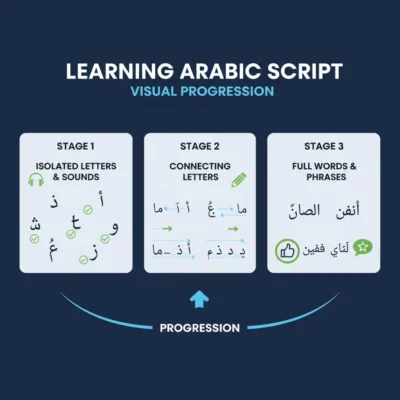
If your goal is to read the Quran or classical Islamic texts, you might be looking for a Classical Arabic course online. Classical Arabic is the older, more complex form from which MSA evolved. It includes grammatical features (like full case endings) that are often dropped in MSA.
How to learn classical Arabic online:
- Start with MSA – the foundation is 80% the same.
- Then take a dedicated classical Arabic course that focuses on Quranic vocabulary, advanced grammar (i’rab), and rhetorical devices (balaghah).
- Work with a teacher who has Ijazah (traditional certification) in Quranic recitation or classical Arabic.
At Alphabet Arabic Academy, we offer both MSA and Classical Arabic tracks. Many students begin with MSA for 6–12 months, then transition to Classical for deeper religious or literary study.
Part 7: Complete Beginner to Intermediate – A Realistic Timeline
Let’s set honest expectations. With consistent study (3–5 hours per week, including live classes and self-study), here’s what you can achieve:
| Level | Time | What You Can Do |
|---|---|---|
| Beginner (A1) | 3 months | Read the alphabet, introduce yourself, basic sentences |
| Elementary (A2) | 6 months | Short conversations, read simple texts, write short paragraphs |
| Lower Intermediate (B1) | 12 months | Discuss familiar topics, read news headlines, understand slow speech |
| Intermediate (B2) | 18–24 months | Fluent conversation on most topics, read unvoweled texts, write essays |
This timeline accelerates with more intensive study (e.g., 10+ hours per week) or slows with less consistency. The key is daily practice – even 20 minutes a day.
Part 8: Tips for Learning MSA Online – From Students Who Succeeded
- Don’t skip the alphabet. Spend 2–4 weeks mastering it. Handwrite the letters daily.
- Learn grammar in context. Don’t memorize tables. Learn rules through example sentences and real texts.
- Use spaced repetition for vocabulary. Anki is your best friend.
- Speak from day one. Even if it’s just “مرحباً، اسمي…” (Hello, my name is…)
- Watch Arabic news with subtitles. Al Jazeera’s “Learning Arabic” section is perfect for intermediates.
- Keep a mistake journal. Note every correction your teacher gives you. Review it weekly.
- Set micro-goals. “Learn 10 new words today” is better than “become fluent.”
- Join a community. Reddit’s r/learn_arabic is active and supportive.
- Don’t compare yourself to others. Your journey is unique.
- Celebrate small wins. Finished a chapter? Understood a news headline? That’s progress.
Part 9: Learn Arabic Fusha Online – Why Fusha Is the Key
Fusha (الفصحى) is another name for both Classical and Modern Standard Arabic. It means “the most eloquent” and refers to the pure, formal language. Learning Fusha opens doors to:
- The Quran – understood in its original revelation
- Arabic literature – from pre-Islamic poetry to modern novels
- Pan-Arab media – Al Jazeera, BBC Arabic, Al Arabiya
- Academic research – in Islamic studies, Middle Eastern history, linguistics
Many learners ask: Should I learn Fusha or a dialect? The answer depends on your goal. If you want to speak with people in Cairo or Beirut, learn a dialect. If you want to read, write, and be understood across the entire Arab world, learn Fusha (MSA). And for most serious learners, the best path is MSA first, then dialect.
Part 10: Al-Azhar Arabic Course – What You Need to Know
Al-Azhar University in Cairo is one of the world’s oldest and most prestigious Islamic universities. Its Arabic language programs are renowned for their depth and rigor. However, the official online Al-Azhar Arabic courses can be expensive (often $500+ per level) and require a significant time commitment.
Alternatives to official Al-Azhar courses:
- Many teachers who graduated from Al-Azhar offer private online lessons at much lower rates ($15–30/hour).
- Alphabet Arabic Academy employs Al-Azhar-trained instructors. You get the same quality of instruction without the university’s bureaucratic hurdles or high fees.
- Look for teachers who mention “Al-Azhar certified” or “Ijazah” in their profiles.
If you specifically need an Al-Azhar certificate for religious or professional reasons, the official program may be worth it. But for most learners, a qualified Al-Azhar-trained tutor is more than sufficient.
Frequently Asked Questions
Q: What is the best way to learn Modern Standard Arabic online?
The best way is to combine daily self-study (vocabulary apps, listening, reading) with live, one-on-one lessons from a native-speaking teacher. This gives you structure, correction, and accountability.
Q: How long does it take to learn MSA online?
Basic conversational ability (A2) takes about 6 months of consistent study (3–5 hours/week). Intermediate proficiency (B1–B2) takes 1–2 years.
Q: Can I learn MSA for free?
You can learn the alphabet and basic vocabulary for free using Duolingo, Anki, and YouTube channels. For grammar correction and speaking practice, a paid teacher is highly recommended.
Q: Is MSA the same as Classical Arabic?
No. Classical Arabic is older and more complex, used in the Quran and early texts. MSA is a modernized, simplified version. However, they share about 80% of the same grammar and vocabulary.
Q: What is the difference between Fusha and MSA?
Fusha technically includes both Classical Arabic and MSA. In common usage, “Fusha” often refers to MSA. Both are formal, written Arabic.
Q: Are there Al-Azhar certified teachers online?
Yes. Many platforms, including Alphabet Arabic Academy, employ teachers with Al-Azhar certification. They bring deep knowledge of Quranic and classical Arabic.
Q: How much does an online MSA course cost?
Prices range from free (limited resources) to $40–100/month for structured group classes, to $200+ for intensive one-on-one. Alphabet Arabic Academy starts at $40/month.
Q: What’s the difference between MSA and Egyptian Arabic?
MSA is formal, written, and understood everywhere. Egyptian Arabic is a spoken dialect used in daily conversation in Egypt. MSA won’t help you order food in Cairo, but it will let you read the news.
Q: Can I learn MSA and a dialect at the same time?
Yes, many advanced learners do. But beginners should focus on one first. MSA is recommended first because it forms the foundation.
Q: Do I need to learn the Arabic script?
Absolutely. Transliteration will only take you so far. The script is learnable in 2–4 weeks and unlocks everything.
Conclusion: Your Journey to MSA Fluency Starts Now
Learning Modern Standard Arabic online is one of the most intellectually and spiritually rewarding investments you can make. Whether your goal is to read the Quran, understand Arabic news, or connect with a rich literary tradition, MSA is your key.
At Alphabet Arabic Academy, we’ve helped hundreds of students go from absolute beginner to confident intermediate speaker. Our native Egyptian teachers, many with Al-Azhar backgrounds, provide structured, live, one-on-one MSA courses starting at just $40/month.
Ready to speak Fusha?
📅 Book your free trial lesson → AlphabetArabicAcademy.com
💰 Affordable plans for complete beginner to intermediate and beyond
🎓 Al-Azhar certified instructors available
يَلَّا نَبْدَأ – Let’s begin.