

🎯 Introduction: Why I Started Believing in Intensive Courses
I didn’t always recommend intensive Arabic Course. In fact, when I first started teaching Arabic, I thought they were overkill. Too intense. Too demanding. I believed the traditional path—studying a few hours a week, taking your time, enjoying the journey—was the better way.
Then I watched something shift in my classroom.
The students who made the biggest breakthroughs weren’t the ones with the most natural talent. They weren’t the ones with the best memory for vocabulary. They were the ones who had decided to go all-in. The ones who had blocked out time, committed to daily immersion, and refused to let anything get in the way.
I started paying attention to what was different about their learning. And I realized it wasn’t just about studying more hours. It was about creating a completely different learning environment. An environment where your brain doesn’t have the luxury of retreating to English. Where you’re forced to think, communicate, and problem-solve in Arabic. Where every single day builds on the previous one in a way that traditional classes simply can’t match.
That’s when I started recommending intensive courses to the right students. And I’ve never looked back.
This intensive approach is a specialized part of our broader methodology; for a full overview, you can check our Learn Arabic for Adults Online: Complete Guide.
👥 The Right Person for This Journey
Not everyone should do an intensive course. I’m going to be direct about this because I’ve seen too many people sign up for something that wasn’t right for them, struggle through it, and then blame the program.
You’re a good fit if:
You have a real deadline. Not a vague goal like “I want to speak Arabic someday.” But an actual date. You’re moving to an Arabic-speaking country in six months. You have a job that requires Arabic proficiency by next year. You’re preparing for a specific event or opportunity. When you have that kind of concrete timeline, intensive courses become your best friend. They give you the structure and urgency that makes real progress possible.
You thrive under pressure and structure. Some people need flexibility. They like choosing when to study, how much to study, and having the freedom to take breaks whenever they want. If that’s you, an intensive course will feel suffocating. But if you’re someone who gets motivated by structure, who performs better when you have clear expectations and daily accountability, then intensive courses will bring out the best in you.
You can actually commit the time. This is non-negotiable. An intensive course isn’t something you do on the side while working full-time and managing a busy life. It requires real commitment. You need to be able to dedicate 4-6 hours daily to focused learning. If you can’t do that, don’t sign up. You’ll fall behind, get frustrated, and waste your money.
You’re willing to be uncomfortable. Learning a language is inherently uncomfortable. You’ll make mistakes. You’ll feel embarrassed. You’ll struggle to find words. You’ll hear native speakers and think you’ll never sound like that. In an intensive course, you experience all of this intensified. If you’re someone who can push through discomfort and see it as part of the process, you’ll do well. If you need everything to feel comfortable and easy, intensive courses aren’t for you.
You should probably choose a different path if:
You’re learning Arabic purely for cultural interest. If you love the language and culture but have no specific goal, a traditional course will probably be more enjoyable. You won’t feel the pressure to perform, and you can move at your own pace.
You have limited availability. If you can only study 1-2 hours per week, an intensive course won’t work. Period. You’ll be wasting your money and your time.
You prefer self-directed learning. Some people love the freedom of choosing their own materials, setting their own pace, and learning independently. Intensive courses are the opposite of that. They’re structured, paced by the program, and require you to show up on schedule.
You get stressed by fast-paced environments. Some people find intensive courses energizing. Others find them overwhelming. Know yourself.
📋 What Your Days Actually Look Like
Let me paint a realistic picture of what happens inside an intensive course. Not the marketing version. The real version.
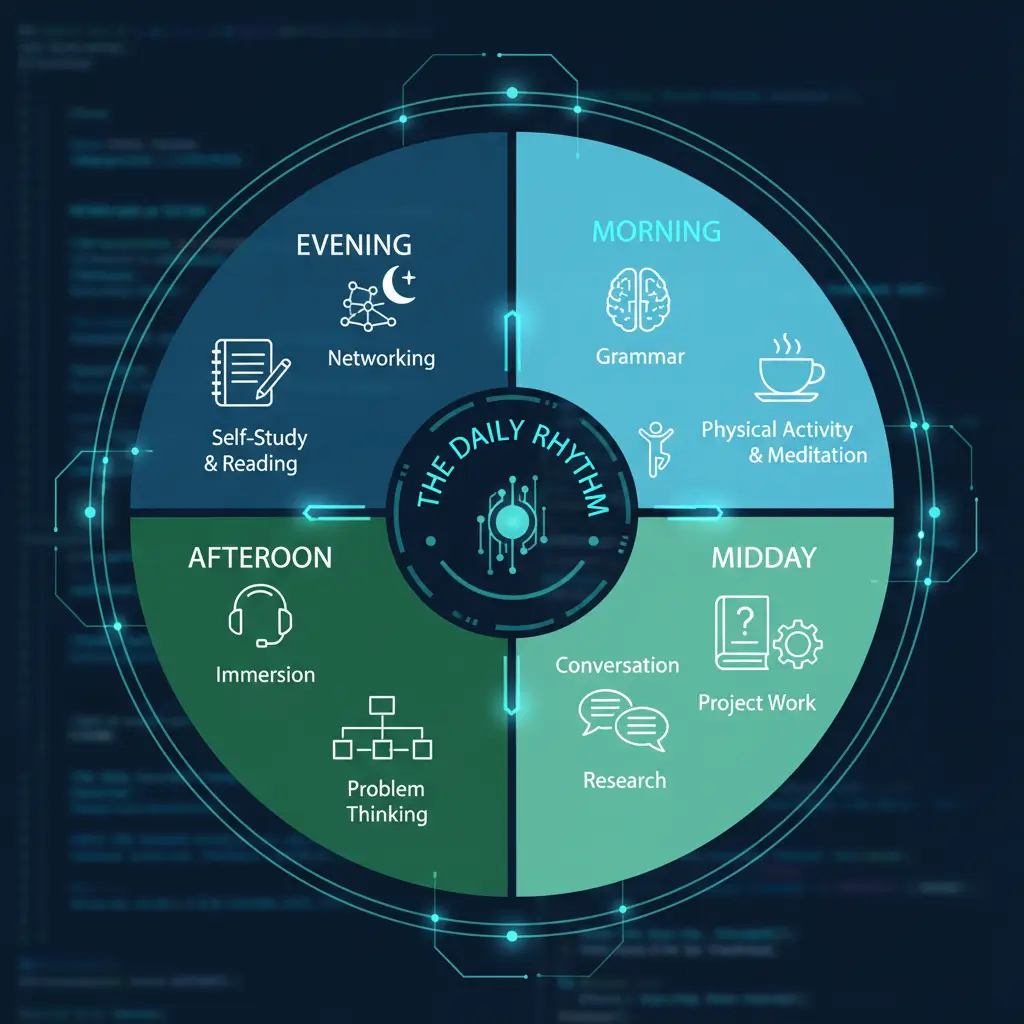
Morning Session: 8 AM – 10 AM
You walk in tired. You had coffee. You’re not sure if you’re ready for this. The teacher starts by reviewing something from yesterday. You thought you understood it, but now you realize you didn’t. This is normal. This is actually where learning happens—at the edge of what you know.
The teacher doesn’t stand at the front lecturing. They’re engaging you in conversation. They tell a story in Arabic. You listen. They ask you questions about the story. You have to think and respond. Your brain is working hard to retrieve vocabulary, construct sentences, and communicate meaning. This is active learning. This is where your brain actually changes.
Vocabulary comes up naturally in context. You’re not memorizing isolated words. You’re learning words because they’re relevant to what you’re discussing. Food words come up when you’re talking about meals. Travel words come up when you’re planning a trip. Business words come up when you’re role-playing a meeting. Your brain connects the word to the context, which makes it stick.
By 10 AM, your brain feels tired. That’s not a sign of failure. That’s a sign that you’re working hard.
Late Morning: 10:15 AM – 12:15 PM
This is the speaking practice session. You’re sitting with a native speaker or in a small group, and you’re actually communicating in Arabic. Not practicing memorized dialogues. Actually talking.
The native speaker asks you about yourself. Your background. Your goals. Your life. You have to think on your feet. You don’t have time to translate in your head. You just have to speak. You make mistakes. You forget words. You construct sentences awkwardly. And then the native speaker gently corrects you. They show you a better way to say it. You hear the correct version. Your brain registers it. You move on.
You practice real scenarios. You role-play a job interview. You negotiate a price at a market. You handle a customer service issue. You book a hotel room. These aren’t artificial textbook exercises. They’re things you might actually need to do. And because they’re realistic, your brain takes them seriously.
The native speaker gives you immediate feedback. Not just “that’s wrong.” But “here’s why it’s wrong, and here’s a better way to say it.” This immediate correction is powerful. Your brain learns faster when it gets feedback in real-time.
By noon, you’re mentally exhausted. This is good. This is where growth happens.
Afternoon: 1 PM – 2:45 PM
This is the cultural immersion block. This is what separates intensive courses from traditional classes.
You might watch an Arabic film and discuss it. You’re not just understanding the words. You’re understanding the cultural references. The humor. The way Arabs interact with each other. The values they express. The assumptions they make. You’re learning why they say things the way they do.
You might cook traditional Arabic food while learning food-related vocabulary. You’re not just learning words. You’re experiencing the culture. You’re understanding the importance of food in Arab culture. You’re learning about hospitality and family meals and the social significance of eating together.
You might have a guest speaker from an Arabic-speaking country. They talk about their life. Their culture. Their perspective. You’re learning language, but you’re also learning to understand a different way of living. You’re building cultural competence alongside language competence.
This cultural immersion is crucial. Language without culture is just sounds and words. Culture gives language meaning. Culture explains why Arabs say things the way they do. Culture shows you the values and assumptions behind the language.
Maintaining this pace is essential because consistent exposure is the key. Discover why we prioritize to Learn Arabic Daily: Way to Fluency.
Evening: Self-Study and Homework
You’re back in your room or at home. You have listening exercises. You have writing assignments. You have vocabulary to review. You’re preparing for tomorrow’s lessons.
This is where many students struggle. After a full day of intensive study, the last thing you want to do is more studying. But this is where the magic happens. This is where your brain consolidates what you learned. This is where information moves from short-term to long-term memory.
The homework isn’t busywork. It’s strategic. It reinforces what you learned. It prepares you for tomorrow. It gives your brain time to process and integrate new information.
🗣️ Speaking: The Thing That Actually Transforms You
I’ve worked with hundreds of students. The ones who improve the fastest aren’t the ones who study grammar the hardest. They’re not the ones who memorize the most vocabulary. They’re the ones who speak the most.

Speaking is terrifying. I understand. You don’t want to sound stupid. You don’t want to make mistakes in front of other people. You’re worried about your accent. You’re worried about forgetting words. You’re worried about looking foolish.
But here’s the thing I’ve learned: you have to sound stupid before you sound good.
In an intensive course, you speak constantly. You speak in class. You speak with native speakers. You speak with classmates. You speak in role-plays. You speak in real situations. You’re not waiting for your turn in a class of 30 students. You’re speaking multiple times every single day.
And here’s what happens. The first week, you’re terrified. You stumble over words. You forget basic vocabulary. You feel embarrassed. You go back to your room and wonder if you made a huge mistake.
By week two, you’re still nervous, but you’re getting used to it. You’re making fewer mistakes. You’re thinking faster. You’re starting to anticipate what you need to say.
By week three, something shifts. You stop thinking about the grammar. You stop translating in your head. You just speak. It’s not perfect, but it’s real. It’s communication.
By week four, you’re having conversations. Real conversations. About real topics. With real people. And it feels amazing. You realize that native speakers understand you. They appreciate your effort. They help you improve. You’re not being judged. You’re being supported.
This is what intensive courses give you that regular classes often don’t. They force you to speak so much that you get over the fear. You realize that making mistakes isn’t the end of the world. You realize that communication is more important than perfection. You realize that you’re capable of more than you thought.
get the most out of these hours, follow our Learn Arabic Speaking Online: Guide and consider joining our specialized Conversational Arabic Classes Online to speed up your progress.
🌊 Immersion: Creating an Environment Where Arabic Becomes Your Default

I’ve tried a lot of teaching methods over the years. Some work better than others. But the one thing that consistently produces the fastest results is immersion. Real immersion. Not just studying Arabic. Living Arabic.
Real immersion means making Arabic your default language for several hours every day. It means your brain doesn’t have the luxury of retreating to English. It means you’re forced to think, communicate, and problem-solve in Arabic.
Immersion is what makes your brain adapt. We’ve perfected this process in our program for Arabic Immersion Online: Fluency.
Here’s what this looks like in practice:
Everything in class happens in Arabic. The teacher uses English minimally. Only when absolutely necessary. At first, this is frustrating. You want them to explain things in English. You want them to make it easier. But then something happens. Your brain adapts. You start understanding more. You start thinking in Arabic.
You interact with native speakers daily. Not just teachers. Native speakers from the local community. Other students from around the world. You make friends. You study together. You practice outside of class. This social immersion is powerful. You’re not just learning a language. You’re building relationships in that language.
You consume Arabic media constantly. You watch Arabic films. You listen to Arabic music. You read Arabic news. You scroll through Arabic social media. Your brain is processing authentic Arabic all day long. Not textbook Arabic. Real Arabic. The Arabic that native speakers actually use.
You participate in cultural activities. You eat Arabic food. You learn about Arab history and traditions. You understand the context behind the language. Language makes so much more sense when you understand the culture behind it.
⚖️ Intensive vs Regular Courses: Making the Right Choice
I get asked this question constantly. Which is better? Intensive or regular courses?
Here’s my honest answer: it depends on your situation. But let me break down the real differences so you can make an informed decision.
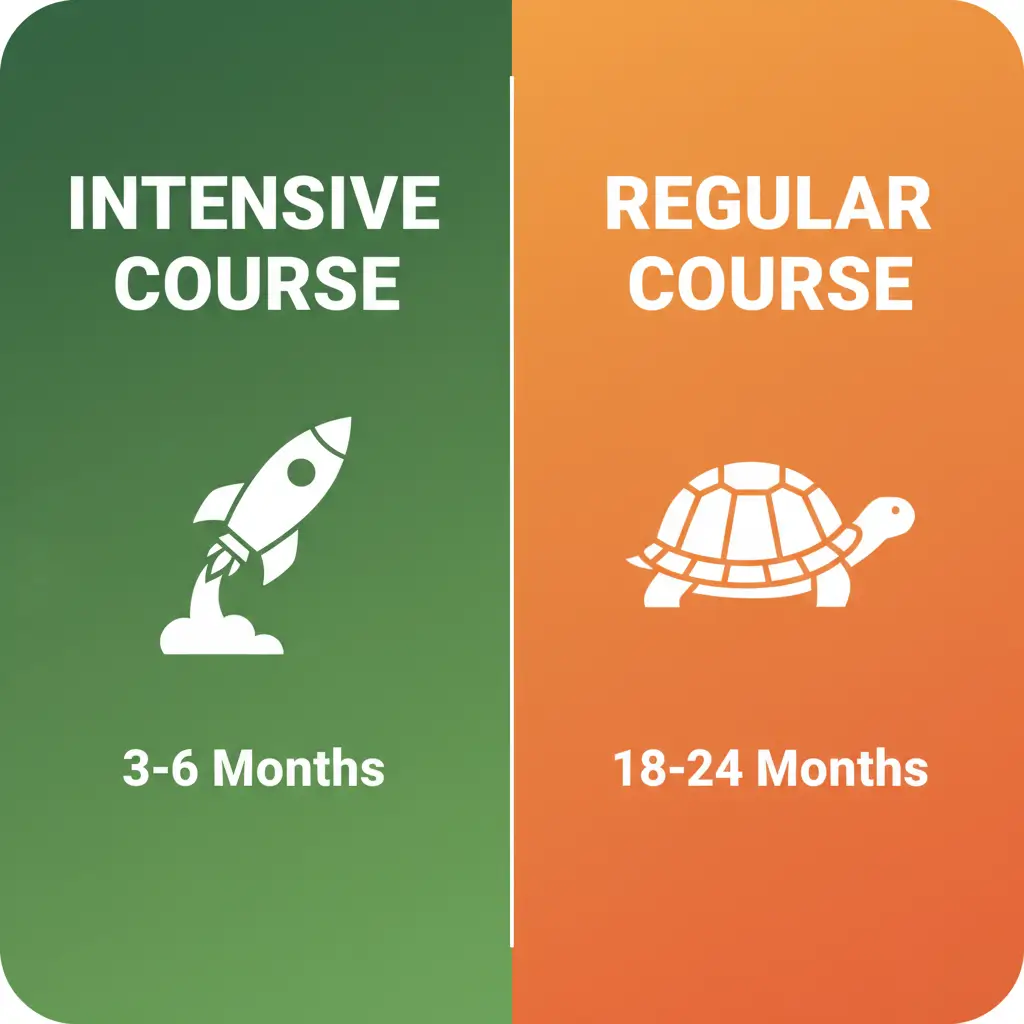
| Factor | Intensive Courses | Regular Courses |
|---|---|---|
| Time to conversational fluency | 3-6 months | 12-18 months |
| Daily time commitment | 4-6 hours | 1-2 hours |
| Speaking practice | 2-3 hours daily | 30 minutes weekly |
| Immersion level | Very high | Moderate |
| Cost | $3,000-8,000 | $2,000-4,000 |
| Stress level | High | Low |
| Best for | Goal-driven learners | Casual learners |
| Sustainability | Short-term | Long-term |
The numbers tell the story. Intensive courses compress learning into a shorter timeframe. But they require more commitment and can be more stressful. Regular courses are more sustainable. You can maintain them while working full-time. But they take longer to produce results.
Choose based on your life situation, not on what sounds cooler.
📚 What I’ve Learned from Students Who Succeeded

I’ve watched hundreds of adults go through intensive courses. Some thrive. Some struggle. Some quit. The ones who succeed have certain things in common.
They have a clear reason why. Not just “I want to speak Arabic.” But a real reason. “I’m moving to Cairo in six months.” “I got a job that requires Arabic.” “I want to reconnect with my family.” “I’m starting a business in an Arabic-speaking country.” When you have a real reason, you push through the hard moments.
They’re willing to be uncomfortable. Learning a language means making mistakes. It means feeling embarrassed. It means struggling to find words. The students who succeed are the ones who see this as part of the process, not as a sign of failure.
They show up every day. Even when they’re tired. Even when they’re frustrated. Even when they want to quit. The ones who succeed are the ones who show up consistently. Day after day. Week after week.
They engage with the culture. They don’t just study the language. They watch Arabic films. They listen to Arabic music. They read Arabic news. They try to understand the culture. This engagement accelerates their learning.
They build relationships. They make friends with classmates. They interact with native speakers. They build a community around their learning. This community keeps them motivated and accountable.
While these students dedicated themselves to the long-term goal to Learn Arabic in 6 Months, others have seen incredible initial results even when they try to Learn Arabic in One Month.
🚧 The Challenges I See Most Often
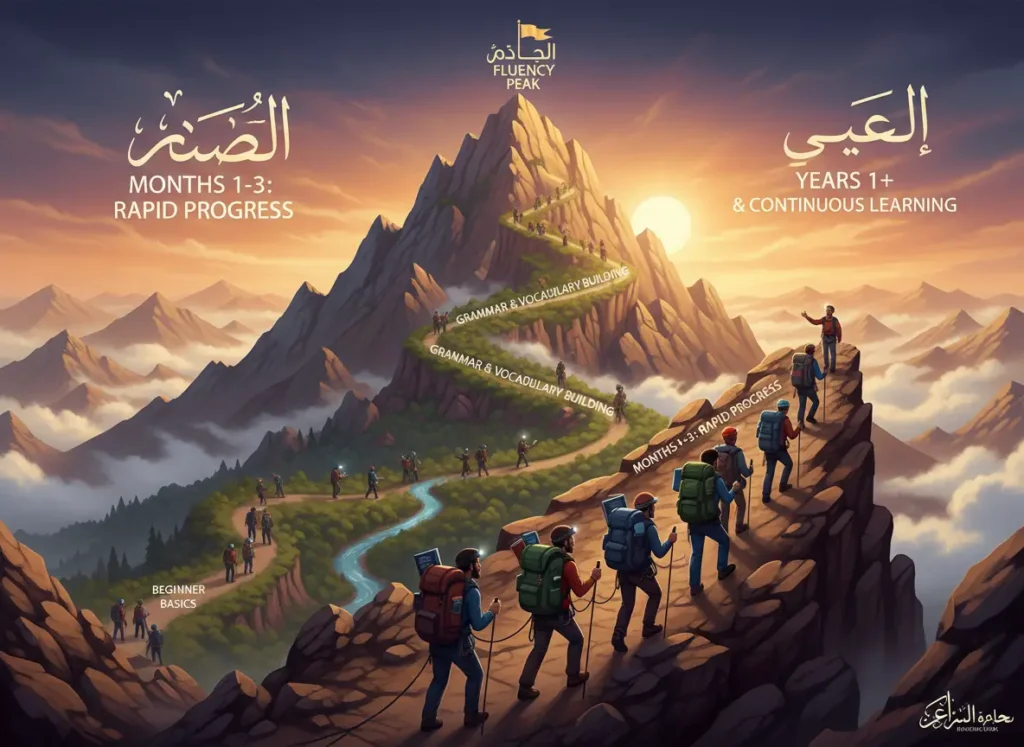
Intensive courses are hard. If someone tells you they’re easy, they’re not being honest. But knowing the challenges in advance helps you prepare for them.
Mental fatigue is real. By week two or three, your brain is exhausted. You’re processing new sounds, grammar patterns, and vocabulary for hours every day. Your brain is working at maximum capacity. I’ve had students tell me they’ve never been more tired in their lives. This is normal. Your brain will adapt. By week four or five, the fatigue decreases. Your brain becomes more efficient at processing Arabic.
Motivation fluctuates. Initial enthusiasm fades. By week three or four, the novelty wears off. You’re tired. Progress feels slower. You question your decision. This is normal. Everyone goes through this. The key is pushing through this valley. Because on the other side of this valley is a breakthrough.
Pronunciation feels impossible. Arabic sounds are challenging for English speakers. The emphatic consonants. The guttural sounds. The different rhythm. These feel unnatural. You hear native speakers and think you’ll never sound like that. But here’s what I’ve learned: perfect pronunciation isn’t necessary for communication. Native speakers understand you even with an accent. And your accent improves with practice. A lot of practice.
Grammar feels overwhelming. Arabic grammar is complex. The verb system. The case endings. The gender agreement. It’s a lot to absorb quickly. You might feel like you’re drowning in rules. But here’s the thing: you don’t need to master grammar perfectly. You learn grammar through usage. You understand patterns through repetition before you understand the rules intellectually.
Homesickness is real. If you’re studying abroad, you’re not just learning a language. You’re adjusting to a new culture. The food is different. Social norms are different. The pace of life is different. This can be emotionally challenging. I’ve had students call me in tears because they miss home. That’s valid. That’s real. But here’s what I tell them: embrace the cultural immersion. That’s the point. Try local food. Participate in local activities. Make friends with locals and other students. The cultural adjustment is part of the learning experience.
❓ Questions I Answer All the Time
Q: How much does an intensive Arabic course cost?
A: It varies. I’ve seen programs from $3,000 to $8,000 for three to six months. Some include accommodation. Some don’t. Some offer payment plans. Some offer scholarships. Do your research. Don’t just pick the cheapest option. Quality matters.
Q: Can I work while doing an intensive course?
A: Realistically? No. Intensive courses demand 4-6 hours daily of focused study. Adding work would compromise both. Most students take a leave of absence or study during a career break. Some online intensive courses offer slightly more flexibility, but even these require significant daily commitment.
Q: What if I fall behind?
A: Talk to your instructor immediately. Most programs offer tutoring or additional support. Falling behind is common. You’re not alone. The key is addressing it quickly rather than letting it compound.
Q: Will I maintain my Arabic after the course ends?
A: Not automatically. Language requires maintenance. After your intensive course, dedicate 30-60 minutes daily to Arabic. Conversation practice. Reading. Listening. Writing. This maintains and builds on your intensive course foundation.
Q: Are online intensive courses as effective as in-person?
A: Online intensive courses can be effective but aren’t quite as immersive as in-person programs. You miss the cultural immersion and constant Arabic environment. However, online programs offer flexibility and are more affordable. Choose based on your circumstances and learning style.
Q: What if I have a family?
A: It’s challenging but possible. Some programs offer family-friendly schedules. Some allow family members to come with you. Some students study while their family is with them. It requires planning and support, but it’s doable.
Q: Which dialect should I study?
A: Most intensive courses teach Modern Standard Arabic (Fusha) combined with a regional dialect—Egyptian, Levantine, or Gulf Arabic. Fusha is understood across the Arab world. Regional dialects help you communicate naturally in specific regions. Choose based on where you plan to use Arabic.
Q: How long before I can have real conversations?
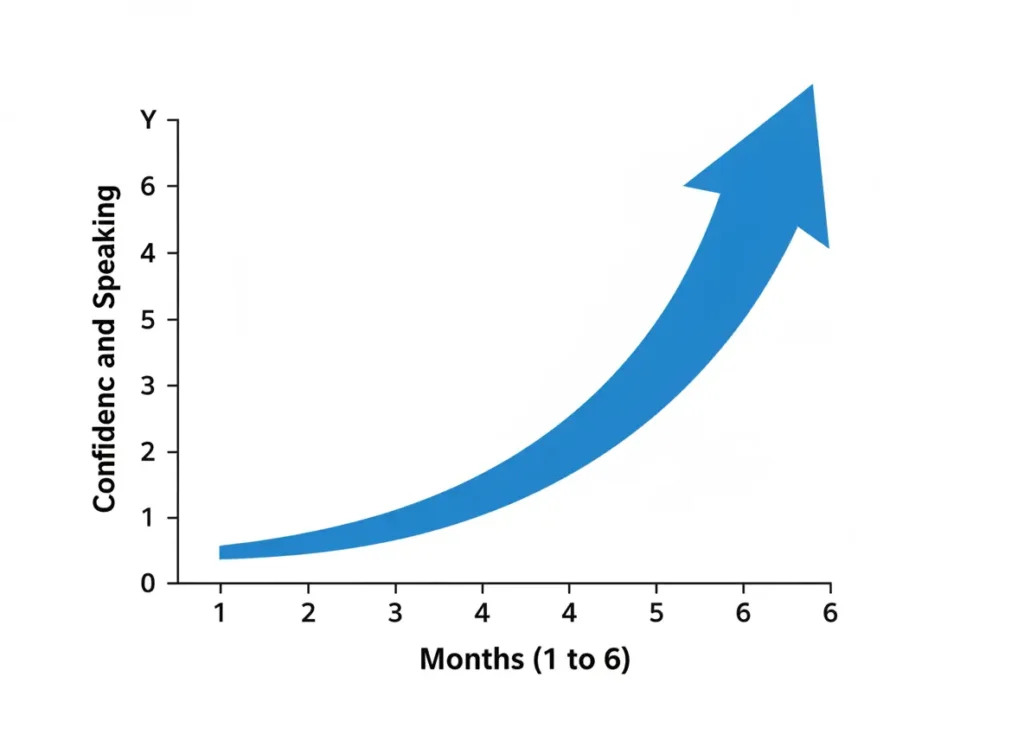
A: In a well-designed intensive course, you can have basic conversations by month two. More complex conversations by month four. Functional fluency by month six. This assumes 4-6 hours daily of focused study and active engagement.
Q: What’s the success rate?
A: Most students who complete intensive courses achieve conversational fluency. The key factor isn’t the program. It’s student commitment. Students who attend consistently, complete assignments, and engage actively succeed. Those who miss classes or don’t commit struggle.
Q: How do I know if I’m ready?
A: You’re ready if you have a clear goal, can commit the time, and are willing to be uncomfortable. You’re not ready if you’re learning for fun, have limited availability, or need everything to feel easy.
🚀 Making Your Decision

Here’s the truth: intensive courses aren’t for everyone. But if you have a clear goal, can commit 4-6 hours daily, and are willing to push through discomfort, an intensive course could transform your Arabic skills in months rather than years.
The investment is significant. Financial, temporal, and emotional. But so are the results.
The adults I’ve worked with who completed intensive courses didn’t regret it. Even the ones who struggled. Even the ones who cried during the first month. They all said it was worth it.
But it’s not for everyone. And that’s okay.
If you decide to do it, commit fully. Show up every day ready to learn. Push through the discomfort. Celebrate the wins. And within months, you’ll be having conversations in Arabic you never thought possible.
Your next step: research programs that match your goals, timeline, and budget. Look for programs with strong reviews, experienced instructors, and curricula aligned with your needs. Many programs offer free consultations. Use them. Ask questions. Understand exactly what you’re signing up for.
Then make a decision. Commit fully. And let me know how it goes.