
If you’ve ever tried to learn Arabic and ended up overwhelmed by grammar rules, verb conjugations, and three different writing systems — you’re not alone. But here’s the truth that most textbooks won’t tell you: the fastest way to connect with Arabic speakers is to start with Egyptian Arabic phrases, not Modern Standard Arabic.
Egyptian Arabic (known as Masri or Ammiyya Masriyya) is the most widely understood dialect across the Arab world. Thanks to Egypt’s massive influence in music, cinema, and television, a person from Morocco to Kuwait will understand you the moment you open your mouth in Egyptian Arabic. That’s a superpower no other dialect gives you.
In this guide, you’ll find the 50 most essential Egyptian Arabic phrases — organized by situation, written in English transliteration, and explained so you actually understand when and how to use them naturally.
Why Egyptian Arabic Phrases First?
Before diving in, it’s worth answering a question many learners ask: “Should I learn Modern Standard Arabic (MSA) or Egyptian dialect?”
For conversation, travel, and real human connection — Egyptian dialect wins every time. MSA is formal, written Arabic. You’ll find it in newspapers, official speeches, and the Quran. Egyptian Arabic is what people actually speak at home, in markets, in cafés, and on the phone with their families.
Once you’ve built a foundation of common Egyptian Arabic phrases, you’ll be amazed how quickly real conversations start happening.
Greetings and First Impressions (Phrases 1–10)
The way you greet someone in Egypt sets the entire tone of an interaction. Egyptians are famously warm, expressive, and generous with their words — so learning greetings well goes a long way.
1. Ahlan wa sahlan (أهلاً وسهلاً) Pronunciation: AH-lan wa SAH-lan The classic Egyptian welcome. Deeper than just “hello,” it literally means “you’ve arrived among family on easy ground.” Use it when welcoming someone to your home, your city, or even your table.
2. Izayak / Izayik (إزيك) Male: ih-ZAY-ak | Female: ih-ZAY-ik “How are you?” — The most natural, everyday greeting between friends. You’ll hear this dozens of times a day in Egypt.
3. Tamam, walhamdulillah (تمام، والحمد لله) TAM-am, wal-HAM-du-LIL-lah “Fine, praise God.” The standard, warm response to “how are you.” Even if your day hasn’t been perfect, Egyptians typically respond this way as an expression of gratitude rather than a literal status update.
4. Sabah el-kheir (صباح الخير) SAH-bah el-KHEIR “Good morning.” The reply is sabah el-noor (SAH-bah el-NOOR), meaning “morning of light.” This back-and-forth is so deeply ingrained that skipping it can feel abrupt.
5. Masa el-kheir (مساء الخير) MAH-sa el-KHEIR “Good evening.” Reply: masa el-noor. Same structure, different time of day.
6. Ismi… (اسمي…) IS-mi “My name is…” Simple, essential, and always appreciated when you make the effort to introduce yourself in Arabic.
7. Ana min… (أنا من) AH-na min “I am from…” Egyptians are genuinely curious about foreigners and will almost always ask where you’re from within the first minute of meeting you.
8. Fursa sa’eeda (فرصة سعيدة) FUR-sa sa-EE-da “Nice to meet you.” Literally “a happy occasion.” Use this after introductions.
9. Ma’a salama (مع السلامة) MA-a sa-LAH-ma “Goodbye.” Literally “go with safety.” The other person typically replies allah yisallimak — “may God keep you safe.”
10. Yalla (يلا) YAL-la “Let’s go / come on.” One of the most versatile words in the Egyptian dictionary. It can mean “hurry up,” “let’s move,” “okay let’s do it,” or even just a casual “alright then” depending on tone.
Everyday Useful Phrases (Phrases 11–20)
These are the phrases that will carry you through an entire day in Egypt — from morning coffee to navigating crowded streets.
11. Mumkin…? (ممكن) MUM-kin “Is it possible to…? / Can I…?” One of the most useful words you’ll ever learn. Mumkin el-menu? = “Can I have the menu?” Mumkin foto? = “Can I take a photo?” Simple, polite, endlessly useful.
12. Law samaht (لو سمحت) law sa-MAHT “Please / Excuse me.” Use it to get someone’s attention, to ask for a favor, or to politely interrupt. It’s the Egyptian “excuse me” and “please” combined into one.
13. Shukran (شكراً) SHUK-ran “Thank you.” The reply is afwan (AF-wan) — “you’re welcome.” Egyptians appreciate when foreigners make the effort to say this in Arabic rather than English.
14. Mish fahim / Mish fahma (مش فاهم / مش فاهمة) mish FAH-him / mish FAH-ma “I don’t understand.” Male/female forms. Absolutely essential for any beginner. Nobody will judge you — Egyptians are incredibly patient with Arabic learners.
15. Tikallim bi-butʾ, min fadlak (تكلم ببطء، من فضلك) ti-KAL-lim bi-BOTE, min FADT-lak “Please speak slowly.” Pair this with mish fahim and you’ve got yourself covered for most confusing moments.
16. Tayib (طيب) TAY-yib “Okay / Good / Alright.” Incredibly versatile. Confirms understanding, expresses agreement, or just signals you’re following along in a conversation.
17. Akid (أكيد) ah-KID “Of course / Definitely.” Strong agreement. If someone asks “are you sure?” and you want to say yes emphatically — akid.
18. Mesh lazzim (مش لازم) mesh LAZ-zim “It’s not necessary / You shouldn’t have.” Used graciously when someone offers you something you want to decline politely, or when someone does something kind for you.
19. Inshallah (إن شاء الله) in-SHA-allah “God willing.” One of the most misunderstood phrases in Arabic. It’s not just a polite evasion — it’s a genuine expression of hope and humility about future events. You’ll hear it in response to almost any future plan.
20. Habibi / Habibti (حبيبي / حبيبتي) ha-BEE-bi / ha-BEE-bti “My dear / My love.” Used between friends, family, strangers in a warm mood — basically everyone in Egypt. Not necessarily romantic. If an Egyptian calls you habibi, they like you.
Shopping and Bargaining (Phrases 21–28)
Egypt’s markets (souqs) are legendary. Knowing a few phrases here will save you money and earn you genuine respect from vendors.
21. Bikam da? (بكام ده؟) bi-KAM da “How much is this?” Your first weapon in any market. Point and ask.
22. Ghali awi (غالي أوي) GHA-li AW-wi “That’s very expensive!” Always said with feeling. This is the opening move in any price negotiation.
23. Momkin tkhaffid shwayya? (ممكن تخفض شوية؟) MUM-kin ti-KHAF-fid SHWAY-ya “Can you lower the price a little?” The polite negotiation follow-up. Say it with a smile.
24. Mish ayiz / Mish ayza (مش عايز / مش عايزة) mish AY-yiz / mish AY-za “I don’t want it.” Male/female. Said firmly but not rudely — useful when vendors are persistent.
25. Khod / Khodi (خد / خدي) KHOD / KHO-di “Take it.” As in “take my final price offer.” Used when you’ve made your best offer in a negotiation.
26. Tayib, hakhod da (طيب، هاخد ده) TAY-yib, HA-khod da “Okay, I’ll take this.” The satisfying phrase that closes a deal.
27. ‘Andak/Andik fakka? (عندك فكة؟) AN-dak FAK-ka / AN-dik FAK-ka “Do you have change?” Egypt often has a coin shortage, so asking this in advance saves awkward moments at checkout.
28. El-hisab, law samaht (الحساب، لو سمحت) el-hi-SAB, law sa-MAHT “The bill, please.” Essential for restaurants and cafés.
Getting Around (Phrases 29–35)
29. Fein…? (فين) FEIN “Where is…?” Fein el-hammam? = Where is the bathroom? Fein el-funduq? = Where is the hotel? Learn this word and you can ask about anything.
30. ‘Ayiz aruh… (عايز أروح) AY-yiz a-ROOH “I want to go to…” Follow with your destination. ‘Ayiz aruh el-ahram = “I want to go to the Pyramids.”
31. ‘Ala tool (على طول) AH-la TOOL “Straight ahead.” You’ll hear this constantly from locals giving directions.
32. Shimaal / Yimeen (شمال / يمين) shi-MAAL / yi-MEEN “Left / Right.” The two most critical direction words.
33. Wi’if hena, law samaht (وقف هنا، لو سمحت) WI-‘if HE-na, law sa-MAHT “Stop here, please.” For taxis and microbuses. Say it with confidence or they’ll miss the spot.
34. Kaam el-taman? (كام التمن؟) kam el-TA-man “How much does it cost?” Slightly different from bikam — used more specifically for transport fares.
35. Mish ‘arif el-tareeq (مش عارف الطريق) mish ‘AH-rif el-ta-REEQ “I don’t know the way.” Useful when someone asks you for directions before you’ve mastered the city yourself.
Food and Restaurants (Phrases 36–42)
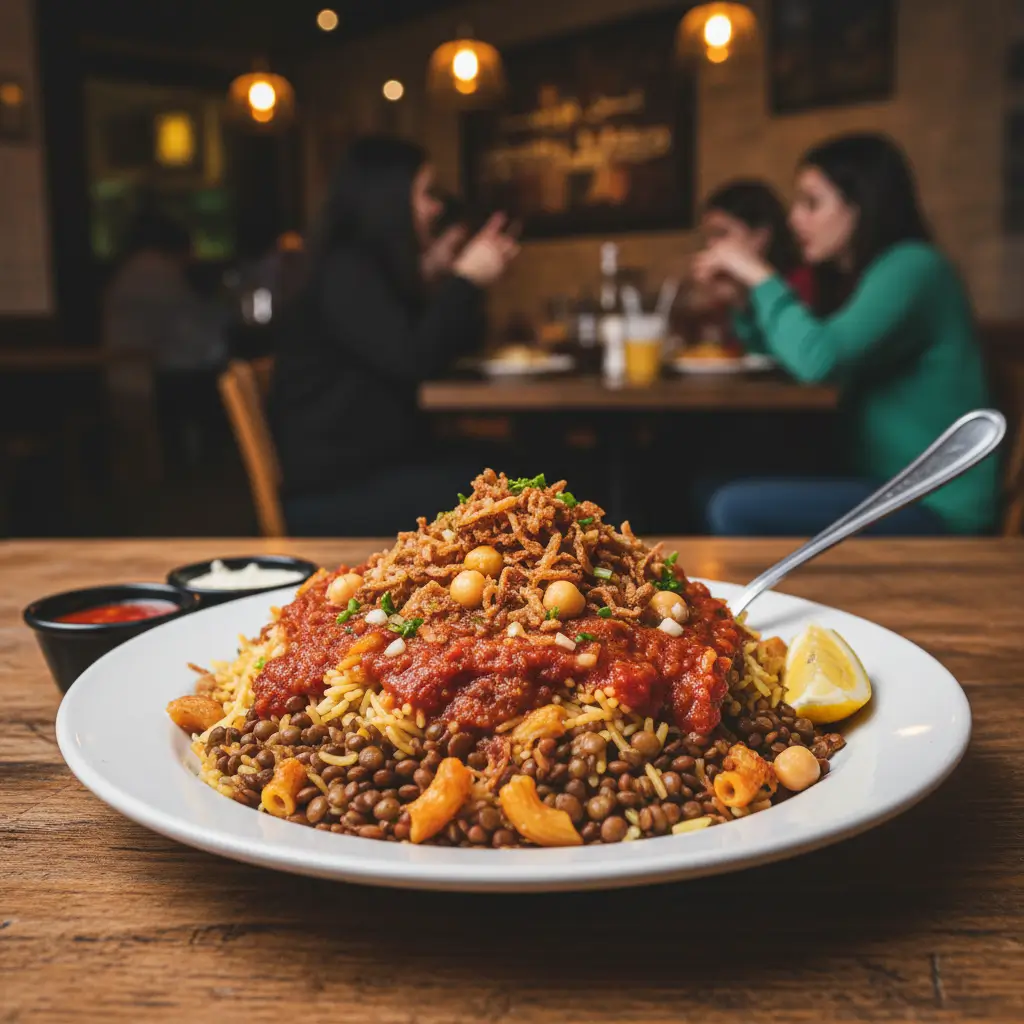
Egyptian food culture is rich, generous, and centered around sharing. These phrases will help you eat well.
36. Ana ga’an / Ana gaw’ana (أنا جعان / أنا جوعانة) AH-na GAH-‘an / AH-na GAW-‘AH-na “I’m hungry.” Male/female forms. A perfectly acceptable thing to announce in Egypt — it practically guarantees you’ll be fed.
37. Da zaki awi! (ده زاكي أوي) da ZAH-ki AW-wi “This is delicious!” One of the most welcome compliments you can give. Egyptians take tremendous pride in their food.
38. El-akl tayib (الأكل طيب) el-AKL TAY-yib “The food is good.” Slightly more reserved than da zaki awi, but still warmly received.
39. Min gheir… (من غير) min GHEIR “Without…” Min gheir basal = without onions. Essential if you have dietary preferences.
40. Kaman wahid, law samaht (كمان واحد، لو سمحت) KA-man WA-hid, law sa-MAHT “One more, please.” Whether it’s tea, bread, or a second helping — this phrase gets used constantly at Egyptian tables.
41. Shaba’tit / Shaba’tu (شبعت) sha-BA’-tit (female) / sha-BA’-tu (male) “I’m full.” Said with satisfaction. In Egyptian culture, finishing your food and declaring you’re full is a genuine compliment to the host.
42. Bidi heya dol (بيدي هي دول) BI-di HI-ya DOL “I’m treating / It’s on me.” Prepare for a gentle battle — Egyptians are fiercely competitive about paying the bill for guests.
Emotions and Social Phrases (Phrases 43–50)
43. Mabrouk (مبروك) mab-ROOK “Congratulations.” Used for birthdays, engagements, new jobs, new babies — basically any good news. The reply is allah yibarak feek — “may God bless you.”
44. El-hamdulillah (الحمد لله) el-HAM-du-LIL-lah “Praise God / Thank God.” The answer to how are you, the response to good news, and the expression after finishing a meal. Possibly the most frequently spoken phrase in Egypt.
45. Bakhtak (بختك) BAKHT-ak “You’re lucky.” Said when someone has good fortune — finding a taxi, getting a good deal, escaping the summer heat.
46. Mesh mohem (مش مهم) mesh mo-HEM “It doesn’t matter / Never mind.” The Egyptian shrug in word form. Used to dismiss small problems or signal that you’re not bothered.
47. Khaleeha ‘ala Allah (خليها على الله) KHA-lee-ha AH-la AL-lah “Leave it to God.” The phrase Egyptians use when something is out of their hands. A beautifully accepting philosophy compressed into four words.
48. Rouh bi-salama (روح بسلامة) rooh bi-sa-LAH-ma “Go safely.” Said when someone leaves on a journey — a heartfelt farewell with a layer of genuine care.
49. Inta/Inti walla! (إنت ولا!) IN-ta WAL-la / IN-ti WAL-la “You’re amazing! / You’re the best!” An enthusiastic Egyptian compliment. Expect to receive this if you make any attempt to speak Arabic — Egyptians are enormously encouraging.
50. Ahla wa sahla beek / beeki (أهلاً وسهلاً بيك) AH-la wa SAH-la BEEK / BEE-ki “Welcome to you specifically.” The personal version of the opening phrase — said directly to a guest, a new friend, or someone you’re genuinely glad to see. End where we began, because in Egypt, every good relationship circles back to welcome.
How to Practice These Phrases Effectively
Reading a list of phrases is a start — but speaking is where real progress happens. Here are three practical ways to move from memorization to actual conversation:
Record yourself. Egyptian Arabic has sounds that don’t exist in English, particularly the ‘ain (ع) and ghain (غ). Recording yourself and comparing to native speakers accelerates your ear significantly.
Use phrases in pairs. Almost every Egyptian greeting has a specific response. Learn the call and the reply together — sabah el-kheir / sabah el-noor, shukran / afwan — and you’ll start sounding natural much faster.
Find a native-speaking conversation partner. Nothing replaces live practice with a patient, qualified Egyptian teacher who can correct your pronunciation in real time, explain the cultural context behind expressions, and push you to speak more than you listen.
Take Your Egyptian Arabic Further
These 50 phrases will open doors — but they’re the beginning of a much richer journey. Egyptian Arabic has layers of humor, idiom, warmth, and poetry that take time and real conversation to uncover.
If you’re serious about moving from phrases to genuine fluency, a structured course with native Egyptian teachers will get you there far faster than self-study alone. At Alphabet Arabic Academy, our Colloquial Egyptian Arabic course is built entirely around spoken communication — with 1-on-1 lessons, flexible scheduling, and teachers who are as invested in your progress as you are.
You might also be interested in exploring:
- Arabic Conversation Course — If speaking confidently is your primary goal, this program puts you talking for 80% of every session.
- Modern Standard Arabic (MSA) — Ready to add formal Arabic reading and writing alongside your spoken dialect skills?
- Arabic for Kids — Introducing a child to Arabic? Our kids program builds vocabulary and pronunciation through games and stories.
The best phrase you’ll ever learn in Egyptian Arabic is the one you actually say out loud to a real person. Start there.
Want to practice these phrases with a native Egyptian teacher? Book a free 60-minute trial lesson — no credit card required.