
Last updated: April 2026
Let’s Start with the Truth Nobody Tells You
arabic grammar online 🙁 arabic grammar has a reputation problem.
Ask most people why they stopped learning Arabic, and somewhere in the answer you’ll find the word “grammar.” Too complicated. Too many rules. Too many exceptions to the rules. Charts that go on forever. Terminology that sounds like it was invented specifically to discourage beginners.
Here’s what’s actually true: Arabic grammar is not harder than it’s made to seem. What’s hard — genuinely hard — is the way it’s usually taught. When grammar is presented as a collection of rules to memorize rather than a system to understand, confusion is the inevitable result. When it’s disconnected from real sentences and real speech, it becomes an obstacle instead of a tool.
This guide exists to fix that. Whether you’re opening an Arabic grammar lesson for the first time and have no idea where to start, or you’ve been studying for a while and feel like you’re moving in circles, what follows is a clear, honest, practical walkthrough of Arabic grammar from the ground up — with guidance on what to study, in what order, with what tools, and how to make it actually stick.
Before Grammar: You Need the Alphabet

This is not negotiable, and it’s worth saying directly: you cannot learn Arabic grammar without first learning to read Arabic. Not because it’s a rule, but because Arabic grammar is inseparable from how Arabic words are written and formed. The shape of a word, its pattern, its root — all of this is visible in the script and invisible in transliteration.
The good news is that the Arabic alphabet is learnable in a matter of weeks, not months. There are 28 letters. Each letter has up to four forms depending on its position in a word — isolated, initial, medial, and final — but the variations are systematic, not random. Once you understand the pattern, the forms start to feel logical rather than overwhelming.
Some sounds in Arabic have no equivalent in English — the ع, the غ, the ق, the خ — and these require patient practice with a native speaker or high-quality audio. This is one of the genuine advantages of live instruction over self-study: a teacher can hear whether your pronunciation is landing correctly in a way that no app or grammar checker can.
Give the alphabet three to four weeks of daily practice. Use flashcards, tracing sheets, and any resource that makes you write the letters by hand rather than just recognize them passively. When you can read Arabic text aloud — slowly, with effort, but accurately — you’re ready to start grammar.
What Arabic Grammar Actually Is
Arabic grammar has two classical branches that have been studied and taught for over a thousand years, and understanding what they cover helps you study them more deliberately.
Nahw (النحو) is syntax — the study of how sentences are constructed, how words relate to each other, and how meaning is shaped by the position and endings of words. When you learn about subjects and predicates, about the difference between verbal and nominal sentences, about how the ending of a noun tells you its role in the sentence — that’s nahw.
Sarf (الصرف) is morphology — the study of how individual words are formed, modified, and derived. Arabic is a root-based language, which means that the vast majority of words are built from three-letter roots. From the root ك-ت-ب (related to writing), you get كَتَبَ (he wrote), كِتَاب (book), كَاتِب (writer), مَكْتَبَة (library), مَكْتُوب (letter/written). Understanding this root system transforms vocabulary learning from endless memorization into pattern recognition — and that shift is one of the most powerful moments in any Arabic learner’s journey.
For practical purposes, both branches are usually taught together in online Arabic grammar courses, and that’s the right approach for most learners. The distinction matters more at advanced levels.
The Core Concepts, in the Right Order
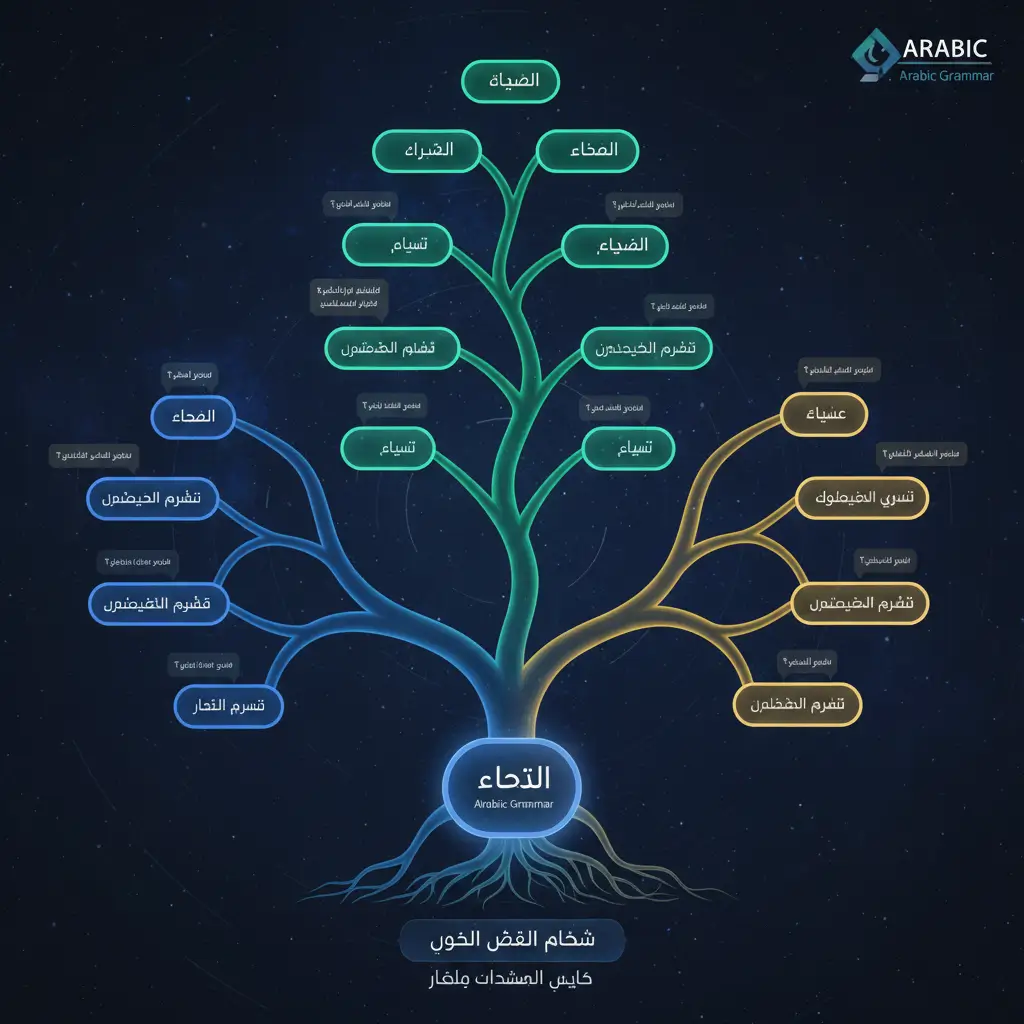
One of the most common mistakes in Arabic grammar instruction — online and offline — is teaching concepts in the wrong order, or all at once. What follows is the sequence that works for non-native adult learners based on what builds on what.
Start with Sentence Types
Arabic has two fundamental sentence types, and understanding both early prevents enormous confusion later.
A nominal sentence (الجملة الاسمية) begins with a noun or pronoun and makes a statement about it. “The book is on the table.” “Ali is a student.” These sentences don’t require a verb. In Arabic, the present tense of “to be” is simply absent — meaning is carried by word order and context.
A verbal sentence (الجملة الفعلية) begins with a verb. This is where Arabic most visibly differs from English: the standard word order is verb-subject-object rather than subject-verb-object. “Wrote Ahmed the letter” rather than “Ahmed wrote the letter.” This feels strange at first and then, quite quickly, becomes natural — especially once you understand that Arabic also allows for subject-first sentences when emphasis or clarity requires it.
Understanding the difference between these two sentence types, and being able to identify which one you’re reading, is the first real foundation of Arabic grammar.
Understand Gender and Agreement
Arabic marks grammatical gender consistently and thoroughly. Every noun is either masculine or feminine. This isn’t arbitrary — there are patterns, particularly the feminine ة (ta marbuta) ending — but there are exceptions that require memorization. Adjectives, verbs, and pronouns must all agree in gender with the nouns they refer to. This agreement system, once internalized, gives Arabic a kind of internal consistency that actually makes comprehension easier: the agreement markers tell you which words belong together.
Number in Arabic has three forms rather than two: singular, dual (exactly two of something), and plural. The dual has its own grammatical form. Plurals in Arabic are notoriously varied — some follow predictable patterns (sound plurals), while others are “broken plurals” that change the internal structure of the word in ways that must be memorized individually. This is one of the areas where patient practice and good instruction make the biggest difference.
Learn the Case System — Without Fear
Arabic uses a grammatical case system. Nouns change their endings (or their vowel markings) depending on their role in the sentence: nominative for subjects, accusative for objects and various adverbial uses, genitive for possession and after prepositions. In Modern Standard Arabic writing, these endings are often not written at all — you infer them from context and grammatical knowledge. In Quranic Arabic, they are marked precisely and matter enormously for interpretation.
The case system sounds complicated on paper, and many learners approach it with dread. In practice, for speaking and basic reading, you can get quite far without mastering every case rule — native speakers of colloquial Arabic rarely use formal case endings in conversation. But for reading classical texts, the Quran, formal newspapers, and academic Arabic, understanding the case system is genuinely necessary.
The key insight that makes the case system manageable: there are only three cases, and the patterns are consistent once you learn them. The endings change in predictable ways. It is not as chaotic as early exposure makes it seem.
Verb Patterns: The Architecture of Arabic
Arabic verbs operate through a system of patterns — called binyanim or أوزان — that apply across different roots. The verb فَعَلَ (fa-ʿa-la, meaning “he did/made”) is the template verb used to illustrate every verbal pattern. Once you know the pattern, you can predict the pronunciation, meaning, and grammatical behavior of thousands of verbs.
There are ten main derived verb forms in Arabic, and each form carries a general meaning tendency. Form II (with the doubled middle consonant) often indicates causation or intensification. Form III often suggests doing something with or toward another person. Form X often means to consider something or to seek something.
You don’t need to memorize all ten forms at once. Start with Form I — the simple verb form — and the past, present, and command tenses. Add Form II and Form V early because they appear constantly. The other forms can be added as you encounter them.
Particles, Prepositions, and Connectors
Arabic has a rich system of particles — small words that carry grammatical function. Prepositions like في (in), على (on), من (from), إلى (to), and عن (about) govern the genitive case of the nouns that follow them. Connectors like و (and), لكن (but), لأن (because), and إذا (if) link clauses and sentences. The definite article ال (al-) attaches directly to nouns and triggers various assimilation rules with certain letters.
These particles are small in size but enormous in frequency. Getting them right early pays compounding dividends in reading, writing, and listening comprehension.
Modern Standard Arabic vs. Spoken Dialects: Which Grammar?

This question creates more confusion than almost any other in Arabic learning, and it deserves a direct answer.
Modern Standard Arabic (MSA) is the formal written and broadcast language — the Arabic of newspapers, books, official speeches, and the Quran’s classical cousin. It follows the full grammar system described above: case endings, the complete verb system, precise agreement rules.
Spoken dialects — Egyptian, Levantine, Gulf, Moroccan — simplify many of these rules significantly. Case endings largely disappear. Certain verb forms are dropped or merged. The vocabulary shifts. Someone who speaks only Egyptian Arabic would sound strange reading a formal MSA text aloud, and someone who speaks only MSA would sound bizarre trying to buy vegetables in Cairo.
For non-native learners, the practical guidance is this: learn MSA grammar as your foundation, because it gives you access to reading, writing, formal comprehension, and the structural understanding that makes learning any dialect faster. Then add the spoken dialect you need based on your goal. The two reinforce each other more than they conflict.
If your goal is exclusively Quranic Arabic, classical grammar is your focus — it is close to MSA but with important distinctions, and should be studied with a teacher who knows the difference.
Online vs. Live Instruction for Grammar
Online Arabic grammar courses have improved significantly in recent years. The best ones offer structured video lessons, downloadable grammar charts, interactive exercises, and voice practice. For building foundational knowledge and reviewing concepts, they are genuinely useful.
The limitation of self-study grammar courses — and it’s a real one — is the absence of correction. Grammar is a system, and learners who study alone tend to develop fossilized errors: mistakes that have been repeated so many times that they feel correct. These errors are much harder to fix later than they are to prevent early. A teacher who hears you make a grammatical mistake in speech, or reads your written exercise and explains precisely why the verb ending is wrong, provides something no platform can automate.
At Alphabet Arabic Academy, Arabic grammar is taught live by native Egyptian Arabic speakers with formal training in Arabic pedagogy for non-native learners. Grammar is never taught as an isolated subject — every rule is connected immediately to speaking, reading, writing, or Quranic application, so that learners understand not just what the rule is but why it matters and where they will encounter it.
Our grammar curriculum runs from complete beginner to advanced level, with dedicated tracks for general MSA, Quranic Arabic, and conversational use. Sessions are live, interactive, and scheduled around your life.
Free Resources That Are Actually Worth Your Time
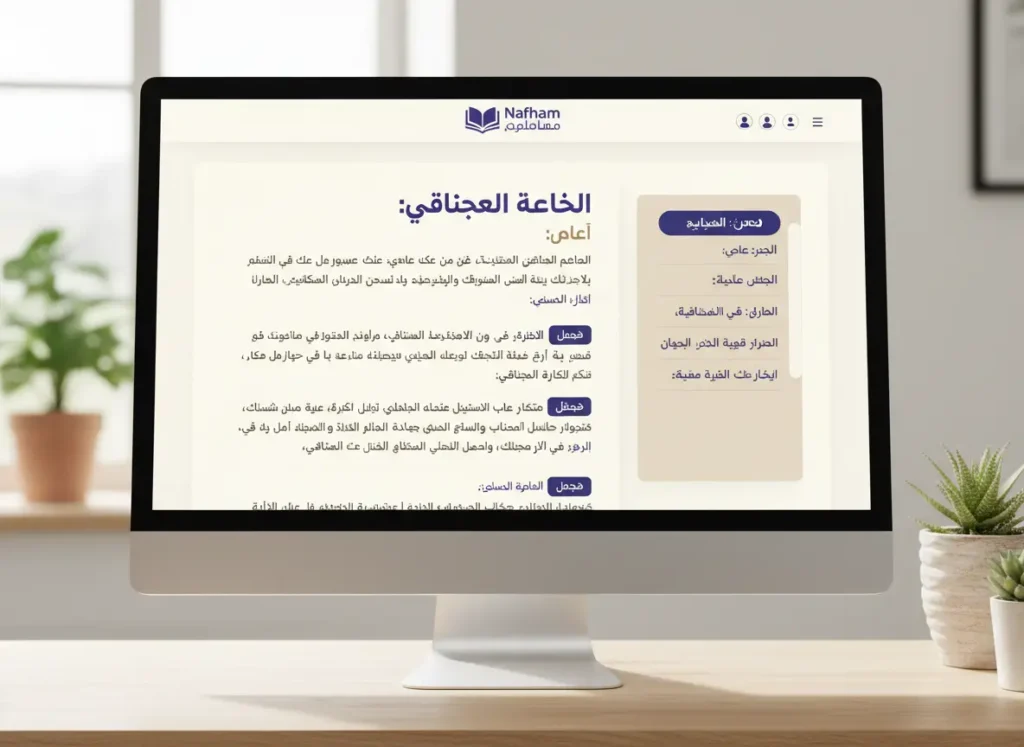
Free resources for Arabic grammar are better in 2026 than they have ever been, and some of them are genuinely excellent.
Madinah Arabic remains one of the strongest free resources for MSA grammar, particularly Books 1 and 2 of the Madinah series. The approach is traditional and text-heavy, but the content is solid and sequenced well.
Bayyinah TV and the work of Nouman Ali Khan offer Quranic grammar explanations of exceptionally high quality for learners who want to understand Arabic in its classical Quranic context. The teaching style is engaging and the grammatical depth is real.
YouTube has produced several dedicated Arabic grammar channels with structured playlists. The quality varies significantly, so read the comments, check whether the channel covers grammar systematically rather than randomly, and look for native speakers with teaching credentials rather than enthusiastic amateurs.
Arabic grammar PDF resources — particularly the annotated grammar guides available from Al-Azhar and various Islamic universities — are valuable for intermediate and advanced learners who want reference material.
The honest limitation of all free resources is accountability. Without a deadline, a teacher, and someone who notices when you disappear for two weeks, free grammar study tends to drift. Use free resources to supplement a structured program, not to replace one.
Common Mistakes That Slow Learners Down
After years of working with non-native Arabic learners, the same patterns appear repeatedly. Knowing them in advance saves time.
Starting with terminology instead of meaning. When a grammar lesson opens with “the mubtada and khabar of a nominal sentence must agree in number and gender,” many learners freeze — not because the concept is hard, but because the terminology is unfamiliar. Good instruction introduces the concept through examples first and names it second.
Studying grammar separately from language use. Grammar studied in isolation from reading, writing, and speaking tends not to transfer. Every grammar rule you learn should be immediately applied in a sentence you write, a passage you read, or a phrase you say aloud.
Prioritizing comprehensiveness over consolidation. Some learners try to understand every Arabic grammar rule before using any of them. This approach produces theoretically knowledgeable learners who cannot form a sentence under pressure. Learn a rule, use it repeatedly until it feels automatic, then add the next one.
Avoiding the case system. Many learners skip the case system because it seems optional for basic communication. At the beginner level, this is reasonable. At intermediate and above, the absence of case knowledge creates a ceiling that is painful to break through later.
Not getting pronunciation corrected early. Mispronounced letters — particularly the emphatic consonants, the pharyngeal sounds, and the distinction between short and long vowels — become habits quickly. Correcting pronunciation at the beginner stage is far easier than correcting it at the intermediate stage.
A Realistic Timeline
Arabic grammar is not learned in a weekend, and programs that suggest otherwise are not being honest with you. Here is a realistic timeline based on three to four hours of study per week, including live instruction.
In the first four to eight weeks, a learner with no prior Arabic background who studies consistently can master the alphabet, understand the difference between verbal and nominal sentences, learn the basic gender and number system, conjugate common verbs in past and present tense, and read simple Arabic sentences with effort.
By three to six months, with consistent practice, most learners can read basic texts with a dictionary, form grammatically correct simple sentences, understand the case system in principle, and follow MSA audio at a slow pace.
A solid intermediate grammar foundation — meaning the ability to read formal Arabic texts, write coherent paragraphs, and understand most grammatical structures encountered in the wild — typically takes one to two years of consistent study. That sounds long, but most learners who give up do so in the first two months, before the foundational investment begins to pay off.
Frequently Asked Questions

Do I need to learn grammar to speak Arabic? For conversational spoken Arabic, you can reach a basic level without formal grammar study — particularly in a dialect context. But for reading the Quran, understanding formal Arabic, writing correctly, or reaching genuine fluency in any variety of Arabic, grammar is not optional. It is the structural foundation everything else is built on.
Is Quranic Arabic grammar different from MSA grammar? Yes, meaningfully so. Quranic Arabic uses the full classical system, including case endings that are often absent in modern written Arabic, and certain grammatical constructions that are rare or archaic in MSA. The core system is shared, but Quranic grammar requires dedicated study with a qualified teacher who knows the classical tradition.
Can I learn Arabic grammar online without a teacher? You can make genuine progress through structured self-study, particularly with strong resources like Madinah Arabic. The limitation is error correction — mistakes made in isolation tend to fossilize. For most learners, a combination of structured online resources and regular live sessions with a qualified teacher produces the best results.
How is Arabic grammar taught at Alphabet Arabic Academy? Every grammar lesson is connected to practical use — reading, writing, speaking, or Quranic application. We don’t teach grammar as an isolated subject. Rules are introduced through examples, practiced immediately in context, and reviewed in subsequent sessions. Our teachers adapt explanations to each learner’s specific confusion rather than delivering a fixed lecture.
What level do I need to start a grammar course? No level at all. Our grammar curriculum starts from the alphabet and sentence basics for complete beginners. If you already have some foundation, a placement session determines exactly where to begin so you’re neither bored nor overwhelmed.
Where to Start Today
If you’ve read this far, you already have more clarity about Arabic grammar than most people who’ve been studying it for months.
The next step is simple: start, and start with structure. Arabic grammar rewards patience and systematic study in a way that random dabbling never will. Ten minutes of focused, structured grammar practice every day produces more progress than two hours once a week with no direction.
If you want to study independently, start with Madinah Arabic Book 1 for MSA, or Bayyinah TV’s grammar series for Quranic Arabic. Use flashcards for verb patterns and vocabulary. Write sentences every day.
If you want to move faster, make fewer fossilized errors, and have someone who genuinely understands the language hold you accountable — Alphabet Arabic Academy offers Arabic grammar courses for every level, from beginner to advanced, live with native-speaking teachers, starting from $40 per month.
Visit AlphabetArabicAcademy.com to book your placement session and get matched with the right grammar program for your goal.
Arabic grammar is not the obstacle. It’s the bridge.
Follow us on social media for Arabic learning tips, grammar explanations, and student success stories. AlphabetArabicAcademy.com still need more info read full guide