

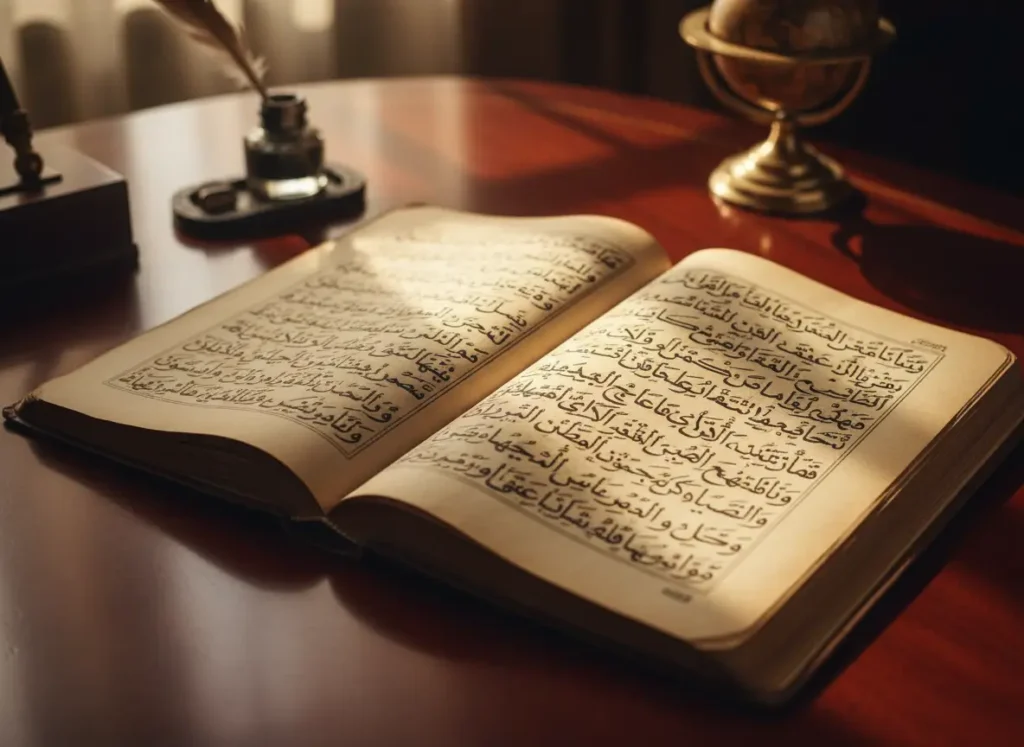
arabic for beginners” Most people who want to learn Arabic spend more time researching how to start than actually starting. They compare apps, browse Reddit threads, bookmark YouTube channels, and end up three weeks later having learned approximately nothing.
This guide is different. It gives you a concrete, day-by-day roadmap for your first 30 days — built around what actually moves the needle for Arabic beginners, not what sounds impressive on paper.
Thirty days from now, you’ll recognize Arabic letters, know over 100 high-frequency words, speak your first real phrases with correct pronunciation, and understand what you need to focus on in Month 2. That’s a realistic, achievable foundation — if you follow the roadmap instead of just reading it.
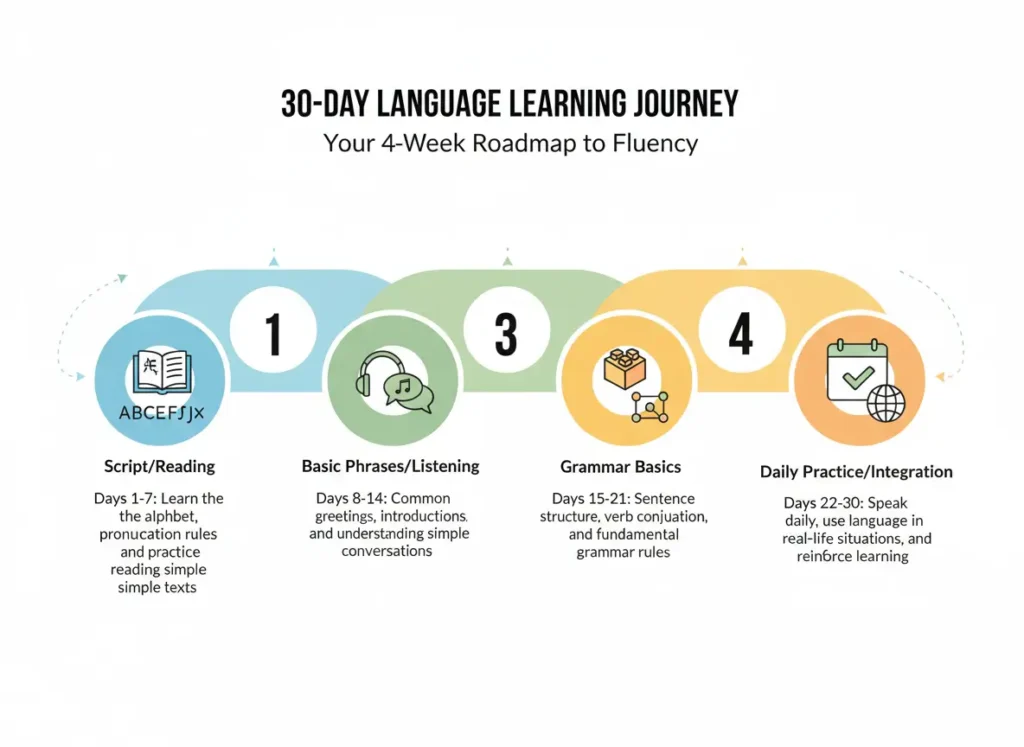
Your 30-Day Plan at a Glance
Not sure what you’re signing up for? Here’s the complete roadmap in one table before we break each week down in detail:
| Week | Focus | Daily Time | Expected Outcomes |
|---|---|---|---|
| Week 1 | Arabic alphabet + first 50 words | 30 min | Recognize all 28 letters, decode simple words, recall 40+ words |
| Week 2 | 20 core phrases + pronunciation | 30 min | Speak short sentences, handle basic greetings and introductions |
| Week 3 | Listening + shadowing habit | 30–40 min | Improved ear for Egyptian Arabic, recognise words in natural speech |
| Week 4 | Real conversations + first lesson | 30–45 min | First complete interaction in Arabic, clear roadmap for Month 2 |
No week stands alone. Each one builds the foundation the next week requires. Skipping Week 1 makes Week 2 harder. Skipping Week 2 makes Week 3 hollow. The sequence is intentional — follow it.
What One Beginner Said After Following This Plan
“I’d tried Duolingo for four months and learned almost nothing that stuck. A friend told me to follow a structured 30-day plan and get a real teacher. I was skeptical. By Day 14 I was saying actual phrases in Egyptian Arabic — not just reciting them from a card, but actually using them in a short conversation. By Day 30 I’d had my first real lesson and I was hooked. The alphabet was the thing I most dreaded. It took me six days. Six days. I wasted four months on an app before that.”
— James, Software Engineer, United Kingdom ⭐⭐⭐⭐⭐
James’s experience is not unique. The pattern — months of app-based plateau followed by rapid progress once a structured plan and native teacher were introduced — appears consistently among learners who make the switch.
Before Day 1: The One Decision You Cannot Skip
Before you open a single app or watch a single YouTube video, you need to answer one question: which Arabic are you learning?
This question matters more than any method, app, or textbook you choose. Arabic is not one language in practice — it exists in two forms that are genuinely different.
Modern Standard Arabic (MSA / Fusha) is the formal written language. It appears in newspapers, academic texts, official documents, and formal broadcasts. No Arabic-speaking country uses it as their everyday spoken language. If you want to read the Quran in its original form, study Arabic literature, or work in academia or journalism across the Arab world — MSA is your path.
Spoken dialects are what people actually use in daily life. Egyptian Arabic is the most widely understood dialect across the Arab world, thanks to Egypt’s dominant role in Arabic film, television, and music. If you want to travel, connect with Arab friends or family, or hold real conversations with real people — start with a spoken dialect. Egyptian Arabic is the strongest first choice for most learners because a speaker from Morocco to Kuwait will understand you.
For this 30-day roadmap, the structure works for both paths. Where the content differs, we’ll flag it clearly. Make your choice now. Everything else depends on it.
Week 1 (Days 1–7):
Why the Alphabet Comes First
Many beginners want to skip the Arabic alphabet and start speaking using phonetic English spellings. This is understandable — the Arabic script looks intimidating. But phonetic spellings create a dependency that limits you quickly. The moment you encounter a menu, a street sign, or a WhatsApp message in Arabic, you’re helpless.
The Arabic alphabet has 28 letters. Most flow together in a connected script, and letters change form depending on whether they appear at the beginning, middle, or end of a word. This sounds complicated. In practice, most learners who commit to focused daily practice can recognize all 28 letters within five to seven days — not master them, but recognize them.
Your Week 1 Daily Plan
Days 1–2: Learn letters 1–14. Write each one by hand ten times — research consistently shows that handwriting activates deeper memory formation than typing. Don’t worry about their names yet. Focus on shape recognition and the sound each makes.
Days 3–4: Learn letters 15–28. Begin connecting previously learned letters. Arabic has connectors and non-connectors — knowing which letters never attach to the letter that follows them will save you significant confusion.
Days 5–6: Practice reading simple two and three-letter words aloud. You won’t understand them yet. That’s fine. Your goal is phonetic decoding — turning symbols into sounds.
Day 7: Write the full alphabet from memory. Check your work. Mark the letters that gave you trouble and review them three times before the day ends.
First 50 Words: Build Around Your Goal
Alongside the alphabet, start building your first vocabulary bank. Don’t use a generic frequency list — choose 50 words relevant to your specific reason for learning Arabic. If your goal is travel, your first 50 should include greetings, directions, numbers, food, and transport. If your goal is family connection, start with family members, feelings, home vocabulary, and daily routines.
Use spaced repetition. The free Anki app lets you create flashcard decks that show you words at scientifically optimal intervals. Five to ten minutes of Anki review per day will anchor these 50 words more effectively than an hour of passive re-reading.
By the end of Week 1 you should be able to recognize all 28 letters, decode simple Arabic words aloud, and recall 40+ of your first 50 words. These are your benchmarks. Honest self-testing matters more than comfortable self-assessment.
Week 2 (Days 8–14): Phrases, Pronunciation, and Your First Spoken Sentences
Speaking Before You Feel Ready
The single most damaging habit for Arabic beginners is waiting until they feel ready to speak. Readiness of this kind never arrives. Fluency doesn’t precede speaking — it follows it.
Starting in Week 2, you will speak out loud every day. This means saying words and phrases to yourself, to a mirror, out loud in your car, or to anyone patient enough to listen. The goal is not accuracy. The goal is getting your mouth, tongue, and throat accustomed to Arabic sounds — several of which don’t exist in English.
The Sounds That Will Trip You Up
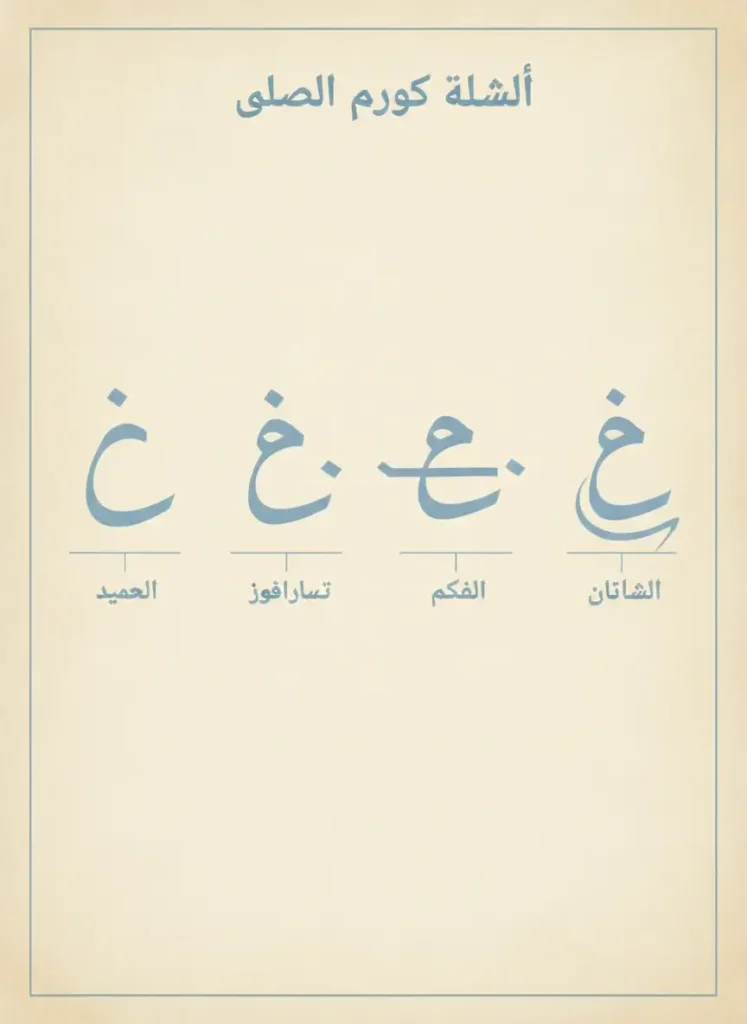
Two Arabic sounds cause most beginners genuine difficulty: the letter ع (ain) and the letter غ (ghain). The ain is a voiced constriction produced deep in the throat — nothing in English comes close. The ghain is a guttural sound similar to a French R but produced further back in the throat.
Don’t panic. Don’t try to perfect these in Week 2. Do listen carefully to native speakers producing these sounds, attempt them yourself, and understand that your pronunciation will improve gradually with exposure. A qualified Egyptian Arabic teacher is invaluable here — they can hear exactly what you’re doing wrong and correct it in real time in a way no app or video can replicate.
20 Phrases Every Beginner Must Know
Learn these 20 phrases in Week 2. Say each one out loud ten times. Record yourself and compare your pronunciation to a native speaker on YouTube:
Ahlan wa sahlan — Welcome / Hello (the warm Egyptian greeting) Sabah el-kheir / Masa el-kheir — Good morning / Good evening Izayak / Izayik — How are you? (male / female) Tamam, walhamdulillah — Fine, thank God Ismi… — My name is… Ana min… — I am from… Law samaht — Please / Excuse me Shukran / Afwan — Thank you / You’re welcome Mish fahim / Mish fahma — I don’t understand (male / female) Tikallim bi-bute, min fadlak — Please speak slowly Mumkin…? — Is it possible…? / Can I…? Fein…? — Where is…? Bikam da? — How much is this? Tayib — Okay / Good Inshallah — God willing (used constantly in everyday speech) Yalla — Let’s go / Come on Habibi / Habibti — My dear (male / female — warm, not always romantic) Ma’a salama — Goodbye Fursa sa’eeda — Nice to meet you El-hamdulillah — Praise God / Thank God
These 20 phrases will carry you through an enormous range of real Egyptian Arabic interactions. Knowing them well is worth more than knowing 200 vocabulary words passively.
Want to go deeper on phrases? Read our full guide: The 50 Most Common Egyptian Arabic Phrases You Need to Know.
Week 3 (Days 15–21): Listening and the Immersion Habit
Your Ear Needs Training Separately From Your Brain
One of the most counterintuitive facts about language learning is this: your ear requires its own dedicated training. You can know a word perfectly in a flashcard and still fail to recognize it when a native speaker says it at natural speed, with natural connected speech, and surrounded by other words.
Arabic has an additional challenge. The phoneme inventory — the set of sounds the language uses — is significantly larger than English. Several Arabic sounds have no English equivalent. Your brain, optimized for English sounds, will initially process unfamiliar Arabic sounds incorrectly or simply drop them entirely.
The solution is early, consistent, comfortable listening to natural Arabic content — not artificially slowed lesson audio, but real speech produced by real native speakers.
Building Your Week 3 Listening Routine
Daily listening (20–30 minutes): Choose content with visual context. Egyptian Arabic YouTube channels, Egyptian comedies, or cooking shows where you can understand meaning from images even when the language escapes you. Don’t force comprehension. Let your ear absorb patterns.
Shadowing (10 minutes): Choose a short clip — thirty to sixty seconds of natural Egyptian Arabic speech. Listen to it three times. Then listen and repeat phrase by phrase, mimicking the speaker’s rhythm, stress, and intonation as closely as possible. Shadowing is one of the most powerful tools for pronunciation development in any language.
Active word hunting (5 minutes): After any listening session, write down every word or phrase you recognized — even partially. On Day 15 this might be three words. By Day 21 it might be fifteen. Track it. Progress in listening comprehension is real but gradual, and tracking makes it visible.
For structured Egyptian Arabic listening resources, our Arabic Conversation Course includes native-speaker audio with guided comprehension exercises built specifically for beginners.
Week 4 (Days 22–30): Your First Real Conversations
From Phrases to Actual Exchange
Week 4 is where everything shifts. You stop practicing in isolation and start connecting language to interaction — even if that interaction is with yourself, a patient friend, or a native-speaking teacher in a structured lesson.
Write a short dialogue. Eight to ten lines. Two people meeting, greeting each other, exchanging basic information — where are you from, what do you do, where are you going. Write it using words and phrases you actually know. Read it out loud until you can do it without looking at the page. Then try to do it from memory, varying the details.
This is your first real act of Arabic production — not recognition, not copying, but generating language from your own memory and putting it into the world.
The Trial Lesson: Your Week 4 Milestone
The most valuable thing you can do in Week 4 is have one real conversation with a native Egyptian Arabic speaker. Not perfect. Not polished. Just real.
At Alphabet Arabic Academy, we offer a free 60-minute trial lesson with certified native Egyptian teachers — no credit card, no commitment. A single session at this stage does three things that weeks of self-study cannot:
It exposes your actual gaps. You’ll discover quickly which of your phrases you can produce under mild conversational pressure and which dissolve the moment a real person is listening.
It calibrates your pronunciation. A native teacher hears things a recording and playback loop misses entirely.
It gives you a clear direction for Month 2. After one real conversation, you’ll know exactly what to focus on next — far more precisely than any self-assessment provides.
What to Expect: Honest Progress Benchmarks
One of the most damaging things the language learning industry does is create unrealistic expectations. Apps promise fluency in three months. Social media celebrates polyglots who seem to absorb languages overnight. The reality for most learners is different — and knowing this in advance prevents the discouragement that causes most people to quit.
After 30 days of consistent daily practice (thirty to sixty minutes), a realistic beginner can expect to recognize the Arabic alphabet reliably, know one hundred to one hundred and fifty vocabulary words, produce twenty to thirty phrases with reasonable pronunciation, and hold a simple three to five minute exchange on basic topics.
After three months, with consistent practice including regular lessons with a native teacher, a realistic beginner can expect genuine conversational survival — navigating travel situations, introductions, shopping, ordering food, and expressing basic opinions.
After twelve months, with two to three weekly teacher sessions and daily independent practice, many learners reach genuine conversational comfort in Egyptian Arabic — following most of a natural conversation and participating meaningfully.
The variable that matters most is not talent. It’s consistency. Thirty minutes every day beats three hours every weekend without exception.
The 5 Mistakes Every Arabic Beginner Makes (And How to Avoid Them)

Mistake 1: Skipping the alphabet. The Arabic script is your foundation. Without it, you’re dependent on phonetic crutches that limit your exposure to real Arabic content. Invest the time in Week 1.
Mistake 2: Studying instead of speaking. Arabic knowledge stored in your brain as passive recognition does not automatically convert to speaking ability. Speaking is a separate skill that requires dedicated practice — starting in Week 2, not Month 3.
Mistake 3: Choosing the wrong Arabic variety for your goals. Spending six months on MSA when your goal is conversation, or studying dialect when your goal is Quranic reading, wastes enormous time. Choose once, choose correctly, and commit.
Mistake 4: App dependency. Language apps are useful vocabulary tools. They are not Arabic courses. No app teaches you to think in Arabic, correct your pronunciation, or have a real conversation. Apps are supplements, not core.
Mistake 5: Learning alone indefinitely. Self-study has a ceiling. The learners who make the fastest and most durable progress are those who combine independent practice with regular feedback from a qualified native-speaking teacher — especially in the early months when habits form and errors solidify.
Your Resources for the Journey Ahead
As you move beyond the first 30 days, here are the resources and courses most relevant to where beginners typically want to go:
Deepen your conversational speaking: Our Arabic Conversation Course is built around the 80/20 speaking method — you speak for 80% of every session. Purpose-built for learners whose primary goal is confident real-world communication.
Explore the Egyptian dialect fully: Colloquial Egyptian Arabic — the most widely understood spoken dialect in the Arab world. Ideal if your goals involve travel, cultural connection, or everyday conversation.
Pursue formal and written Arabic: Modern Standard Arabic (MSA) — for learners targeting media, academia, professional documentation, or pan-Arab communication.
Add Quranic understanding: Quran and Tajweed Online — for learners who want to read and understand the Quran with correct recitation rules.
For younger learners: Arabic for Kids — age-adapted lessons that build vocabulary and pronunciation through games, stories, and structured play.
Study our complete guide: Best Way to Learn Arabic at Home: 7 Methods That Work — a deeper dive into every method covered in this article, with tools and timelines for each stage.
Build your phrase vocabulary: The 50 Most Common Egyptian Arabic Phrases — the exact phrases that come up most in real Egyptian Arabic conversation, with pronunciation guides and usage context.
📥 Download: The 30-Day Arabic Starter Plan (Free PDF)
Everything in this article — the weekly breakdown, daily tasks, phrase lists, pronunciation checkpoints, and progress milestones — is available as a structured 7-page PDF you can download, print, and follow day by day.
Download the Free 30-Day Arabic Starter Plan →
The PDF includes:
- ✅ A day-by-day task list for all 30 days — no ambiguity, no guesswork
- ✅ The complete 20 beginner phrases with pronunciation notes
- ✅ Weekly milestone checklists to measure real progress
- ✅ A 30-minute and 60-minute daily schedule option
- ✅ Recommended free tools for each stage
- ✅ Honest benchmarks for Days 7, 14, 21, and 30
No email required. No upsell. Print it, put it on your desk, and cross off each day as you go. Visible progress is one of the strongest motivators in language learning — and a physical checklist makes progress visible in a way that an app streak never does.
Start Now — Not When You Feel Ready
The most dangerous phrase in language learning is “I’ll start properly when I have more time.” You have thirty minutes today. That is enough to begin.
Write out the first eight Arabic letters. Say ahlan wa sahlan out loud three times. Open Anki and create your first five vocabulary cards.
Three small actions. Ten minutes. That’s Day 1.
The learners who reach real Arabic fluency are not the ones who waited for perfect conditions. They are the ones who started imperfectly, adjusted as they went, and kept showing up every day.
Your first 30 days begin now.
Ready to start with a native Egyptian teacher? Book your free 60-minute trial lesson — no credit card, no commitment, just your first real Arabic conversation.