Your child is four. Maybe five. Or maybe nine and has never opened a Quran primer in their life. And everyone keeps telling you, “Start with Noor Al-Bayan.” Great. But nobody tells you when.
Here’s the short answer. For most children, ages 4 to 6 is the sweet spot. But age is only half the story. Readiness matters more. A calm, curious five-year-old will beat a restless six-year-old every time.
I teach Arabic online, and this is the first question parents ask me. So here’s the honest version: what Noor Al-Bayan actually is, when to start, when to wait, and what to do if you think you’ve missed the window. (Spoiler: you probably haven’t.)
If you’d rather jump straight to a plan for your child, our Arabic for kids course lays out the tracks by age.
What Is Noor Al-Bayan, Exactly?
Noor Al-Bayan is a step-by-step method for teaching a child to read Arabic, using Quranic words from the very beginning. It’s credited to the Egyptian teacher Sheikh Tariq Al-Saeed, and it spread from a village in Menoufia to nurseries and Quran circles across the Arab world. The main book is called Noor Al-Bayan: Mu’allim al-Qira’a bil-Quran. Roughly, “the teacher of reading through the Quran.”
The idea is simple. Your child doesn’t jump into long verses. They learn one small thing at a time, practise it until it’s automatic, and only then move on.
Most course outlines split it into seven levels:
- Level 1: the letters and their sounds
- Level 2: short vowels (fatha, kasra, damma)
- Level 3: long vowels (madd with alif, waw and ya)
- Level 4: sukun, a letter with no vowel
- Level 5: tanween, the “-un / -an / -in” endings
- Level 6: shaddah (doubled letters) and the sun letters
- Level 7: the first rules of Quranic recitation
Editions group these a little differently, so don’t panic if your child’s book looks slightly different.
That last level is where tajweed begins. Wikipedia’s article on tajweed describes it as the set of rules for pronouncing every letter correctly when reciting the Quran. Noor Al-Bayan gets your child ready for it. It doesn’t replace it.
Is it the same as Noorani Qaida?
No. They’re two different books. Noorani Qaida comes from India and was written for people who don’t speak Arabic. Noor Al-Bayan is Egyptian. People mix up the names constantly, and plenty of academies group them together because both do the same job: get a beginner reading.
Honestly, the book matters less than the teacher. A good teacher picks the one that fits your child, then teaches it properly.
So, When Should a Child Start Noor Al-Bayan?
Most Quran teachers say 4 to 6. I agree, with one catch.
By four or five, most kids speak clearly enough to copy new sounds. And Arabic has sounds that English-speaking children simply don’t have, like ayn (ع), ha (ح) and qaf (ق). Young children tend to pick these up more naturally because their mouths haven’t settled into one language yet. That’s what I see in class, and it’s what most teachers report.
Here’s roughly how it looks by age:
| Age | What it usually looks like |
| Under 4 | Listening, songs and letter play. Formal lessons are usually too early. Some 3-year-olds are ready, but most aren’t. |
| 4 to 6 | The sweet spot. Short sessions (20 to 30 minutes at most), lots of games, and a slow, steady pace. |
| 7 to 9 | Not late at all. Kids this age move faster and often read and write alongside the lessons. |
| 10 to 12 | Still fine. Faster again, but some children feel shy about starting from letters. One-to-one lessons help a lot. |
| 13 and up | Totally possible. Teens need patience and privacy more than anything else. |
Readiness Beats Birthdays
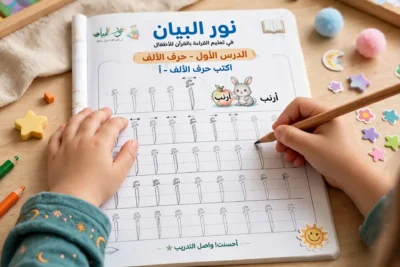
Here’s the thing. I’ve met five-year-olds who were completely ready and seven-year-olds who weren’t. The calendar doesn’t know your child. So check these instead.
Your child is probably ready if they:
- speak in full sentences in their home language
- can sit with something they enjoy for about 10 minutes
- can copy a sound or a short word after you say it
- recognise shapes, letters or numbers in any language
- show a bit of interest, or at least don’t run from it
If most of those are a no, wait. Three to six months of play costs you nothing. Letter songs, flashcards, recitation playing in the car. Starting too early costs more. A child who links the Quran with tears and pressure doesn’t forget that feeling.
Even the scholarly answers parents get on this question come down to the same point: it depends on the child, not on a fixed number.
Does My Child Need to Speak Arabic First?
No. Not even a little. Reading Arabic and speaking Arabic are different skills. Noor Al-Bayan teaches your child to decode the script and make the right sounds. Meaning comes later, and it can come in English.
And you don’t need Arabic either. Our teachers send a short WhatsApp summary after every lesson: what was covered and what to practise. Homework stays small, around 10 to 15 minutes, so a parent who can’t read a word of Arabic can still sit beside their child and help.
How Long Does It Take?
I’ll be straight with you: nobody can promise a date. It depends on age, how often you practise, and how consistent the lessons are.
For beginners with two lessons a week and 10 to 15 minutes of daily practice, we tell families that reading basic text independently takes about 2 to 3 months, and comfortable reading with basic tajweed is closer to 6 to 9 months. You’ll find those numbers on our Quran online classes page. Little ones usually take longer than that. Older children usually take less.
Most teachers I know put a 5-year-old at somewhere between six and twelve months to get through the whole book solidly. A nine-year-old might need three or four.
The biggest mistake? Moving on because the book has more pages. If your child still mixes up two letters, the next level will wobble. Slow down. A page repeated is not a page wasted.
Frequency beats length, too. Two short lessons a week plus ten minutes at home is better than one long lesson and nothing else. If you want help building the habit, our daily Arabic study routine guide has a simple structure you can borrow.
What If My Child Is Older? Is It Too Late?
It’s not too late. Really.
An eight-year-old who quit weekend school after three months can restart. An eleven-year-old who has never read a letter can start. Older children often move faster, because they grasp the rules quickly and need fewer repeats.
The real problem at 10 or 12 isn’t ability. It’s embarrassment. Nobody wants to sit with a group of six-year-olds sounding out letters. That’s where one-to-one lessons earn their keep. Your child learns privately, at their own speed, and nobody hears the early mistakes. We explain how that works in Arabic Teacher Online for Kids.
Noor Al-Bayan First, or Straight to the Quran?
A parent will tell me, “She already knows Surah Al-Fatiha and a few short surahs. Can we skip the basics?”
Memorising by ear is wonderful. Keep it going. But it isn’t the same as reading. Here’s a quick test. Open a Quran page with full vowel marks and point to a word your child hasn’t memorised. Can they read it, or do they guess from the shape? Guessing means they need the early levels. They’ll probably move through them quickly, though.
Not sure where your child stands? A teacher can tell you within one lesson. Or try our Arabic level test to get a starting point.
Can a 4 or 5-Year-Old Really Learn Online?
Yes, if the lesson is built for a 4 or 5-year-old. Most online lessons for little kids fail for one reason: they’re adult lessons with a cartoon on top.
What actually works:
- One-to-one, not a class of fifteen. In a big group, a small child gets very little real reading time.
- 20 to 30 minutes, tops. Mix songs, flashcards and tiny games.
- A parent nearby for the first few lessons.
- Gentle correction. No pressure, no comparing.
At Alphabet Arabic Academy, lessons are private, parents are welcome to sit in on the first sessions, every lesson is recorded, and you can ask for a female teacher at no extra cost. You can read the details in our child safety policy and meet the people behind the screen on the teachers page.
What Does a First Lesson Look Like for a Little One?
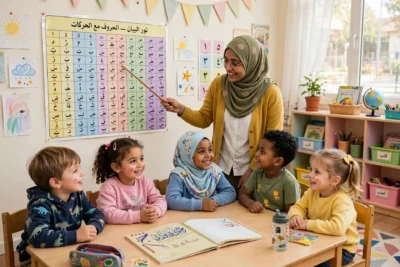
Parents often picture a child sitting still while a teacher drills letters. That would last about four minutes. A good lesson for a 4 to 6-year-old looks more like this:
- A hello song (first few minutes). The same greeting every time. It tells your child’s brain, “Arabic time now.”
- Flashcards. Last lesson’s letters first, then one or two new ones with big pictures.
- A game. Matching, hunting for a letter, a quick race. Learning disguised as play.
- A little speaking. Your child repeats the sounds. The teacher corrects gently and moves on.
- A sticker and a tiny task. Five minutes of practice at home, no more.
Exact timing changes from child to child. Some days the game takes over the whole lesson, and that’s fine. If your child leaves smiling and remembers one new letter, that was a good lesson.
How to Help at Home (Without Becoming the Teacher)
- Ten minutes, same time every day. After dinner, before bed, whatever sticks.
- Play recitation in the background. Ears learn first.
- Praise effort, not speed.
- Never turn practice into a fight. On a bad day, do two minutes and stop.
- Make it physical. Letters in sand, play dough, even cookies. Our guide to kids Arabic lessons and activities has plenty of ideas.
Five Mistakes Parents Make (I See Them All the Time)
- Comparing. “Your cousin finished in three months.” Comparing is the quickest way to make a child hate the book.
- Long sessions. Forty-five minutes for a five-year-old means thirty minutes of staring out of the window.
- Switching books or teachers every few weeks. Every switch means a new method, new habits and a fresh round of confusion.
- Focusing only on letter names. Noor Al-Bayan is about sounds. A child who can say “baa” but can’t read the letter with a fatha isn’t reading yet.
- Treating practice like a test. If every session ends with “you got it wrong again,” the child learns one thing: avoid sessions.
Notice what’s missing from that list? Talent. Almost every child can learn this. What changes the outcome is pace, patience and a calm routine.
Quick Answers
Is 3 too early for Noor Al-Bayan?
For formal lessons, usually yes. Letter songs and listening, absolutely. A child who talks in sentences and sits happily can try a short, playful start, but most don’t need to.
Is there a maximum age?
No. Adults learn it too.
Do we need to buy the book first?
Not before you talk to a teacher. On our Quran plans, materials are included, so you don’t have to hunt for the right edition.
When does my child move on to the Quran and tajweed?
Once they can read through all the levels smoothly, without sounding out every letter. Then come short surahs, and tajweed rules one at a time. For the bigger picture, our complete guide to Quran courses explains the full path.
So, Where Do You Start?
Here’s the plan. Check the readiness list. If your child ticks most of the boxes, start now, keep lessons short, and keep them fun. If not, play for a few months and check again. And if your child is older and you’re worried you’ve missed the boat, you haven’t.
If you’d like a teacher to look at your child first, book a free trial. No credit card. No commitment. We’ll tell you honestly whether to start now or wait. For costs, see the pricing page.
Ready? Start the children’s track.