
By the Alphabet Arabic Academy team
Noor Al-Bayan is a step-by-step method for learning to read the Quran from zero. You start with single letters and short vowels. Then you join them into syllables, then words, then real Quranic text. No guessing. No copying your teacher by ear and hoping it sticks. Just one small skill at a time.
That’s the short answer. The longer one is more interesting, because it explains why so many beginners say this is the first time Arabic script finally made sense.
If you’ve never read a single Arabic letter, this article is for you. I’ll explain what Noor Al-Bayan is, what you actually learn, how long it takes, and where it stops. Because it does stop. And that’s fine.
Noor Al-Bayan in Plain English
Noor means light. Bayan means clarity. Put them together and you get the idea: making reading clear.
It’s a foundation course in reading. Not a Tajweed course. Not a Quran translation course. Its one job is to get you from “I can’t read this” to “I can read this, slowly, and I’m saying it correctly.”
That one job matters more than people think. Almost every problem I see later, the rushed reading, the swallowed letters, the guessing at words, traces back to a shaky start. Noor Al-Bayan is the fix for that. It builds the base first.
In our academy we teach it as part of the Noorani method, the same beginner track. If you want to see how it fits with everything else, our Quran online classes page lays out the full path from first letter to Ijazah.
What You Actually Learn
The exact chapter order changes a little between editions and teachers. But the core journey looks like this.
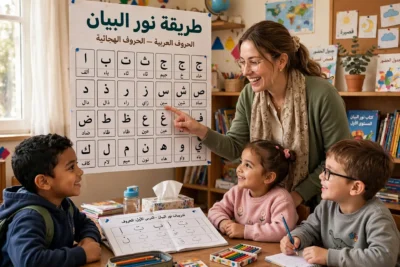
1. The 28 letters. You learn each letter’s name and its sound. Not just the shape. The sound, and where in your mouth it comes from.
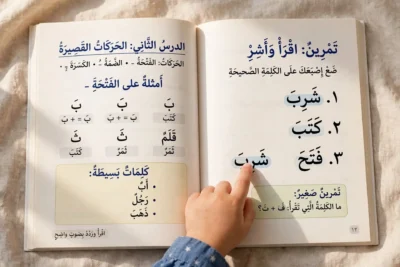
2. Short vowels. Fatha, damma, kasra. These three little marks change how every letter sounds. So بَ is ba, بِ is bi, and بُ is bu. Simple. But you’d be surprised how many people read for years without being sure of this.
3. Letter forms and connections. Arabic letters change shape depending on where they sit in a word. At the start, middle, or end, they look different. This is the part that scares people. Honestly, it’s less scary than it looks once you’ve seen it done slowly.
4. Long vowels. The stretched sounds, like بَا (baa). Learning to hold a sound for the right length is the first step toward good recitation.
5. Tanween, sukoon, shaddah. The marks that add the “n” sound, stop a letter, or double it.
6. Real words, then real verses. Once you can blend sounds, you stop reading exercises and start reading actual Quranic text. Short surahs first.
Notice the pattern. Every step uses only what you already know. Nothing arrives out of nowhere. That’s the whole trick.
Why Beginners Love It
I’ve heard the same reasons over and over. Here are the ones that come up most.
It starts where you actually are
Most people who come to us aren’t “a bit rusty.” They’re at zero. They’ve seen the script in a mushaf and it looks like beautiful, locked handwriting. Noor Al-Bayan doesn’t assume you know anything. Not the letters. Not the vowels. Nothing.
Sounds before rules
Here’s the thing. A lot of beginners get hit with Tajweed terms in week one. Makharij, sifaat, ikhfa. It’s too much, too soon. Noor Al-Bayan keeps you on sounds first. You learn to produce the letter, then blend it, then read with it. Rules come after you can read.
That order isn’t laziness. It’s how reading works. You can’t apply a rule to a word you can’t decode.
Small wins, fast
You read a syllable on day one. A word within the first couple of weeks. That feeling, “wait, I just read that”, is the thing that keeps people showing up. Motivation isn’t a personality trait. It’s a result of seeing progress.
It works for adults
There’s a myth that this kind of method is for children. It isn’t. Adults often move faster because they’re motivated and they can focus. Our teachers explain things in clear English and go at your pace, with no judgment. If you’re 35 or 55 and starting from nothing, you’re not late. You’re exactly the kind of student this was built for.
It gives your teacher a clear map
Because the steps are small and ordered, a good teacher can see exactly where you’re stuck. Is it the letter ع? The long vowel? The connection between two letters? They fix that one thing, then move on. No vague “practice more.”
Noor Al-Bayan vs Noorani Qaida
You’ll see these two names everywhere. And you’ll see people argue about which is better.
I’ll be straight with you. I looked at what other academies say, and they contradict each other. One says Noor Al-Bayan is faster. Another says it’s slower and gentler. One says Noorani Qaida repeats more. Another says the opposite about Tajweed. They can’t all be right.
Here’s what I can say from teaching beginners.
Both are foundation methods. Both aim for the same result: you reading the Quran accurately. The layout, the pacing, and the order of topics differ a bit. But a method on paper matters far less than the person teaching it.
A good teacher watches your face, hears your mistakes, and slows down or speeds up. A great book in the hands of someone who isn’t listening to you won’t fix your ع.
So don’t spend three weeks agonizing over which book. Pick a qualified teacher and let them choose the approach that suits how you learn. That’s what we do. Our beginner track combines the two traditions, and your teacher adjusts as you go.
How Long Does It Take?
Everyone asks this first. So let’s talk numbers, and let’s keep them honest.
With two lessons a week and about 10 to 15 minutes of daily practice, most complete beginners can read basic Quranic text on their own within two to three months. Reading smoothly with basic Tajweed usually takes more like six to nine months.
That range is wide because people are different. Your speed depends on three things:
- Consistency. Fifteen minutes every day beats two hours on Sunday. Always.
- Your starting point. If you already recognize some letters, you’ll move quicker.
- Correction. Someone catching your mistakes early saves you months.
Need help building a practice habit? Our 15-minute daily Arabic study routine shows how to structure short sessions so you actually keep going. It’s written around Arabic in general, but the same logic applies to your reading practice.
Not sure whether you’re a true zero or a “I know a few letters” student? Take the free Arabic placement test. It takes a few minutes and tells you where to begin.
What Noor Al-Bayan Doesn’t Do
This part matters, so I’m not going to skip it.
Noor Al-Bayan teaches you to read. It doesn’t make you a skilled reciter. It doesn’t teach you the meaning of what you read. And it doesn’t replace Tajweed.
Tajweed is the set of rules for pronouncing each letter correctly and applying the traditional methods of recitation. Wikipedia’s article on Tajwid gives a clear overview if you want the background, including the verse people most often cite for it, 73:4, about reciting with measured recitation. Scholars discuss the exact ruling on learning it in detail, so if that question matters to you, ask a scholar you trust.
In practice, here’s how the pieces fit:
- Noor Al-Bayan / Noorani: learn to read.
- Tajweed: learn to read beautifully and correctly.
- Hifz: memorize.
- Quranic Arabic: understand.
Think of it as learning to drive. Noor Al-Bayan teaches you the controls. Tajweed teaches you to drive well. You can’t do the second without the first.
When you’re ready for the next step, our complete guide to Tajweed courses explains what to expect, how long it takes, and how to choose a program. And if you want the big picture of every Quran path in one place, the complete guide to Quran courses covers recitation, Tajweed, memorization, and Quranic Arabic side by side.
Can You Learn It on Your Own?
You can learn about it on your own. Learning it properly is harder.
Here’s the problem. Arabic has sounds that don’t exist in English. ح and ه. ع and أ. ق and ك. These aren’t tiny differences. Say the wrong one and you’ve said a different word. And you can’t hear your own mistake, because your ear is trained on your native language.
Apps and videos are great for listening and review. But they can’t hear you. They can’t say “almost, now push the sound from further back.” That’s what a teacher does, in real time.
I’m not saying this to sell you something. I’m saying it because the most common regret I hear is “I wish I’d had someone correct me at the start.” Bad habits set fast. Undoing them takes about twice as long.
Use apps to support your lessons. Don’t use them instead of lessons.
What Your First Month Looks Like
We don’t believe in vague promises. Here’s roughly what happens in our first four weeks.
Week 1: Assessment and foundation. Your teacher finds out exactly where you are and builds your personal plan.
Week 2: Fixing the biggest errors first. Mispronounced letters, missing vowels, rushing. These get corrected at the root.
Week 3: Applying what you’ve learned. Reading real words and short verses with your teacher listening live.
Week 4: Review and roadmap. A full reading session, a look at your progress, and a clear plan for the next three months.
Every lesson is one-on-one and 30 minutes long, so your teacher is listening to you and only you. Lessons are recorded, so you can replay a correction later. And you’ll get a short written summary of what to practice. You can meet the people who’ll be teaching you on our teachers page.
Mistakes That Slow Beginners Down
A few things I see again and again.
Skipping ahead. You can read a few words, so you jump to a surah you love. Then you hit a verse with a long vowel and a tanween and you’re lost. Finish the foundation. The surah will still be there.
Memorizing instead of reading. Some beginners learn a verse by ear and think they can read it. Test yourself: can you read a new verse you’ve never heard? That’s the real skill.
Ignoring the short vowels. The fatha, damma, and kasra are tiny. They’re also everything. Get these automatic early.
Practicing in marathons. One long session a week feels productive. It isn’t. Short and daily wins.
Being embarrassed. Nobody gets this right the first time. Your teacher has heard every possible mistake. Being corrected isn’t being judged.
Questions People Keep Asking
What is Noor Al-Bayan?
It’s a beginner method for learning to read the Quran. It starts with letters and short vowels, then moves through syllables and words into real Quranic text.
Is Noor Al-Bayan the same as Noorani Qaida?
Not exactly. They’re two beginner methods with the same goal and some differences in layout and order. Sources online disagree about which is faster or gentler, so a qualified teacher choosing the right fit for you matters more than the label.
Is Noor Al-Bayan only for kids?
No. Adults and new Muslims use it all the time, and many progress quickly because they’re focused and motivated.
Do I need to know Arabic first?
No. You don’t need any Arabic at all. You start from the very first letter.
How long does it take to finish?
It depends on your lessons per week and your daily practice. With two lessons weekly and 10 to 15 minutes of daily practice, many beginners read basic text independently in two to three months.
What comes after Noor Al-Bayan?
Tajweed, usually. Once you can read confidently, you learn the rules that refine your pronunciation. After that, some students continue to memorization, Quranic Arabic, or an Ijazah.
Can I start if I’m a total beginner and I’m nervous?
Yes. That’s who it’s for. A free trial lesson lets you meet a teacher and see how it feels before you commit to anything.
Start from Scratch
Here’s what I want you to take from all this. You don’t need talent. You don’t need a head start. You need a clear first step and someone to tell you when you’re doing it right.
Noor Al-Bayan is that first step.
At Alphabet Arabic Academy, our Al-Azhar certified teachers take you from the very first letter to reading the Quran on your own. Lessons are one-on-one, flexible, and available seven days a week, with female teachers available on request. Plans start from $35 a month, and you can see everything on our pricing page.
Not sure where you stand? Take the free placement test first.
Ready to begin?