
Here’s a question I hear almost every week. “How do I say ‘I’m eating’ in Egyptian Arabic? Is it different from ‘I eat’?”
Short answer: no. It’s one form, not two.
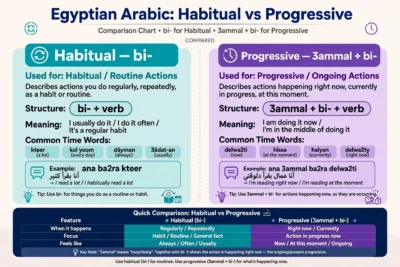
Egyptian Arabic uses a tiny prefix, bi-, for both “I’m doing it right now” and “I do it regularly.” Once that clicks, the present progressive in Egyptian Arabic stops being scary. Honestly, it’s one of the easiest tenses in the whole dialect.
If you studied Modern Standard Arabic first, this will feel strange for about ten minutes. There’s no separate “-ing” tense to learn. If you’re still deciding where to start, our guide on Egyptian Arabic vs Modern Standard Arabic will help you pick a path.
By the end of this article you’ll know how to build the form, how to tell “now” from “every day,” which verbs break the rule, and the mistakes I see most often in colloquial Egyptian Arabic classes.
The Quick Answer: How to Form the Present Progressive in Egyptian Arabic
Three steps. That’s all.
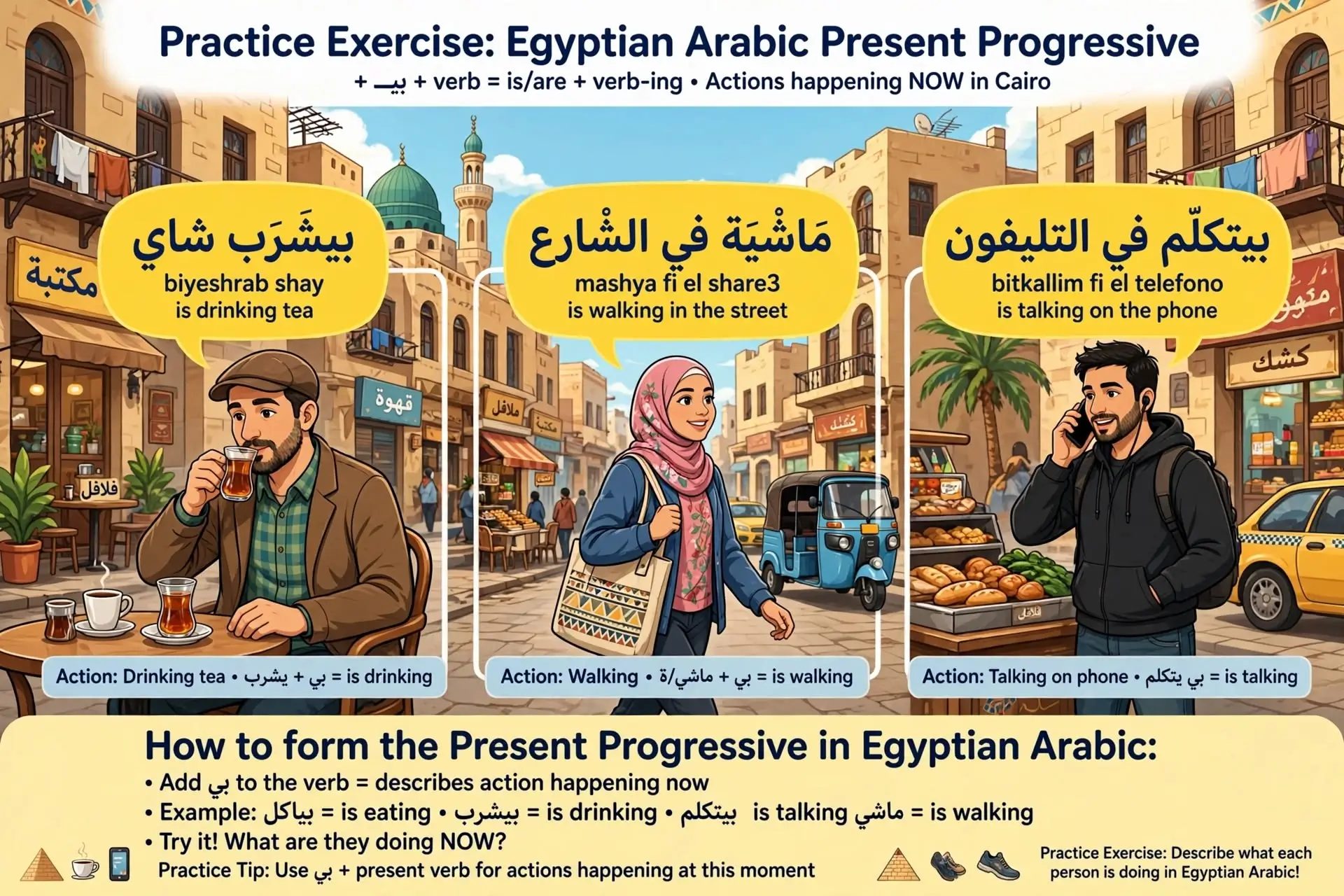
- Start with the present-tense verb: يشرب (yishrab), “he drinks.”
- Add bi- to the front: بيشرب (biyishrab), “he drinks / he’s drinking.”
- With “I,” the prefix changes to ba-: باشرب (bashrab), “I drink / I’m drinking.”
Egyptian Arabic doesn’t have a special “-ing” tense. The bi- prefix marks the verb as present, and context tells the listener whether you mean right now or in general.
Want the big-picture view? Linguists call this difference between “ongoing” and “regular” actions grammatical aspect. Wikipedia’s page on continuous and progressive aspects explains how different languages handle it. Egyptian Arabic just happens to handle both with the same prefix.
The Full Conjugation (With a Real Verb)
Let’s use the verb شرب (to drink). Here’s every person.
| Pronoun | Arabic | Transliteration | Meaning |
|---|---|---|---|
| أنا | باشرب | ana bashrab | I’m drinking |
| إنت (m.) | بتشرب | inta bitishrab | you’re drinking |
| إنتي (f.) | بتشربي | inti bitishrabi | you’re drinking |
| هو | بيشرب | huwwa biyishrab | he’s drinking |
| هي | بتشرب | hiyya bitishrab | she’s drinking |
| إحنا | بنشرب | ihna binishrab | we’re drinking |
| إنتو | بتشربوا | intu bitishrabu | you (pl.) are drinking |
| هم | بيشربوا | humma biyishrabu | they’re drinking |
Here’s the thing. Don’t memorize that table cell by cell. Memorize four prefixes instead:
- ba- for “I”
- bit- for “you” and “she”
- biy- for “he” and “they”
- bin- for “we”
Then add -i for “you (f.)” and -u for any plural. Done. You just learned the pattern for almost every regular verb in the language.
Notice something else too. “You (m.)” and “she” look identical: بتشرب. That’s normal. The pronoun or the situation tells you who you mean, and in real conversation nobody gets confused.
Want to hear it in a natural flow? Egyptian speakers also say these prefixes fast, so biyishrab often sounds like “biyshrab.” Don’t panic when you hear that. It’s the same word.
Now or Every Day? Same Form, Different Time Words
This is the part that trips people up. Compare these two sentences:
- باشرب قهوة دلوقتي. Bashrab ahwa dilwa’ti. “I’m drinking coffee right now.”
- باشرب قهوة كل يوم. Bashrab ahwa kull yom. “I drink coffee every day.”
Same verb. Same form. Different time word. That’s the whole trick.
Here are the time words you’ll use constantly:
- دلوقتي (dilwa’ti): now, right now
- حالياً (ḥāliyyan): currently, at the moment
- الأيام دي (il-ayyām di): these days
- كل يوم (kull yom): every day
- دايماً (dayman): always
- أحياناً (aḥyānan): sometimes
Honestly, if you drop one of these into your sentence, you’ll almost never be misunderstood. And when you don’t use any time word, the situation does the work. If your friend calls and asks بتعمل إيه؟ (bit’mil eh, “what are you doing?”), the answer is obviously “right now.”
Ten Everyday Sentences You Can Steal
Say these out loud. Seriously. Reading them silently doesn’t count.
- باكل غدا. Bākul ghada. “I’m eating lunch.”
- بتذاكر دلوقتي. Bitzākir dilwa’ti. “She’s studying right now.”
- بنتفرج على فيلم. Binitfarrag ‘ala film. “We’re watching a movie.”
- بيلعبوا كورة. Biyil’abu kōra. “They’re playing football.”
- باشتغل من البيت. Bashtaghal min il-beit. “I’m working from home.”
- بتكلم مين؟ Bitkallim mīn? “Who are you talking to?”
- بيشرب شاي. Biyishrab shāy. “He’s drinking tea.”
- بنستنى الأتوبيس. Binistanna l-otobīs. “We’re waiting for the bus.”
- بتسمعي إيه؟ Bitisma’i eh? “What are you listening to?” (to a woman)
- باتعلم عربي. Bata’allim ‘arabi. “I’m learning Arabic.”
Pick three and use them today. That’s better than reading ten more grammar pages.
How to Make It Negative and Ask Questions
Negative is easy. Wrap the verb with ma- at the front and -sh at the end.
- مابشربش قهوة. Mabashrabsh ahwa. “I don’t drink coffee / I’m not drinking coffee.”
- مابتذاكرش. Mabitzakarsh. “You’re not studying.”
- مابيشتغلش دلوقتي. Mabyishtaghalsh dilwa’ti. “He’s not working right now.”
Forget the -sh and you sound like you’re mixing dialects. It’s a small thing, but Egyptians notice it right away.
Questions are even easier. Keep the same sentence and raise your voice at the end, or add a question word:
- بتعمل إيه؟ Bit’mil eh? “What are you doing?”
- بتروح فين؟ Bitrūh fēn? “Where are you going?”
- بيعمل كده ليه؟ Biy’mil keda leih? “Why is he doing that?”
The Exception: Verbs That Don’t Use bi- for “Right Now”
I’ll be straight with you. This is the part most textbooks rush through, and it’s where learners start sounding “off.”
For movement and state verbs, Egyptians usually use an active participle for what’s happening right now. It works like an adjective. It agrees with the speaker: add -a for feminine and -īn for plural.
| Verb | Participle | Meaning |
|---|---|---|
| راح (to go) | رايح (rāyiḥ) | going |
| جه (to come) | جاي (gayy) | coming |
| قعد (to sit/stay) | قاعد (ʾāʿid) | sitting, staying |
| نام (to sleep) | نايم (nāyim) | sleeping, asleep |
| عرف (to know) | عارف (ʿārif) | know |
| فهم (to understand) | فاهم (fāhim) | understand |
| سكن (to live) | ساكن (sākin) | living (somewhere) |
Now look at how the meaning changes:
- أنا رايح الشغل. Ana rāyiḥ ish-shughl. “I’m going to work (right now).”
- باروح الشغل كل يوم. Barūḥ ish-shughl kull yom. “I go to work every day.”
Both are correct. They just mean different things. The participle points at the moment. The bi- verb points at the routine.
A few more you’ll hear all the time:
- أنا جاي. Ana gayy. “I’m coming.”
- هي رايحة الجامعة. Hiyya rāyḥa l-gam’a. “She’s going to university.”
- إحنا ساكنين في القاهرة. Ihna saknīn fi l-Qāhira. “We live in Cairo.”
- أنا مش فاهم. Ana mish fāhim. “I don’t understand.”
And أنا عارف (ana ʿārif) is how you say “I know.” Say that, not a bi- form. It’s much more natural.
One more word you might hear is عمّال (ʿammāl). It goes before a verb with no bi- and means “keeps doing” or “has been doing nonstop.” For example, عمّال يذاكر من الصبح (ʿammāl yizākir min iṣ-ṣubḥ), “he’s been studying since the morning.” You don’t need it on day one, but it’s good to recognize.
Don’t Put bi- Everywhere: Modals and the Future
This one causes the most mistakes. The bi- prefix marks the present. After words like “want,” “must,” and “can,” you use the bare verb, with no prefix.
- عايز أشرب. ʿāyiz ashrab. “I want to drink.”
- لازم أروح. Lāzim arūḥ. “I have to go.”
- ممكن أقعد؟ Mumkin a’ʿud? “Can I sit?”
Saying ʿāyiz bashrab is a classic beginner mistake. It sounds like “I want I’m drinking.”
The future works differently too. It uses ha- instead of bi-:
- باشرب (bashrab): I drink / I’m drinking
- هاشرب (hashrab): I’ll drink
- عايز أشرب (ʿāyiz ashrab): I want to drink
Three tiny differences. Three completely different meanings. Learn them together and you’ll cover most of what you need in daily conversation.
A Mini Dialogue: Everything Together
Let’s see all of it working in one phone call. Two friends, Omar and Salma.
- عمر: ألو؟ إنتي فين؟ بتعملي إيه دلوقتي؟ (Alo? Inti fēn? Bit’mili eh dilwa’ti?) “Hello? Where are you? What are you doing right now?”
- سلمى: أنا رايحة الشغل. إنت بتعمل إيه؟ (Ana rāyḥa sh-shughl. Inta bit’mil eh?) “I’m going to work. What are you doing?”
- عمر: باشرب قهوة وباستنى الأتوبيس. (Bashrab ahwa wa-bastanna l-otobīs.) “I’m drinking coffee and waiting for the bus.”
- سلمى: مابتشربش قهوة كل يوم؟ (Mabitishrabsh ahwa kull yom?) “Don’t you drink coffee every day?”
- عمر: لأ، عايز أبطل. بس النهاردة لازم أشرب! (La’, ʿāyiz abattal. Bas inaharda lāzim ashrab!) “No, I want to quit. But today I have to drink it!”
Count what happened here. Salma uses a participle (rāyḥa) for movement. Omar uses ba- twice for “I.” The negative question has the -sh ending. And after “want” and “have to,” the verbs go bare: abattal and ashrab. That’s the whole lesson in six lines.
Try rewriting this dialogue with your own details. Change the verbs, the places, the drinks. Then read it aloud with a friend or a teacher.
Six Mistakes I See All the Time
1. Using bi- with “I.” Students say bi-ashrab. The correct form is ba-shrab. “I” always takes ba-.
2. Mixing in Modern Standard Arabic. Saying أريد (urīdu) with an Egyptian accent instead of عايز (ʿāyiz) creates a weird hybrid that sounds strange to every Egyptian. Our guide to learning Egyptian Arabic explains why keeping the two separate early on saves you a lot of confusion.
3. Adding bi- after “want,” “must,” and “can.” Covered above. Bare verb only.
4. Using bi- for state verbs. “I know,” “I understand,” and “I’m living in Cairo” use the participle. Not bi-.
5. Forgetting the -sh in negatives. Mabashrab feels unfinished. It’s mabashrabsh.
6. Translating “-ing” word for word. English has “I am drinking.” Egyptian Arabic doesn’t have a matching helper verb. Just say باشرب. Short is good.
Questions Learners Keep Asking
I’ve pulled these from the questions learners post on language forums and from my own classes.
Does bi- mean “I am doing” or “I do”?
Both. Context decides. Add دلوقتي (now) or كل يوم (every day) if you want to be clear.
Why is it ba- for “I” and not bi-?
It’s just how the first person works in Egyptian Arabic. The prefix ba- replaces the usual a- of the “I” form. So ashrab becomes bashrab.
Do I use bi- after “I want”?
No. Use the bare verb: ʿāyiz ashrab, not ʿāyiz bashrab.
Is bi- the same in other dialects?
Not exactly. Many dialects use a b- prefix, but the meaning changes. Levantine learners often hear an extra word, عم (ʿam), for “right now.” In many Gulf varieties, the same b- can point to the future. That’s one more reason to pick one dialect and stay with it at the start. For background on where Egyptian Arabic sits among Arabic varieties, see Wikipedia’s article on Egyptian Arabic.
Do I need to read Arabic script for this?
It helps, but you can start with transliteration. Just don’t stay there forever. Arabic script shows you the prefix clearly, and that makes the pattern easier to see.
A 10-Minute Practice Routine
Reading about grammar isn’t the same as using it. Here’s what I’d do if I were you.
- Narrate your day. Say it out loud: bafṭar, bashtaghal, batghadda, barūḥ. (“I eat breakfast, I work, I eat lunch, I go.”)
- Ask yourself the question. Every few hours, say bit’mil eh dilwa’ti? and answer in Arabic.
- Swap the pronoun. Take one sentence and run it through all eight forms from the table above.
- Listen for the prefix. Watch an Egyptian show and count how many times you hear bi-, bit-, and bin-. You’ll hear dozens in a single scene.
Ten minutes a day beats two hours once a week. If you need help building the habit, our daily Arabic study routine walks you through a simple plan.
Not sure which level you’re at? Take our free Arabic placement test and find out in a few minutes.
Ready to Speak, Not Just Study?
Grammar rules are useful. But the bi- prefix only sticks when you use it with a real person who corrects you in the moment.
In our Colloquial Egyptian Arabic course, you speak from the first lesson. Our teachers will fix your prefixes, your pronunciation, and your confidence as you go. You can check the course pricing anytime, and there’s no pressure.
Start speaking today. Develop your speaking skills with Colloquial Egyptian Arabic.