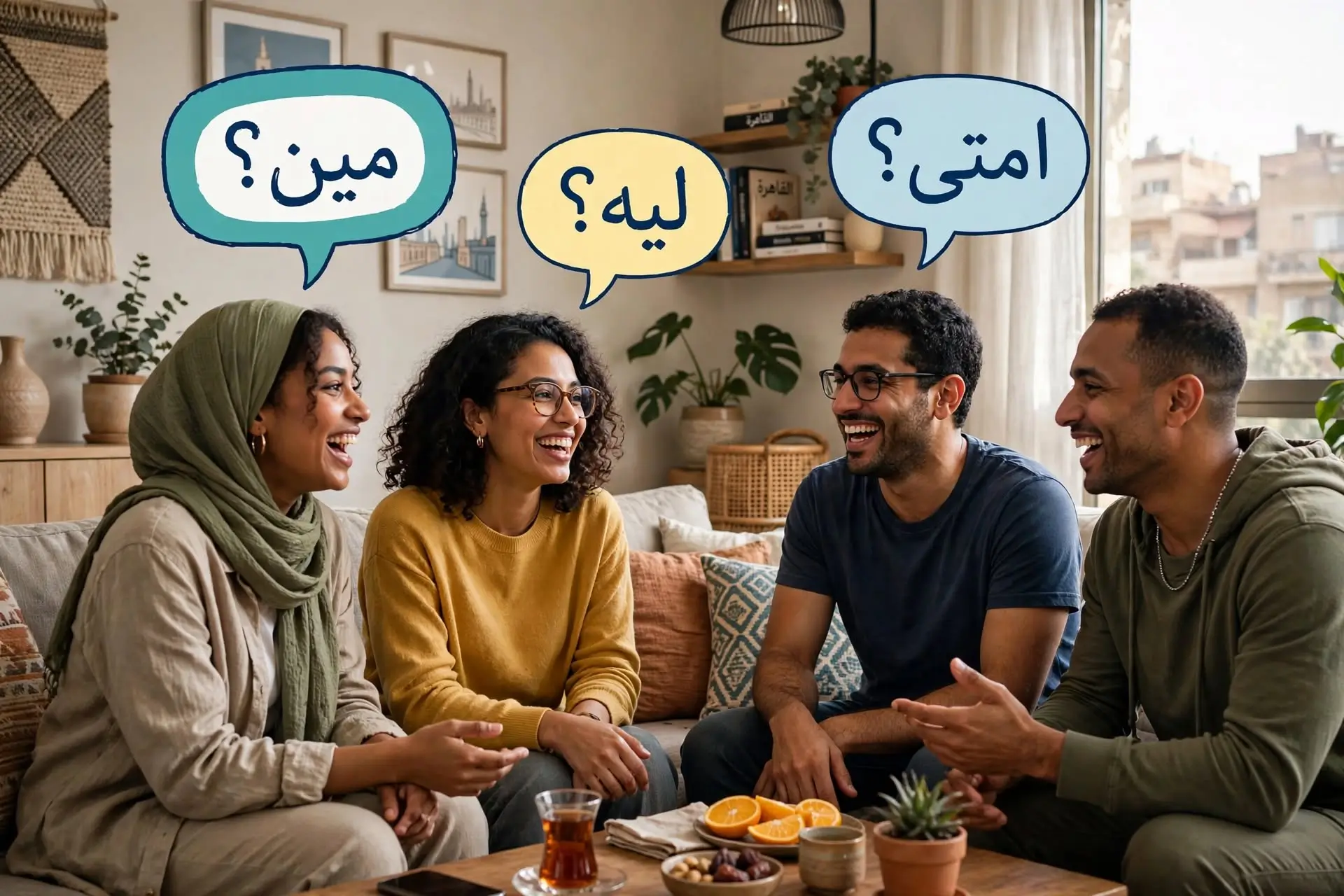
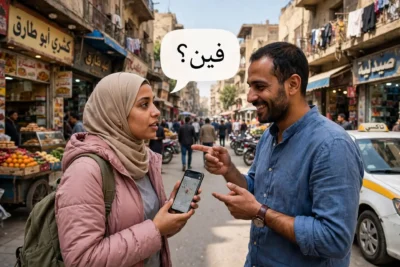
Here’s a weird thing I see all the time. A student learns “hello,” “thank you,” and “I’m fine.” Then they land in Cairo, a taxi driver says something, and they freeze. Not because they lack vocabulary. Because they can’t ask the one thing that saves every conversation: “Sorry, what? Where? When? How much?”
Question words are survival tools. Learn eight of them and you can get directions, buy things, make friends, and keep a conversation going when it stalls.
The good news? Egyptian Arabic (also called Masri or Cairene Arabic) makes this easy. The grammar is lighter than Modern Standard Arabic. The question words are short. And they sit right where you’d expect them.
Let’s go through them.
A quick note on spelling: I’m writing the sounds in Latin letters so you can read along, with “3” for the Arabic letter ع. Transliteration is a crutch. Use it for now, then drop it as soon as you can read the script.
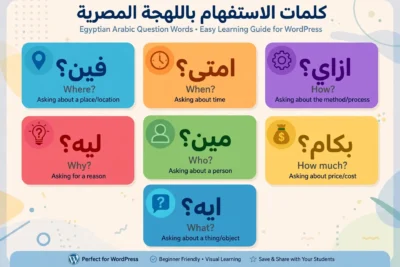
The 8 Egyptian Arabic question words at a glance
| English | Arabic | Sounds like | Quick example |
|---|---|---|---|
| Who | مين | meen | مين ده؟ (meen da?) |
| What | إيه | eih | ده إيه؟ (da eih?) |
| Where | فين | fein | فين الحمام؟ (fein el-hammam?) |
| When | إمتى | emta | هتيجي إمتى؟ (hateegi emta?) |
| Why | ليه | leih | ليه؟ (leih?) |
| How | إزاي | ezzay | إزاي أروح؟ (ezzay arooh?) |
| How much / how many | كام | kam | بكام ده؟ (bekam da?) |
| Which | أنهي | anhi | أنهي واحد؟ (anhi wahed?) |
Screenshot that table if you want. Now the real work: using them.
Why question words are the best place to start
Honestly, most beginners study the wrong things first. They memorize colors and animals. Cute, but you won’t use “giraffe” on Tuesday.
Questions, on the other hand, work on day one. And they do two jobs at once. They let you get information, and they keep the other person talking, which means more listening practice for you.
One more thing. A learner on Reddit asked what the biggest challenge for beginners is. In my experience, it’s not grammar. It’s understanding the answer. So when you ask a question, you need to be ready for a real response. Ask “fein?” and someone will rattle off directions at full Cairo speed. That’s fine. Smile, ask them to repeat, and you’ve just learned something.
Each question word, one by one
1. مين (meen), “who”
The easiest one. It works like English.
- مين ده؟ (meen da?), Who’s that? (about a man)
- مين دي؟ (meen dee?), Who’s that? (about a woman)
- مين جه؟ (meen geh?), Who came?
- إنت مين؟ (inta meen?), Who are you?
Careful with that last one. It can sound blunt, like “Who are YOU?” If you want to ask someone’s name politely, say اسمك إيه؟ (ismak eih?), “What’s your name?” Use اسمِك إيه؟ (ismik eih?) for a woman.
Add small words to build more questions:
- مع مين؟ (ma3 meen?), With whom?
- ده بتاع مين؟ (da beta3 meen?), Whose is this?
- لمين؟ (li-meen?), For whom?
2. إيه (eih), “what”
You’ll hear this one a hundred times a day. Egyptians use it for almost everything.
- ده إيه؟ (da eih?), What’s this?
- بتعمل إيه؟ (bet3mel eih?), What are you doing?
- عايز إيه؟ (3ayez eih?), What do you want?
- يعني إيه؟ (ya3ni eih?), What does it mean?
That last one, يعني إيه؟, is your best friend as a learner. Hear a new word? Ask “ya3ni eih?” Done. Native speakers respect it, because it shows you’re actively learning.
It also shows up in greetings:
- عامل إيه؟ (3amel eih?), How are you doing?
- إيه الأخبار؟ (eih el-akhbar?), What’s the news?
- إيه رأيك؟ (eih ra’yak?), What do you think?
And here’s the thing about tone. “Eih?” alone, shot back at someone, can sound like “What do you want?!” in an annoyed voice. Same word, same letters. The difference is your face and your pitch. If you need someone to repeat themselves, use أفندم؟ (afandem?) instead. It’s polite, and it works everywhere in Egypt.
3. فين (fein), “where”
Probably your most-used word while traveling.
- فين الحمام؟ (fein el-hammam?), Where’s the bathroom?
- إنت فين؟ (inta fein?), Where are you?
- رايح فين؟ (rayeh fein?), Where are you going? (to a man)
- رايحة فين؟ (rayha fein?), Where are you going? (to a woman)
Add من (min, “from”) and you get “where from”:
- إنت منين؟ (inta mneen?), Where are you from?
Yes, it squashes together in speech: min + fein becomes mneen. Everyone does this. You’ll sound more natural the second you copy it.
4. إمتى (emta), “when”
- إمتى؟ (emta?), When?
- هنتقابل إمتى؟ (hanet’abel emta?), When are we meeting?
- الفيلم يبدأ إمتى؟ (el-film yebda’ emta?), When does the movie start?
Related: الساعة كام؟ (es-sa3a kam?) means “What time is it?” Literally, “The hour is how many?” That’s a kam sentence, which we’ll get to in a second.
5. ليه (leih), “why”
Short, simple, and powerful.
- ليه؟ (leih?), Why?
- ليه اتأخرت؟ (leih it’akhart?), Why were you late?
- ليه لأ؟ (leih la’?), Why not?
If you want “what for?”, say عشان إيه؟ (3ashan eih?). It means “for what reason?”
Quick personal opinion: “leih?” is the most underrated word in the language. Kids learn fast because they ask “why” nonstop. Be that kid.
6. إزاي (ezzay), “how”
- إزاي أروح التحرير؟ (ezzay arooh el-Tahrir?), How do I get to Tahrir?
- إزاي بتقول ده بالعربي؟ (ezzay bet’ool da bil-3arabi?), How do you say this in Arabic?
- إزاي؟ (ezzay?), How? / Really? How come?
And the greeting everyone knows, which is actually just “ezzay” with a pronoun attached:
- إزيك؟ (ezzayyak?), How are you? (to a man)
- إزيك؟ (ezzayyek?), How are you? (to a woman)
The only difference is the last vowel. Tiny, but it matters.
7. كام (kam), “how many / how much”
This one does double duty. Money, numbers, time, age.
- بكام ده؟ (bekam da?), How much is this?
- عندك كام سنة؟ (3andak kam sana?), How old are you?
- الساعة كام؟ (es-sa3a kam?), What time is it?
- كام واحد؟ (kam wahed?), How many?
Notice بكام (bekam). That be- means “for” or “at,” so it’s the price question. Learn it as one chunk. You’ll use it at every market.
8. أنهي (anhi), “which”
The least common of the eight, but still handy.
- أنهي واحد؟ (anhi wahed?), Which one?
- أنهي شارع؟ (anhi share3?), Which street?
In casual speech, people often skip it and just point and say ده ولا ده؟ (da wala da?), “This one or that one?” Totally normal.
Where do question words go in the sentence?
This is the part that surprises people coming from MSA or English.
In English, you move the question word to the front. “You’re going where?” becomes “Where are you going?”
In Egyptian Arabic, the question word very often stays in the same spot as the answer would be:
- إنت رايح فين؟ (inta rayeh fein?), You’re going where?
- إنت عايز إيه؟ (inta 3ayez eih?), You want what?
- هتيجي إمتى؟ (hateegi emta?), You’ll come when?
It can also go first, and nobody will blink. فين الحمام؟ is just as normal as الحمام فين؟. But here’s the practical tip: if you’re nervous, just build the sentence normally and stick the question word at the end. It works almost every time.
Yes/no questions: forget “hal”
If you’ve seen MSA, you know hal (هل) starts yes/no questions. Egyptian doesn’t use it.
You raise your voice. That’s it.
- إنت جعان. (inta ga3aan.), You’re hungry.
- إنت جعان؟ (inta ga3aan?), Are you hungry?
Same words. Different melody.
Sometimes people add هو (howwa) at the start, as a soft marker: هو إنت جعان؟ And ولا (wala) works as a tag: حلو، ولا لأ؟ (7elw, wala la’?), “Good, or not?” But rising pitch does 90% of the work.
Combos you’ll hear all the time
Question words rarely travel alone. Here are chunks worth memorizing whole:
| Chunk | Arabic | Meaning |
|---|---|---|
| ya3ni eih | يعني إيه | What does that mean? |
| 3ashan eih | عشان إيه | What for? |
| ma3 meen | مع مين | With whom? |
| min fein / mneen | من فين / منين | From where? |
| beta3 meen | بتاع مين | Whose? |
| bekam | بكام | For how much? |
| eih el-7ekaya | إيه الحكاية | What’s the story? / What’s going on? |
| leih la’ | ليه لأ | Why not? |
Learn them as chunks, not as grammar. You’ll pick up the structure later without trying. 50 common words
A mini conversation to read out loud
You’re in a café in Cairo. Read this aloud. Seriously, out loud. Your mouth needs the practice.
You: لو سمحت، عندكم إيه؟
(law samaht, 3andokom eih?), Excuse me, what do you have?
Waiter: عندنا شاي وقهوة وعصير.
(3andena shai we-ahwa we-3aseer.), We have tea, coffee, and juice.
You: العصير بكام؟
(el-3aseer bekam?), How much is the juice?
Waiter: (tells you the price)
You: تمام. وهيخلص إمتى؟
(tamam. we-hayekhlas emta?), Okay. And when will it be ready?
Waiter: كمان خمس دقايق.
(kamaan khamas de’ayy’.), In five minutes.
You: شكراً. إنت منين؟
(shukran. inta mneen?), Thanks. Where are you from?
Four question words, one short chat. That’s real conversation.
The questions real learners keep asking
I’ve read a lot of Reddit and Quora threads from people starting Egyptian Arabic. The same worries come up again and again. Let me answer the ones that connect to question words.
“MSA or Egyptian dialect?”
Depends on your goal. Want to talk to people, watch Egyptian shows, travel, or live in Egypt? Start with Egyptian. Want to read news, study formally, or take exams? MSA matters more. Neither choice is wrong. I wrote a longer breakdown here: Egyptian Arabic vs Modern Standard Arabic: Which to Learn First?. And if MSA is your direction, this MSA comparison will help.
“If I know Egyptian, will I understand MSA?”
Partly. You’ll recognize roots, plenty of vocabulary, and sentence rhythm. But MSA has case endings and formal grammar you won’t get from Egyptian alone. Think of it as a head start, not a free pass. Question words are a good example: meen, fein, and kam are close cousins of MSA man, ayna, and kam, so you’ll spot the family resemblance.
“Where do I start learning Egyptian dialect?”
With things you’ll say tomorrow. Greetings, then question words, then numbers, then food and transport. Our complete guide to learning Egyptian Arabic lays out the whole path.
“Can I teach myself as an absolute beginner?”
You can start alone. Plenty of people do. The tricky part comes later: pronunciation. Sounds like ع and ح are hard to fix without someone listening to you. Self-study gets you moving. A teacher stops you from locking in mistakes.
“Is it worth spending time on basic Egyptian Arabic?”
Yes. Even 20 minutes a day gets you further than you’d think. Egyptian Arabic is understood across much of the Arab world, largely thanks to Egyptian cinema and music. Basic phrases pay off quickly.
“What’s the best way to learn without getting overwhelmed?”
Small daily doses. Pick two question words a day. Use each in three sentences. Say them out loud. Our daily Arabic study routine shows how to fit this into a busy week without burning out.
Mistakes I see all the time
1. Translating word for word from English. “Where you go?” is fine in Egyptian. It’s rarely wrong to keep it short.
2. Ignoring gender. Egyptian Arabic marks gender in “you.” Inta is a man, inti is a woman. Verbs shift too: rayeh vs rayha. Don’t panic. People will understand you. Just keep practicing.
3. Saying “eih?” like you’re annoyed. Covered above. Use afandem? when in doubt.
4. Learning only from transliteration. I’ll be straight with you: it’s useful for week one, and harmful by week six. Learn the script. It’s not as scary as it looks, and it fixes your pronunciation faster than anything.
5. Using MSA question words in casual chat. If you say mata (متى) instead of emta, or limatha instead of leih, people will smile and answer you. But you’ll sound like a news anchor ordering falafel. Egyptians love it, but it’s a bit funny.
A 10-minute practice plan
You don’t need a big study session. Try this for a week:
- Minutes 1–3: Read the table at the top out loud.
- Minutes 4–6: Pick two question words. Write three sentences with each.
- Minutes 7–9: Record yourself asking them. Play it back. Cringe a little. Fix it.
- Minute 10: Ask yourself a question in Arabic about your day. “إنت عملت إيه النهارده؟” (inta 3amalt eih en-naharda?), What did you do today?
Do that for seven days. By Sunday you’ll own all eight.
Ready to actually talk?
Reading about question words is step one. Using them with a real person who corrects you gently, and then answers you at normal speed, is where it clicks.
If you want to improve your conversation in Egyptian Arabic, that’s exactly what we do at Alphabet Arabic Academy. You’ll practice live with native Egyptian teachers, not scripts.
- Not sure where you stand? Take the free Arabic placement test.
- Curious about the course? See the Colloquial Egyptian Arabic program.
- Want to meet the people behind the lessons? Check out our teachers.
- Comparing options? Here’s our pricing.
Start with one question: فين أبدأ؟ (fein abda?), “Where do I start?” Right here. Today.
- I couldn’t open your site pages directly (they block automated access), so internal links come from search results showing the live URLs. I didn’t find a verified URL for your “50 Most Common Egyptian Arabic Phrases” post. If it’s live, add it near the combos table.