
Most beginners start Egyptian Arabic with nouns. Coffee. Taxi. Water. Then they hit a wall.
They can name everything and say nothing. Because you can’t build a sentence out of nouns alone. You need verbs.
I teach Egyptian Arabic for a living, and I see this every week. A student walks in knowing 80 food words and zero ways to say “I want to eat.” So this article fixes that. Here are 25 verbs that cover most of what you’ll say in a normal day.
I’ve also answered the questions I see learners asking on Reddit and Quora all the time. Things like “will other Arabs understand me?” and “if I learn Egyptian, will I understand MSA?” Those are near the end.
How Egyptian Arabic verbs work (the 2-minute version)
Don’t skip this part. It’ll make the whole list easier.
Egyptian verbs have two main forms you’ll use every day: the past and the present. Each list below gives you both, in the “he” form. That’s the form dictionaries use, and it’s the form I want you to memorize.
Past tense is simple. You add endings to the verb.
Take katab (he wrote):
- katabt — I wrote (or you wrote)
- katab — he wrote
- katabit — she wrote
- katabna — we wrote
Present tense takes a prefix. The most common one is bi- (بـ), which means “I do this regularly” or “I’m doing this now.”
- baktib — I write
- bitiktib — you write
- biyiktib — he writes
- binktib — we write
Future tense is even easier. Swap bi- for Ha- (حـ) or ha-. So haktib means “I will write.”
That’s the skeleton. Everything else is just practice. And if you can’t read Arabic script yet, don’t panic. I’ve added the pronunciation for every verb. (A quick note: the apostrophe (‘) stands for the glottal stop or the letter ع. Don’t stress about it at first. Listen to a native speaker and copy them.)
Movement verbs
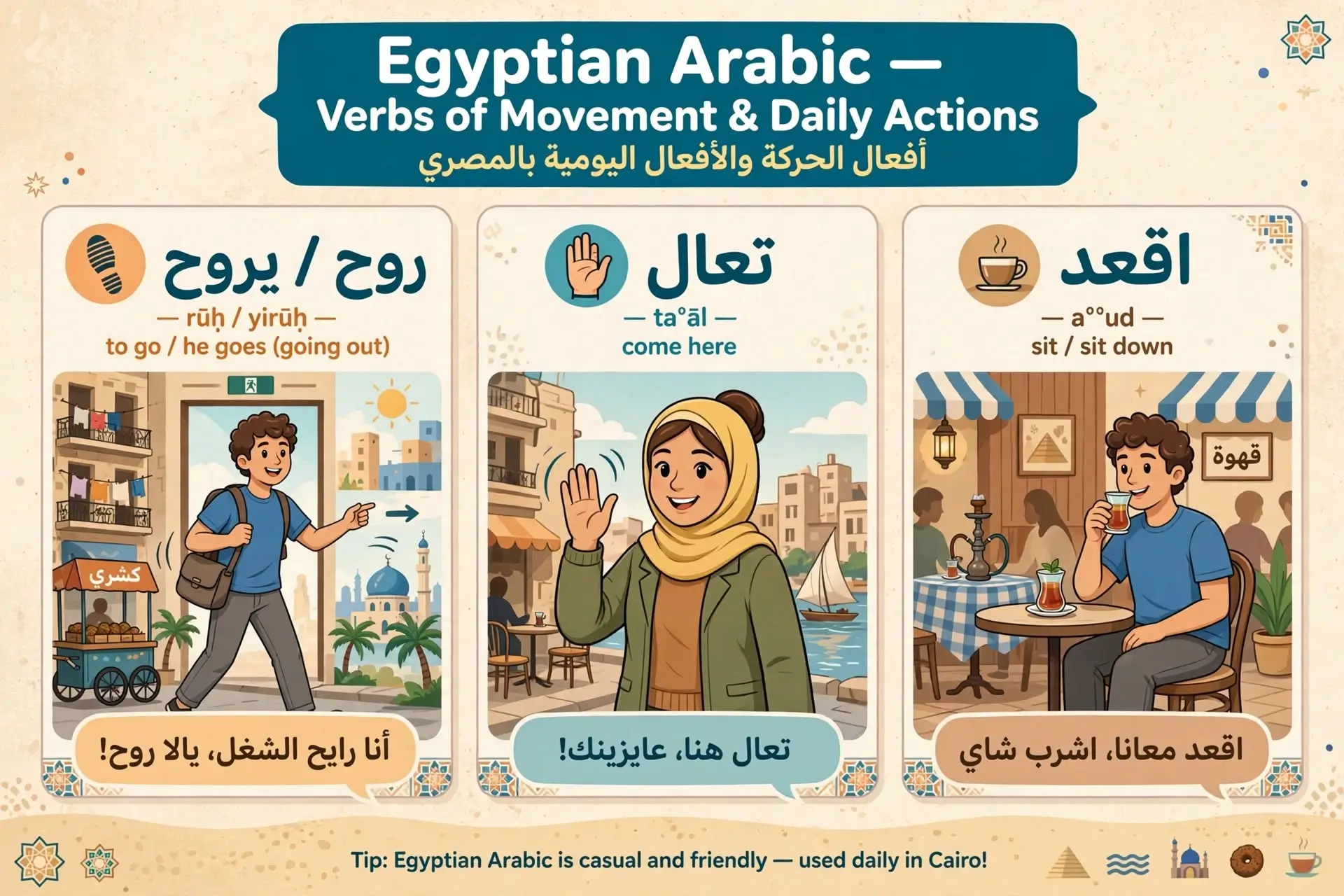
These are the verbs you’ll use the minute you step outside.
| English | Arabic (past / present) | Pronunciation | Example |
|---|---|---|---|
| 1. To go | راح / بيروح | raaH / biyrooH | هروح السوق بكرة. (haroH es-soo’ bukra) I’ll go to the market tomorrow. |
| 2. To come | جه / بييجي | gih / biyiigi | هييجي بعد شوية. (hayiigi ba’d shwayya) He’ll come in a bit. |
| 3. To arrive | وصل / بيوصل | wiSil / biyooSal | وصلت البيت. (wiSilt el-beit) I got home. |
| 4. To take | خد / بياخد | khad / biyaakhud | خد التاكسي. (khod it-taksi) Take a taxi. |
| 5. To wait | استنى / بيستنى | istanna / biyistanna | استنى شوية. (istanna shwayya) Wait a little. |
RaaH is probably the first verb I teach. If you’re going to learn only one, make it that one.
Here’s the thing about gih. It looks irregular, and it kind of is. Don’t try to figure out why. Just learn it as a chunk. Egyptian Arabic has a handful of these, and fighting them wastes your time.
Everyday action verbs
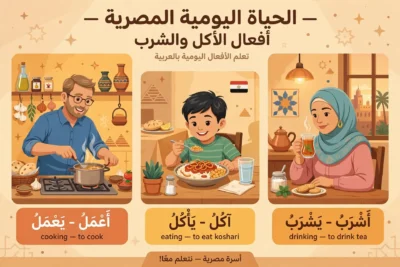
This is the “what are you doing?” group. Eating, drinking, sleeping, and so on.
| English | Arabic (past / present) | Pronunciation | Example |
|---|---|---|---|
| 6. To eat | كل / بياكل | kal / biyaakul | باكل رز كل يوم. (baakul ruzz kull yoom) I eat rice every day. |
| 7. To drink | شرب / بيشرب | širib / biyishrab | بشرب شاي بالنعناع. (bashrab shaay bin-na’na’) I drink mint tea. |
| 8. To sleep | نام / بينام | naam / biynaam | عاوز أنام. (aawez anaam) I want to sleep. |
| 9. To wake up | صحي / بيصحى | SiHi / biySHa | بصحى بدري. (baSHa badri) I wake up early. |
| 10. To work | اشتغل / بيشتغل | ishtaghal / biyishtaghal | بشتغل في القاهرة. (bashtaghal fi el-qaahira) I work in Cairo. |
Notice something about aawez anaam in the example. There’s no “to” and no extra word between “want” and “sleep.” You just say “I want, I sleep.” Egyptian Arabic is gloriously lazy about this, and I love it.
Verbs for communicating
If you want to actually talk to people, these five do most of the heavy lifting.
| English | Arabic (past / present) | Pronunciation | Example |
|---|---|---|---|
| 11. To say | قال / بيقول | ‘aal / biy’ool | إنت بتقول إيه؟ (inta bit’ool eh?) What are you saying? |
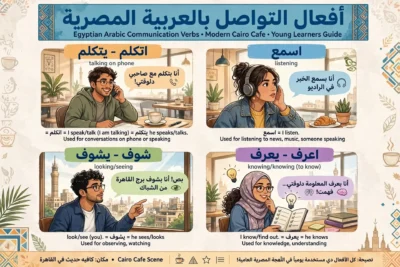
| 12. To speak | اتكلم / بيتكلم | itkallim / biyitkallim | بتكلم عربي شوية. (batkallim ‘arabi shwayya) I speak a little Arabic. |
| 13. To ask | سأل / بيسأل | sa’al / biys’al | عاوز أسأل سؤال. (aawez as’al su’aal) I want to ask a question. |
| 14. To understand | فهم / بيفهم | fihim / biyifham | مفهمتش. (mafhimtish) I didn’t understand. |
| 15. To know | عرف / بيعرف | ‘eref / biya’raf | بعرف أتكلم شوية. (ba’raf atkallim shwayya) I know how to speak a bit. |
Honestly, mafhimtish is the most useful word on this list. It means “I didn’t understand.” You will say it a hundred times in your first month. Say it without shame. Egyptians are patient with learners, and they’ll slow down for you.
See how it’s built? Ma- + verb + -sh. That wrapper makes any past verb negative. Maktabtish (I didn’t write). Maruhtish (I didn’t go). One pattern, endless use.
Senses and feelings
| English | Arabic (past / present) | Pronunciation | Example |
|---|---|---|---|
| 16. To see | شاف / بيشوف | shaaf / biyshoof | شفت الفيلم ده؟ (shuft el-film da?) Did you see this movie? |
| 17. To hear | سمع / بيسمع | simi’ / biyisma’ | سمعت الأغنية دي؟ (sma’t el-oghniyya di?) Did you hear this song? |
| 18. To love/like | حب / بيحب | Habb / biyiHebb | بحب القهوة. (baHebb el-ahwa) I love coffee. |
Habb is bigger than “like.” Egyptians use it for coffee, football, and their grandmother’s cooking. Don’t worry about the difference between “like” and “love” like you would in English.
Money and shopping verbs
You’ll need these in the first hour of any trip to Egypt.
| English | Arabic (past / present) | Pronunciation | Example |
|---|---|---|---|
| 19. To buy | اشترى / بيشتري | ishtara / biyishtiri | اشتريت ده. (ishtareet da) I bought this. |
| 20. To pay | دفع / بيدفع | dafa’ / biyidfa’ | هدفع كاش. (hadfa’ kaash) I’ll pay cash. |
| 21. To give | ادّى / بيدّي | idda / biyiddi | إديني المية. (iddiini el-maya) Give me the water. |
| 22. To order/ask for | طلب / بيطلب | Talab / biyuTlub | طلبت أكل. (Talabt akl) I ordered food. |
Iddiini is “give me.” It’s idda plus -ni (me). You’ll hear it in every shop and café. Learn it, and you can get anything.
Everyday essentials
| English | Arabic (past / present) | Pronunciation | Example |
|---|---|---|---|
| 23. To do/make | عمل / بيعمل | ‘amal / biy’mil | بتعمل إيه؟ (bit’mel eh?) What are you doing? |
| 24. To write | كتب / بيكتب | katab / biyiktib | كتبت الرسالة. (katabt er-risaala) I wrote the message. |
| 25. To read | قرا / بيقرا | ‘ara / biy’ra | بقرا كتاب. (ba’ra kitaab) I’m reading a book. |
Bit’mel eh? is the classic Egyptian “what’s up?” or “what are you doing?” Friends text it to each other constantly. If you want a feel for how these verbs show up in real conversations, check out our list of 50 common Egyptian Arabic phrases. Many of them are built on exactly these verbs.
How to actually learn these 25 verbs
I’ll be straight with you. Reading a list won’t make them stick. Here’s what does.
Learn them in sentences, not alone. Don’t memorize “to eat = kal.” Memorize “baakul ruzz kull yoom.” Your brain remembers stories and chunks better than isolated words.
Start with the “he” form. I said it above and I’ll say it again. Learn kal, biyaakul. The other forms are just small changes on top.
Use them out loud. Say three sentences with each verb. Out loud. Yes, even if you’re alone in the kitchen. Speaking trains your mouth in a way reading never will.
Five a day is plenty. You don’t need to cram all 25 this weekend. Learn five, use them, then move on. A short, steady habit beats a huge weekend session. If you want help building that habit, our guide to a daily Arabic study routine walks through it step by step.
Get a real person to correct you. Pronunciation of letters like ع and ق is hard to fix on your own. A teacher hears the problem in seconds. If you want that, you can meet our teachers.
Questions learners keep asking
I went through the questions people post on Reddit and Quora about Egyptian Arabic. These come up again and again. Here are my honest answers.
“I’m learning Egyptian Arabic. Will speakers of other dialects understand me?”
Mostly, yes. Egyptian Arabic is understood across much of the Arabic-speaking world, largely because of Egyptian films, TV, and music. Wikipedia’s overview of Egyptian Arabic says the same thing.
But let me be careful here. Understanding you isn’t the same as speaking like them. A Moroccan or Gulf Arab will usually follow your Egyptian. They may not answer in Egyptian, and some of their own words will sound totally different to you. That’s normal.
“What dialect is understood the most?”
Egyptian is the one most people point to, again because of the media. That doesn’t mean it’s “better.” It means you’ll find more people who can follow it. If your goal is to talk with the widest range of Arabic speakers, it’s a strong first choice.
“If I know Egyptian, will I understand MSA?”
Partly. Egyptian and Modern Standard Arabic share roots, and many verbs have clear cousins. Our verb katab / biyiktib matches MSA kataba / yaktubu. You’ll spot patterns quickly.
But MSA has things Egyptian dropped, like case endings. And the formal vocabulary is different. So Egyptian gives you a head start, not a free pass. Many learners do both, and the order is your call. We cover that decision in Egyptian Arabic vs. MSA: which to learn first.
“How long does it take to learn MSA if I already know Egyptian?”
Nobody can give you an honest fixed number, and I’d distrust anyone who does. It depends on your hours, your teacher, and your goals. What I can say is this: your Egyptian ear and vocabulary will carry over, so you won’t start from zero. If you’d like to see where you’d start, take our free Arabic level test.
“Any tips for learning the Egyptian dialect?”
Yes. Four, and they’re short:
- Learn verbs early. They unlock sentences faster than nouns.
- Listen to real Egyptian speech, like shows and songs, even before you understand it.
- Speak from day one. Mistakes are fine.
- Don’t get lost in grammar charts. Use the language first, study the rules second.
Common mistakes with Egyptian verbs
A few quick traps I see all the time.
Using MSA verb forms in conversation. If you say dhahaba instead of raaH, you’ll sound like a news anchor ordering falafel. Egyptians will understand, but they might smile.
Forgetting the bi- prefix. Without it, aktib is closer to “that I write” (like “I want that I write”). With it, baktib means “I write.” It’s a tiny letter with a big job.
Mixing up male and female forms. “You” changes based on who you’re speaking to. Bitiktib works for both, but past forms like katabti (you, female) differ from katabt (you, male). Listen for it.
Translating word for word from English. Egyptians don’t say “I am wanting.” They say “I want” with the right form. Think in Arabic patterns, not English ones.
What to do next
You’ve got 25 verbs. That’s the engine of your Egyptian Arabic.
Pick five today. Write three sentences for each. Say them out loud. Tomorrow, pick five more. Within a week, you’ll be building real sentences instead of pointing at things.
And when you’re ready for the next step, don’t stall. Expand your vocabulary with our Colloquial Egyptian Arabic course. You’ll work with native teachers, practice speaking from lesson one, and learn the verbs, phrases, and patterns that Egyptians actually use. If you’re comparing options first, here’s our pricing page.