

Introduction: The Moment Everything Changed
Quranic Arabic Course for Beginners best story I’ll never forget watching Fatima’s face as she read Surah Ar-Rahman for the first time—not just reciting the sounds, but actually understanding the words.
She’d been Muslim for five years. She prayed five times daily. She recited Quran beautifully with proper Tajweed. But every single ayah was just beautiful sounds without meaning. She depended completely on English translations to know what she was reciting.
“It’s like singing opera in Italian without knowing Italian,” she told me, frustrated. “The sounds are beautiful, but I have no idea what Allah is actually saying to me.”
That’s when Fatima enrolled in a Quranic Arabic course for beginners. Eighteen months later, she opened Surah Ar-Rahman and read: “فَبِأَيِّ آلَاءِ رَبِّكُمَا تُكَذِّبَانِ” (Fa bi-ayyi alaa’i rabbikuma tukaththibaan).
For the first time, she didn’t need the translation. She understood directly: “So which of your Lord’s favors will you deny?”
Tears streamed down her face. “This entire time, Allah was speaking to me, and I couldn’t hear Him,” she said. “Now I can.”
This transformation—from reciting sounds to understanding meanings—is what Quranic Arabic courses create. You go from complete dependence on translations to direct comprehension of Allah’s words. From reading letters to reading meanings. From distant observer to intimate participant in divine conversation.
This comprehensive guide provides everything you need to start your Quranic Arabic journey: what Quranic Arabic is, how it differs from modern Arabic, what you’ll actually learn, how to choose the right course, proven learning strategies, and resources that accelerate your progress.
Whether you can’t read Arabic script at all or you already recite but don’t understand, whether you have two hours daily or just twenty minutes, whether you’re 15 or 75—Quranic Arabic is accessible, and this guide shows you exactly how to master it.
Let’s unlock Allah’s words together.
read more information about Quran Courses the Complete Guide : Learning Quran, Arabic, Tajweed
What Is Quranic Arabic and Why It Matters
Quranic Arabic: The Language of Divine Revelation
Quranic Arabic is the classical Arabic language in which the Quran was revealed to Prophet Muhammad ﷺ in the 7th century. It’s not just “old Arabic”—it’s the purest, most eloquent form of the language, preserved exactly as Allah revealed it.
Key Characteristics:
- Classical Grammar: Complex but systematic rules governing word relationships
- Rich Vocabulary: Deep, layered meanings; single words convey multiple concepts
- Rhetorical Beauty: Literary devices, rhythm, and eloquence unmatched in human speech
- Precision: Every word deliberately chosen; no synonyms are truly interchangeable
Why Understanding Quranic Arabic Transforms Your Islam
Direct Access to Allah’s Words: Translations are interpretations. When you understand Quranic Arabic, you access Allah’s exact words without the filter of translators’ understanding, biases, or limitations.
Deeper Spiritual Connection: Hearing “Inna ma’al usri yusra” (Indeed, with hardship comes ease) in your heart—not just reading an English translation—creates intimacy with Allah that translation cannot replicate.
Independent Learning: You’re no longer dependent on scholars’ explanations for basic understanding. You can open the Quran and comprehend directly.
Prayer Transformation: Imagine understanding every word you recite in Salah. Prayer becomes conversation, not just ritual. You know what you’re saying to Allah and what Allah is saying to you.
Tafseer Access: Advanced Quran commentaries are written in Arabic. Understanding Quranic Arabic unlocks centuries of Islamic scholarship.
Quranic Arabic vs. Modern Standard Arabic
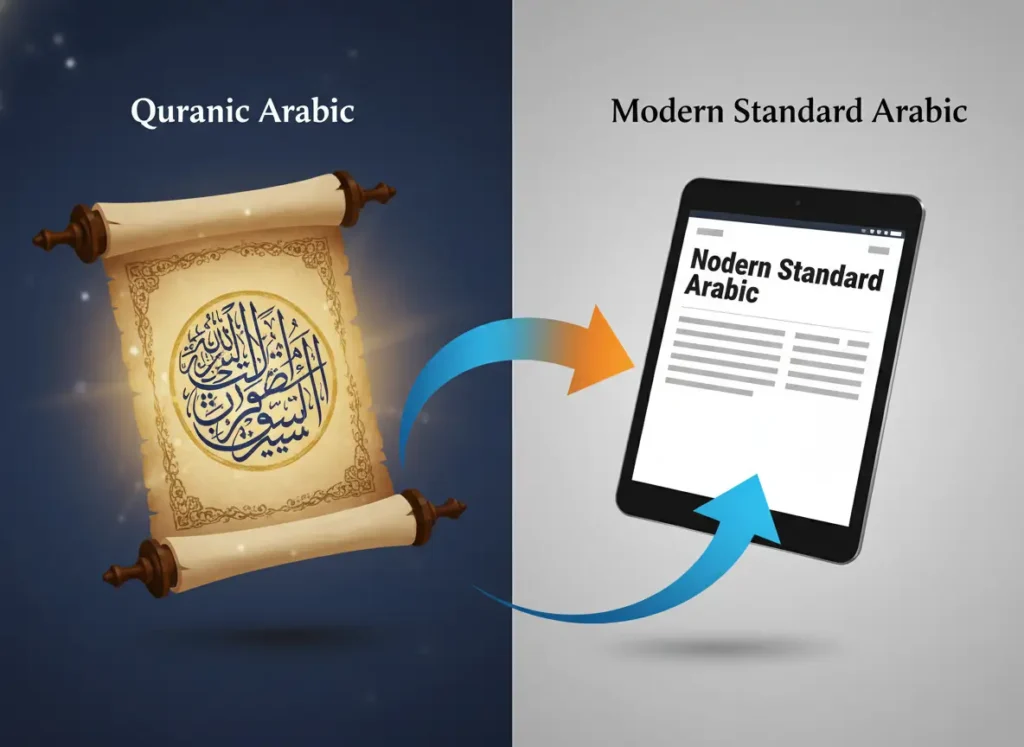
Many beginners ask: “Should I learn MSA or Quranic Arabic?” The answer depends on your goals, but understanding the differences helps you choose wisely.
Modern Standard Arabic (MSA)
What It Is: The formal Arabic used in news, literature, official documents, and formal speech across Arab countries today.
Characteristics:
- Simplified grammar compared to classical Arabic
- Modern vocabulary for contemporary concepts (internet, airplane, democracy)
- Standardized across Arab world
- Nobody’s native language (it’s learned, not acquired naturally)
Uses:
- Reading newspapers (Al Jazeera, Al Arabiya)
- Formal writing and speeches
- Modern Arabic literature
- Academic contexts
Quranic Arabic
What It Is: The classical Arabic of the Quran—pure, unchanged, eloquent 7th-century language.
Characteristics:
- Full classical grammar (including features MSA simplified)
- Vocabulary focused on Quranic themes (faith, guidance, stories, laws)
- Rhetorical devices and literary beauty
- Unchanged for 1,400+ years
Uses:
- Understanding Quran directly
- Accessing classical Islamic texts (Hadith, tafseer, fiqh)
- Deep Islamic scholarship
- Personal spiritual connection
Key Differences That Matter for Beginners
Grammar Complexity:
- MSA: Simpler verb conjugations, fewer grammatical cases
- Quranic Arabic: Full case system, more complex structures
Vocabulary:
- MSA: Includes modern words, simplified classical terms
- Quranic Arabic: Classical vocabulary, Quranic-specific terms
Learning Path:
- MSA: Broader communication, modern contexts
- Quranic Arabic: Focused on Quran understanding
For detailed comparison, see Quranic Arabic vs Modern Standard Arabic.
Which Should You Learn?
Learn Quranic Arabic First If:
- Your primary goal is understanding Quran
- You want spiritual connection over conversational ability
- You’re focused on Islamic knowledge
- You’re willing to learn a specific, targeted form of Arabic
Learn MSA First If:
- You want broader Arabic literacy
- You need Arabic for work or travel
- You want to read modern Arabic content
- You plan to learn dialects eventually
Learn Both Simultaneously If:
- You have time for comprehensive study
- You want complete Arabic mastery
- You’re committed to long-term learning
Strategic Recommendation for Most Muslims: Start with Quranic Arabic if Quran understanding is your priority. MSA knowledge will come naturally as you progress, since MSA derives from classical Arabic.
What You’ll Actually Learn in Quranic Arabic Courses
Quranic Arabic courses for beginners aren’t abstract language classes. They’re practical, focused programs teaching exactly what you need to understand the Quran.
What You’ll Learn: The Four Phases
Phase 1 (Months 1-6): Foundation
- Arabic script mastery (28 letters, vowels, reading)
- Essential vocabulary (100-300 high-frequency words)
- Basic grammar (noun, verb, particle; tenses)
- Milestone: Recognize common words, understand simple ayaat
Phase 2 (Months 7-12): Building
- Expanded vocabulary (300-500 words = 50-60% of Quran)
- Grammar deep dive (subject, predicate, verb conjugations, pronouns)
- Sentence analysis skills
- Milestone: Understanding 50-60% without translation
For comprehensive grammar, visit Quranic Arabic Grammar Explained.
Phase 3 (Months 13-18): Intermediate
- Advanced vocabulary (500-1,000 words = 70-80% of Quran)
- Advanced grammar (grammatical states, conditionals, relatives)
- Morphology (roots, patterns, word derivation)
- Milestone: Understanding 70-80% directly
Phase 4 (Months 19-24+): Advanced
- Comprehensive vocabulary (1,000+ words)
- Complete grammar mastery and rhetoric (Balagha)
- Independent study and teaching ability
- Milestone: Functional Quranic literacy
For structured learning expectations, see Quran Arabic Learning Course: What to Expect.
How to Start Learning Quranic Arabic: Practical Steps

Starting is the hardest part. Here’s your clear roadmap.
Step 1: Assess Your Current Level
Complete Beginner (Can’t Read Arabic): Start with: Arabic alphabet course + Quranic Arabic for absolute beginners
Can Read Arabic (Slowly): Start with: Vocabulary-focused Quranic Arabic + grammar basics
Read Fluently But Don’t Understand: Start with: Intensive Quranic vocabulary + intermediate grammar
Some Understanding Already: Start with: Advanced grammar + morphology + independent study
For personalized guidance, see Beginners’ Guide to Quranic Arabic Course.
Step 2: Choose Your Learning Format
One-on-One Online Classes:
- Best For: Personalized pace, maximum teacher attention
- Cost: $20-40/session typically
- Effectiveness: Highest for most learners
Group Online Classes:
- Best For: Community learning, lower cost
- Cost: $10-20/session typically
- Effectiveness: Good if small groups (5-8 max)
Self-Paced Online Courses:
- Best For: Flexible schedules, self-motivated learners
- Cost: $50-300 one-time or $20-50/month
- Effectiveness: Requires strong discipline
In-Person Classes:
- Best For: Those preferring physical presence
- Cost: Varies widely
- Effectiveness: Depends on teacher quality and class size
For comprehensive online options, explore Expert Guide to Online Quranic Arabic Classes and Best Online Quranic Arabic Course: Top Picks.
Step 3: Commit to Realistic Schedule
Minimum Effective Effort:
- 30 minutes daily (5 days weekly) = 2.5 hours weekly
- 1-2 live teacher sessions weekly
- Timeline: 18-24 months to functional understanding
Optimal Effort:
- 60 minutes daily (6 days weekly) = 6 hours weekly
- 2-3 live teacher sessions weekly
- Timeline: 12-18 months to functional understanding
Intensive Effort:
- 90-120 minutes daily = 10+ hours weekly
- 4-5 live teacher sessions weekly
- Timeline: 8-12 months to functional understanding
Reality Check: Consistency beats intensity. 30 minutes daily for 18 months surpasses 3 hours weekly for same period.
Step 4: Select Quality Resources
Must-Have Resources:
- Structured Quranic Arabic course (online or in-person)
- Word-by-word Quran translation (digital or print)
- Arabic-English dictionary (Quranic-focused)
- Flashcard app (Anki, Quizlet) for vocabulary
- Grammar reference book
For course recommendations, see Best Quranic Arabic Course 2025 and Quranic Arabic Course.
For app comparisons, visit Quranic Arabic Apps Compared.
Step 5: Create Your Study Plan
For expert study planning, see Expert Advice: Quranic Arabic Study Plan.
Daily Structure (60-minute example):
- 20 mins: New vocabulary (10 words daily with Anki)
- 20 mins: Grammar lesson or review
- 20 mins: Practical application (analyze 2-3 ayaat)
Weekly Structure:
- Monday: Vocabulary focus
- Tuesday: Grammar lesson
- Wednesday: Teacher session + homework
- Thursday: Vocabulary + review
- Friday: Surah analysis practice
- Saturday: Teacher session
- Sunday: Weekly review + memorization
Monthly Milestones:
- Month 1: 100 words learned, basic grammar concepts
- Month 3: 300 words, analyzing simple ayaat
- Month 6: 500 words, understanding 50% of short surahs
- Month 12: 800 words, understanding 70% of Quran
- Month 18: 1,200+ words, functional Quranic literacy
Proven Learning Strategies for Quranic Arabic
Generic language learning advice often fails for Quranic Arabic. These strategies work specifically for Quran understanding.
Strategy 1: Vocabulary Through Frequency, Not Alphabetically
The Mistake: Learning words alphabetically (alif to yaa)
Why It Fails: Rare words get equal time as essential ones
The Solution: Focus on high-frequency Quranic vocabulary
The Data:
- Top 100 words = 50% of Quran
- Top 300 words = 65% of Quran
- Top 500 words = 75% of Quran
- Top 1,000 words = 85% of Quran
Your Strategy: Master top 100 first, then 200-500, then 500-1,000. This creates fastest comprehension gains.
For vocabulary guidance, see How to Start Understanding Quranic Vocabulary.
Strategy 2: Grammar Through Quran, Not Textbooks
The Mistake: Learning grammar rules abstractly
Why It Fails: Disconnected from actual Quran usage, hard to retain
The Solution: Learn every grammar rule through Quranic examples
Example: Instead of: “The subject (mubtada) is in the nominative case (raf’).”
Learn through: “اللَّهُ نُورُ السَّمَاوَاتِ وَالْأَرْضِ (Allah is the Light of the heavens and earth) – Allah (اللَّهُ) is mubtada in raf’, noor (نُورُ) is khabar.”
Your Strategy: Every grammar concept must connect immediately to Quranic ayaat you analyze.
Strategy 3: Spaced Repetition for Long-Term Retention
The Challenge: Forgetting words you learned weeks ago
The Solution: Spaced repetition software (Anki, Quizlet)
How It Works:
- Day 1: Learn new word
- Day 2: Review it
- Day 4: Review it
- Day 8: Review it
- Day 16: Review it
- System automatically schedules based on how well you remember
Your Strategy: Add every new Quranic word to Anki. Review daily (15-20 minutes). This builds permanent vocabulary.
Strategy 4: Word-by-Word Quran Analysis
The Method: Take one short surah (Al-Ikhlas, Al-Falaq, An-Nas). Analyze every single word:
- Root letters
- Pattern/form
- Grammatical role
- Meaning in context
- Other Quranic occurrences
Time Investment: 30-60 minutes per short surah
Result: Deep understanding that transfers to other ayaat using same words and patterns
Your Strategy: Complete one surah weekly using this method. In 6 months, you’ll have deeply understood 24+ surahs.
Strategy 5: Listen Before Reading
Before analyzing a surah: (1) Listen to expert recitation 10+ times, (2) Recite along until memorized, (3) Then study meanings. This builds pronunciation, memorization, and authentic transmission.
Strategy 6: Find a Qualified Teacher
Self-study creates permanent errors without correction. Teachers provide real-time feedback, explanation of difficult concepts, motivation, and connection to scholarly tradition. Invest in 1-2 teacher sessions weekly minimum.
For choosing quality courses, see Why Choose a Quranic Arabic Language Course and Quran Arabic Language Course: 6 Tips.
Success Story: Brother Khalid’s Transformation
Background: 35-year-old engineer, born Muslim, always depended on English translations
Commitment: 45 minutes daily (6 days weekly), 2 teacher sessions weekly
Progress:
- Months 1-6: 400 words, basic grammar, understanding 60% of short surahs
- Months 7-12: 700 words, advanced grammar, 70-75% comprehension of most surahs
- Months 13-18: 1,000+ words, complete grammar, 80%+ understanding, started teaching others
His Reflection: “For 35 years, I read translations thinking that was enough. Learning Quranic Arabic showed me I was reading a translation of Allah’s words, not His actual words. Now when I read ‘Ya ayyuhal insaan,’ I don’t think ‘O mankind’—I hear Allah directly. The translation was a shadow. The Arabic is the reality.”
Success Factors: Daily consistency, high-frequency vocabulary focus, qualified Azhari teacher, direct Quran analysis, patience
Frequently Asked Questions
How long does it take to understand Quranic Arabic?
Basic comprehension (50-60% of Quran): 6-12 months with daily practice. Functional understanding (70-80%): 12-18 months. Advanced mastery (90%+ with nuances): 24-36 months. Speed depends on daily time invested, teaching quality, and prior Arabic knowledge.
Do I need to learn Modern Standard Arabic first?
No. If your goal is Quran understanding, start directly with Quranic Arabic. MSA can come later if needed. Quranic Arabic is more targeted and achieves your spiritual goal faster.
I’m 50+. Am I too old to learn Quranic Arabic?
Absolutely not. Many successful Quranic Arabic students are 40-70+. Adults bring motivation, discipline, and life experience that aids learning. You might progress slower than a 20-year-old, but you’ll achieve the same result with patience.
Can I learn Quranic Arabic without a teacher?
Possible but not recommended. Self-study works for vocabulary and basic grammar, but pronunciation errors, grammatical misunderstandings, and incorrect analysis become permanent without expert correction. At minimum, occasional teacher check-ins are essential.
What’s the difference between Quranic Arabic courses and general Arabic courses?
Quranic Arabic courses focus specifically on Quran comprehension: classical grammar, Quranic vocabulary, and ayah analysis. General Arabic courses teach modern conversation, broader vocabulary, and communication skills. Quranic courses are faster for Quran understanding; general courses are broader but slower for that specific goal.
How much should a quality Quranic Arabic course cost?
Online one-on-one: $20-40 per session. Group classes: $10-20 per session. Self-paced courses: $50-300 one-time or $20-50 monthly. Very cheap courses (<$10/session) often indicate undertrained teachers. Very expensive (>$50/session) may be overpriced unless teacher has exceptional credentials.
Why Choose Alphabet Arabic Academy for Quranic Arabic
At Alphabet Arabic Academy, we don’t just teach Arabic grammar—we unlock direct access to Allah’s words.
What Makes Our Quranic Arabic Program Different
✅ Native Egyptian Teachers with Azhari Training Every instructor is Egyptian, trained at Al-Azhar University, with deep classical Arabic expertise and Quranic focus.
✅ Quran-Centered Curriculum Every lesson connects to actual Quranic ayaat. No abstract grammar divorced from Quran text—everything you learn applies immediately to understanding Quran.
✅ High-Frequency Vocabulary Focus We prioritize the 1,000 most common Quranic words systematically, ensuring fastest comprehension gains.
✅ One-on-One Personalized Classes Your pace, your questions, your specific challenges addressed individually. No getting lost in large groups.
✅ Proven Progression System Clear milestones, regular assessments, and visible progress tracking. You always know where you are and where you’re going.
✅ Flexible Scheduling Classes available 7 days a week across all time zones. Learn when it fits your life.
✅ Beyond Grammar: Spiritual Connection We teach Quranic Arabic not just as academic subject but as pathway to intimacy with Allah’s words.
Your Next Steps: Begin Your Quranic Arabic Journey
Every Muslim who understands Quran directly started exactly where you are—at the beginning, feeling overwhelmed, wondering if they could do it.
They did. And so can you.
How to Start Today
Step 1: Commit to Your Goal Write it down: “I will understand Quranic Arabic within [timeline].”
Step 2: Assess Your Level Complete beginner? Can read Arabic? Already understand some?
Step 3: Choose Your Format One-on-one online? Group class? Self-paced + teacher?
Step 4: Book Trial Class Experience the teaching method before committing.
Step 5: Create Your Schedule Minimum 30 minutes daily, 2 teacher sessions weekly.
Step 6: Start Now Not tomorrow. Not next month. Today.
Conclusion: The Quran Is Waiting for You
For 1,400 years, Muslims have recited Quran in Arabic—but how many truly understand what they’re reciting?
The difference between reciting sounds and understanding meanings is the difference between distant observer and intimate participant. Between reading letters and reading light. Between hearing speech and hearing your Creator speak directly to you.
Fatima, from my introduction, now opens Quran daily and understands. When life is difficult, she reads “Inna ma’al usri yusra” and hears Allah promise that ease accompanies hardship—not in translation, but in His own words. When she’s grateful, she recites “Alhamdulillahi Rabbil ‘alameen” knowing exactly what each word means.
This intimacy with Quran is available to you.
Whether you’re 15 or 75, whether you have two hours daily or twenty minutes, whether you’ve never read Arabic or you recite with perfect Tajweed—Quranic Arabic courses designed for beginners can transform your relationship with Allah’s words.
At Alphabet Arabic Academy, we’ve guided hundreds of students from complete beginners to confident Quranic Arabic readers. We’ve watched tears flow when students understand their first ayah directly. We’ve seen spiritual transformations as Quran stops being foreign text and becomes intimate conversation.
👉 Book your free Quranic Arabic consultation with Alphabet Arabic Academy and begin your journey to understanding Allah’s words directly.
The Quran has been waiting for you to understand it your entire life.
Today is the day you start.
إِنَّا أَنزَلْنَاهُ قُرْآنًا عَرَبِيًّا لَّعَلَّكُمْ تَعْقِلُونَ
“Indeed, We have sent it down as an Arabic Quran that you might understand.” [12:2]
Allah made the Quran in Arabic so you would understand.
Now it’s time to actually understand it.
بسم الله – In the name of Allah.
This guide was created to help beginners navigate Quranic Arabic learning with clarity and confidence. Whether starting from zero or building on existing knowledge, structured courses with qualified teachers and consistent practice transform aspiration into Quranic literacy.