

The Arabic alphabet has 28 letters, reads right to left, and most dedicated beginners can recognize all of them within 4 weeks of daily practice. That’s the honest answer. This guide walks you through every single letter — its sound, its shape, how it connects, and exactly how to write it — plus a 6-week practice plan, the most common mistakes beginners make, and a built-in interactive tool where you can hear each letter spoken aloud by clicking a button.
Not sure where you stand right now? Take the free Arabic placement test and find out in 5 minutes.
Before the Letters: What Makes Arabic Script Different
Here’s the mistake almost every beginner makes.
They download an app. They memorize phrases using transliteration — Arabic sounds spelled out in English letters like “marhaba” or “shukran.” And then, around week three, they realize something uncomfortable: they can say the words but they can’t read a single sign, menu, or message.
Transliteration feels helpful. It isn’t. It trains your eye to depend on the Latin alphabet, and it creates a habit that’s genuinely hard to break later.
The Arabic alphabet is where everything begins. Not vocabulary. Not grammar. Not phrases.
Before you learn even one letter, there are five things about Arabic script you need to understand. Know these upfront and you’ll avoid enormous confusion later.
Arabic Is Written Right to Left
This is the first adjustment. It feels strange for about a week, then completely natural. Most learners stop noticing the difference after 10–14 days of consistent reading practice.
Arabic Is Always Cursive
In English, you can print or write in cursive. In Arabic, there’s no such choice — letters always connect within words. This is why each letter has different forms depending on its position: beginning of a word (initial), middle (medial), end (final), or standing alone (isolated).
Sounds complex? It looks that way from the outside. But here’s the key insight that makes it simple: the core identity of each letter — its dots, its main stroke — stays the same in all four positions. What changes are only the connecting strokes at each end.
Once you learn the isolated form of a letter, the other three forms are variations. Not entirely new shapes.
There Are No Capital Letters
Every letter is the same size regardless of position or importance. One less thing to worry about.
Six Letters Are “Non-Connectors”
Six letters never connect to the letter that follows them: Alif (ا), Dal (د), Dhal (ذ), Ra (ر), Zay (ز), and Waw (و). When one of these appears in the middle of a word, there’s a visual break, and the next letter starts fresh. Learn this rule early. It prevents a huge amount of reading confusion.
Short Vowels Are Usually Invisible in Adult Text
In the Quran, children’s books, and language learning materials, small marks called harakat (حَرَكَات) appear above and below letters to indicate vowel sounds. In most adult Arabic text, those marks aren’t written. As a beginner, always start with fully vocalized text. It lets you read accurately instead of guessing.
The 28 Arabic Letters: Complete Pronunciation, Writing, and Examples
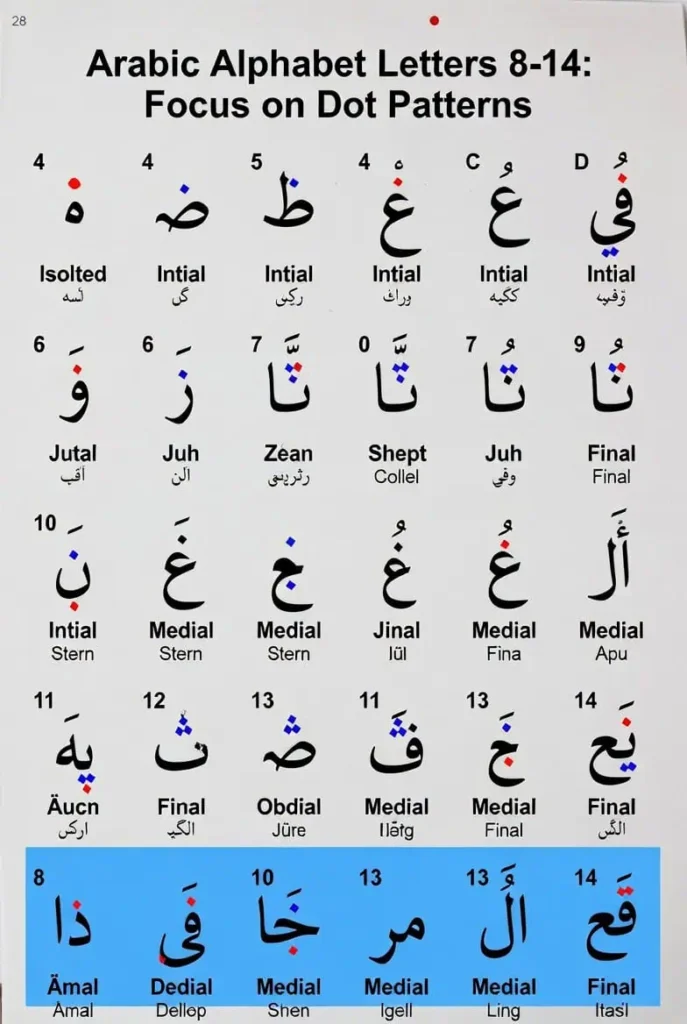
Here is every letter of the Arabic alphabet — in order, with its name, sound, dots, how to write it, word examples, and the four position forms. Work through these 7 letters at a time, one group per week.
Group 1 — Letters 1 to 7: Alif to Kha (أ ب ت ث ج ح خ)
1. Alif — أ / ا
Sound: A vertical line that acts as a support for vowel sounds. On its own, it represents a long “a” as in “father.” With a hamza (أ), it produces a glottal stop sound.
Dots: None.
How to write it: A single vertical stroke, drawn from top to bottom. Simple, clean, unmistakable. In its non-hamza form (ا), it’s just a straight line.
Position forms:
| Isolated | Initial | Medial | Final |
|---|---|---|---|
| ا | أَـ | ـا | ـا |
Non-connector: Yes. Alif never connects to the letter that follows it.
Word example: أَسَد (asad) — lion | أُم (umm) — mother | آب (ab) — father
Key tip: Alif is the most common letter in Arabic. You’ll see it everywhere. The hamza on top (أ) and bottom (إ) changes the vowel sound. The plain alif (ا) at the end or middle of a word is usually a long vowel.
2. Ba — ب
Sound: A soft “b” — identical to English. No surprises here.
Dots: One dot below the letter.
How to write it: A shallow curved bowl shape, open at the top, with one dot below. Start from the right, curve down and sweep left, then add the dot.
Position forms:
| Isolated | Initial | Medial | Final |
|---|---|---|---|
| ب | بـ | ـبـ | ـب |
Word example: بَيت (bayt) — house | باب (bab) — door | كِتاب (kitab) — book
Key tip: Ba, Ta, Tha, Nun, and Ya all share the same basic bowl shape. The only difference between them is the number and position of dots. Master this shape once — it covers five letters.
3. Ta — ت
Sound: A clean “t” sound — like the “t” in “time.”
Dots: Two dots above the letter.
How to write it: Same bowl shape as Ba, but with two dots above instead of one dot below.
Position forms:
| Isolated | Initial | Medial | Final |
|---|---|---|---|
| ت | تـ | ـتـ | ـت |
Word example: تُفّاح (tuffah) — apple | تَمر (tamr) — dates | بَيت (bayt) — house
Key tip: “Two dots above = Ta.” That’s the rule. If you remember Ba (one dot below), then Ta is simply the same shape with two dots moved to the top.
4. Tha — ث
Sound: The “th” in “think” — not the “th” in “the.” It’s unvoiced and breathy.
Dots: Three dots above the letter.
How to write it: Same bowl shape again, this time with three dots above, arranged in a triangle.
Position forms:
| Isolated | Initial | Medial | Final |
|---|---|---|---|
| ث | ثـ | ـثـ | ـث |
Word example: ثَوب (thawb) — garment | ثَلاثة (thalatha) — three | مَثَل (mathal) — example
Key tip: Three dots, think of the word “three” — both start with the same “th” sound. That association is enough to lock this letter in.
5. Jim — ج
Sound: A “j” sound in MSA and most dialects. In Egyptian Arabic — the dialect spoken by Alphabet Arabic Academy’s teachers — this becomes a hard “G” sound. This is why Egyptians say Gamal where others say Jamal.
Dots: One dot below the main curve, inside the hook.
How to write it: A curved hook shape that swoops down and to the left. The dot sits inside the lower hook.
Position forms:
| Isolated | Initial | Medial | Final |
|---|---|---|---|
| ج | جـ | ـجـ | ـج |
Word example: جَمَل (jamal / gamal) — camel | جَميل (jamil) — beautiful | جَواب (jawab) — answer
Key tip: Jim, Ha, and Kha all share the same base shape. The difference is only dots: Jim has one dot inside, Ha has no dots, Kha has one dot above.
6. Ha — ح
Sound: A breathy, deep-throat “H” produced from the pharynx. There’s no English equivalent. This isn’t the “h” in “hello” — it’s heavier, deeper, and comes from the throat. This is one of the sounds that most trips up English speakers.
Dots: None.
How to write it: Same hook shape as Jim, but with no dot anywhere.
Position forms:
| Isolated | Initial | Medial | Final |
|---|---|---|---|
| ح | حـ | ـحـ | ـح |
Word example: حَصان (hisan) — horse | حُب (hubb) — love | حَياة (hayah) — life
Key tip: The sound here is the hard part, not the shape. You need to hear a native speaker demonstrate this and then practice it out loud. Don’t try to self-study this particular sound from text alone. For structured pronunciation guidance from native teachers, one session will save you weeks of bad habits.
7. Kha — خ
Sound: The sound in the Scottish “loch” or German “Bach.” A voiceless fricative from the back of the throat — like clearing your throat gently.
Dots: One dot above the letter.
How to write it: Same hook shape as Jim and Ha, but with one dot above the curve.
Position forms:
| Isolated | Initial | Medial | Final |
|---|---|---|---|
| خ | خـ | ـخـ | ـخ |
Word example: خُبز (khubz) — bread | خَير (khayr) — goodness | أَخ (akh) — brother
Key tip: Jim, Ha, Kha — same shape, three different dot patterns. This is the most elegant feature of Arabic script: one shape, three letters, distinguished only by dots. Once you see it, you can’t unsee it.
Group 2 — Letters 8 to 14: Dal to Sad (د ذ ر ز س ش ص)
8. Dal — د
Sound: A “d” sound. Clean, identical to English.
Dots: None.
How to write it: A small angular shape like a boomerang or a backward “c” with a flat top. Stroked from right to left, curving downward.
Position forms:
| Isolated | Initial | Medial | Final |
|---|---|---|---|
| د | د | ـد | ـد |
Non-connector: Yes. Dal never connects to the letter after it.
Word example: دَرس (dars) — lesson | دار (dar) — house | وَلَد (walad) — boy
9. Dhal — ذ
Sound: The “th” in “the” or “this” — voiced and soft. Different from Tha (ث), which is the unvoiced “th” in “think.”
Dots: One dot above the letter.
How to write it: Same shape as Dal, with one dot added above.
Position forms:
| Isolated | Initial | Medial | Final |
|---|---|---|---|
| ذ | ذ | ـذ | ـذ |
Non-connector: Yes.
Word example: ذَهَب (dhahab) — gold | ذِكر (dhikr) — remembrance | أُذُن (udhun) — ear
Key tip: Dal vs. Dhal: same shape, one dot above = Dhal. The voiced “th” (Dhal, ذ) vs. the unvoiced “th” (Tha, ث) is a distinction English speakers need to practice carefully.
10. Ra — ر
Sound: A rolled “r,” like the “r” in Italian or Spanish. Not the English “r.”
Dots: None.
How to write it: A smooth, elongated curve that hooks downward and to the left, smaller and more flowing than Dal.
Position forms:
| Isolated | Initial | Medial | Final |
|---|---|---|---|
| ر | ر | ـر | ـر |
Non-connector: Yes.
Word example: رَجُل (rajul) — man | رَأس (ra’s) — head | نَهر (nahr) — river
11. Zay — ز
Sound: A “z” sound — identical to English.
Dots: One dot above the letter.
How to write it: Same curved shape as Ra, with one dot above.
Position forms:
| Isolated | Initial | Medial | Final |
|---|---|---|---|
| ز | ز | ـز | ـز |
Non-connector: Yes.
Word example: زَهرة (zahra) — flower | زَيت (zayt) — oil | زَمان (zaman) — time
Key tip: Ra and Zay are identical in shape. One dot above = Zay. No dot = Ra. Clean, simple distinction.
12. Sin — س
Sound: A soft “s” — like the “s” in “see.” Regular, unemphasized.
Dots: None. Three “teeth” bumps along the top.
How to write it: Three serrated bumps along the top, with a curved tail sweeping left at the end. The bumps are the signature feature.
Position forms:
| Isolated | Initial | Medial | Final |
|---|---|---|---|
| س | سـ | ـسـ | ـس |
Word example: سَمَك (samak) — fish | سَماء (sama’) — sky | رَأس (ra’s) — head
Key tip: Sin (س) and Shin (ش) are the same shape. The difference? Shin has three dots above. Sin has none. And both are completely different from Sad (ص), which is an emphatic “s” — heavier, from the back of the mouth.
13. Shin — ش
Sound: An “sh” sound — like “sh” in “shine.”
Dots: Three dots above the three-bump shape.
How to write it: Exactly like Sin, with three dots added above.
Position forms:
| Isolated | Initial | Medial | Final |
|---|---|---|---|
| ش | شـ | ـشـ | ـش |
Word example: شَمس (shams) — sun | شَاي (shay) — tea | شَجَرة (shajara) — tree
14. Sad — ص
Sound: An emphatic “s” — heavier and deeper than Sin. The tongue presses down and the back of the mouth opens slightly. You’ll hear the difference clearly when a native speaker demonstrates it.
Dots: None. A large oval loop with a small tooth and a tail.
How to write it: A large round loop on the right with a small jagged bump on the left side, and a tail extending left.
Position forms:
| Isolated | Initial | Medial | Final |
|---|---|---|---|
| ص | صـ | ـصـ | ـص |
Word example: صَباح (sabah) — morning | صَديق (sadiq) — friend | صَوت (sawt) — voice
Key tip: Sad and Dad share the same base shape. Sad has no dot; Dad has one dot above. These emphatic consonants (Sad, Dad, Ta, Dha) are a group — learn them together and contrast them with their non-emphatic equivalents.
Group 3 — Letters 15 to 21: Dad to Qaf (ض ط ظ ع غ ف ق)
15. Dad — ض
Sound: An emphatic “d” — one of the most iconic sounds in Arabic. The Arabic language was historically called lughat al-Dad (the language of the Dad) because this sound is unique to Arabic among world languages.
Dots: One dot above the Sad shape.
How to write it: The same large oval loop as Sad, with one dot added above it.
Position forms:
| Isolated | Initial | Medial | Final |
|---|---|---|---|
| ض | ضـ | ـضـ | ـض |
Word example: ضَوء (daw’) — light | ضَيف (dayf) — guest | أَرض (ard) — earth/land
16. Ta — ط
Sound: An emphatic “t” — heavier and fuller than the regular Ta (ت). The tongue presses flat and the throat opens.
Dots: None. A distinctive tall loop with a vertical stroke.
How to write it: An oval loop on the bottom with a vertical stroke rising upward from the right side of the oval. One of the most visually distinctive Arabic letters.
Position forms:
| Isolated | Initial | Medial | Final |
|---|---|---|---|
| ط | طـ | ـطـ | ـط |
Word example: طائِرة (ta’ira) — airplane | طَعام (ta’am) — food | طالِب (talib) — student
17. Dha — ظ
Sound: An emphatic version of the Dhal (ذ) sound. A voiced, emphatic interdental sound that sits between “z” and “th” in most pronunciations.
Dots: One dot above the Ta shape.
How to write it: The same tall oval + vertical stroke as Ta, with one dot above.
Position forms:
| Isolated | Initial | Medial | Final |
|---|---|---|---|
| ظ | ظـ | ـظـ | ـظ |
Word example: ظِل (dhil) — shadow | ظَهر (dhahar) — back/noon | نَظَر (nadhar) — sight
18. Ayn — ع
Sound: One of the most important — and most challenging — sounds in Arabic. It’s a voiced pharyngeal fricative: your throat constricts and you produce a voiced vowel-like sound from deep in the pharynx. Some describe it as a “squeezed vowel.” Others say it sounds like a strangled vowel.
Dots: None. A shape like an angular “c” or a partial eye.
How to write it: An angular, open loop that’s wider on the left, with a tail curving down. The shape changes significantly across its four positions.
Position forms:
| Isolated | Initial | Medial | Final |
|---|---|---|---|
| ع | عـ | ـعـ | ـع |
Word example: عَيْن (ayn) — eye | عَرَبي (arabi) — Arabic | عِلم (ilm) — knowledge
Key tip: You cannot learn Ayn correctly from text. You need to hear it demonstrated and then practice producing it yourself with feedback. This is one of the clearest cases where a native teacher is worth every minute. Once you get it right, it becomes natural.
19. Ghayn — غ
Sound: A gargling sound from the back of the throat — similar to the French “r” in Paris or garçon. It’s the voiced equivalent of Kha.
Dots: One dot above the Ayn shape.
How to write it: Same shape as Ayn, with one dot above.
Position forms:
| Isolated | Initial | Medial | Final |
|---|---|---|---|
| غ | غـ | ـغـ | ـغ |
Word example: غَيم (ghaym) — cloud | غُرفة (ghurfa) — room | بَلَغ (balagh) — reached
Key tip: Ayn and Ghayn are the same shape. One dot = Ghayn. Zero dots = Ayn. Just like the Jim/Ha/Kha family.
20. Fa — ف
Sound: An “f” sound — identical to English.
Dots: One dot above a circular loop with a tail.
How to write it: A rounded head (like a circle) with a tooth in front and a tail extending left. One dot sits above the circle.
Position forms:
| Isolated | Initial | Medial | Final |
|---|---|---|---|
| ف | فـ | ـفـ | ـف |
Word example: فَرَح (farah) — joy | فَم (fam) — mouth | كَيف (kayf) — how
21. Qaf — ق
Sound: A deep “q” produced at the very back of the throat — deeper than English “k.” Think of it as a “k” made as far back in your mouth as possible, almost at the uvula.
Dots: Two dots above the rounded shape.
How to write it: Similar to Fa but with a deeper, more closed circle and two dots above. The tail drops below the baseline.
Position forms:
| Isolated | Initial | Medial | Final |
|---|---|---|---|
| ق | قـ | ـقـ | ـق |
Word example: قَلب (qalb) — heart | قَمَر (qamar) — moon | حَقيقة (haqiqa) — truth
Key tip: In Egyptian Arabic and Gulf Arabic, Qaf is often pronounced differently — as a glottal stop in Egyptian (قَلب → ‘alb) and as a hard “G” in Gulf. These are regional variations, not errors.
Group 4 — Letters 22 to 28: Kaf to Ya (ك ل م ن ه و ي)
22. Kaf — ك
Sound: A “k” sound — similar to English “k.” Produced a bit closer to the front of the mouth than Qaf.
Dots: None, but has a distinctive diagonal stroke or small “tick” inside the shape.
How to write it: A tall, angular shape with a diagonal mark inside. One of the letters whose shape changes most dramatically between its isolated and connected forms.
Position forms:
| Isolated | Initial | Medial | Final |
|---|---|---|---|
| ك | كـ | ـكـ | ـك |
Word example: كِتاب (kitab) — book | كَلام (kalam) — speech | بَنك (bank) — bank
23. Lam — ل
Sound: An “l” sound — identical to English. Consistent regardless of position (no “dark l” like in English “all”).
Dots: None.
How to write it: A vertical stroke that hooks left at the bottom, like an angled fishhook. Clean and consistent.
Position forms:
| Isolated | Initial | Medial | Final |
|---|---|---|---|
| ل | لـ | ـلـ | ـل |
Word example: لَيل (layl) — night | لُغة (lugha) — language | جَمَل (jamal) — camel
Key tip: Lam-Alif (لا) is a special ligature — when Lam is followed immediately by Alif, they merge into a single combined shape (لا). You’ll see it constantly. Recognize it as one unit.
24. Mim — م
Sound: An “m” sound — identical to English.
Dots: None. A small closed circle with a tail.
How to write it: A small round loop, like a closed circle or a spiral, with a tail that extends left. The most circular letter in Arabic.
Position forms:
| Isolated | Initial | Medial | Final |
|---|---|---|---|
| م | مـ | ـمـ | ـم |
Word example: مَاء (ma’) — water | مَدرسة (madrasa) — school | قَلَم (qalam) — pen
25. Nun — ن
Sound: An “n” sound — identical to English.
Dots: One dot above the curved bowl shape.
How to write it: A bowl shape similar to Ba/Ta/Tha, but Nun’s bowl is smaller and sits slightly higher. One dot above.
Position forms:
| Isolated | Initial | Medial | Final |
|---|---|---|---|
| ن | نـ | ـنـ | ـن |
Word example: نَهر (nahr) — river | نَور (nur) — light | إِنسان (insan) — human
Key tip: Nun in its isolated and final forms looks like a bowl with one dot above. In its initial and medial forms, it looks very similar to Ba and Ta. The dot above distinguishes it in all forms.
26. Ha — ه
Sound: A regular “h” — like the “h” in “hello.” Completely different from the earlier Ha (ح), which is the deep pharyngeal “h.” These two letters look different, sound different, and come from different places in the throat. Beginners mix them up constantly.
Dots: None. A rounded, open shape like a small figure-eight or connected circles.
How to write it: The shape changes significantly across positions — from a rounded figure-eight in isolation, to a simpler shape connected to other letters.
Position forms:
| Isolated | Initial | Medial | Final |
|---|---|---|---|
| ه | هـ | ـهـ | ـه |
Word example: هاتِف (hatif) — phone | هَواء (hawa’) — air | وَجه (wajh) — face
27. Waw — و
Sound: A “w” sound, like in “water.” Also serves as the long vowel “uu” as in “moon” (وُ).
Dots: None. A round head with a downward tail.
How to write it: A round loop at the top with a curved tail dropping below the baseline — like a tadpole or a comma with a round top.
Position forms:
| Isolated | Initial | Medial | Final |
|---|---|---|---|
| و | و | ـو | ـو |
Non-connector: Yes.
Word example: وَرد (ward) — roses | وَلَد (walad) — boy | نُور (nur) — light
28. Ya — ي
Sound: A “y” sound as in “yes.” Also serves as the long vowel “ii” as in “see” (يِ).
Dots: Two dots below in its isolated and final forms. No dots in initial and medial forms.
How to write it: In isolation and at the end of words, a sweeping curved shape with two dots below. In the initial and medial positions, it looks similar to Ba/Ta but the tail curves differently.
Position forms:
| Isolated | Initial | Medial | Final |
|---|---|---|---|
| ي | يـ | ـيـ | ـي |
Word example: يَد (yad) — hand | يَوم (yawm) — day | عَيْن (ayn) — eye
Interactive Arabic alphabet guide — click any letter to hear its name and sound
The Arabic Vowel System: Short, Long, and Everything Between
Arabic vowels work differently from English, and understanding the system early makes reading click much faster. There are three layers to know.
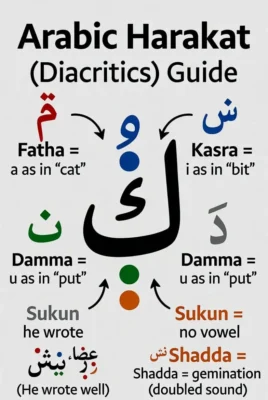
Short Vowels (حَرَكَات — Harakat)
Short vowels are written as tiny marks above or below letters. They don’t appear in most adult Arabic text — but in learning materials, the Quran, and children’s books, they’re always there. Start with these.
Fatha (فَتحة) ـَ — A small diagonal line above the letter. Produces a short “a” sound as in “cat” or “hat.” Example: بَيت (bayt) — house. The fatha above Ba gives the “a” sound.
Damma (ضَمّة) ـُ — A small loop above the letter. Produces a short “u” sound as in “put” or “book.” Example: كُتُب (kutub) — books. The damma makes the “u” sound.
Kasra (كَسرة) ـِ — A small diagonal line below the letter. Produces a short “i” sound as in “bit” or “sit.” Example: بِنت (bint) — girl. The kasra below Ba makes the “i” sound.
Sukun (سُكون) ـْ — A small circle above the letter. Means this consonant carries NO vowel sound. The consonant is “closed.” Example: بَيْت — the Ya has a sukun, meaning it’s pronounced as part of a diphthong.
Shadda (شَدّة) ـّ — A small “w” shape above the letter. Means the consonant is doubled — pronounced twice in quick succession. Example: مُحَمَّد — the doubled Mim gives the “mm” sound.
Long Vowels
Long vowels use three letters:
- Alif (ا) → long “a” as in “father” — فَاتَح (fatah)
- Waw (و) → long “u” as in “moon” — نُور (nur)
- Ya (ي) → long “i” as in “see” — كَبِير (kabir)
The combination of a short vowel + its matching long vowel letter creates the lengthened sound. Fatha + Alif = long “aa.” Damma + Waw = long “uu.” Kasra + Ya = long “ii.”
Tanwin (تنوين — Nunation)
A doubling of the vowel mark that adds an “-n” sound at the end of a word. Common in indefinite nouns.
- Double fatha (ـً) = “-an” sound: كِتاباً (kitaban)
- Double damma (ـٌ) = “-un” sound: كِتابٌ (kitabun)
- Double kasra (ـٍ) = “-in” sound: كِتابٍ (kitabin)
One important rule: In most adult Arabic text, short vowels aren’t written. You infer them from grammatical knowledge and context. Always practice with fully vocalized text first. It’s the only way to read accurately as a beginner.
6 Tips to Learn the Arabic Alphabet for Beginners Faster
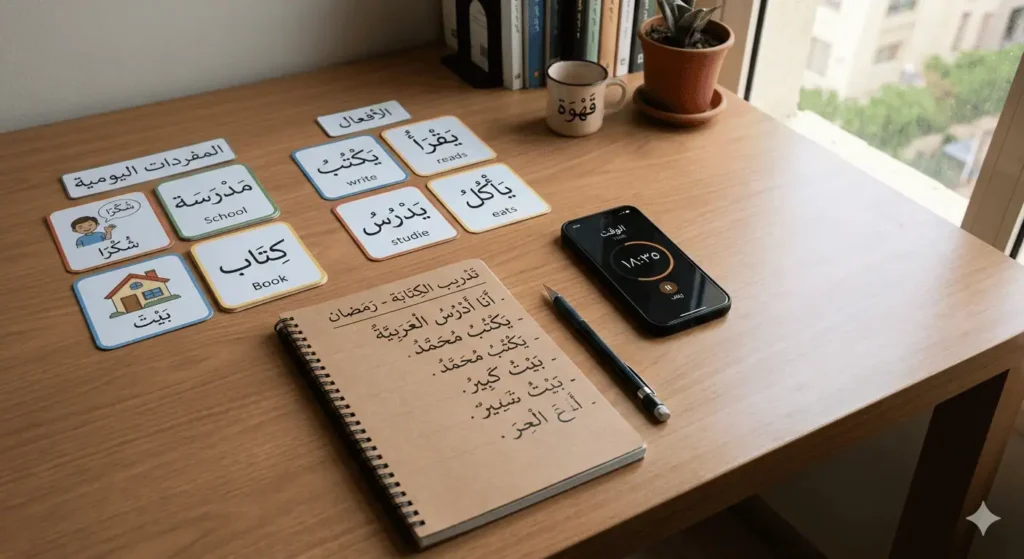
Most people overcomplicate this. Here’s what actually accelerates learning.
Tip 1: Learn in Groups of 7 — Never All 28 at Once
Twenty-eight letters at once is overwhelming. Seven letters per week is completely manageable. Four weeks and you know the full alphabet. That’s a real, achievable pace that most learners can maintain without burning out.
Tip 2: Write by Hand — Every Single Day
There’s something the brain does when the hand moves. Writing by hand — feeling the stroke direction, forming the curves and dots — builds muscle memory that typing never replicates. Even 10 minutes of handwriting daily beats an hour of passive reading.
Tip 3: Use Image Flashcards — Not Just Letter Names
Ba with a picture of a بَيت (house). Alif with أَسَد (lion). Visual association sticks faster than abstract memorization. Make your own — the act of creating the flashcard is itself practice.
Tip 4: Say Every Sound Out Loud — Not Just in Your Head
Arabic has sounds that don’t exist in English. The only way to learn them is to produce them out loud, get feedback, and adjust. Silent study won’t work for Ayn, Ghayn, Ha (ح), Qaf, or the emphatic consonants. Say them every time, without exception.
Tip 5: Read Real Words by Week 2 — Don’t Wait
This is the tip most beginners skip for too long. As soon as you know 7–10 letters, start reading simple words that use only those letters. Reading كِتاب (book) or بَيت (house) in connected script teaches letter forms, reading direction, and word recognition simultaneously. Don’t wait until you “know all 28.”
Tip 6: 20 Minutes Daily Beats 2 Hours Once a Week
Every time. The spacing effect is real. Your brain consolidates letters better when it returns to them regularly. A 20-minute daily habit will outperform a two-hour weekend session every single week. Consistency over intensity.
The Sounds That Require Extra Attention
Not all 28 letters are equally challenging for English speakers. Knowing which ones need extra focus helps you direct your effort intelligently.
The Emphatic Consonants: Sad, Dad, Ta, Dha (ص ض ط ظ)
These are heavier, more “backed” versions of sounds English has. The tongue flattens and the back of the mouth opens. Hard to describe in writing. Immediately clear when demonstrated by a native speaker.
The good news: once you hear the difference between سَلام (salam) and صَلاة (salat), you’ll never confuse them again.
The Throat Sounds: Ha, Kha, Ayn, Ghayn, Qaf (ح خ ع غ ق)
These five have no English equivalents. They require specific positions of the throat and vocal cords.
- Ha (ح) — breathy pharyngeal h
- Kha (خ) — Scottish “loch” sound
- Ayn (ع) — voiced pharyngeal constriction
- Ghayn (غ) — voiced gargle, French “r”
- Qaf (ق) — uvular “k,” deep in the throat
All are learnable. None are dangerous. But they genuinely require live feedback.
The Two Ha Letters: ه vs. ح
Regular Ha (ه) sounds like “h” in “hello.” Deep Ha (ح) is the pharyngeal one. They look completely different. They sound completely different. Beginners mix them up in reading and speaking for months if not corrected early.
Honest advice: Don’t self-study these sounds exclusively from text. One session with a qualified teacher who can hear you and correct you in real time will fix weeks of developing bad habits.
A 6-Week Daily Practice Routine
Total daily time: 20–30 minutes. No more. Consistency is everything.
Week 1 — Letters 1–7 (Alif to Kha) Learn each letter’s name, isolated form, sound with all three short vowels, and stroke order. Write each letter 10 times. Say them out loud as you write. End each session by reading back what you’ve written.
Week 2 — Letters 8–14 (Dal to Sad) Add the new letters. Start combining everything you know into simple two- and three-letter words. Focus hard on the non-connector rule — Dal, Dhal, Ra, and Zay never connect to the letter after them.
Week 3 — Letters 15–21 (Dad to Qaf) Continue building words. Begin tracing simple words from a vocalized text. Practice recognizing letters in their connected forms — not just isolated. The shape shifts matter.
Week 4 — Letters 22–28 (Kaf to Ya) By the end of this week, identify all 28 letters in isolation and in simple words. Start reading three- and four-letter words from fully vocalized text without writing first.
Weeks 5–6 — Reading Simple Sentences Focus on recognition speed. The goal is to stop sounding out each letter individually and start recognizing common letter combinations as units. Practice writing sentences from dictation.
After six weeks, you’ll read simple Arabic text slowly and accurately. You won’t be fast yet. But you’ll have the foundation that makes everything after this dramatically easier.
Teaching Children the Arabic Alphabet: What Actually Works
Children between three and seven learn the Arabic alphabet differently from adults. And that difference matters a lot.
Young children learn through play, repetition, and sensory engagement — not through explanation. A five-year-old who traces Ba with her finger while saying its name builds muscle memory. A child who hears the Arabic alphabet song every morning absorbs the letter sequence without effort.
What works for children:
Songs. The Arabic alphabet song works on the same psychological principle as the English ABC song — the melody creates a retrieval structure that makes the letter sequence stick.
Tracing worksheets. Printable tracing exercises develop fine motor control alongside letter recognition. Two skills for the cost of one.
Image flashcards. Bright cards pairing each letter with a vivid image build visual recognition that’s durable and quick.
Short stories. Arabic children’s books with large, clearly vocalized text make reading feel like part of storytelling — not a separate academic activity.
Apps. Several Arabic alphabet apps for children use games, animation, and sound to make letter practice feel like play. Noorani Qaida apps are particularly effective for children who’ll also learn Quranic Arabic.
The single most important thing for parents:
Consistency beats intensity. Ten minutes daily beats one hour weekly. Every time. If Arabic is present in your child’s environment every day — songs in the car, a flashcard at breakfast, a short story before bed — it stops feeling like a subject. It becomes part of life.
Our Arabic for Kids program at Alphabet Arabic Academy serves learners from age four, with teachers who specialize in working with young learners. Sessions are 30–60 minutes, built around exactly these methods.
Common Mistakes Beginners Make
Mistake 1: Relying on Transliteration
Writing “marhaba” instead of مَرحبا feels helpful. It isn’t. Transliteration trains your eye to depend on English letters, and it delays actual reading ability by weeks, sometimes months. Drop it as early as possible — ideally, from day one.
Mistake 2: Only Memorizing Letters in Isolation
Drilling Alif, Ba, Ta in their isolated forms and then struggling to recognize them inside connected words is incredibly common. Start reading connected text by week two. That’s when letter forms actually become readable in the real world.
Mistake 3: Skipping Pronunciation Practice Entirely
Silent study of the Arabic alphabet doesn’t build pronunciation. In Arabic, mispronounced letters create compounding problems — wrong sounds in vocabulary, wrong recitation of Quran, confusion in conversation. Get feedback on sounds early. It’s much easier to fix at week two than at month six.
Mistake 4: Inconsistent Practice
Three days of intense study, then a week of nothing. It doesn’t work for language learning. The brain needs consistent, spaced exposure. Twenty minutes daily — even on your tired days — will outperform any irregular approach.
Mistake 5: Waiting Until All 28 Letters Are Learned Before Reading
You don’t need to finish the alphabet to start reading. As soon as you know 7–10 letters, start sounding out simple words that use only those letters. This dramatically speeds up letter recognition and keeps motivation high when it might otherwise flag.
Who Is This Guide For?
This is for you if:
- You’re a complete beginner who’s never studied Arabic script
- You’ve tried apps or YouTube and felt stuck without clear structure
- You’re a parent looking for the right approach to teach your child Arabic
- You’re preparing to learn the Quran and need a solid alphabet foundation
- You’ve tried before and hit a wall — this guide is built for exactly that
This is NOT for you if:
- You already read Arabic fluently and want grammar or advanced vocabulary
- Your only goal is spoken dialect with no interest in reading at all (though even then, the alphabet helps enormously)
Frequently Asked Questions
Q1: How long does it take to learn the Arabic alphabet?
Most dedicated learners recognize and write all 28 letters in 2–3 weeks of daily practice. Reading connected Arabic text accurately — including position-based forms — takes 4–6 weeks. Reading comfortably and automatically takes several months of regular practice after that. The timeline depends almost entirely on consistency, not on talent.
Q2: Is the Arabic alphabet the same as the Quranic alphabet?
Yes. The same 28 letters are used in all varieties of Arabic — Modern Standard Arabic, dialects, and the Quran. Quranic text is always fully vocalized with harakat, which actually makes it easier to read once you know the letter forms. Tajweed — the rules governing Quranic recitation — adds phonological precision on top.
Q3: Should I learn MSA or Egyptian Arabic alongside the alphabet?
The alphabet is the same for all varieties. What differs between MSA and dialects is vocabulary, grammar, and some pronunciation — not the script. Learn one alphabet, use it for everything. If conversation is your goal, Egyptian Arabic is one of the most practical starting points — it’s the most widely understood dialect across the Arab world. Read our comparison: Arabic Alphabet Beginner’s Guide to Mastering Arabic.
Q4: Do I need a teacher to learn the alphabet, or can I self-study?
Many learners successfully self-study the basic letter shapes using books, apps, and YouTube. The specific benefit a teacher adds at this stage is pronunciation correction — especially for the challenging throat sounds and emphatic consonants. If you plan to learn Arabic seriously, getting pronunciation right from the beginning is worth every penny. Check our course plans and pricing — lessons start from $60/month with all materials included.
Q5: What age is best to start learning the Arabic alphabet?
Children can begin around age three to five through songs, games, and tracing. Formal reading instruction typically starts between five and seven, when children have the fine motor control for writing and the cognitive readiness for phonics. Adults learn the alphabet equally well — the approach is different, but the outcome is the same.
Q6: What’s the easiest way to remember which dots go where?
Group the letters by shape family and note the dot pattern:
- Ba/Ta/Tha/Nun/Ya — same bowl shape; 1 below = Ba, 2 above = Ta, 3 above = Tha, 1 above = Nun, 2 below = Ya
- Jim/Ha/Kha — same hook; 1 dot inside = Jim, 0 dots = Ha, 1 dot above = Kha
- Dal/Dhal — same shape; 0 dots = Dal, 1 above = Dhal
- Ra/Zay — same curve; 0 dots = Ra, 1 above = Zay
- Sin/Shin — same bumps; 0 dots = Sin, 3 above = Shin
- Sad/Dad — same oval; 0 dots = Sad, 1 above = Dad
Q7: Can I learn the Arabic alphabet entirely online?
Yes, completely. Online instruction has a real advantage at the alphabet stage: a native teacher can hear your pronunciation, correct mistakes in real time, and pace lessons to your actual progress. It’s more effective than self-study for most learners. Take the free Arabic placement test to find the right starting point for you.
Conclusion: The First Letter Is the Hardest
The Arabic alphabet isn’t a barrier between you and the language. It’s the door.
Every Arabic word you’ll ever read, write, or understand passes through these 28 letters. Every Quranic verse. Every headline. Every conversation you’ll eventually follow. Every street sign you’ll recognize. It all starts right here.
And here’s the truth: it’s not as hard as it looks from the outside. Twenty-eight letters. A logical system. Four to six weeks of daily practice. That’s the deal.
The first letter really is the hardest. After that, each one gets easier. And by week three or four, something shifts — the shapes stop looking like random squiggles and start looking like letters. That moment is worth every minute you put in before it.
Not sure where you are right now? Take the free Arabic placement test and find out exactly where to begin — whether you’re starting from absolute zero or you already know some basics.
At Alphabet Arabic Academy, our Arabic alphabet program — for children and adults — is taught live by native Egyptian Arabic speakers who are graduates of Al-Azhar University. We’ve worked with students from over 80 countries, hold a 4.9/5 rating on Trustpilot, and our teachers know exactly how to guide you through this stage — patiently, clearly, and at your pace.
The first letter is waiting.