
Introduction: When the Magic Teacher Arrived
Fun Arabic Lessons for Children best real story : Seven-year-old Omar dreaded Arabic lessons. Every Saturday, he sat through 45 minutes of tedious drills: repeating letters, copying words, memorizing vocabulary lists. His teacher was qualified and well-meaning, but the lessons were… boring.
Omar fidgeted. He watched the clock. He complained of stomachaches before class. “Do I have to go?” became his weekly refrain.
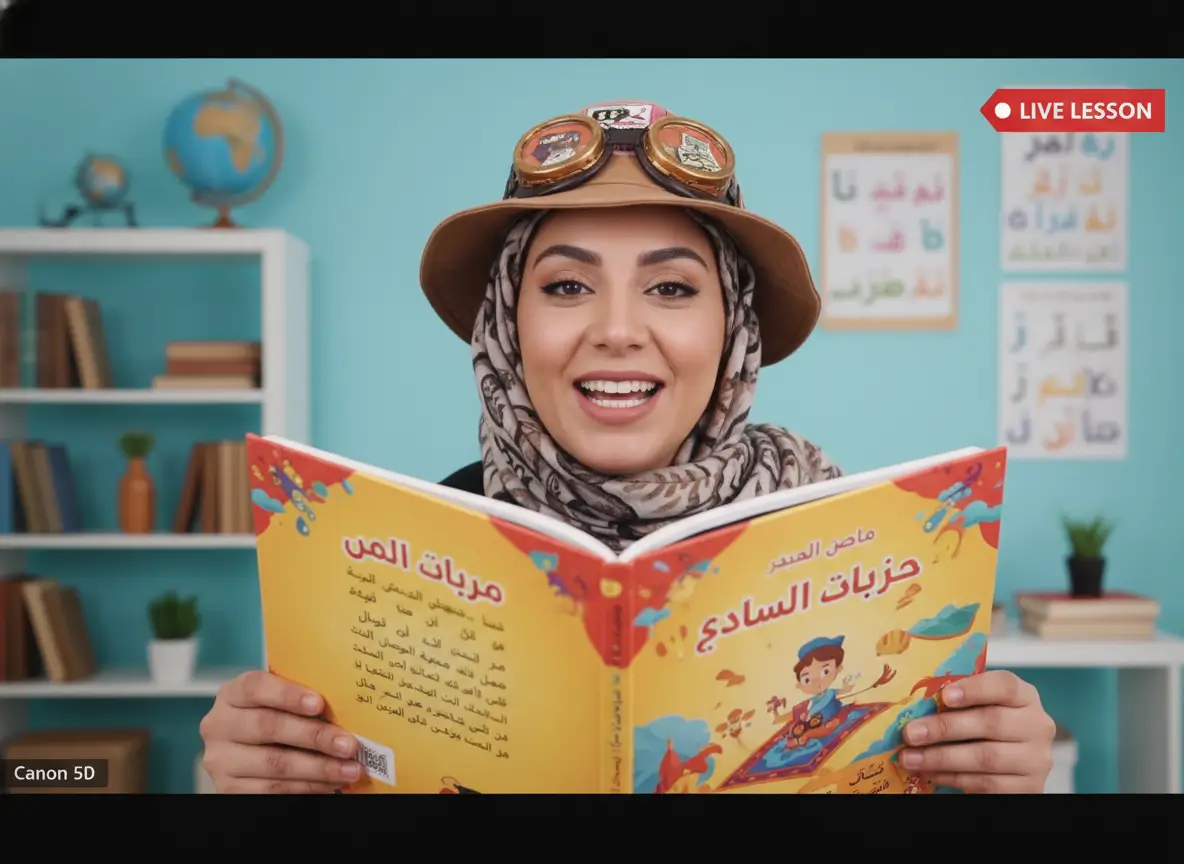
Then his family switched to Teacher Salma.
The first lesson, Omar came home animated. “Mama! We went on a treasure hunt! We had to find Arabic letters hidden around the room! And then we became pirates speaking only Arabic to find the treasure!”
His mother was skeptical. “But… did you learn anything?”
Omar proceeded to recite 15 new Arabic words—perfectly pronounced—that he’d learned during the “treasure hunt.” Words he’d practiced dozens of times before with his old teacher but never retained.
That was six months ago. Now Omar asks, “When is my next Arabic lesson?” He practices Arabic voluntarily. He makes up Arabic games with his siblings. The language he once resisted has become something he genuinely enjoys.
What changed? Not the content. Not Omar’s brain. Just the teaching approach.
Teacher Salma understood a fundamental truth about children’s learning: fun isn’t frivolous. Fun is essential. When lessons are engaging, creative, and joyful, children’s brains enter optimal learning states. Attention sharpens. Memory strengthens. Motivation soars.
This comprehensive guide reveals the research-backed principles and practical techniques that transform ordinary Arabic lessons into adventures children love—while achieving better learning outcomes than traditional drill-based instruction.
Why Fun Matters: The Neuroscience of Joyful Learning
Many educators mistakenly believe fun and learning are opposites—that serious learning requires serious, joyless instruction. Neuroscience proves otherwise.
How Joy Enhances Learning
Dopamine and Memory Formation: When children experience joy during learning, their brains release dopamine—a neurotransmitter crucial for memory formation and motivation (Schultz, 2007). This biochemical process means:
- Information learned joyfully is encoded more deeply
- Positive associations with Arabic strengthen motivation
- Children voluntarily seek more learning experiences
The Opposite Effect: Boring, stressful lessons trigger cortisol release—inhibiting memory formation and creating negative associations with Arabic that persist for years.
Engagement and Attention
The Challenge: Children’s attention spans are limited: 5-10 minutes for ages 5-7, 10-20 minutes for ages 8-10, 20-30 minutes for ages 11-12 (Pashler et al., 2007).
Traditional Boring Lessons: Teacher lectures → Child’s attention wanders → Misses information → Falls behind → Becomes more bored
Engaging Fun Lessons: Teacher creates compelling activity → Child stays focused → Absorbs information → Succeeds → Wants more
Motivation and Persistence
Intrinsic vs. Extrinsic Motivation: Fun lessons build intrinsic motivation—wanting to learn Arabic for its own sake. Boring lessons require extrinsic motivation—rewards, punishments, parental pressure (Deci & Ryan, 2000).
Long-Term Impact: Intrinsically motivated children continue learning independently. Extrinsically motivated children quit when external pressure ends.
The Research Verdict
Studies consistently show that students learning through engaging, playful methods outperform those receiving traditional instruction—not just in enjoyment but in actual achievement (Ginsburg, 2007; Hirsh-Pasek et al., 2009).
Fun isn’t opposed to learning. Fun IS effective learning.
What Makes an Arabic Lesson Genuinely Fun?
Not all attempts at “fun” succeed. Some teachers add superficial elements (stickers, cartoon characters) without changing underlying boring instruction. Genuine fun requires transformation of the lesson itself.
Boring Lesson Characteristics
Passive Reception: Teacher talks. Children sit and listen (or pretend to listen). No interaction, no participation, no agency.
Meaningless Repetition: “Repeat after me: ب، ب، ب” 20 times with no context, no story, no reason except “because I said so.”
Disconnected from Children’s Lives: Vocabulary and examples irrelevant to children’s experiences, interests, or worlds.
Predictable and Monotonous: Same structure every lesson. Children know exactly what’s coming. No surprise, no curiosity, no excitement.
No Choice or Creativity: Children follow instructions. No opportunities for imagination, problem-solving, or creative expression.
Fun Lesson Characteristics
Active Participation: Children DO things: move, create, solve problems, make choices. They’re participants, not passive receivers.
Story and Context: Every element embedded in narrative. “We’re not just learning ب. We’re helping Baba Bear find his lost باب (door) in the forest!”
Connected to Children’s Interests: Lessons incorporate what children love: animals, adventures, magic, dinosaurs, space, princesses, superheroes.
Surprise and Variety: Each lesson brings something unexpected. Children arrive curious: “What will we do today?”
Creative Expression: Children use Arabic creatively: telling stories, creating dialogues, solving puzzles, making up songs.
Success and Confidence: Activities designed so all children experience success. Winning feels achievable. Effort is celebrated.
Storytelling: The Ancient Art That Makes Lessons Magical
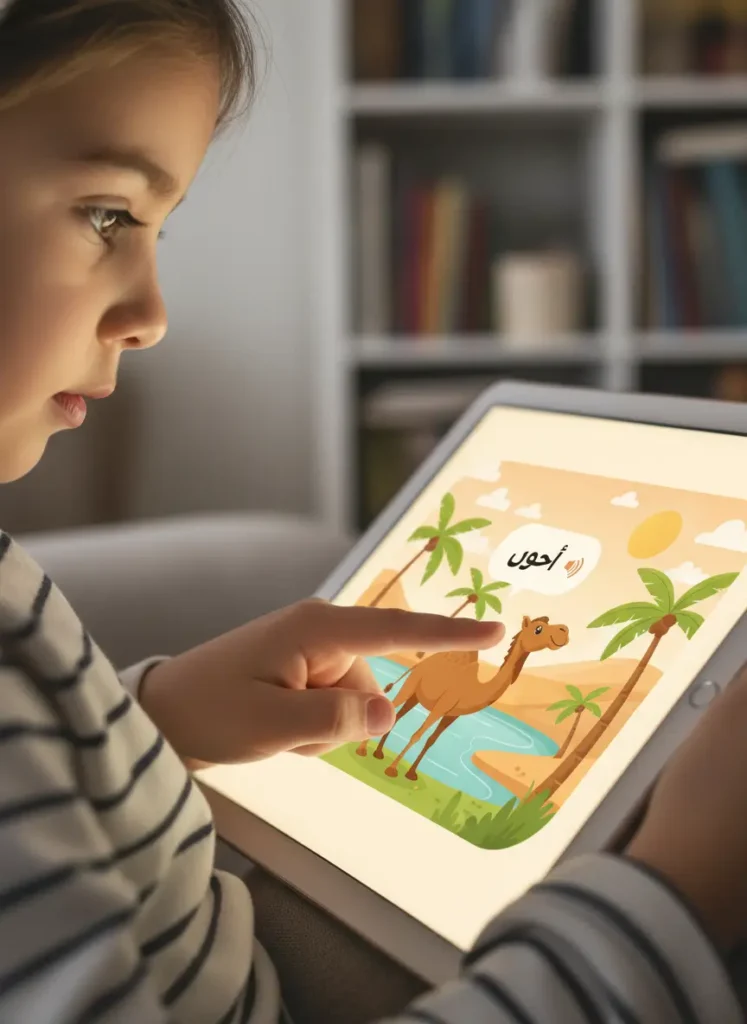
Human brains are wired for stories. For thousands of years before formal education existed, cultures transmitted knowledge through narrative. This ancient method remains the most powerful teaching tool available.
How Teachers Use Stories in Lessons
Not: “Let’s read a story after learning” But: “Let’s learn THROUGH stories”
Example 1: Teaching Arabic Letters Through Character Stories
Boring Approach: “This is ب. It makes ‘buh’ sound. Repeat: ب، ب، ب. Write it 10 times.”
Story Approach: “Meet Baba Bear! He’s looking for his باب (door) because he wants to go to bed. Can you help him? First, we need to learn his special letter—ب! It looks like a little bed with one pillow underneath. Say ‘Baba Bear’s ب!’ Now let’s follow Baba Bear through the forest making the ب sound as we search for his door…”
What Happened: Same letter. Same sound. But one approach is forgettable drill. The other is an adventure children remember.
Example 2: Teaching Vocabulary Through Ongoing Narratives
Boring Approach: “Today’s vocabulary: كتاب (book), قلم (pen), حقيبة (bag). Memorize these.”
Story Approach: “Remember Layla, the girl who discovered the magic school in our last lesson? Today she’s packing her حقيبة (bag) for her first day. What does she need? A magic كتاب (book) that glows! And a special قلم (pen) that writes in golden ink! Let’s help her pack while learning these words in Arabic…”
What Happened: Vocabulary becomes part of narrative children care about. They remember words because they’re embedded in meaningful story.
Age-Appropriate Storytelling
Ages 3-5: Simple characters (animals, family members). Clear plots. Repetitive phrases children can join in saying. Physical props (puppets, pictures).
Ages 6-8: Adventure stories. Problem-solving plots where children’s Arabic skills help characters succeed. Beginning chapter stories spanning multiple lessons.
Ages 9-12: Complex narratives. Mystery or quest stories where each lesson reveals new information. Stories incorporating historical or cultural elements.
For creative storytelling resources, explore Magical Worlds in Arabic Stories.
Songs and Rhymes: Making Arabic Melodic and Memorable
Music activates multiple brain regions simultaneously—enhancing memory, engagement, and joy. Children who learn language through song retain vocabulary 40% better than those using traditional methods (Ludke et al., 2014).
How Teachers Integrate Songs Into Lessons
Not: “Let’s sing a song as a break from learning” But: “Let’s LEARN through singing”
Example 1: Alphabet Through Song
Boring Approach: Reciting alphabet from ا to ي mechanically.
Musical Approach: Teaching alphabet through catchy melody where each letter has distinctive tune and movement. Children sing while acting out letters with their bodies.
Result: Children remember entire alphabet sequence effortlessly and enjoy practicing independently.
Example 2: Grammar Through Rhythmic Chants
Boring Approach: “Masculine nouns use هذا. Feminine nouns use هذه. Memorize this rule.”
Rhythmic Approach: Creating chant with clapping pattern: “هذا for boys (clap-clap) هذه for girls (clap-clap) هذا كتاب (point at book) هذه حقيبة (point at bag)”
Result: Children internalize grammar rule through rhythm and movement without conscious memorization.
Creating Classroom Songs
Effective songs share characteristics:
- Simple, repetitive melody children can learn quickly
- Incorporating target vocabulary or grammar naturally
- Actions or movements accompanying lyrics
- Familiar tunes with Arabic lyrics (to songs children already know)
- Call and response patterns encouraging participation
Example Structure: Teacher sings: “ما اسمك؟” (What’s your name?) Children respond singing: “اسمي…” (My name is…) Repeat with different questions and answers.
For comprehensive collection of effective songs, see Arabic Songs and Rhymes for Children and Arabic for Kindergarten: Top 10 Arabic Songs Kids Love.
Movement and Total Physical Response: Getting Children Moving
Young children think with their bodies. Sitting still actually impairs learning for many kids. Movement-based instruction (Total Physical Response – TPR) leverages this reality.
How Teachers Use Movement in Lessons
Example 1: Vocabulary Through Actions
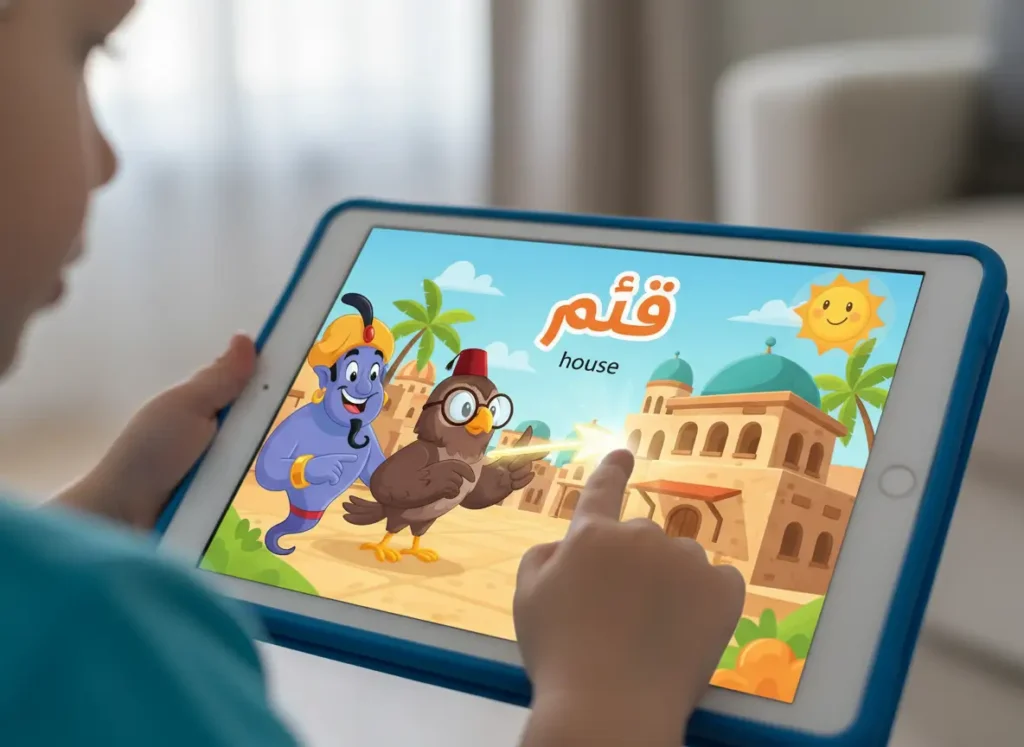
Teaching Body Parts: “Touch your رأس (head)!” – children touch heads “Wave your يد (hand)!” – children wave “Stomp your قدم (foot)!” – children stomp
After 5 minutes of this, children have embodied vocabulary. They remember قدم because their feet stomped. They remember يد because their hands waved.
Example 2: Verbs Through Physical Enactment
Boring Approach: “يجري means run. يقفز means jump. Write them down.”
Movement Approach: “When I say يجري, RUN in place!” “When I say يقفز, JUMP!” “When I say يمشي, WALK slowly!”
Then playing Simon Says entirely in Arabic using these verbs.
Result: Children’s muscles remember verbs. Vocabulary becomes kinesthetic, not just auditory.
Movement Activities for Different Skills
For Pronunciation: Exaggerated mouth movements. Making letter sounds while doing specific actions (hopping for ه، arms wide for ا).
For Reading: Standing when they see ا، sitting for ي، clapping for ب.
For Sentence Construction: Children become words. They arrange themselves physically to form sentences. “You are الكتاب (the book). You are على (on). You are الطاولة (the table). Now arrange yourselves in correct order!”
For Listening Comprehension: Following physical commands in Arabic. “قف (stand). اجلس (sit). دور (turn). اقفز (jump).”
Dramatic Play and Role-Playing: Becoming Arabic Speakers
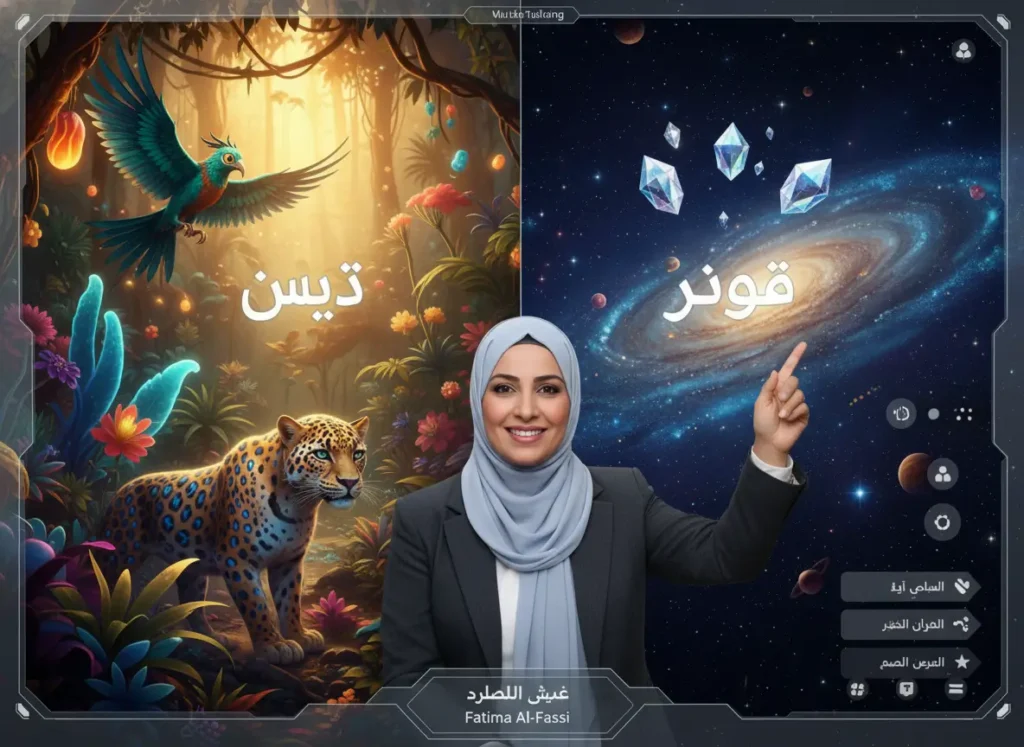
Children love pretending. Effective teachers harness this for language acquisition.
How Teachers Use Drama in Lessons
Example 1: Restaurant Role-Play
Setup: Classroom becomes Arabic restaurant. Children take turns being waiter/customer.
What Children Practice: Waiter: “مرحباً! ماذا تريد؟” (Hello! What would you like?) Customer: “أريد…” (I want…)
Why It Works: Meaningful context. Real communication purpose. Low stakes (it’s pretend). Natural repetition as children cycle through roles.
Example 2: Market Shopping
Setup: Teacher sets up “market” with pictures of fruits/vegetables.
What Children Practice: Shopkeeper: “هذا تفاح. خمسة جنيهات” (This is apple. Five pounds) Buyer: “أريد اثنين” (I want two)
Why It Works: Combines numbers, vocabulary, and conversational phrases in authentic context.
Age-Appropriate Dramatic Activities
Ages 4-6: Simple role-plays with clear roles (family members, animals). Lots of movement and sound effects.
Ages 7-9: More complex scenarios (school, hospital, store). Beginning improvisation within structured frameworks.
Ages 10-12: Creating original skits. Performing for others. More sophisticated dialogue and conflict resolution scenarios.
Real Examples: How Expert Teachers Make Lessons Fun
Teacher Hala’s “Mystery Box” Lessons (Ages 5-7)
Every lesson begins: Hala brings mysterious box. Children ask questions in Arabic to guess contents.
“هل هو كبير؟” (Is it big?) “هل هو أحمر؟” (Is it red?)
Why children love it: Suspense. Curiosity. They’re detectives using Arabic.
What they learn: Question formation. Adjectives. Vocabulary. Grammar naturally through communication.
Teacher Mahmoud’s “Magic Carpet Adventures” (Ages 6-9)
Structure: Classroom rug becomes magic carpet. Each lesson, they “fly” to different Arabic-speaking country.
“اليوم نذهب إلى مصر!” (Today we go to Egypt!)
Children learn vocabulary and phrases needed for that country’s adventure.
Why children love it: Imagination. Travel. Adventure. Different theme each week.
What they learn: Geography. Cultural knowledge. Country-specific vocabulary. Grammar in context.
Teacher Nour’s “Build-A-Story” (Ages 8-11)
Structure: Children collaboratively create ongoing Arabic story. Each lesson adds chapter.
Teacher provides story prompts and new vocabulary. Children decide plot directions, character actions.
Why children love it: Agency. Creativity. Investment in story they’re creating. Anticipation of what happens next.
What they learn: Past tense verbs. Descriptive language. Narrative structure. Creative language use.
Teacher Zahra’s “Arabic Detectives” (Ages 9-12)
Structure: Each lesson presents mystery (missing object, mixed-up message, secret code). Children use Arabic skills to solve.
Example: “Someone stole the teacher’s قلم (pen)! Read these clues in Arabic to discover who!”
Why children love it: Problem-solving. Challenge. Working together. Satisfaction of solving.
What they learn: Reading comprehension. Following written instructions. Deductive reasoning in Arabic. Specialized vocabulary.
For comprehensive methodology resources, see Fun Arabic Lessons for Kids: Games.
Age-Appropriate Fun: What Works When
Ages 3-5: Movement, Music, Make-Believe
What Works: Songs with actions, simple dramatic play (animals, family), movement learning (hopping, clapping), repetitive patterns, bright colors, short activities (5-10 min).
Lesson Example: “Be animals! When I show كلب (dog), bark and say كلب! When I show قطة (cat), meow and say قطة!”
Ages 6-8: Stories, Adventures, Challenges
What Works: Adventure narratives, quests using Arabic, friendly competition, crafts while using Arabic, silly humor, achievable goals.
Lesson Example: “We’re treasure hunters! This Arabic map shows treasure location. First clue: ‘Go to big شجرة (tree).’ Walk to tree picture! Next clue…”
Ages 9-12: Creativity, Choice, Complexity
What Works: Creating original content, personalized projects, intellectual challenges, collaborative complex tasks, topics matching interests (sports, technology), demonstrating competence.
Lesson Example: “Create TV commercial in Arabic for product you invented. Include: product name, three benefits, price, call to action. Choose product and presentation!”
Common Concerns About Fun Lessons
“But are they actually learning?” Research proves fun lessons produce superior outcomes. Children retain information longer, transfer knowledge better, show higher motivation, and develop deeper understanding (Hirsh-Pasek et al., 2009). Fun with clear learning objectives = effective education.
“I’m not naturally creative enough.” Fun techniques can be learned systematically. Start with one or two proven structures, master them, expand gradually. Teachers don’t invent everything—proven frameworks exist.
“Won’t children expect everything fun and resist practice?” Fun makes children WANT to practice. When Arabic is enjoyable, “hard work” happens naturally through engaging activities. They voluntarily do what would otherwise feel tedious.
Related Resources for Engaging Arabic Learning
Arabic for Kindergarten: Top 10 Arabic Songs Kids Love
Discover the most effective songs for young learners—proven to build vocabulary, pronunciation, and joy simultaneously. Perfect for teachers working with ages 3-6. Explore songs
Fun Arabic Lessons for Kids: Games
Specific game structures teachers use within lessons to practice grammar, vocabulary, and conversation skills while maintaining engagement and fun. Discover games
Magical Worlds in Arabic Stories
Master the art of storytelling in Arabic lessons—how to create narratives that captivate children while teaching language skills effectively. Learn storytelling
Arabic Songs and Rhymes for Children
Comprehensive collection of songs, chants, and rhymes for integrating music naturally into Arabic instruction across age groups. Access collection
Arabic for Kids: Complete Guide
For comprehensive understanding of children’s Arabic education principles, developmental stages, and effective teaching approaches. Read guide
Frequently Asked Questions
How do I balance fun with actually covering curriculum?
Fun isn’t separate from curriculum—it’s HOW you teach curriculum. Same vocabulary, grammar, and skills; different delivery method. Well-designed fun lessons cover content MORE efficiently because engaged children learn faster.
What if my personality isn’t naturally fun or entertaining?
You don’t need to be comedian or performer. Fun lessons are about structure and technique, not personality. Quiet, reserved teachers create engaging lessons using storytelling, movement, and meaningful activities. Authenticity matters more than entertainment.
Do fun lessons work for online teaching?
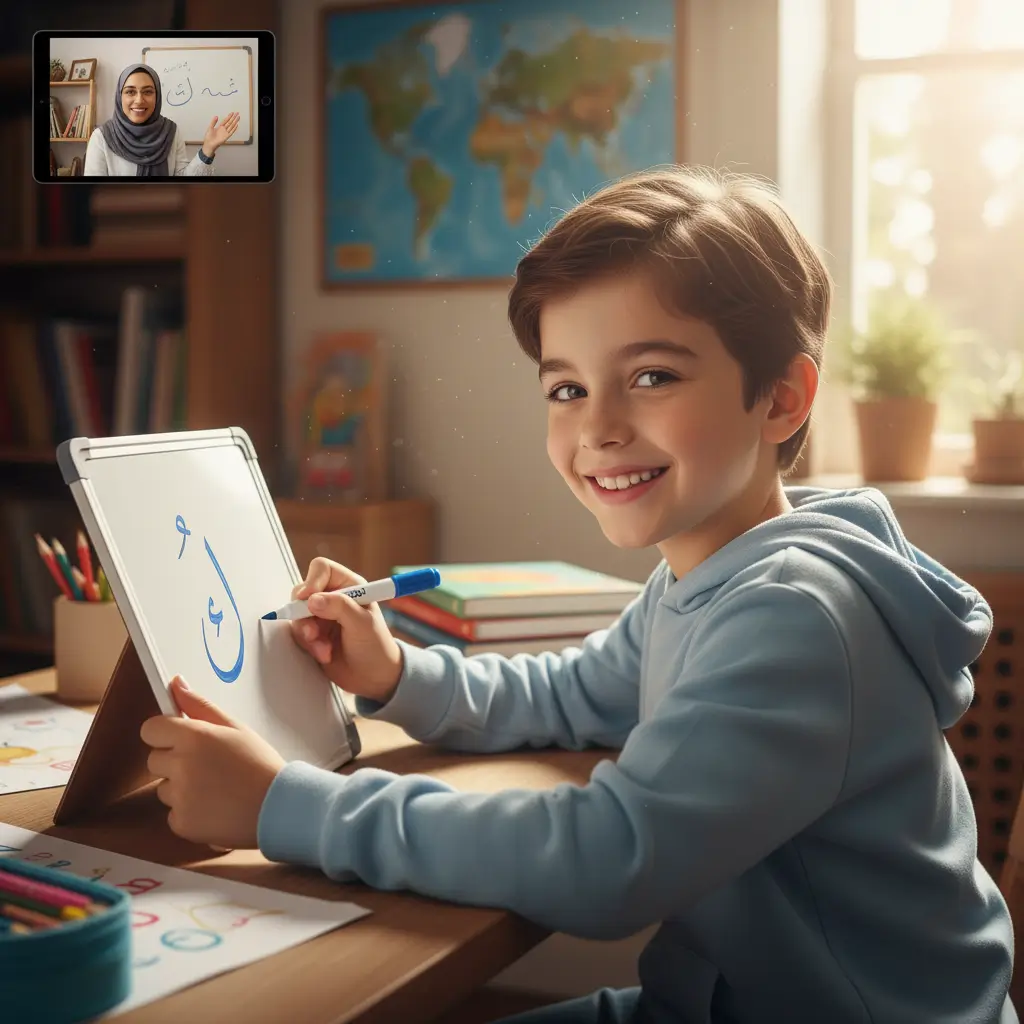
Absolutely. Online teachers successfully use: digital storytelling with screen sharing, movement activities children do at home, interactive games using online whiteboards, songs and rhythm, virtual role-plays. Sometimes easier online (access to unlimited visual resources).
How do I manage classroom behavior when lessons are active and energetic?
Clear structure and expectations. Active lessons with defined rules and transitions actually improve behavior compared to boring lessons where children seek stimulation through misbehavior. Keys: clear start/stop signals, established routines, purposeful activity (not chaos).
Can older students (10-12) benefit from fun lessons or is it just for young kids?
Older students desperately need engaging lessons—they just need age-appropriate engagement. Replace tedious grammar drills with detective challenges. Replace vocabulary lists with creating TV commercials. Replace reading exercises with mystery story comprehension. Fun doesn’t mean childish.
How long does it take to prepare fun lessons?
Initially more time investment learning techniques. Once mastered, often LESS time than traditional lessons because you develop frameworks you reuse. “Treasure hunt” structure works for any vocabulary. “Build-a-story” works for any grammar point. Initial investment pays ongoing dividends.
Why Choose Alphabet Arabic Academy for Fun, Effective Arabic Lessons
At Alphabet Arabic Academy, we don’t believe children must choose between enjoyment and learning. Our teachers create lessons where fun IS the learning method.
What Makes Our Lessons Different
✅ Every Teacher Trained in Engagement Techniques Not just native Arabic speakers—teachers specifically trained in storytelling, movement-based instruction, dramatic methods, and age-appropriate engagement strategies.
✅ Curriculum Designed Around Joy Our curriculum integrates fun methods from ground up—not traditional lessons with fun “added.” Every objective has corresponding engaging activity.
✅ Developmental Appropriateness Different approaches for different ages. Preschoolers get movement and music. Elementary students get adventure stories. Preteens get creative challenges and choice.
✅ Balance of Structure and Spontaneity Clear learning objectives with flexibility for children’s interests and energy. Teachers adapt in real-time to what’s working.
✅ Evidence of Effectiveness We track outcomes. Our students show: higher retention rates, faster skill acquisition, stronger intrinsic motivation, positive associations with Arabic learning.
✅ One-on-One and Small Groups Intimate settings allow personalization. Teacher reads child’s engagement and adjusts immediately. Every child participates actively (impossible in large groups).
✅ Parent Feedback Integration We listen to what your child responds to. If they love dinosaurs, suddenly dinosaurs appear in their Arabic lessons. We personalize fun.
Your Next Steps: Transform Your Child’s Arabic Experience
Every child deserves to experience learning Arabic as adventure, not tedium. The difference between children who persist with Arabic and those who resist often comes down to one factor: whether lessons are genuinely engaging.
How to Begin
Step 1: Recognize That Fun Matters Accept that engagement isn’t optional extra—it’s essential for effective learning. Fun lessons produce better outcomes than boring ones.
Step 2: Identify Current Engagement Level Ask your child: “Do you enjoy your Arabic lessons?” “What’s your favorite part?” “What’s boring?” Their answers guide improvement.
Step 3: Seek Teachers Trained in Engagement Not all teachers know how to make lessons fun. Find teachers specifically trained in child-centered, engaging instruction.
Step 4: Observe a Lesson Watch how teacher interacts with children. Are kids actively participating? Smiling? Fully engaged? Or passive and bored?
Step 5: Give Engaging Methods Time Some children initially resist new approaches after experiencing only traditional instruction. Give engagement-based teaching several weeks. Watch motivation transform.
Conclusion: When Learning Feels Like Playing
Remember Omar from our introduction? He went from dreading Arabic lessons to eagerly anticipating them. Not because Arabic became easier. Not because he suddenly developed talent he lacked before.
Because Teacher Salma understood that children’s brains are wired for:
- Stories that capture imagination
- Songs that create joy
- Movement that embodies learning
- Play that makes practice natural
- Creativity that builds investment
- Success that builds confidence
She transformed how Arabic was taught—not what was taught. Same alphabet. Same vocabulary. Same grammar. Completely different experience.
This is what fun Arabic lessons accomplish: making children WANT to learn the very content they previously resisted.
The research is clear: engagement enhances learning. The neuroscience is clear: joy optimizes memory formation. The practical evidence is clear: children learning through fun lessons outperform those suffering through boring instruction.
Your child can learn Arabic through adventure, story, song, and play—while achieving better outcomes than traditional drill-based teaching produces.
At Alphabet Arabic Academy, every lesson is designed to be genuinely fun—not superficially entertaining but pedagogically effective engagement that produces both joy AND learning.
👉 Schedule a trial lesson with Alphabet Arabic Academy and watch your child discover that Arabic can be an adventure they love.
Fun isn’t frivolous. Fun is how children’s brains are designed to learn best.
The lesson your child loves is the lesson they remember.
Make Arabic memorable. Make it joyful. Make it fun.
بسم الله – In the name of Allah.
This guide reveals research-backed methods for making Arabic lessons genuinely engaging for children. Fun isn’t opposed to learning—it’s the optimal method for children’s acquisition. Every child deserves Arabic instruction that sparks joy while building real proficiency.