
Introduction: Why the Arabic Alphabet Is Your Gateway to Fluency
Here’s something every successful Arabic Alphabet learner knows: you can’t skip the alphabet.
I’ve seen learners try. They want to jump straight to conversation. They think memorizing phrases will get them fluent. They assume the script will “come naturally” later.
It never does.
The Arabic alphabet isn’t like adding vocabulary to a language you already read. It’s a completely different writing system—flowing from right to left, with letters that change shape depending on position, and sounds your mouth has probably never made before.
But here’s the good news: once you master these 28 letters, the entire Arabic language opens up. You can read signs, menus, messages. You can sound out words. You can start actually learning Arabic instead of just memorizing transliterated phrases.
Most beginners think the Arabic alphabet will take months to learn. In reality, with focused daily practice, most students recognize and write all 28 letters within 2-4 weeks. Reading simple words? Another 2-3 weeks. Short sentences? By week 8, you’re there.
This guide walks you through every letter of the Arabic alphabet—from Alif (ا) to Yaa (ي)—with clear pronunciation guidance, writing instruction, and practical examples. Whether you’re an absolute beginner intimidated by the script or someone who tried and got frustrated, this systematic approach makes Arabic letters achievable.
Let’s start from the very beginning and build your foundation letter by letter.
THE FULL GUIDE about arabic grammar
Understanding the Arabic Writing System
Before diving into individual letters, understanding how Arabic script works prevents confusion and accelerates learning.
Right-to-Left Reading and Writing
Arabic flows from right to left—the opposite of English. This feels strange at first, but your brain adapts within days of consistent practice.
When you see: مرحبا (marhaban – hello)
You read: م – ر – ح – ب – ا (right to left)
Writing practice tip: Start your pen on the right side of the page. Your hand will feel awkward initially. That’s normal. Within a week, it becomes natural.
Letters Change Shape by Position
This is what trips up most beginners: Arabic letters look different depending on where they appear in a word.
Each letter has up to four forms:
- Isolated (letter standing alone)
- Initial (beginning of word)
- Medial (middle of word)
- Final (end of word)
Example with the letter Baa (ب):
- Isolated: ب
- Initial: بـ (as in بيت – bayt – house)
- Medial: ـبـ (as in كتاب – kitaab – book)
- Final: ـب (as in حب – hubb – love)
Don’t panic: You don’t need to memorize all four forms immediately. Learn the isolated form first. The other forms become recognizable through reading practice.
Connecting vs. Non-Connecting Letters
Most Arabic letters connect to the letter that follows them. But six letters never connect forward:
- Alif (ا)
- Daal (د)
- Dhaal (ذ)
- Raa (ر)
- Zay (ز)
- Waw (و)
What this means: When these letters appear in a word, they create a natural break. The next letter starts fresh in its initial form.
Example: The word “madrasa” (مدرسة – school) breaks after the letter Daal (د) because Daal doesn’t connect forward.
Short Vowels vs. Letters
Arabic has three short vowels that aren’t actually letters—they’re marks (diacritics) written above or below letters:
- Fatha (َ) = “a” sound (like “cat”)
- Kasra (ِ) = “i” sound (like “sit”)
- Damma (ُ) = “u” sound (like “put”)
Important: Most adult Arabic texts don’t include these vowel marks. They’re assumed. Beginners use texts with vowel marks (called “vowelized” or “Tashkeel” texts). As you advance, you read without them.
The 28 Letters of Arabic
Arabic has exactly 28 letters—no more, no less. Unlike English’s 26 letters that make 44+ sounds, Arabic’s 28 letters each represent specific sounds.
Compared to English:
- Arabic has sounds English doesn’t have (ع, ح, غ, خ, ق)
- English has sounds Arabic doesn’t distinguish (P vs. B)
- Some Arabic sounds exist in English but we don’t think of them distinctly (glottal stop in “uh-oh”)
Let’s meet each letter systematically, group by group.
The Arabic Alphabet: Letters 1-7 (Foundational Group)
These first seven letters introduce core sounds and patterns. Master these, and you’ve built the foundation.
1. Alif (ا) – The Foundation Letter
Sound: Makes an “aa” sound (like “father”) or serves as a glottal stop
Pronunciation: Open your mouth and say “ah” naturally. That’s Alif.
Writing: A simple vertical line. Easy to write, but crucial to recognize.
Position Forms:
- Isolated: ا
- Initial: ا
- Never appears medial or final in connected form (Alif doesn’t connect forward)
Common Words:
- أنا (ana) – I/me
- أب (ab) – father
Key Point: Alif is often silent when it carries a Hamza (glottal stop marker). Don’t overthink it initially—just recognize the shape.
Learn more: Alif Alphabet in Arabic Explained
2. Baa (ب) – Your First Real Consonant
Sound: Exactly like English “B” in “ball”
Pronunciation: Press your lips together, then release with voice. Simple.
Writing: Like a small bowl with one dot underneath.
Position Forms:
- Isolated: ب
- Initial: بـ
- Medial: ـبـ
- Final: ـب
Common Words:
- بيت (bayt) – house
- باب (baab) – door
- كتاب (kitaab) – book
Practice Tip: Baa is often the first letter students truly master because it’s so familiar. Use it as your confidence builder.
Learn more: Baa Arabic Letter Explained
3. Taa (ت) – Just Like Baa, But Different
Sound: Exactly like English “T” in “top”
Pronunciation: Tongue touches the roof of your mouth behind your teeth, then releases.
Writing: Identical to Baa, but with two dots on top instead of one dot underneath.
Position Forms:
- Isolated: ت
- Initial: تـ
- Medial: ـتـ
- Final: ـت
Common Words:
- تفاح (tuffaah) – apple
- بنت (bint) – girl
- بيت (bayt) – house
Why It Matters: Taa and Baa look almost identical. The only difference is dot placement. This teaches you to pay attention to dots—they change everything in Arabic.
Learn more: Taa Arabic Letter with Words
4. Thaa (ث) – The “TH” Sound
Sound: Like “TH” in “think” or “thought”
Pronunciation: Tongue between your teeth, blow air gently. Voiceless.
Writing: Same shape as Baa and Taa, but with three dots on top.
Position Forms:
- Isolated: ث
- Initial: ثـ
- Medial: ـثـ
- Final: ـث
Common Words:
- ثلاثة (thalaatha) – three
- ثوم (thoom) – garlic
Pattern Recognition: You now see the pattern—same base shape, different dots:
- 1 dot below = Baa (ب)
- 2 dots above = Taa (ت)
- 3 dots above = Thaa (ث)
Learn more: Thaa Arabic Letter Explained
5. Jeem (ج) – The “J” Sound
Sound: Like “J” in “jar” or “jump”
Pronunciation: In Egyptian Arabic, pronounced like hard “G” in “go.” In MSA, like “J” in “jar.”
Writing: A hook-like curve with one dot in the middle.
Position Forms:
- Isolated: ج
- Initial: جـ
- Medial: ـجـ
- Final: ـج
Common Words:
- جميل (jameel) – beautiful
- جبل (jabal) – mountain
- مسجد (masjid) – mosque
Regional Note: Egyptian and some Levantine dialects pronounce Jeem as hard “G.” Gulf and MSA use “J.” Context tells you which pronunciation natives expect.
Learn more: Jeem Arabic Letter Pronunciation
6. Haa (ح) – The Breathy “H”
Sound: A deep, breathy “H” from the throat—not like English “H”
Pronunciation: This is one of those uniquely Arabic sounds. Open your throat and exhale with friction. Like whispering “ha” but deeper.
Writing: Like Jeem, but without the dot.
Position Forms:
- Isolated: ح
- Initial: حـ
- Medial: ـحـ
- Final: ـح
Common Words:
- حب (hubb) – love
- صباح (sabaah) – morning
- محمد (Muhammad) – common name
Beginner Challenge: English speakers often pronounce this like regular “H.” Practice making it deeper and throatier. Native speakers notice the difference immediately.
Learn more: Haa Arabic Letter Pronunciation
7. Khaa (خ) – The Guttural “KH”
Sound: Like “ch” in Scottish “loch” or German “Bach”
Pronunciation: Back of your throat, like you’re clearing your throat gently. It’s not “K” and not “H”—it’s from deeper.
Writing: Like Jeem and Haa, but with one dot on top.
Position Forms:
- Isolated: خ
- Initial: خـ
- Medial: ـخـ
- Final: ـخ
Common Words:
- خبز (khubz) – bread
- أخ (akh) – brother
- مطبخ (matbakh) – kitchen
Practice Exercise: Say “loch” or “Bach” ten times. That throat position is where Khaa lives.
Learn more: Khaa Arabic Letter Pronunciation
Arabic Alphabet Practice Strategy
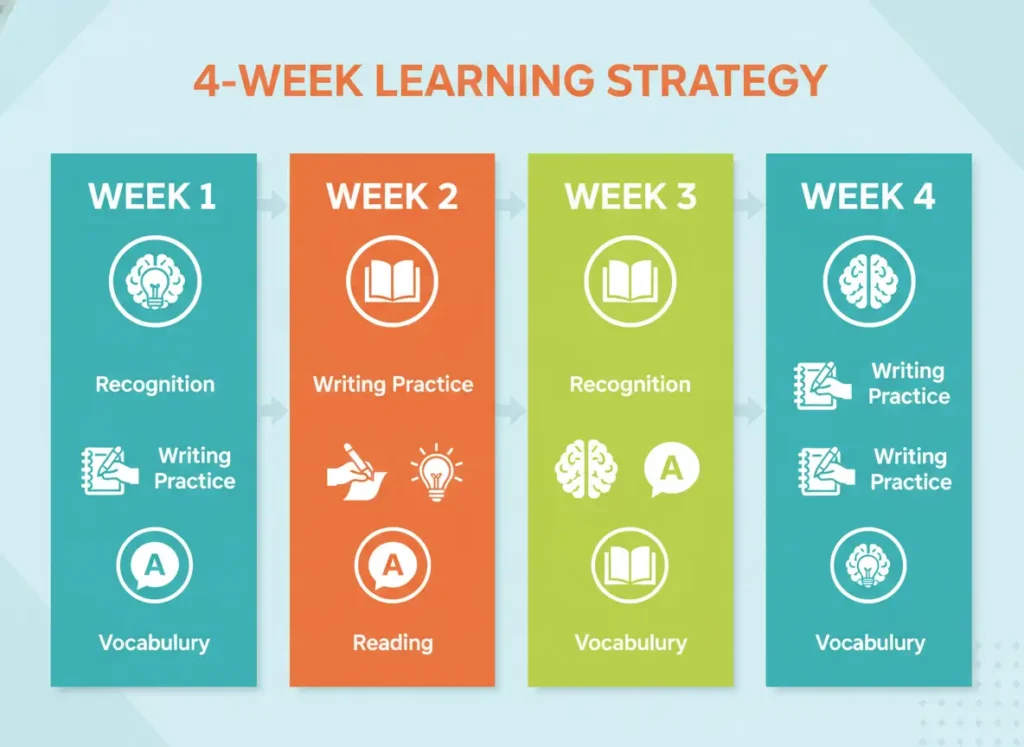
Now that you’ve met the first seven letters, here’s how to actually master them (and all 28):
Week 1: Recognition and Isolated Forms
Daily Practice (20 minutes):
- Write each letter 10 times in isolated form
- Say the sound out loud as you write
- Label household items with Arabic letters
- Use flashcards: letter on one side, sound on the other
Goal: Recognize all seven letters instantly and write them from memory.
Week 2: Connecting Letters and Position Forms
Daily Practice (25 minutes):
- Practice writing letters in initial, medial, final positions
- Copy simple words containing these letters
- Practice connecting letters smoothly
- Notice patterns (how letters flow together)
Goal: Write simple two-letter and three-letter combinations without thinking.
Week 3: Reading Simple Words
Daily Practice (30 minutes):
- Read vowelized words containing your learned letters
- Sound out each letter slowly
- Gradually increase speed
- Use children’s books with large, clear text
Goal: Read simple words accurately, even if slowly.
Week 4: Expanding Vocabulary
Daily Practice (30 minutes):
- Learn 5-10 new words daily using your known letters
- Write short phrases
- Practice with a language partner or tutor
- Begin recognizing these letters in context (signs, menus, social media)
Goal: Confident recognition and use of your first seven letters in real contexts.
Common Mistakes Beginners Make (and How to Avoid Them)
Mistake 1: Trying to Learn All 28 Letters in One Day
Why It Fails: Your brain can’t process that much new visual and auditory information at once. You’ll confuse similar letters and forget most by tomorrow.
Better Approach: Learn 3-5 letters per week. Master them completely before moving to the next group.
Mistake 2: Ignoring Pronunciation and Focusing Only on Writing
Why It Fails: If you can write Arabic but can’t pronounce it correctly, you can’t actually communicate. Native speakers won’t understand you.
Better Approach: Always practice pronunciation alongside writing. Say each letter out loud as you write it.
Mistake 3: Not Practicing Connected Forms
Why It Fails: Isolated letters look different from connected letters in actual words. If you only practice isolated forms, you can’t read real Arabic.
Better Approach: From week 2 onward, practice letters in all four positions. Copy real words, not just isolated letters.
Mistake 4: Skipping the “Difficult” Arabic Sounds
Why It Fails: Sounds like ع (Ain) and ح (Haa) feel impossible at first, so beginners skip them. But these sounds are everywhere in Arabic. Avoiding them means you can’t pronounce half the language correctly.
Better Approach: Embrace the challenge. Practice difficult sounds daily. Listen to native speakers. Record yourself and compare. These sounds become natural with consistent practice.
Mistake 5: Learning Without a System
Why It Fails: Random, sporadic practice doesn’t build retention. You forget what you learned last week because there’s no reinforcement.
Better Approach: Follow a structured sequence. Review previous letters while learning new ones. Use spaced repetition.
The Remaining Arabic Letters (Overview)
You’ve learned the first seven letters in detail. Here’s an overview of the remaining 21 letters, organized by similarity:
Letters 8-14: The Second Group
- Daal (د) – “D” sound, doesn’t connect forward
- Dhaal (ذ) – “TH” sound (like “this”), doesn’t connect forward
- Raa (ر) – Rolled “R” sound, doesn’t connect forward
- Zay (ز) – “Z” sound, doesn’t connect forward
- Seen (س) – “S” sound
- Sheen (ش) – “SH” sound
- Saad (ص) – Emphatic “S” sound
Letters 15-21: The Third Group
- Daad (ض) – Emphatic “D” sound
- Taa (ط) – Emphatic “T” sound
- Dhaa (ظ) – Emphatic “TH” sound
- Ain (ع) – Deep throat sound (no English equivalent)
- Ghayn (غ) – Like French “R,” from throat
- Faa (ف) – “F” sound
- Qaaf (ق) – Deep “K” from throat
Letters 22-28: The Final Group
- Kaaf (ك) – “K” sound
- Laam (ل) – “L” sound
- Meem (م) – “M” sound
- Noon (ن) – “N” sound
- Haa (ه) – Regular “H” sound (different from ح)
- Waw (و) – “W” sound or long “oo,” doesn’t connect forward
- Yaa (ي) – “Y” sound or long “ee”
Detailed guides for each letter coming soon. The letters linked above provide comprehensive pronunciation, writing, and usage instruction.
Special Features of Arabic Script
Hamza (ء) – The Glottal Stop
Hamza isn’t technically a letter—it’s a symbol representing the glottal stop (the catch in your throat when you say “uh-oh”).
Hamza can sit on top of Alif (أ), Waw (ؤ), Yaa (ئ), or alone on the line (ء).
Why It Matters: Hamza changes pronunciation. Without it, words sound completely different.
Example:
- أكل (akala) – he ate
- كل (kul) – eat! (command)
Taa Marbuta (ة) – The Tied Taa
This letter appears only at the end of words and is pronounced like “a” or “ah” in most contexts, but like “t” when followed by another word.
Common in:
- Feminine nouns (مدرسة – madrasa – school)
- Abstract nouns (حرية – hurriya – freedom)
Shadda (ّ) – The Doubling Mark
This mark above a letter means you pronounce that letter twice (doubled).
Example:
- مُدَرِّس (mudarris) – teacher
- The doubled “r” is essential to the meaning
Sukoon (ْ) – The “No Vowel” Mark
This small circle above a letter means don’t add a vowel sound—stop the sound sharply.
Example:
- كَتَبْتُ (katabtu) – I wrote
- The Sukoon on the Baa (ب) means you say “katab-tu” not “kataba-tu”
Arabic Alphabet Learning Resources
Best Tools for Practice
Digital Flashcard Apps:
- Anki (create custom Arabic letter decks)
- Quizlet (pre-made Arabic alphabet decks available)
- Memrise (gamified Arabic script learning)
Writing Practice:
- Grid paper for proper letter sizing and spacing
- Calligraphy pens for understanding letter flow
- Dry-erase boards for repetition without wasting paper
Audio Resources:
- Forvo.com (native speaker pronunciation of individual letters)
- YouTube Arabic alphabet videos (watch mouth positions)
- Language learning apps with audio (Duolingo, Rosetta Stone)
Practice with Real Content
Once you know 10-15 letters, start reading real Arabic:
Beginner-Friendly Sources:
- Children’s books (simple vocabulary, large clear text)
- Arabic learning textbooks with vowel marks
- Social media posts in Arabic (short, informal, engaging)
- Arabic subtitles on familiar movies
Intermediate Sources:
- Arabic news websites (Al Jazeera, BBC Arabic)
- Arabic menus and signs (when traveling or at restaurants)
- Arabic product labels
- Arabic greetings cards
Frequently Asked Questions
How long does it take to learn the Arabic alphabet?
Most students master recognition and writing of all 28 letters in 4-8 weeks with daily practice (20-30 minutes). Reading simple words fluently takes another 4-6 weeks. Total timeline to comfortable alphabet competence: 2-3 months.
Is the Arabic alphabet harder than learning Chinese characters?
No. Chinese has thousands of characters to memorize. Arabic has 28 letters with logical patterns. The challenge with Arabic isn’t quantity—it’s the right-to-left direction, connecting forms, and new sounds. Most learners find Arabic script easier than Chinese once they adjust.
Do I need to learn to write Arabic, or can I just learn to read it?
Writing reinforces recognition dramatically. Students who write learn to read 2-3x faster than those who only practice reading. The muscle memory of writing helps your brain recognize letters instantly.
Should I learn print or cursive Arabic first?
Arabic doesn’t have “print” vs. “cursive” the way English does. All Arabic script is naturally connected (cursive-like). You learn one form and it works for everything.
Can I learn the alphabet without a teacher?
Yes, many successful self-learners master the alphabet independently using online resources, videos, and apps. However, having a tutor or native speaker check your pronunciation prevents bad habits from forming.
Do Arabic letters have capital and lowercase forms?
No. Arabic has no uppercase/lowercase distinction. Every letter is the same size; only position (isolated, initial, medial, final) changes the form.
Why Choose Alphabet Arabic Academy for Learning Arabic Letters

At Alphabet Arabic Academy, we’ve refined Arabic alphabet instruction over years of teaching thousands of beginners.
Our Approach to Teaching the Alphabet
✅ Systematic Letter-by-Letter Progression We don’t overwhelm you with all 28 letters at once. You learn in manageable groups (3-5 letters weekly), mastering each before moving forward.
✅ Native Speaker Pronunciation Modeling Every letter is taught by native Egyptian speakers who model proper pronunciation, mouth position, and common mistakes to avoid.
✅ Writing Practice with Feedback You don’t just watch videos—you write, and we review your writing to ensure proper form, spacing, and connection.
✅ Integrated Vocabulary Building As soon as you learn a few letters, we introduce real words using those letters. You’re reading Arabic words within the first week.
✅ Cultural Context and Real-World Application We show you how these letters appear in street signs, menus, social media, and everyday Arab life—not just textbook examples.
✅ Flexible Learning Formats Whether you prefer self-paced video lessons or live sessions with instructor feedback, we adapt to your learning style and schedule.
Your Next Steps: Start Mastering Arabic Letters Today
The Arabic alphabet isn’t a barrier—it’s a gateway. Every letter you master opens more of the Arabic language to you.
How to Begin Your Alphabet Journey
Step 1: Commit to Daily Practice Even 15 minutes daily beats 2 hours on weekends. Consistency builds retention.
Step 2: Start with the First 5 Letters Don’t try to learn all 28 at once. Master Alif, Baa, Taa, Thaa, and Jeem this week.
Step 3: Write, Don’t Just Read Copy each letter 10 times daily. Say the sound out loud as you write. Muscle memory accelerates recognition.
Step 4: Use Flashcards for Recognition Speed Create physical or digital flashcards. Drill until recognition is instant, not gradual.
Step 5: Find a Teacher or Language Partner Self-study works, but feedback from a native speaker prevents pronunciation errors that become bad habits.
Step 6: Read Real Words as Soon as Possible Once you know 5-7 letters, start sounding out simple words. Even slow, halting reading builds fluency faster than perfect isolation practice.
Conclusion: Your Arabic Journey Begins with 28 Letters
Every fluent Arabic speaker—every scholar, every businessperson conducting deals in Dubai, every traveler navigating Cairo independently, every student reading classical texts—started exactly where you are now: staring at 28 unfamiliar letters.
The alphabet feels impossible until suddenly it doesn’t. Most students have that breakthrough moment around week 3 or 4 when letters they struggled with last week now feel automatic. The squiggles transform into meaningful symbols. You start recognizing words on signs. You can sound out a menu.
That moment is closer than you think.
At Alphabet Arabic Academy, we’ve guided thousands of absolute beginners through this exact journey. We’ve seen the frustration in week 2, the breakthrough in week 4, and the confidence by week 8 when students are reading their first short Arabic sentences.
The Arabic alphabet isn’t magic. It’s pattern recognition, consistent practice, and proper guidance. The 28 letters follow logical rules. The sounds, even the ones that feel impossible now, become natural with repetition.
Your task isn’t to master everything immediately. It’s to master one letter today. Then another tomorrow. Within a month, you’ll have them all.
👉 Book your free Arabic alphabet lesson with Alphabet Arabic Academy and start your journey with expert native instructors who make the impossible feel achievable.
28 letters. 8 weeks. The entire Arabic language unlocked.
Your journey starts with Alif (ا). Let’s begin.
This comprehensive guide was created to demystify the Arabic alphabet for absolute beginners. Whether you’re starting your Arabic journey or restarting after frustration, systematic letter-by-letter learning with proper pronunciation and writing practice transforms the impossible into inevitable.