

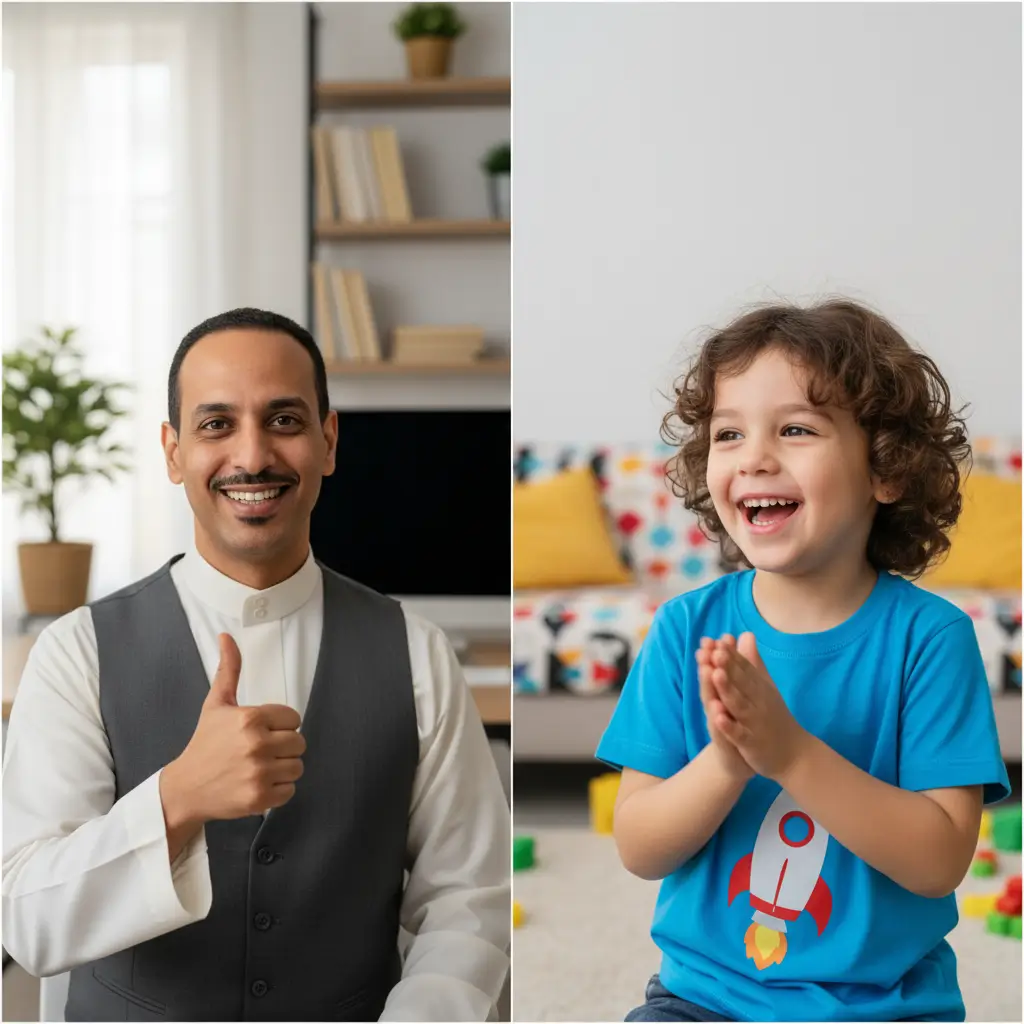
Understanding Modern Quran Education – The New Reality for Parents
The Phone Call That Changed Everything
the beginning of Online Quran Classes for Kids story Sarah was crying on the phone, but these weren’t tears of sadness.
“My seven-year-old son, who couldn’t even recognize Arabic letters six months ago, just led us in prayer,” she told me, her voice breaking with emotion.
Six months earlier, Sarah had a completely different story. Her son Omar hated Quran class. Every weekend, driving him to the local mosque became a battle. The teacher was well-meaning but overwhelmed with 15 kids in one room. Omar sat in the back, barely learning. After a year, he still struggled with basic Arabic letters.
That’s when we introduced Omar to online Quran classes designed specifically for children. Everything changed.
A qualified Egyptian teacher appeared on screen—just for Omar. No crowded classroom. No rushing. The teacher used colorful digital tools, turned lessons into games, celebrated every victory. Omar went from resisting Quran to asking, “When’s my next Quran class?”
This transformation happens to thousands of Muslim children worldwide through online classes that meet them where they are—engaging, age-appropriate, and effective.
if you want to read Quran Courses the Complete Guide : Learning Quran, Arabic, Tajweed
Why 2026 is the Perfect Time for Kids’ Online Quran Classes
The landscape of Islamic education has transformed dramatically. What was once a logistical challenge—finding qualified teachers, coordinating schedules, ensuring child safety—has become an opportunity for customized, high-quality learning.
The Evidence-Based Benefits:
- Personalized Attention Your Child Actually Gets
- Traditional Classroom: One teacher, 10-20 children, 60-90 minutes. Your child gets maybe 3-5 minutes of individual attention.
- Online One-on-One: One teacher, one child, 30-45 minutes. Your child gets 100% attention. Every mistake corrected immediately.
- The Impact: Children progress 2-3x faster with personalized instruction.
- Access to Expert Teachers Regardless of Location
You’re not limited to whatever teacher happens to live near your mosque. Your child can learn from Al-Azhar trained Egyptian teachers, certified instructors with Ijazah, and specialists in children’s education—regardless of where you live. - Flexible Scheduling That Fits Your Life
No more weekend battles. Schedule classes when it works—after school, early morning, evening, weekends. Sick days don’t mean missing weeks. Travel doesn’t interrupt learning.
How Children Learn the Quran Differently Than Adults
This is a mistake many programs make: teaching children the same way adults learn.
Children:
- Have shorter attention spans (15-25 minutes maximum for young learners)
- Learn better through repetition and visuals
- Need encouragement more than pressure
- Respond strongly to the teacher’s personality
That’s why successful online Quran classes for kids focus on engagement first, then structure. A good children’s program blends:
- Clear pronunciation practice
- Gentle correction
- Interactive recitation
- Simple explanations
- Positive reinforcement
The Modern Parent’s Dilemma and Solution
| The Challenge | Traditional Solution | Online Solution |
|---|---|---|
| Finding Qualified Teachers | Limited to local options, varying quality | Access to certified, specialized teachers worldwide |
| Busy Family Schedules | Fixed class times often conflict with activities | Flexible scheduling around your family’s rhythm |
| Child Engagement | One-size-fits-all approach losing kids’ interest | Gamified, interactive lessons designed for digital natives |
| Safety Concerns | Unknown environments and people | Secure, monitored sessions from your own home |
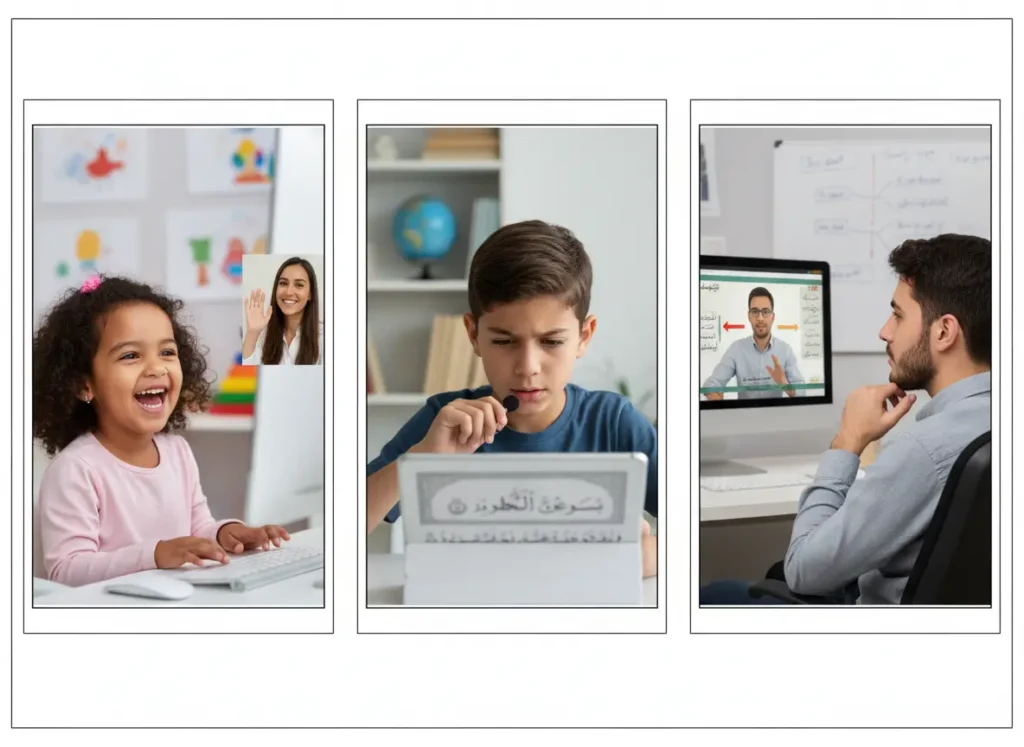
A structured, staged approach ensures children build skills without overwhelm:
Phase 1: Foundation Building (Ages 4-7)
- Focus: Positive association, Arabic letter recognition, basic Islamic manners
- Methods: Songs, stories, colorful visuals, 15-20 minute sessions
- Outcome: Excitement about “Quran time,” ability to identify letters
Phase 2: Skill Development (Ages 8-12)
- Focus: Letter joining, beginning recitation, short Surah memorization
- Methods: Noorani Qaida, repetition with correction, meaning connections
- Outcome: Reading simple words, memorizing 5-10 short Surahs
Phase 3: Fluency Building (Ages 13-15)
- Focus: Fluent reading, Tajweed application, longer memorization
- Methods: Surah-by-Surah progression, rule application, comprehension work
- Outcome: Independent reading, 15-20 Surahs memorized, basic Tajweed
Essential Components of Quality Programs
| Component | What It Looks Like | Why It Matters |
|---|---|---|
| Child-Specialized Teachers | Teachers trained in child development, not just Quran knowledge | Children need patience, creativity, and psychological awareness |
| Age-Appropriate Curriculum | Different approaches for 4-6, 7-10, 11-14, and 15-18 age groups | A 6-year-old learns differently from a 12-year-old |
| Interactive Learning Tools | Digital whiteboards, Quran apps, educational games, animated stories | Engagement leads to retention and positive association |
| Parent Involvement Systems | Regular progress reports, observation access, home practice guidance | Parents are partners in Islamic education |
Practical Implementation – Making Quran Learning Engaging and Effective
The Engagement Framework: What Actually Works
After observing thousands of successful student journeys, we’ve identified what truly engages children in Quran learning:
The Engagement Pyramid:
        ╱╲ LOVE: Intrinsic motivation, personal connection
       ╱  ╲
      ╱    ╲ ENJOYMENT: Fun activities, games, positive emotions
     ╱      ╲
    ╱________╲ ATTENTION: Interactive tools, varied activities, sensory engagement
The Foundation: Capturing Attention
In a world of constant digital stimulation, Quran classes must first compete for attention through:
- Visual appeal: Colorful interfaces, friendly teacher presence, animated elements
- Interactivity: Clickable elements, drawing tools, immediate feedback
- Variety: Mixing activities every 5-7 minutes to match children’s attention spans
Many parents worry about the transition from English to Arabic. This is why our Quranic Arabic for Children: Guide focuses on making the alphabet intuitive and
The Middle Layer: Creating Enjoyment
Attention alone isn’t enough. Enjoyment ensures children return willingly:
- Game elements: Points, levels, achievements for completing Surahs or lessons
- Choice: Allowing some selection in what to practice or which activity to do next
- Social connection: Seeing other children’s progress (with privacy protection), group activities
The Peak: Fostering Love
The ultimate goal—genuine affection for Quran and its learning:
- Personal relevance: Connecting verses to children’s own experiences and questions
- Meaning before mechanics: Understanding why before perfecting how
- Positive association: Quran time equals special, valued time with caring adults
Age-Appropriate Learning: One Size Does Not Fit All
The Early Bloomers (Ages 4-7)
For our youngest students, the goal is familiarity and love. We use a “Play-and-Learn” approach.
- Focus: Recognizing letters through colors, shapes, and sounds
- Method: Short 20-minute sessions to keep them excited
- Outcome: Memorizing short Surahs (Juz Amma) with focus on basic pronunciation
The Foundation Builders (Ages 8-12)
This is the “Golden Age” of memorization. At this stage, children are ready for more structure.
- Focus: Mastering Quranic Arabic and applying Tajweed rules
- Method: Interactive quizzes and “Tafseer Stories” to explain why a Surah was revealed
- Outcome: Developing independent reading skills and memorizing larger portions
The Future Leaders (Ages 13-18)
Teenagers need a “Why.” They need to connect the Quran to their identity.
- Focus: Advanced Tajweed, deep understanding of Quranic vocabulary
- Method: Discussion-based classes where they can ask questions
- Outcome: A strong Islamic identity and ability to recite with both beauty and understanding
Gamification That Actually Works (Not Just Points)
Empty point systems quickly lose their appeal. Effective gamification includes:
We believe that boredom is the enemy of learning. Our approach is Fun and Interactive: Learn Quran Online for Kids, where digital whiteboards and storytelling turn every lesson into an adventure.”
| Game Element | Quran Learning Application | Why It Works |
|---|---|---|
| Unlockable Content | New Surahs or stories unlock as skills improve | Creates natural pacing and achievement moments |
| Choice-Based Pathways | “Would you like to practice reading or learn the story today?” | Increases ownership and engagement |
| Narrative Framing | “You’re on a journey to become a Quran explorer” | Provides context beyond isolated lessons |
| Collaborative Goals | Class works together to “complete” a Juz’ | Builds community and shared purpose |
Quranic Arabic for Children: When and How
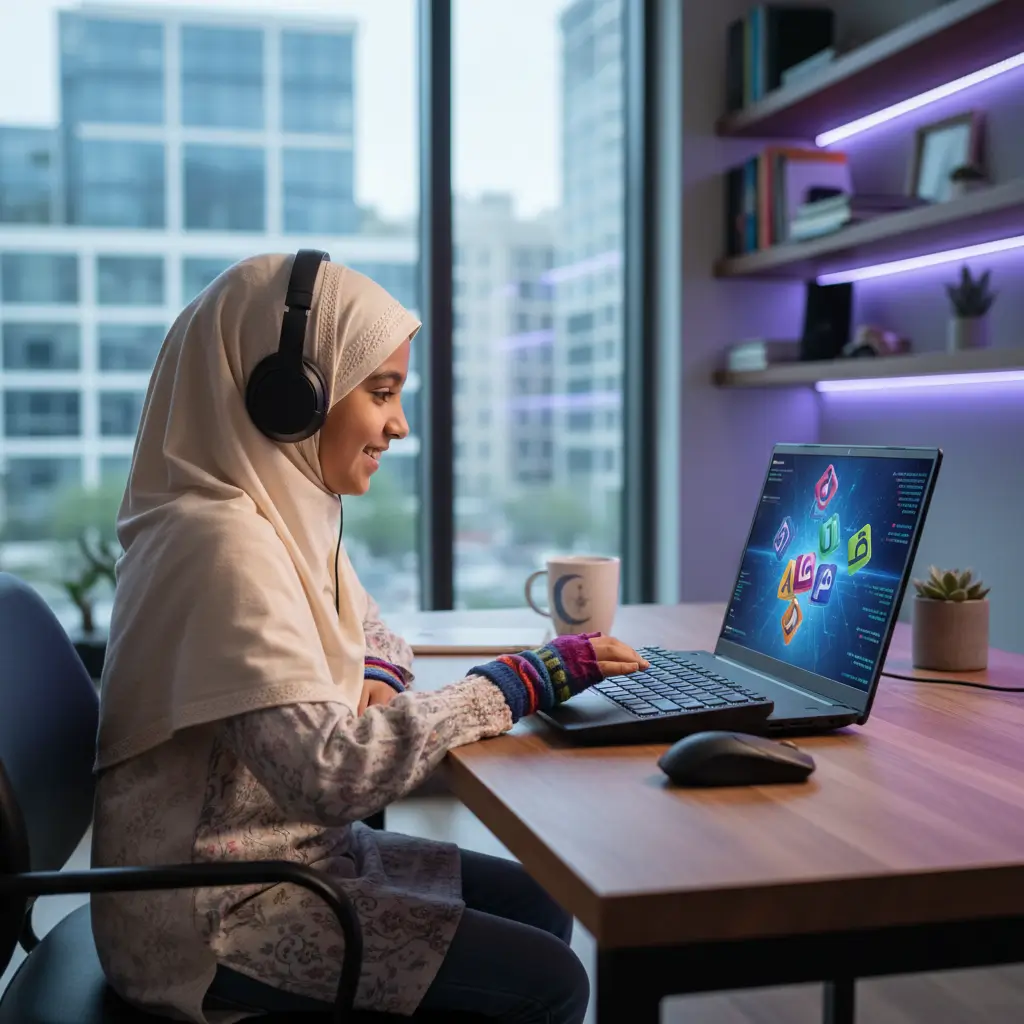
One of the most common parental questions is: “Should my child learn to understand Quranic Arabic, or just recite?”
to read more about Quranic arabic for children you have to read the special post
The modern consensus among Islamic educators: Both, but sequenced appropriately.
| Age Range | Arabic Focus | Sample Activities | Realistic Goals |
|---|---|---|---|
| 4-6 Years | Familiarity & Positive Association | Arabic letter art projects, songs with basic vocabulary | Recognizing that Quran is in Arabic, not fearing the script |
| 7-9 Years | Basic Meaning Connection | Learning 5-10 common words, simple phrase translation | Understanding that Arabic words carry meaning, not just sounds |
| 10-12 Years | Structured Vocabulary Building | Themed word groups, root word discovery games | 50-100 word recognition, understanding simple phrases |
| 13+ Years | Systematic Language Study | Grammar introduction through patterns, translation exercises | Following Arabic sentence structure, comprehending verses |
Technology Tools That Enhance (Not Replace) Learning
The best online Quran programs don’t just use technology—they thoughtfully integrate it:
| Tool Type | Purpose | Quality Examples |
|---|---|---|
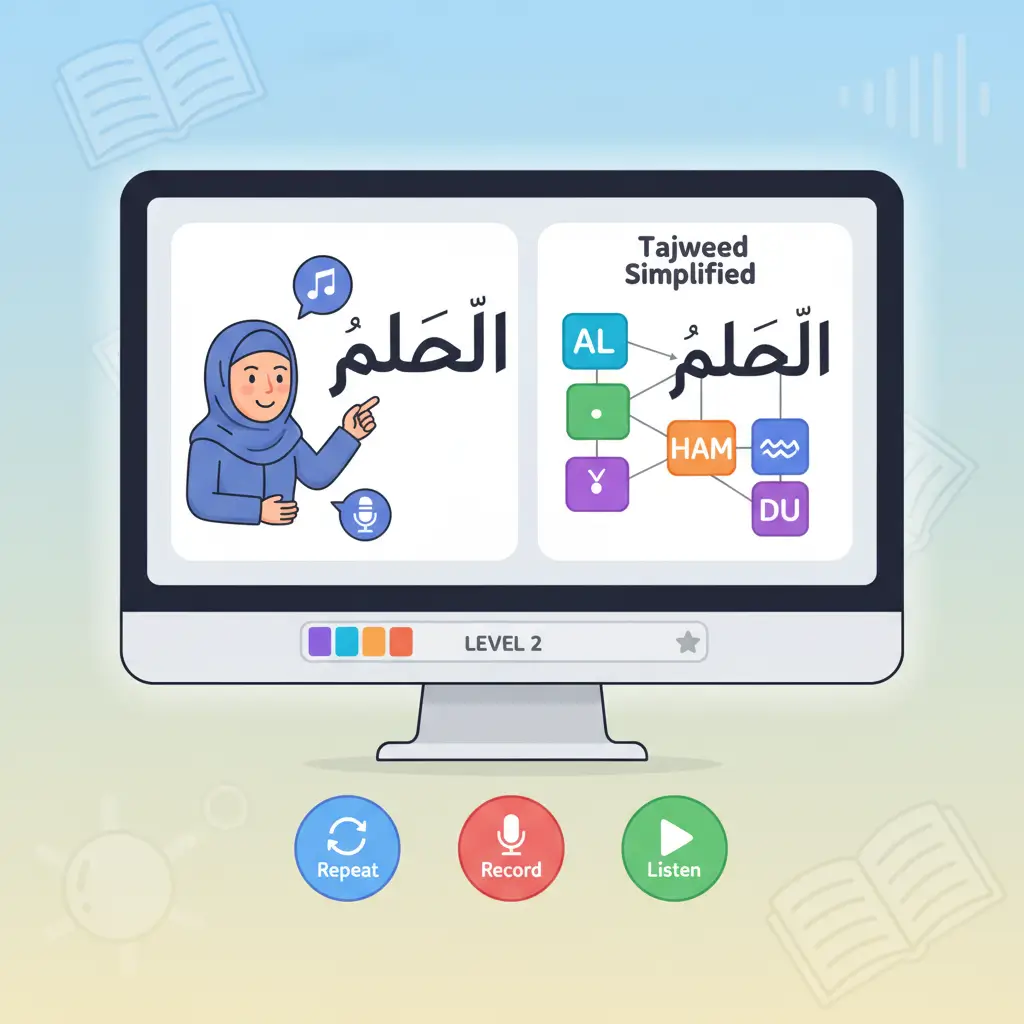
| Interactive Digital Mushaf | Visual learning with color-coded Tajweed, word-by-word translation | Apps that highlight words as recited, change colors for different rules |
| Recording & Playback Tools | Self-assessment, progress tracking, sharing with family | Simple recording features with visual waveforms, comparison to teacher models |
| Arabic Letter Games | Making initial learning engaging, reinforcing recognition | Drag-and-drop letter formation, pronunciation games with voice recognition |
| Virtual Reward Systems | Motivation, milestone celebration | Digital badges that unlock Islamic art or stories, progress thermometers |
The Parent’s Critical Role
Role 1: Creating Consistent Routine
Schedule Quran time like prayer: same time, same days weekly. Non-negotiable.
Example: 5:00 PM – Snack, 5:30 PM – Quran class, 6:00 PM – homework
Role 2: Daily Practice
- Ages 4-7: 10 minutes daily
- Ages 8-12: 15-20 minutes daily
- Ages 13+: 20-30 minutes daily
Formula: 2-3 classes weekly + daily practice = progress
Role 3: Modeling Quran Love
Children learn by watching:
- Parents reading Quran daily
- Parents excited about their own learning
- Quran treated with respect
- Family making dua together
Powerful: Enroll in your own Quran class. Learn alongside your child.
Success Strategies and Getting Started
The Parent’s Action Plan: 7 Steps to Success
Step 1: The Family Assessment (Before Searching)
Take 15 minutes to answer:
- What is our primary goal? (Memorization? Understanding? Emotional connection?)
- What is a realistic weekly schedule we can commit to?
- What challenges do we anticipate based on our child’s personality?
Step 2: Research and Shortlisting (7 Days)
Don’t choose the first program. Gather 3-5 options from trusted recommendations.
Step 3: The Trial Experience
During trial classes, observe:
- Teacher-Child Chemistry: Do they connect?
- Engagement Level: Is your child actually interested?
- Technology Usability: Good audio/video quality?
- Learning Approach: Does it match your child’s style?
Step 4: Creating Your Family Quran Ecosystem
Before lessons begin, establish:
- Physical Space: A dedicated, distraction-free learning area
- Technology Setup: Reliable internet, headphones, device charged
- Family Schedule: Quran time as non-negotiable as meals
Step 5: The First 30 Days – Building Habits
Focus on consistency over perfection:
- Week 1-2: Establish routine. Celebrate simply showing up.
- Week 3-4: Begin tracking small wins.
Step 6: The 90-Day Review
After one quarter, assess:
- Has the routine become habitual?
- Is your child’s attitude positive?
- Are you seeing measurable progress?
Step 7: Long-Term Planning
- Set quarterly goals with teacher input
- Plan for breaks and transitions
- Gradually increase child’s ownership of learning
Overcoming Common Challenges
Challenge 1: “My Child Resists Quran Time”
Solutions:
- The Choice Framework: “Would you like to do Quran before or after snack?”
- The Connection Method: Link to something they enjoy
- The Mini-Goal Approach: “Let’s just do 10 minutes today”
Challenge 2: “Inconsistency Due to Busy Schedules”
The Non-Negotiable Minimum: Even on busy days:
- 10 minutes of listening to beautiful recitation
- 5 minutes of reviewing one previously learned ayah
- 2 minutes of discussing one Quranic word
Challenge 3: “Technology Fatigue or Issues”
Preventive Measures:
- Designated Device: Use one device only for Quran learning
- Digital Minimalism: Close all other apps during lessons
- Low-Tech Backups: Have physical materials ready if technology fails
Success Stories: Real Transformations
Zaynab: From Frustration to Hafiza
Age 8, UK, local madrasah with 20 kids
Challenge: Barely learning, growing to dislike Quran
Solution: One-on-one online with female Egyptian teacher (3x weekly)
Results: Completed Juz Amma fluently in 6 months, became Hafiza at age 13
Yusuf: Late Start, Amazing Progress
Age 12, American convert, zero Arabic
Challenge: Felt behind other Muslim kids, embarrassed
Solution: Online classes for older beginners (4x weekly)
Results: Reading full Quran with Tajweed, understanding 40% in 3 years
What to Look For (and What to Avoid)
Green Flags: Indicators of Quality Programs
✅ Teacher Specialization: “Certified in Quran AND child education”
✅ Structured Curriculum: Clear progression from level to level
✅ Trial Options: Opportunity to evaluate before commitment
✅ Safety First: Background-checked teachers, secure platforms
Red Flags: Warning Signs to Heed
❌ “One-Size-Fits-All” Approach: Same methods for 5-year-olds and 15-year-olds
❌ Vague Credentials: “Experienced teacher” without specific qualifications
❌ No Parent Involvement: Closed sessions, minimal communication
Key Questions Every Parent Should Ask
- “What specific training do your teachers have in child development?”
- “Can you show me the curriculum roadmap for my child’s age group?”
- “How do you handle different learning styles or special needs?”
- “What safety measures protect children during sessions?”
Why Alphabet Arabic Academy Stands Out
What Makes Us Different:
- Al-Azhar Certified Teachers specializing in children’s education
- Age-Specific Curriculum for 4-6, 7-10, and 11-16 year olds
- One-on-One Personalized Attention with 100% teacher focus
- Fun, Interactive Digital Tools that engage modern learners
- Parent Partnership Approach with regular progress reports
- Flexible Scheduling across all time zones
For parents looking for a structured academic path, our Expert Guide to Quranic Arabic for Kids provides a deep dive into how we build fluency and Tajweed mastery step-by-step.
Conclusion: Your Child’s Eternal Investment

In a world full of temporary achievements—sports trophies, video game levels—Quran is the one accomplishment your child carries into the next life.
The child who grows up loving Quran, reading with Tajweed, understanding Allah’s words—that child carries light into every aspect of life. Quran shapes character, guides decisions, provides comfort, and becomes their companion in this life and the next.
Omar, from our introduction, is now 9 years old. He leads his family in prayer. He’s memorized 20 surahs. He understands basic Quranic Arabic. Most importantly, when he’s sad, he opens the Quran for comfort. Quran isn’t just something he learned—it’s part of who he is.
This transformation is possible for your child too.
Whether they’re 5 or 15, whether they know zero Arabic or are already reading—the right online Quran program, with qualified teachers and your support, can build the foundation they’ll treasure forever.
Ready to Begin Your Family’s Journey?
👉 Book Your Free Trial Lesson with an Expert Egyptian Teacher Now
During this session, you’ll:
- Meet teachers specializing in your children’s age groups
- See our learning platform and curriculum in action
- Get answers to your specific questions
- Receive a customized plan for your first 90 days
Join a community that understands your values and loves your children as much as you do.
FAQ
- Can my child really stay focused during an online Quran class?
- Answer: Yes, absolutely. Unlike traditional classrooms, our online sessions for kids are one-on-one and highly interactive. We use gamified learning, digital whiteboards, and storytelling specifically designed to match a child’s attention span, ensuring they remain engaged and excited throughout the lesson.
- What is the best age for a child to start learning Quran online?
- Answer: We recommend starting as early as age 4 or 5. At this stage, children are like sponges, and our “Early Bloomers” program focuses on fun, sounds, and letter recognition. However, we have tailored programs for all ages, including older children and teenagers who are starting from scratch.
- How long will it take for my child to start reciting the Quran?
- Answer: While every child learns at their own pace, most students who attend 2-3 sessions a week start recognizing letters and forming words within the first 3 months. By 6 months, many are able to begin reading short verses with basic Tajweed rules.
- Why should I choose an Egyptian teacher for my child?
- Answer: Egyptian teachers are world-renowned for their mastery of Quranic Arabic and Tajweed. More importantly, at Alphabet Arabic Academy, our teachers are trained in “Child Pedagogy”—meaning they have the patience and warmth needed to make learning a joyful experience for children living in the West.
- Do I need to be present with my child during every lesson?
- Answer: For very young children (ages 4-6), we recommend a parent stays nearby for the first few sessions to help with technology. However, our teachers are experts at managing the virtual classroom, and most children become fully independent and comfortable within a week or two.
- How do you track my child’s progress in the Quran?
- Answer: Transparency is key. We provide parents with regular progress reports and have periodic assessments to ensure your child is mastering each level. You will always know exactly which Surahs they’ve memorized and which Tajweed rules they are currently practicing.
[وَلَقَدْ يَسَّرْنَا الْقُرْآنَ لِلذِّكْرِ فَهَلْ مِن مُّدَّكِرٍ]
“And We have certainly made the Quran easy for remembrance, so is there any who will remember?” [54:17]
Your child’s Quran journey begins today. بسم الله