If you’ve spent any time researching Arabic, you’ve encountered the same confusing question in every forum, Reddit thread, and language learning community: should I learn Modern standard arabic online or a spoken dialect?
The honest answer is: it depends on what you actually want to do with Arabic — and most guides online get this wrong because they’re written for a general audience rather than for someone with your specific goals.
This guide does something different. It gives you a complete, honest comparison for 2026 — what Modern Standard Arabic actually is, who should learn it, how it compares to spoken dialects for real-world use, and what your fastest path to fluency looks like if MSA is the right choice for you.
By the end of this article, you’ll know exactly which variety of Arabic fits your goals, how long it will realistically take, and which resources and courses will get you there.
What Is Modern Standard Arabic?
Modern Standard Arabic — known in Arabic as Al-Fusha (الفصحى) — is the standardised, formal written and spoken register of Arabic used across the Arab world today. It is directly descended from Classical Arabic, the language of the Quran, but has been modernised over the past two centuries to include vocabulary for concepts that didn’t exist in the 7th century: technology, journalism, international relations, medical science, and more.
Modern Standard Arabic is the official language of 22 countries and the Arab League. It appears in:
- Newspapers, magazines, and digital news publications across the Arab world
- Academic textbooks, research papers, and university instruction
- Government documents, legal texts, official speeches, and diplomatic communication
- Formal television broadcasts, news programmes, and documentaries
- The Quran and Islamic religious texts (in its Classical Arabic form)
- Literature, poetry, and formal written communication between educated Arabs
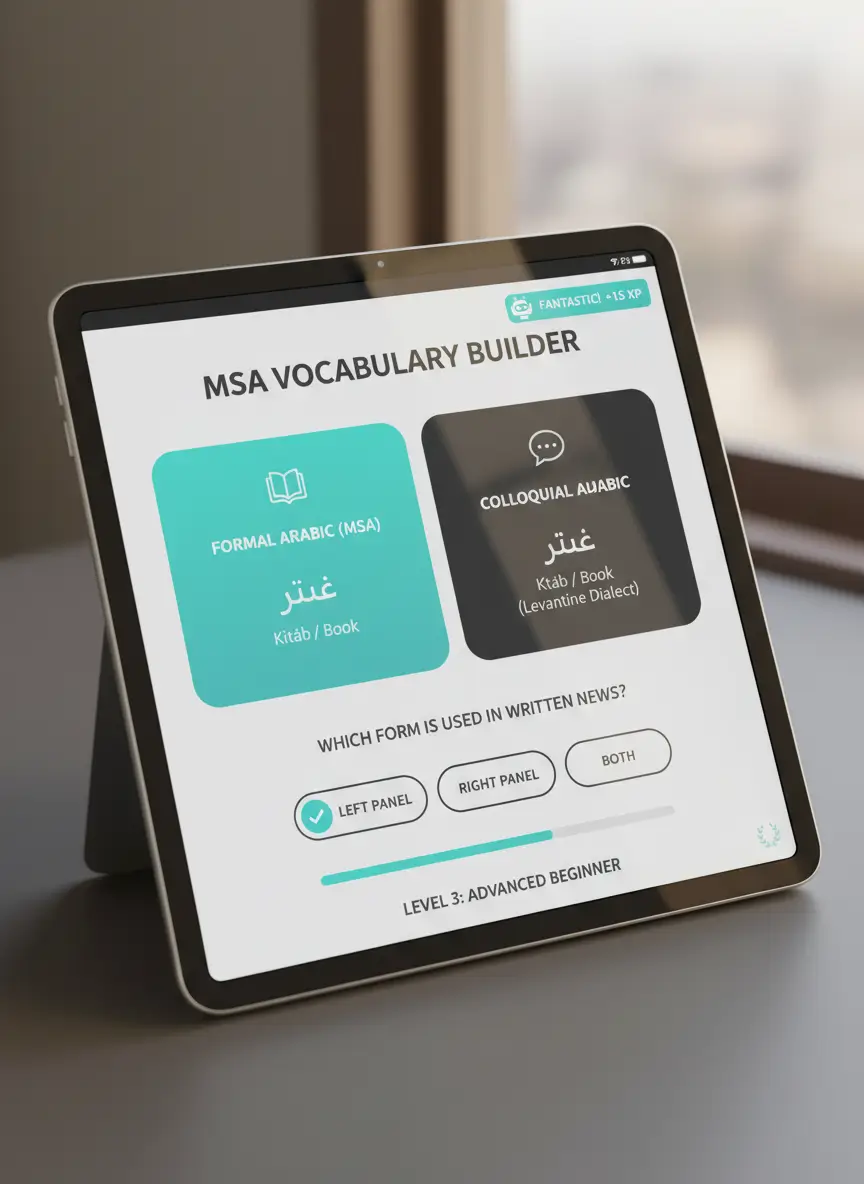
Here is the critical fact that most guides bury or omit entirely: no Arab country uses Modern Standard Arabic as its everyday spoken language. A person in Cairo speaks Egyptian Arabic. A person in Casablanca speaks Moroccan Darija. A person in Beirut speaks Lebanese Arabic. In professional and formal contexts — a conference, a news broadcast, an official ceremony — educated Arabs switch to Modern Standard Arabic. But at home, in shops, with friends and family, and in the rhythms of daily life? They speak their local dialect.
This distinction is not a minor footnote. It is the most important fact about Arabic for any learner to understand before choosing what to study.
MSA vs Spoken Dialect: The Honest 2026 Comparison
The debate between Modern Standard Arabic and spoken dialects is one of the oldest in language learning communities — and it generates more heat than clarity. Here is the comparison you actually need.
Communication
Modern Standard Arabic gives you access to educated, formal communication across the entire Arab world. Every educated Arab, regardless of their country, can read and write MSA. In formal spoken contexts — conferences, official broadcasts, public speeches — MSA is understood universally.
However, if you walk down a street in Cairo, Tunis, or Baghdad and try to have a conversation in Modern Standard Arabic, you will be understood — but you will sound academic, formal, and slightly strange. Native speakers will often switch to English or simplify their speech. You will not blend in. Practical daily conversation in MSA works, but it feels unnatural to native speakers.
Spoken dialects allow you to sound like a real person having a real conversation. Egyptian Arabic, the most widely understood dialect thanks to Egypt’s dominance in film, television, and music, gives you genuine conversational reach across the Arab world. You can joke, argue, flirt, and connect in ways that MSA simply does not enable.
Reading and Writing
MSA wins decisively here. All formal Arabic writing — every newspaper, every book, every academic text, every WhatsApp message written in Standard Arabic — uses Modern Standard Arabic. If your goal involves reading Arabic in any substantial way, MSA is not optional.
Spoken dialects are overwhelmingly oral. While dialects are increasingly written in informal digital communication — particularly on social media — there is no standardised written form for most dialects. Written Egyptian Arabic, for example, varies significantly between writers and contexts.
Professional and Academic Use
If your career involves journalism, international relations, translation, academia, law, or any field that requires engagement with the Arab world at a formal level — Modern Standard Arabic is what you need. Full stop. No dialect will substitute for MSA in these contexts.
Religious Use
For learners whose goal is Quran reading, Islamic studies, or understanding classical religious texts — the relevant variety is Classical Arabic, which is closely related to MSA. Learners who study MSA will find Quranic Arabic significantly more accessible, though additional study of Classical forms is still required.
Speed of Conversational Return
Spoken dialects win here, often dramatically. A learner who studies Egyptian Arabic for three months will typically achieve functional conversational ability much faster than a learner who spends three months on MSA. The reason: dialects are built for conversation. MSA grammar is considerably more complex — intricate verb conjugation systems, case endings (i’rab), formal vocabulary — and takes longer to convert into fluent spoken production.
This does not mean MSA is harder to learn overall. It means the return on conversational investment takes longer.
Who Should Learn Modern Standard Arabic Online?
Based on the comparison above, Modern Standard Arabic is the clear choice for these learners:
Journalists, writers, and media professionals who need to read Arab media, communicate with Arab colleagues in formal contexts, or produce Arabic content for professional publication.
Students of Arabic language and literature pursuing university degrees, research fellowships, or academic careers that require engagement with Arabic texts.
Islamic scholars, students of theology, and Quran teachers who need to engage deeply with Islamic classical texts, Hadith literature, and Quranic Arabic.
Diplomats, international relations professionals, and NGO workers whose careers involve formal engagement across multiple Arab countries.
Learners pursuing official certifications such as the CEFR, ACTFL, or ILM examinations, which test Modern Standard Arabic.
Translators and interpreters working in Arabic-English or Arabic-other-language pairs.
If you fit into one of these categories, Modern Standard Arabic with a native teacher online is your clear path forward.
Who Should Learn Egyptian Arabic Instead?
Egyptian Arabic is the better first choice for:
Travellers and tourists visiting Egypt or anywhere in the Arab world who want real, human connections — not just the ability to read a menu.
Learners connecting with Arab family or friends whose relatives speak Egyptian or are widely exposed to Egyptian media.
Anyone whose primary goal is conversation and who wants the fastest possible route to functional, natural-sounding spoken Arabic.
Digital content creators and social media learners who consume Arabic content primarily through entertainment, music, and social media.
Learners who want to reach the Arab world at a human level first — connection before comprehension of newspapers.
Egyptian Arabic online is the fastest path to sounding like a real Arabic speaker rather than a textbook.
Can You Learn Both? The Sequential Approach
Many serious Arabic learners eventually want both MSA fluency and spoken dialect competence. The question is: which comes first?
There are two schools of thought, and both have genuine arguments in their favour.
MSA First (Traditional Approach): This is how Arabic has been taught in universities for decades. Learn the grammar system, the vocabulary base, the writing system, and the formal structures through MSA. Dialect acquisition follows more naturally once the formal foundation is in place. This approach tends to produce stronger readers and writers and gives learners access to formal Arabic content from early in their study.
Dialect First (Communication-Led Approach): Start with a spoken dialect — typically Egyptian Arabic — because it produces conversational fluency faster and sustains motivation more effectively. Once you’re having real conversations, you build MSA on top as a second register. This approach tends to produce stronger speakers faster and keeps learners engaged through early communicable progress.
Our teachers at Alphabet Arabic Academy typically recommend the dialect-first approach for learners whose primary motivation is connection and conversation, and the MSA-first approach for learners with professional, academic, or religious goals. There is no single correct answer — the right sequence depends entirely on why you’re learning Arabic.
If you want to explore the spoken side first, our Arabic Conversation Course is purpose-built for learners who want fast, confident spoken Arabic.
How Long Does It Take to Learn Modern Standard Arabic Online?
The US Foreign Service Institute (FSI) classifies Arabic as a Category IV language — the most difficult category for English speakers, requiring approximately 2,200 class hours to reach professional working proficiency. This figure is frequently misquoted as a reason not to learn Arabic, which misses its context entirely.
Professional working proficiency is the level required for a diplomat or intelligence analyst to operate in Arabic under pressure. It is not the level required to read a newspaper, follow a documentary, or correspond formally in Arabic.
More useful benchmarks for most learners:
Functional reading (simple news, basic documents): Achievable within 12–18 months of consistent study with a qualified teacher.
Intermediate reading and writing (most newspapers, formal correspondence, academic abstracts): Achievable within 2–3 years of serious study.
Advanced formal communication (academic publication, diplomatic correspondence, media translation): Typically 4–6 years of intensive study.
The most important variable is not hours — it’s consistency. Thirty minutes with a native teacher every day, combined with daily reading and vocabulary practice, will produce faster and more durable progress than sporadic intensive sessions. A learner who studies consistently for 12 months with a qualified native MSA teacher will typically outpace a learner who accumulates the same total hours irregularly over three years.
The 5 Most Common Mistakes When Studying MSA Online
Mistake 1: Using only apps. Duolingo, Rosetta Stone, and similar platforms offer introductory exposure to Arabic. They do not teach Modern Standard Arabic grammar at the level required for real comprehension and production. Apps are a supplement to human instruction, never a substitute for it.
Mistake 2: Ignoring the script from the start. The Arabic writing system is not optional for MSA learners. Every text, resource, and professional document you will eventually use is written in Arabic script. Learners who delay the writing system inevitably hit a wall that requires going back to basics.
Mistake 3: Studying grammar without reading. MSA grammar is genuinely complex. But grammar studied in isolation — conjugation tables without texts, case endings without sentences — does not produce Arabic competence. Grammar and reading must develop together from the beginning.
Mistake 4: Avoiding native speaker feedback. Modern Standard Arabic pronunciation — particularly the emphatic consonants, pharyngeal sounds, and formal vowelling — requires correction from a native speaker. No textbook, recording, or app can catch the systematic errors that a native teacher hears immediately.
Mistake 5: Treating MSA and dialect as mutually exclusive. Even if MSA is your primary goal, occasional exposure to spoken dialects — especially Egyptian Arabic through films, series, and media — enriches your overall Arabic literacy and keeps your ear attuned to real spoken Arabic.
MSA vs Arabic Dialects: A Complete 2026 Comparison Table
| Feature | Modern Standard Arabic | Egyptian Arabic | Moroccan Darija | Gulf Arabic |
|---|---|---|---|---|
| Written use | ✅ Standard across all Arab countries | ❌ No standard written form | ❌ No standard written form | ❌ No standard written form |
| Understood across Arab world (spoken) | ✅ By educated adults | ✅ Very widely — Egypt’s media influence | ⚠️ Limited outside North Africa | ⚠️ Moderate reach |
| Everyday conversation | ⚠️ Formal, unnatural in daily speech | ✅ Natural and warm | ✅ Natural | ✅ Natural |
| Professional / academic use | ✅ Essential | ❌ Not standard | ❌ Not standard | ❌ Not standard |
| Quran access | ✅ Close (Classical Arabic) | ⚠️ Partial | ⚠️ Partial | ⚠️ Partial |
| News and media reading | ✅ All formal media | ❌ Not applicable | ❌ Not applicable | ❌ Not applicable |
| Speed to conversational fluency | ⚠️ Slower (complex grammar) | ✅ Fastest of all varieties | ⚠️ Moderate | ⚠️ Moderate |
| International certifications | ✅ CEFR, ACTFL, ILM | ❌ No formal certs | ❌ No formal certs | ❌ No formal certs |
| Social media / digital content | ✅ Formal writing | ✅ Very common | ✅ Common | ✅ Common |
Best Methods for Learning Modern Standard Arabic Online in 2026
1. Native Teacher-Led Online Lessons
The most effective method, full stop. A qualified native teacher of Modern Standard Arabic can tailor lessons to your specific goals, correct your pronunciation in real time, explain grammar in context, and provide structured feedback that no app or textbook can replicate.
When choosing a teacher or programme, look for: native Arabic speakers (not heritage speakers with formal gaps), specific experience teaching MSA rather than only dialect, structured curricula that balance grammar, reading, and production, and regular progress assessment.
At Alphabet Arabic Academy, our MSA programme is taught by certified native Egyptian teachers with formal Arabic education backgrounds. Lessons are structured around your specific goal — whether that’s reading comprehension, formal writing, Quranic access, or professional communication. View course options and pricing →
2. Graded Reading
Reading is the single fastest way to build MSA vocabulary and grammar intuition at intermediate and advanced levels. Graded Arabic readers — texts written at controlled vocabulary levels — allow consistent reading practice without the overwhelming density of authentic newspapers or academic texts.
Al-Kitaab Arabic Language Program (Georgetown University Press) remains the most widely used structured MSA curriculum and includes graded reading components. Supplement with simplified Arabic news sources like Arabicpod101‘s reading materials or the BBC Arabic simplified content.
3. Authentic Arabic Media
Once you reach intermediate level, authentic Arabic media is the most powerful vocabulary accelerator available. Al Jazeera Arabic, BBC Arabic, and Al Arabiya broadcast daily news in Modern Standard Arabic. Watching with Arabic subtitles where available maximises the benefit — you train reading, listening, and vocabulary simultaneously.
4. Writing Practice with Feedback
Productive language use — writing — is consistently underused by MSA learners who focus predominantly on input. Regular writing practice with correction from a native teacher builds formal Arabic production skills that are essential for professional and academic goals. Even 15 minutes of structured writing daily — summarising a news article, writing a short formal email, describing a concept in Arabic — produces measurable improvement over weeks.
5. Vocabulary Systematisation with Spaced Repetition
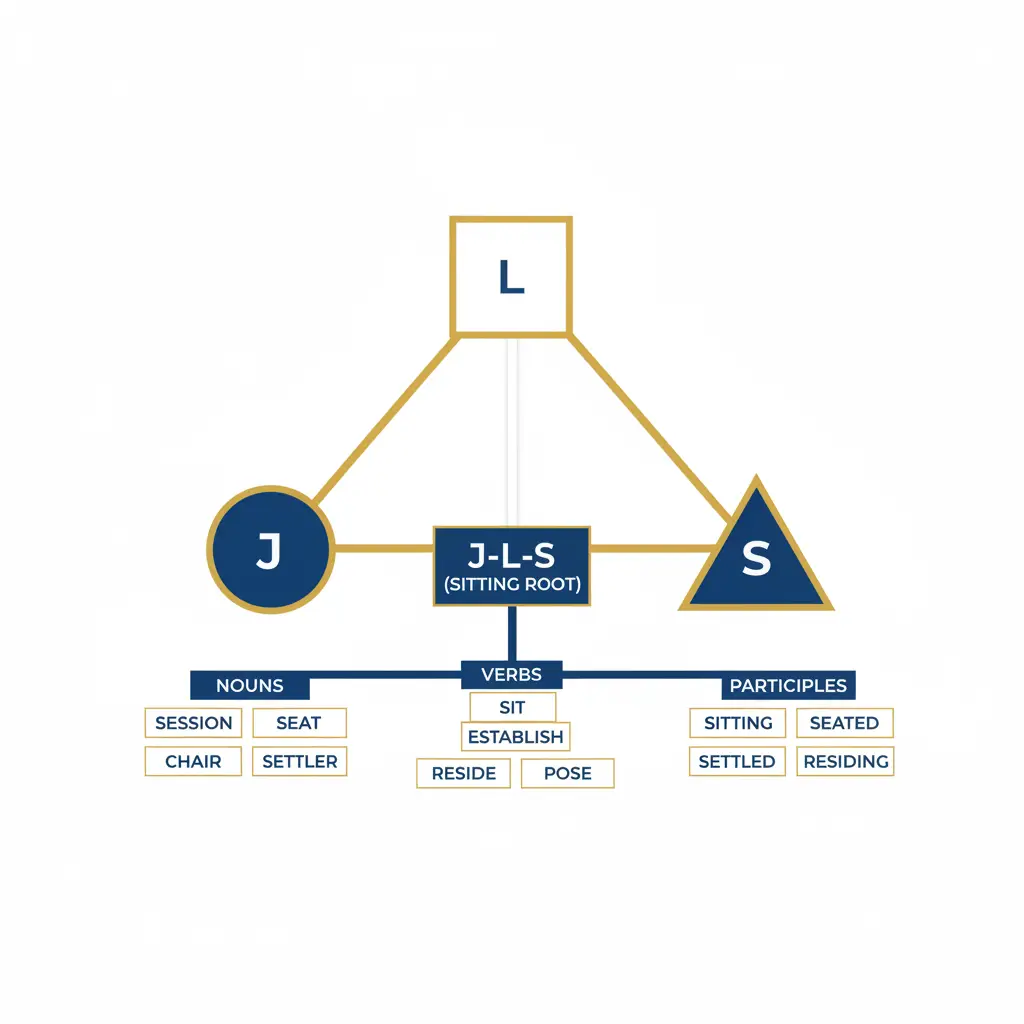
Modern Standard Arabic has a root-based vocabulary system — most words derive from a three or four-letter root, and understanding roots allows you to deduce the meaning of new words systematically. Learning vocabulary in root groups rather than as isolated words is significantly more efficient for MSA learners than for learners of languages without this system.
Use Anki or a similar spaced-repetition tool, and organise cards by root where possible.
Why Online MSA Instruction Works in 2026
The quality of online language instruction has improved dramatically over the past decade. For Modern Standard Arabic specifically, online learning offers advantages that in-person instruction often cannot match:
Access to native Egyptian teachers regardless of where you live. The density of highly qualified MSA teachers in cities like Cairo and Alexandria is unmatched — and online instruction makes this expertise globally accessible.
Flexible scheduling that makes consistent daily practice achievable for working professionals and students. A 30-minute daily lesson is more effective than a 3-hour weekly session — and online delivery makes the daily model sustainable.
Recorded sessions and materials that allow review and revision in a way that classroom instruction doesn’t support.
Cost efficiency. High-quality native teacher instruction online is typically 40–60% less expensive than equivalent in-person tuition in Western countries, without any reduction in quality.
If you’re considering learning Modern Standard Arabic online in 2026, the infrastructure for effective study has never been stronger.
Your Next Step
Modern Standard Arabic is not a language for specialists only. It is the key to the Arab world’s entire written heritage — two thousand years of literature, scholarship, journalism, and formal expression. It is also, for many learners in 2026, the professional credential that opens careers in media, diplomacy, translation, and international development.
If your goals align with what MSA offers, the question is not whether to learn it — it’s how to start effectively.
The most direct path: one free trial lesson with a native Egyptian MSA teacher. Sixty minutes. No credit card required. You’ll get a genuine sense of your current level, a clear picture of what the first three months of structured study look like, and a roadmap tailored to your specific goal.
Further Reading
Colloquial Egyptian Arabic: The Spoken Dialect Explained — If after reading this guide you’re leaning toward Egyptian Arabic first, this is your complete starting point. Egyptian Arabic is the most widely understood spoken dialect in the Arab world and the fastest path to conversational fluency.
Arabic Conversation Course — Purpose-built for learners who want fast, confident spoken Arabic. The 80/20 speaking method means 80% of every lesson is active production, not passive listening.
Arabic for Beginners: Your First 30 Days Roadmap — If you’re starting from zero, this article gives you a concrete day-by-day plan for your first month, whichever variety of Arabic you choose.