
🌟 Introduction: When Life Demands Flexibility
Emma’s Impossible Schedule: Learn Arabic at Your Own Pace story
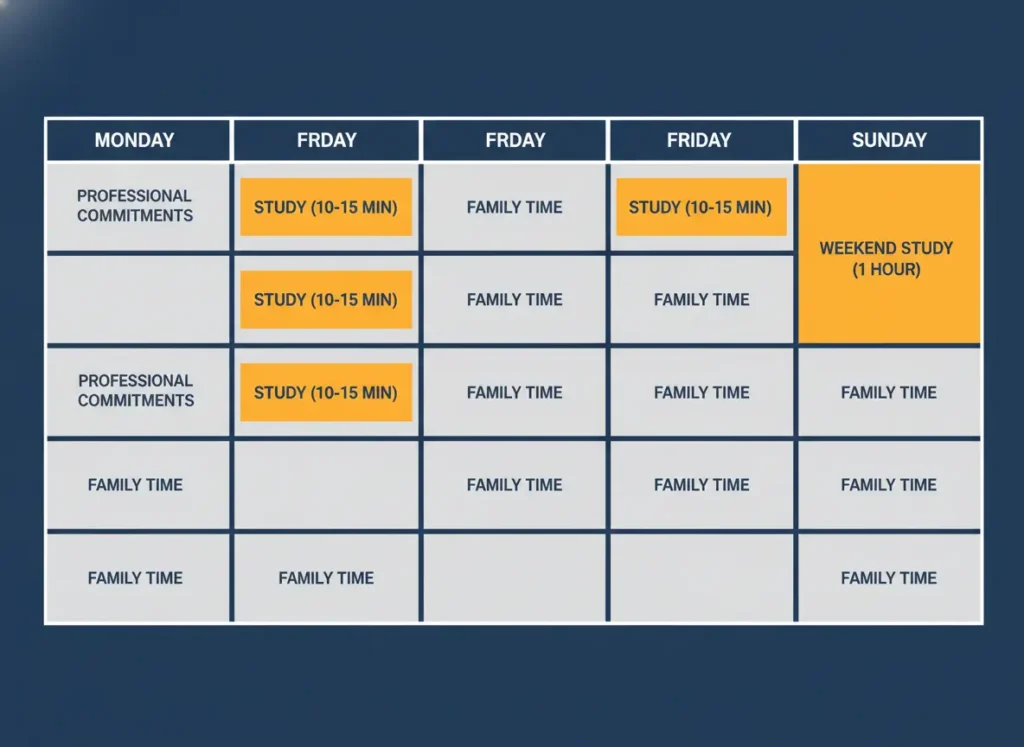
Emma, 34, marketing director and mother of two, desperately wanted to learn Arabic for her company’s Middle East expansion. Her schedule looked like this:
- Monday-Friday: 9am-6pm work (often later)
- Evenings: Kids’ homework, dinner, family time
- Weekends: Soccer games, errands, house chores
- Available study time: Unpredictable, scattered, never the same twice
She tried a traditional Arabic course:
- ❌ Fixed schedule: Tuesday/Thursday 7pm
- ❌ Missed 6 classes in first month (work emergencies, sick kids)
- ❌ Fell behind group (they moved forward without her)
- ❌ Lost $400 (no makeup classes, no refunds for missed sessions)
- ❌ Quit after 8 weeks – frustrated and defeated
“I can’t commit to fixed times,” she told her friend. “My life doesn’t work that way. I need to learn Arabic, but on MY schedule, not a class schedule.”
Then she discovered self-paced Arabic learning.
New approach:
- ✅ Studied 15-30 minutes daily (whenever she could fit it)
- ✅ Morning coffee breaks (10 min listening practice)
- ✅ Commute time (audio lessons in car)
- ✅ Weekend mornings (longer study sessions when kids slept in)
- ✅ No guilt for missing “class” – just picked up next day
12 months later:
- ✅ Reading Arabic news articles
- ✅ Understanding Al Jazeera broadcasts
- ✅ Writing professional emails
- ✅ Conversing with Arab colleagues
- ✅ Achieved intermediate proficiency – while managing full-time job and family
The difference? Learning at her own pace—structure without rigidity, progress without pressure, achievement without sacrificing life balance.
This comprehensive guide reveals what “learn at your own pace” truly means, who benefits most from self-paced learning, proven strategies for success, common pitfalls to avoid, and realistic expectations for flexible Arabic study.
💡 What “Learn Arabic at Your Own Pace” Really Means
Quick Definition:
Learning Arabic at your own pace means self-directed study where YOU control the schedule, speed, and intensity—progressing faster when life allows, slower when life demands, without external deadlines or fixed class times.
🎯 The Core Components:
1. ⏰ Flexible Scheduling
Not This:
- ❌ “Class meets Tuesday/Thursday 7-8:30pm. Attendance mandatory.”
- ❌ “Complete Unit 5 by March 15th.”
- ❌ “Keep pace with the group or fall behind.”
But This:
- ✅ Study when YOUR schedule allows (morning, evening, weekends, lunch breaks)
- ✅ Different times different days (Monday 6am, Wednesday 9pm, Saturday afternoon)
- ✅ 15 minutes one day, 2 hours another day – whatever works
- ✅ Miss a day? No problem. Resume tomorrow.
2. 🚀 Self-Determined Speed
Not This:
- ❌ “Everyone must master present tense this week, past tense next week.”
- ❌ “The class moves to Chapter 6 whether you’re ready or not.”
But This:
- ✅ Spend 2 weeks on present tense if you need it
- ✅ Spend 3 days if you grasp it quickly
- ✅ Repeat difficult lessons until mastered
- ✅ Skip ahead when material is easy
3. 🎯 Personalized Learning Path
Not This:
- ❌ One-size-fits-all curriculum (same for everyone)
- ❌ Must follow exact lesson order
But This:
- ✅ Focus on your goals (Quranic Arabic? Business Arabic? Travel?)
- ✅ Skip topics less relevant to you
- ✅ Deep-dive into areas matching your interests
- ✅ Choose learning methods that work for YOU (visual, audio, reading, writing)
4. 📊 No External Deadlines
Not This:
- ❌ “Test this Friday. Must be ready.”
- ❌ “Assignment due Monday.”
- ❌ “Complete course in 6 months or start over.”
But This:
- ✅ Progress at sustainable pace (even if slow)
- ✅ Take breaks when life gets overwhelming
- ✅ Resume without penalty
- ✅ Your only deadline is your own goal
For foundational understanding of Arabic learning, see our Arabic Language (Fusha) Guide.
⚠️ Important Clarification:
“Your own pace” ≠ “No structure” or “No accountability”
Self-paced learning still requires:
- ✅ Clear goals
- ✅ Consistent practice (even if flexible timing)
- ✅ Self-discipline
- ✅ Progress tracking
Difference:
- Traditional course: External structure, external accountability, fixed schedule
- Self-paced: Internal structure, self-accountability, flexible schedule
👥 Who Benefits Most from Learning Arabic at Their Own Pace?
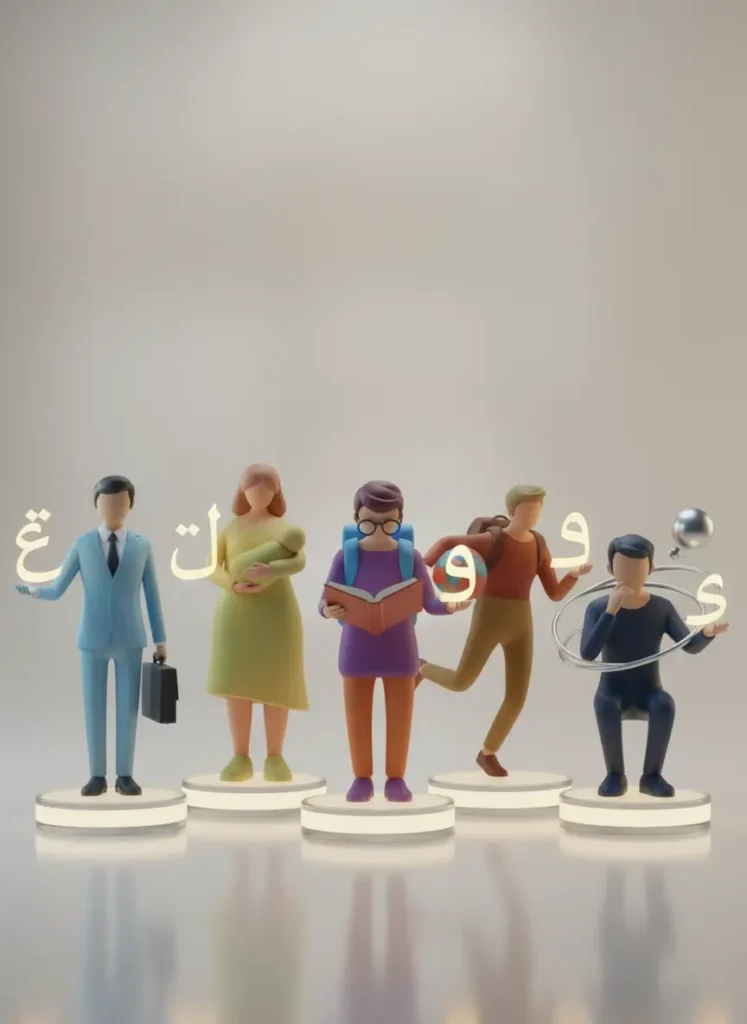
Profile 1: 💼 Busy Working Professionals
Characteristics:
- Irregular work hours
- Travel frequently
- Unpredictable schedule (meetings, deadlines, emergencies)
- Need Arabic for career but can’t commit to fixed class times
Why Self-Paced Works:
- Study during commute, business trips, early mornings, late evenings
- No stress about missing classes
- Progress during calmer periods, maintain during busy periods
- Can prioritize work emergencies without derailing Arabic learning
Example: Software developer working with Dubai office. Studies during flexible work-from-home days, travels for projects. Self-paced allows consistency despite irregular schedule.
Profile 2: 👨👩👧👦 Parents with Young Children
Characteristics:
- Schedule dictated by kids’ needs (school, activities, illnesses)
- Limited predictable free time
- Interrupted study sessions common
- Exhausted, need flexibility without guilt
Why Self-Paced Works:
- Study when kids nap, at school, or asleep
- Pause mid-lesson if child needs attention
- No wasted money on missed classes
- Progress during school year, accelerate during summer
Example: Stay-at-home mom wanting Arabic to teach children heritage language. Studies during preschool hours, naptime, after bedtime. Self-paced accommodates unpredictable parenting demands.
Profile 3: 🎓 Students with Demanding Academic Schedules
Characteristics:
- Full course load in other subjects
- Exam periods requiring full focus
- Semester breaks allowing intensive study
- Want Arabic but can’t add another fixed-schedule course
Why Self-Paced Works:
- Light Arabic study during exam weeks
- Intensive Arabic during breaks and summers
- Adjust pace around academic calendar
- Add skill without overload
Example: Medical student wanting Arabic for future work with refugee populations. Maintains minimal practice during semesters, accelerates during breaks. Graduates with basic Arabic proficiency alongside medical degree.
Profile 4: 🌍 Travelers and Digital Nomads
Characteristics:
- Changing time zones frequently
- Inconsistent internet access
- Different environments constantly
- Lifestyle incompatible with fixed schedules
Why Self-Paced Works:
- Study regardless of location or time zone
- Downloaded materials work offline
- Pause during travel, resume upon settling
- Learning becomes portable skill-building
Example: Freelance writer traveling Southeast Asia. Studies Arabic during slow work periods, long flights, rainy days. Self-paced allows continuous progress despite constant movement.
Profile 5: 🧘 Learners Preferring Gradual Mastery
Characteristics:
- Learn better with deep processing (not rushing)
- Prefer mastering concepts thoroughly before moving forward
- Stressed by external pressure or comparison to others
- Want quality over speed
Why Self-Paced Works:
- Spend as much time as needed on each concept
- No pressure to keep up with faster learners
- No embarrassment about being “slow”
- Learning is intrinsically motivated, not externally pressured
Example: Retired teacher learning Arabic for pleasure and Quranic understanding. Spends weeks mastering each grammar concept thoroughly. No rush, pure enjoyment of learning. Self-paced allows depth over speed.
For listening-based self-paced methods, explore Learn Arabic by Listening: Tricks.
⚖️ Honest Assessment: Pros and Cons of Self-Paced Arabic Learning
✅ PROS:
- Ultimate Flexibility – Study anytime, anywhere, adjust to life changes
- Personalized Pace – Slow on hard topics, speed through easy ones
- Cost-Effective – Often $50-300 vs $500-2,000 for courses
- Reduced Anxiety – No comparison to others, learn without social stress
- Customizable Style – Visual, auditory, kinesthetic—your choice
- Sustainable Long-Term – Maintain through life changes
❌ CONS:
- No External Accountability – Easy to procrastinate (90%+ quit within 3 months)
- Mitigation: Tracking apps, study buddy, public commitment
- Requires Strong Self-Discipline – Must motivate yourself daily
- Mitigation: Build habits, same time daily, track streaks
- Limited Speaking Practice – Most self-paced = reading/listening heavy
- Mitigation: Language exchange, occasional tutoring
- No Personalized Feedback – Can’t correct own pronunciation
- Mitigation: Monthly teacher check-ins, recording yourself
- Slower Progress Typically – May take 2-3x longer than structured courses
- Mitigation: Increase intensity during free periods
- Decision Paralysis – Too many resources, unclear path
- Mitigation: Choose one primary resource, stick 3+ months
For enjoyable self-paced methods, see Learn Arabic with Fun Online.
🎯 How to Structure Self-Paced Arabic Learning for Success
The Flexible Framework:
Even “your own pace” needs structure. Here’s how to build it:
Step 1: 🎯 Define Crystal-Clear Goals
Vague (Doesn’t Work):
- “I want to learn Arabic”
- “I want to be fluent someday”
Specific (Works):
- “Read Al Jazeera articles within 12 months”
- “Understand Quran with 70% comprehension within 18 months”
- “Hold basic work conversations within 9 months”
SMART Goal Template:
- Specific: What exactly? (Read news, hold conversations, understand lectures)
- Measurable: How will I know? (Read one article weekly, 10-min conversation, understand 50% of lecture)
- Achievable: Realistic for my pace? (Not “fluent in 3 months”)
- Relevant: Why does this matter to me? (Career, faith, heritage)
- Time-bound: By when? (6 months, 12 months, 24 months)
Step 2: 📅 Create Minimum Commitment
The Key: Minimum ≠ Maximum
Set MINIMUM daily practice (non-negotiable):
- Absolute minimum: 10 minutes (busy day survival)
- Standard minimum: 20-30 minutes (regular day)
- Ideal: 45-60 minutes (free day)
Why This Works:
- Busy day: Still practice 10 min = maintain momentum
- Free day: Can extend to 2 hours = accelerate progress
- No “all or nothing” thinking (doesn’t have to be perfect hour every day)
Emma’s Example:
- Monday-Friday: 15-20 min (commute, lunch)
- Saturday: 45 min (morning while kids sleep)
- Sunday: 30 min (evening)
- Total: ~2.5 hours weekly – sustainable for her life
Step 3: 🗓️ Establish Flexible Routine
Not This: “Study 7pm every night” (rigid, fails when life happens)
This: “Study sometime between wake-up and bedtime, minimum 10 min”
Flexible Routine Examples:
Routine 1: Morning Person
- Default: 6am, 30 min with coffee
- Backup: If overslept, 10 min during commute
Routine 2: Evening Person
- Default: 9pm, 30 min before bed
- Backup: If exhausted, 10 min audio lesson lying down
Routine 3: Fragmented Schedule
- 10 min morning (listening while getting ready)
- 10 min lunch (vocabulary review)
- 10 min evening (reading practice)
- Total: 30 min, split across day
Key: Have default plan AND backup plan
Step 4: 📊 Track Progress Religiously
Why: Without tracking, feels like no progress → lose motivation → quit
What to Track:
- ✅ Study streak (days in a row)
- ✅ Minutes studied (weekly total)
- ✅ Lessons completed (chapters, videos, units)
- ✅ Skills milestones (first paragraph read, first email written)
- ✅ Vocabulary learned (track new words)
Simple Tracking Tools:
- Spreadsheet (Google Sheets)
- Habit tracker app (Habitica, Streaks)
- Physical calendar (X each study day)
- Study journal (brief daily notes)
Monthly Review: Look back at month’s progress. Celebrate wins. Adjust what’s not working.
Step 5: 🔄 Build Accountability Systems
Problem: Self-paced = no external pressure Solution: Create pressure (healthy, sustainable)
Accountability Options:
Option 1: Study Buddy
- Find another Arabic learner (online or local)
- Weekly check-ins (share progress, challenges)
- Mutual encouragement
- Slight pressure (don’t want to report zero progress)
Option 2: Public Commitment
- Post goal on social media
- Weekly update posts
- Friends/family aware of goal
- Social accountability
Option 3: Money on the Line
- Tools like Beeminder, StickK
- Commit money, lose it if you don’t study
- Financial pain = powerful motivator
Option 4: Reward System
- Set milestones (complete Unit 3, learn 500 words)
- Pre-decide rewards (movie night, favorite meal, new book)
- Only get reward when milestone achieved
Option 5: Monthly Teacher Check-In
- Not full course, just monthly 30-min session
- Show teacher what you learned
- Get feedback, correction, guidance
- Mild external accountability without rigidity
For audio-based flexible learning, see Learn Arabic Audio Fast and Simple.
🛠️ Best Methods for Learning Arabic at Your Own Pace
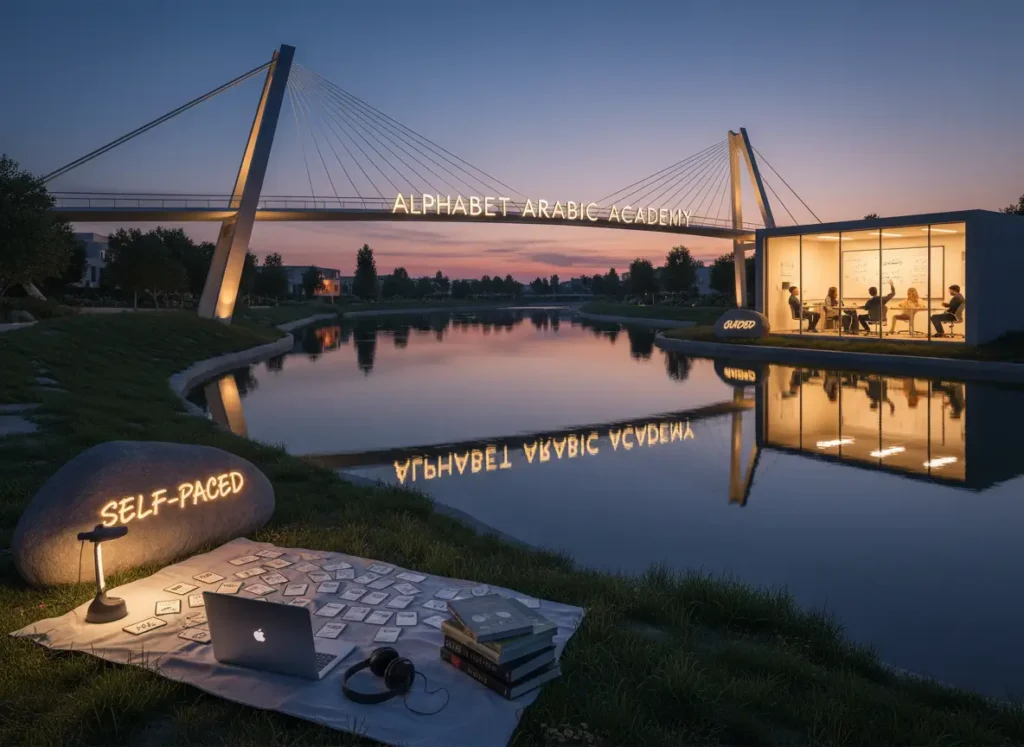
Method 1: 🎧 Audio Lessons – Ultra-Flexible
Download courses (Pimsleur, podcasts), listen during commute/exercise/chores. Hands-free, maximum flexibility. Best for: Busy professionals, auditory learners | Pros: Anywhere, anytime | Cons: No writing/reading
Method 2: 📱 Apps – Bite-Sized
Duolingo, Memrise (5-15 min sessions). Gamified, motivating, phone always with you. Best for: Beginners, quick practice | Pros: Convenient, short sessions | Cons: Superficial alone
Method 3: 📚 Self-Study Textbooks
Al-Kitaab, Mastering Arabic with audio. Comprehensive systematic grammar. Best for: Structured self-studiers | Pros: Complete curriculum | Cons: No speaking, boring
Method 4: 🎥 YouTube Channels
Free visual lessons, learn from multiple teachers, pause/rewatch. Best for: Budget learners, visual style | Pros: Free, visual | Cons: No structure
Method 5: 🎬 Arabic Media
Shows, music, podcasts, news. Authentic exposure, cultural understanding. Best for: Intermediate+, enjoyment | Pros: Fun, authentic | Cons: Too hard for beginners
Method 6: 💬 Language Exchange
Native Arabic speaker learning your language. Free speaking practice, 30min each language weekly. Best for: Speaking on budget | Pros: Free, real practice | Cons: Not trained teacher
Method 7: 🎓 Hybrid – Occasional Tutoring + Self-Study (RECOMMENDED)
Primarily self-study, monthly/bi-weekly 30-60min tutor session for correction, guidance, testing. Best for: Most self-paced learners | Cost: $30-60/month vs $300-600 full course
For free resources, see Learn Arabic Free: Best Websites.
⚠️ Common Pitfalls (And Solutions)
1. 🔄 “Eternal Beginner” – Restart alphabet 5 times, never progress Solution: Set deadline for beginner phase (3-4 months max), move forward at 80% competency
2. 📚 Resource Hopping – Switch resources every 2 weeks Solution: Choose ONE primary, commit 3+ months minimum
3. ⏸️ Indefinite Pause – “Week break” becomes year Solution: Lower daily minimum instead of pausing; schedule restart date if must break
4. 📉 Plateau Without Diagnosis – Study consistently, feel stuck Solution: Monthly self-assessment, occasional tutor check-in, adjust focus
5. 🗣️ Output Neglect – Can read/listen but can’t write/speak Solution: Force daily output (write 3 sentences, shadow speakers), language exchange
For free flexible courses, see Learn Arabic Online Free Course: Best Guidance.
🌟 Success Story: Self-Paced Learning Done Right
Marcus’s Journey:
Background: Freelance designer, 29, irregular schedule (20-60 hr work weeks) Failed First: Fixed course – missed 70%, wasted $600
Self-Paced Success:
- Resources: Al-Kitaab textbook, Anki flashcards, ArabicPod101 audio, monthly iTalki tutor ($25)
- Schedule: 15 min minimum daily, 30-45 min normal, 2-3 hrs intensive (slow weeks)
- Accountability: Daily tracking, weekly Instagram updates, monthly tutor, study buddy
Results Timeline:
- Months 1-3: Alphabet, basic grammar, 400 words | Average 25 min/day
- Months 4-8: Elementary, 1,200 words | Average 35 min/day (maintained even during busy month with only 15 min/day)
- Months 9-15: Intermediate, 2,500 words | Average 45 min/day
- Month 18: Reading Al Jazeera, understanding 60% Quran, conversing 30 min in Arabic
Investment: ~$670 total (vs $2,000-4,000 fixed course)
His Advice: “Self-paced doesn’t mean ‘whenever I feel like it.’ 15 min on 14-hour workdays, 2 hours on zero-client days. NEVER skipping beats perfection. Momentum > perfection.”
📚 Related Resources for Self-Paced Arabic Learning
Essential Guides:
🎧 Learn Arabic by Listening: Tricks Proven listening strategies for self-paced learners—how to use audio effectively for flexible learning.
🎮 Learn Arabic with Fun Online Enjoyable methods making self-study sustainable and engaging rather than grinding through boring exercises.
🔊 Learn Arabic Audio Fast and Simple Audio-based learning perfect for busy schedules—learn during commute, exercise, chores without screen time.
🏠 How to Quickly Learn Arabic at Home Complete guide to effective home-based Arabic study without classroom requirements.
📝 10 Easy Lessons: Learn Arabic Online Free Free structured lessons for self-paced learners on budget—quality learning without financial barrier.
🌐 Learn Arabic Free: Best Websites Curated list of best free Arabic learning websites for different skills and levels.
🎓 Learn Arabic Online Free Course: Best Guidance Complete free courses allowing complete self-paced progression from beginner to intermediate.
Foundational Knowledge:
📚 Arabic Language (Fusha) Guide Essential foundation—what is Modern Standard Arabic, why it matters, and comprehensive learning strategies.
❓ Frequently Asked Questions
Q1: Can I really become proficient learning Arabic at my own pace, or do I need formal classes?
A: Yes, you can achieve proficiency self-paced—BUT requires exceptional self-discipline and smart strategy. Reality check: 90%+ self-paced learners quit within 3 months. Those who succeed: set clear goals, maintain consistent practice (even if flexible timing), include output practice (writing/speaking), and often add occasional tutoring. Self-paced works best combined with minimal external accountability (monthly tutor check-in).
Q2: How much time should I commit if learning at my own pace?
A: Minimum 10-15 minutes daily to maintain progress. Optimal: 30-60 minutes daily for meaningful advancement. Less than 10 min = too little for retention. Sporadic long sessions (5 hours Saturday, nothing all week) less effective than consistent short practice. Quality self-paced learners average 30-45 min/day but flexibility in WHEN, not WHETHER.
Q3: What’s the biggest challenge of self-paced learning?
A: Self-discipline and accountability. Without teacher checking or classmates expecting you, easy to skip “just today” that becomes “just this week” then quitting entirely. Also: speaking practice difficult to arrange yourself. Solutions: create accountability systems (tracking, study buddy, public commitment), add occasional tutoring for speaking, use apps with streak features.
Q4: Is self-paced learning slower than traditional courses?
A: Typically yes, 1.5-2x slower on average. Why: Lower intensity (30 min self-study vs 3-hour class + homework), easier to slack without external pressure, often unbalanced (lots of input, little output). HOWEVER: Can be faster if you’re highly motivated and intensive. Flexibility allows accelerating during free periods unavailable in fixed-schedule courses.
Q5: Can self-paced learning work for complete beginners?
A: Yes, but harder than for those with language learning experience. Beginners need: clear structured resources (good textbook or app), patience with slow initial progress, possibly occasional teacher guidance (monthly check-ins), and realistic expectations (will take 2-4 years, not months). Apps like Duolingo can start alphabet/basics, but need to transition to comprehensive resource within 3 months.
Q6: How do I know if I’m making progress with self-paced learning?
A: Track measurable skills monthly:
- Can you read texts you couldn’t 30 days ago?
- Understand audio you couldn’t before?
- Write longer/better sentences?
- Vocabulary increased (track numbers)? If yes to multiple = progressing. If no visible change after 3 months = reassess approach (maybe studying wrong level, unbalanced practice, or insufficient consistency).
Q7: What if I need to pause self-paced learning due to life circumstances?
A: Pausing is fine—key is resuming. Best practice: Don’t pause completely. Reduce to absolute minimum (5 min/day vocabulary review) rather than stopping. Maintains neural pathways and momentum. If must pause completely: schedule specific restart date, forgive yourself for break, and resume without guilt or starting over (continue where you left off).
Q8: Should I focus on Modern Standard Arabic (Fusha) or dialect for self-paced learning?
A: Fusha for most self-paced learners because: better resources available, standardized (clear progression), enables reading/writing, works across Arab world. Dialects harder self-paced (fewer quality resources, less standardized, primarily oral). Exception: If you’re living in specific Arab country and need survival dialect NOW, then dialect first.
🏆 How Alphabet Arabic Academy Supports Self-Paced Learners

Flexible Self-Paced Support Program:
✅ Recorded Lesson Library – 200+ lessons, lifetime access, watch anytime ✅ Monthly Live Q&A – Optional attendance, ask accumulated questions
✅ Flexible Tutoring – Bi-weekly or monthly 30-60min sessions when convenient ($40-60/session) ✅ Self-Study Materials – Textbooks, audio, flashcards, exercises with answers ✅ Progress Assessment – Placement test, monthly tests, proficiency tracking ✅ Community Forum – Connect with other self-paced learners, study buddy matching
💰 Pricing Options:
| Option | Cost | Support Level |
|---|---|---|
| Materials + Forum | $200 one-time | Pure self-study |
| + Monthly Q&A | $300 + $20/mo | Some support |
| + Bi-Weekly Tutoring | $300 + $80/mo | Significant support |
| + Weekly Tutoring | $300 + $160/mo | Maximum support |
vs Full Course: $400-600/month fixed schedule
Advantage: Choose support level matching needs + budget, with flexibility full courses can’t provide
🎯 Your Next Steps: Begin Your Own-Pace Journey Today
Week 1: Foundation Setup
Day 1-2: Define Your Goal
- Why Arabic? (specific reason)
- Success measure? (what skill by when)
- Pace realistic? (how many hours weekly)
Day 3-4: Choose Primary Resource
- Research options (textbook, app, course)
- Read reviews
- Choose ONE, commit 3+ months
Day 5-6: Build Accountability
- Set up tracking system
- Find study buddy or tutor
- Public commitment
- Plan minimum daily practice
Day 7: Start
- Begin with Day 1 of chosen resource
- Set timer: 15 min minimum
- Track completion
- Celebrate start!
Month 1: Build Habit
Focus: Consistency, not perfection
- Study daily (even if just 10 min on hard days)
- Track every session
- No guilt, just resume if miss day
- Aim: 30-day streak
Months 2-6: Develop Rhythm
Find what works:
- Best time of day for you
- Best study location
- Optimal session length
- Effective methods for your style
Adjust:
- What’s working? Do more.
- What’s not? Stop or modify.
- Balance input and output
- Add speaking practice
Months 6-18: Progress and Persist
Milestones:
- Month 6: Basic proficiency emerging
- Month 12: Intermediate appearing
- Month 18: Functional competency
Challenges:
- Plateaus normal (push through)
- Motivation fades (discipline sustains)
- Life disrupts (maintain minimum)
Keys:
- Monthly assessment (am I progressing?)
- Celebrate small wins
- Connect to original “why”
- Adjust strategies as needed
💭 Conclusion: Freedom and Responsibility of Your Own Pace
Learning Arabic at your own pace offers ultimate freedom: study when you want, where you want, how you want, at speed you choose. No teacher dictating schedule, no classmates pressuring you, no rigid timelines.
But with freedom comes responsibility: YOU must show up. YOU must maintain discipline. YOU must push through when it’s hard. No external structure forcing progress.
The reality:
- 🔴 90% of self-paced learners quit within 3 months
- 🟢 10% who succeed share common traits: clear goals, consistent practice, accountability systems, realistic expectations, balanced approach
You can be in that successful 10% if you:
- ✅ Set specific measurable goals
- ✅ Commit to minimum daily practice
- ✅ Create accountability systems
- ✅ Track progress religiously
- ✅ Include output practice (writing, speaking)
- ✅ Add occasional external feedback (tutoring)
- ✅ Maintain long-term perspective (years, not months)
- ✅ Forgive breaks, resume without guilt
- ✅ Choose quality resources, stick with them
- ✅ Remember why you started when motivation fades
Emma from our introduction achieved intermediate proficiency in 12 months while managing full-time job and two kids. Marcus progressed steadily despite freelance chaos. Both succeeded because they understood: “own pace” doesn’t mean “no pace” or “whenever I feel like it.”
It means flexible schedule with consistent practice. Freedom with structure. Patience with persistence.
Your pace. Your schedule. Your achievement.
Start today.
🚀 Ready to begin your flexible Arabic journey?
Schedule free consultation to discuss your goals, lifestyle, and best self-paced approach for YOU.
🎁 Mention this guide for self-paced starter package discount
Your Arabic mastery begins when YOU decide—not when a class schedule says.
Decide today.
بسم الله – In the name of Allah.
This guide provides honest, comprehensive information about self-paced Arabic learning—both benefits and challenges. Success requires discipline, structure, and realistic expectations. But for those willing to commit, own-pace learning offers flexibility traditional courses cannot match.