
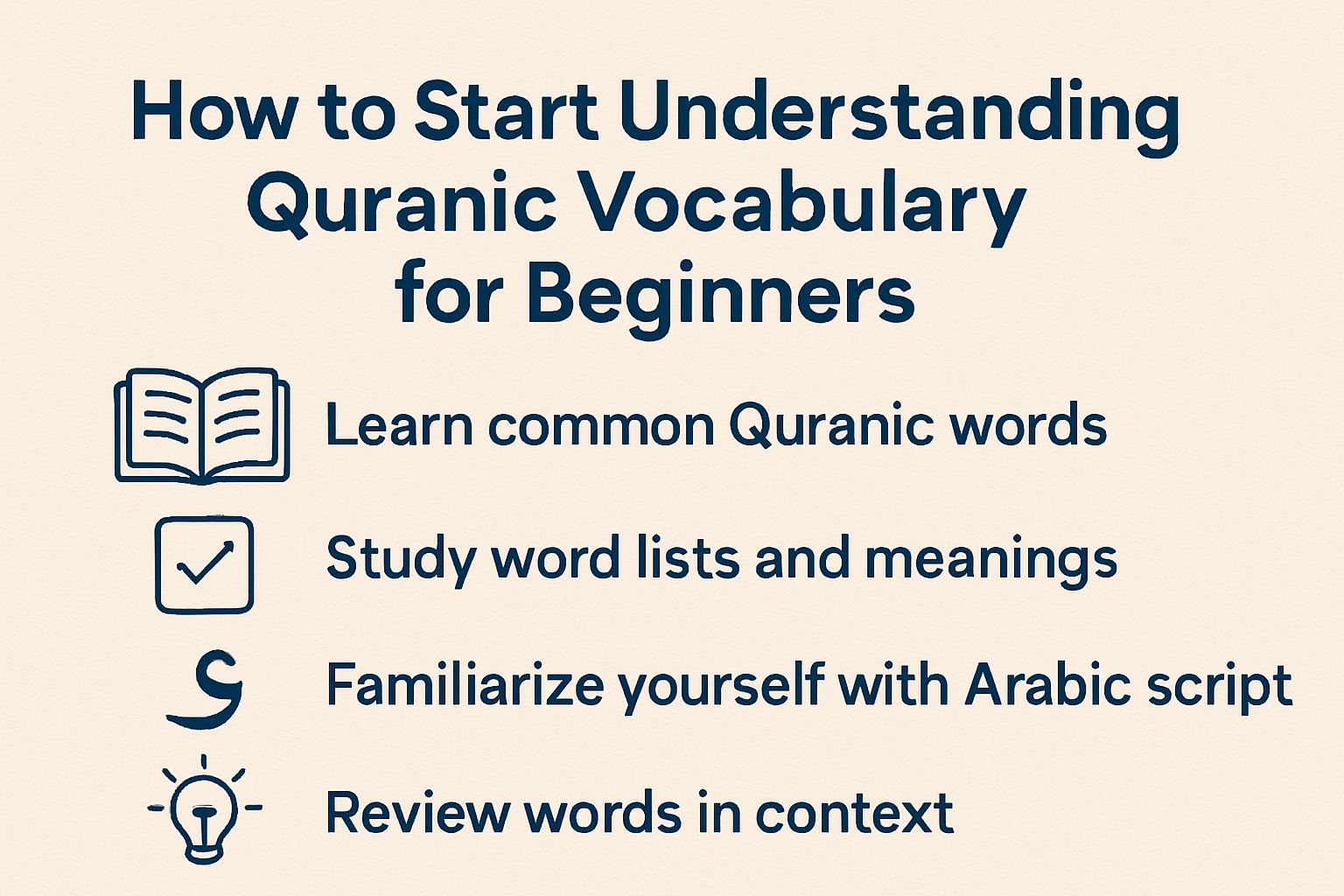
How to Start Understanding Quranic Vocabulary – Foundation
Identify Root Words in Verses – Insight
How to Start Understanding Quranic Vocabulary starts with recognizing that most Arabic words trace back to three-letter roots. When you learn the root, you unlock many related meanings at once.
- Helps you see patterns across the Quranic language.
- Strengthens comprehension fast because you decode whole families of words.
- Makes your reading smoother as your brain starts predicting meanings naturally. If your goal is to understand the meanings behind the verses, explore the most effective beginner’s guide to Quranic Arabic available at our academy.
Break Down Simple Phrases – Clarity
Start small. Break short verses into individual components.
- Notice how prepositions change the meaning.
- Compare the structure between verses.
- Repeat the phrase aloud to improve pronunciation and memory.
Discover Basic Arabic Alphabets – Essentials
Recognize Letter Shapes and Sounds – Start
To understand Quranic vocabulary, mastering the alphabet is non-negotiable.
- Learn each letter in its isolated, initial, medial, and final form.
- Practice how letters connect—Quranic Arabic is all about flow.
- Focus on sounds that don’t exist in English, like ع، غ، ق.
Learn Essential Quranic Words – Priority
Memorize Common Terms and Meanings – Boost
Some words repeat hundreds of times in the Quran.
Examples include: رب، يوم، حق، علم، قوم، نفس، نور.
- Make a list and revise it daily.
- Group words by theme: guidance, creation, faith, morals.
- Build vocabulary around core Islamic meanings to deepen understanding.
How to Start Understanding Quranic Vocabulary Contextually – Depth
Analyze Words Within Surahs – Context
A word’s meaning becomes clearer when studied inside a full verse.
- Look at its relationship with the words before and after it.
- Note if the tone is a command, a reminder, or a story.
- Identify why this specific word was chosen over similar ones.
Explore Historical Word Usages – Legacy
Many Quranic words carry meanings tied to pre-Islamic Arabia.
- Knowing historical context reveals deeper layers.
- It makes tafsir readings more meaningful.
- Helps you appreciate the beauty and precision of the divine language.
Use Effective Learning Tools – Enhancement
Select Beginner-Friendly Apps – Support
To learn faster:
- Choose apps that offer root analysis, pronunciation guides, vocabulary lists, tafsir explanations, and interactive exercises.
- Use apps that allow repetition and spaced learning.
- Pair modern tools with traditional reading for balanced progress.
Practice Daily Vocabulary Exercises – Consistency
Apply Words in Daily Recitations – Flow
Recite and understand at the same time.
- Pick a surah and practice reading with meaning.
- Highlight unfamiliar words and add them to your practice list.
- Repeat the same verse across multiple days until it sticks.
Track Progress with Flashcards – Smart
Flashcards help you remember faster.
- Use digital cards for spaced repetition.
- Add 5–10 new words daily.
- Test yourself at the end of each week.
Engage in Storytelling Methods – Creativity
Relate Words to Prophetic Stories – Memory
When you connect vocabulary to stories:
- The meaning becomes unforgettable.
- Your brain builds emotional links which improve recall.
- This method works amazingly for kids and adults alike.
Overcome Common Learning Barriers – Strength
Address Pronunciation Challenges – Accuracy
Don’t rush. Quranic Arabic requires precision.
- Listen to native reciters.
- Practice challenging letters like ض، ظ، ص.
- Record yourself and compare your pronunciation to experts.
Achieve Fluency in Quranic Language – Growth
Build Sentence-Level Understanding – Confidence
Once you master words, move to sentences.
- Learn how nouns, verbs, and particles interact.
- Study basic grammar (nahw & sarf).
- Read short passages daily to build comprehension naturally.
FAQs
What key words appear frequently in the Quran?
Common repeated words include Allah, Rabb, Yawm, Haqq, Ilm, Nas, Noor, and others that form the foundation of Quranic meaning. Learning these helps you understand a large portion of the text faster.
How long does it take to master basic Quranic vocabulary?
With daily practice, most learners build strong foundational vocabulary within 30–60 days. Consistency matters more than speed.
What are the best resources for learning Quranic words?
Root-based dictionaries, beginner-friendly apps, tafsir summaries, and structured online courses are excellent ways to boost understanding.
Internal Link (as required)
To boost your Quranic Arabic journey with structured lessons, check our academy’s contact page:
https://alphabetarabicacademy.com/contact-us/